Anutin pledges not to abandon Japanese carmakers as Thailand’s automotive crisis deepens. Sales have plunged 26.2%, Chinese brands control 70% of the electric market and factory closures threaten an industrial network supporting 700,000 Thai workers.
Thailand’s car industry faces a defining showdown as Chinese electric vehicles batter its Japanese-built manufacturing base. Prime Minister Anutin Charnvirakul denies Japanese firms are leaving, despite closures, falling output and a brutal 26.2% sales collapse. Chinese brands now control over 70% of the battery-electric market, while 2,000 suppliers and 700,000 jobs face mounting pressure. The government is urgently reviewing its electric vehicle incentives, determined to retain an industry producing roughly 10% of national economic output.
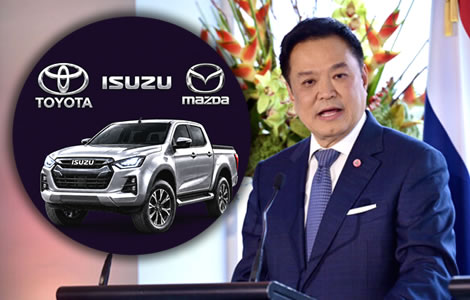
Prime Minister Anutin Charnvirakul has rejected reports that Japanese manufacturers are moving production bases out of Thailand. He said foreign investment remained strong despite deep disruption across the automotive industry. However, Japanese carmakers face falling sales, factory consolidation and aggressive Chinese electric vehicle competition. Several have already closed plants, ended assembly or reduced production.
Speaking in Wellington on August 21, Mr Anutin promised continued support for Thailand’s long-established Japanese investors. The Prime Minister also serves as Minister of Home Affairs. In particular, he stressed Japan’s unique position within the kingdom’s industrial economy. Japanese manufacturers have used Thailand as a major production centre for more than 60 years.
Over that period, Japanese companies became embedded across Thailand’s factories, supply chains and export networks. They developed extensive dealership, engineering, logistics and maintenance operations. Moreover, their investment helped turn Thailand into the “Detroit of Asia”. Generations of Thai engineers and factory workers developed their skills within those operations.
Anutin pledges better business conditions to protect Japan’s longstanding production base
Against this backdrop, Mr Anutin said the government was prepared to improve business conditions. It would also remove obstacles affecting long-term investor confidence. Accordingly, the government wants Japan’s extensive automotive production base to remain in Thailand.
“The government’s core policy is to remain open and improve various conditions to make business operations more flexible under our good relationship, so that we can achieve sustainable growth and long-term economic cooperation and maintain Japan’s strong production base in Thailand,” Anutin said.
The Prime Minister described automotive production as too important for Thailand to lose. Most engines, vehicle bodies, chassis and related systems used by Japanese brands are manufactured locally. Consequently, any substantial Japanese withdrawal would reach far beyond final vehicle assembly. Thousands of component producers, transport companies and dealerships depend upon that activity.
“This is something we cannot abandon, and we must ensure that investors do not abandon Thailand either,” he said.
Japanese carmakers face deepening crisis as Chinese electric vehicle brands seize the Thai market
Indeed, Japanese manufacturers have operated in Thailand across several generations. Their production systems are now deeply intertwined with the kingdom’s industrial base. As a result, their factories support a broad network of local and international suppliers. Many of those companies were established specifically to serve Japanese vehicle producers.
Mr Anutin said investors required consistent treatment after committing capital and technology. In response, his government was prepared to ease obstacles affecting Japanese operations. It would also review policies governing the electric vehicle transition.
“We are ready to ease obstacles to reassure them that we have not abandoned them. It cannot be a situation where we give them everything when we need them, but once they are doing well, we later add more conditions,” he said.
Despite those assurances, Thailand’s Japanese-dominated car industry faces its deepest crisis in decades. Domestic vehicle sales have collapsed, while national production has fallen sharply. Meanwhile, Chinese electric vehicle companies have captured most of Thailand’s battery-electric market. Established Japanese brands are restructuring as pressure spreads across the industry.
The automotive sector contributes roughly 10% of Thailand’s gross domestic product. It includes around 2,000 component manufacturers and supports approximately 700,000 workers. Furthermore, the wider sector was valued at about $53 billion during 2024. Its economic reach extends far beyond vehicle assembly plants.
Toyota anchors vast Japanese supply network supporting Thai factories, exports and skilled employment
Parts manufacturers produce engines, body panels, chassis and electrical equipment. Separately, logistics companies move vehicles and components between plants, ports and dealerships. Banks and finance companies also depend heavily upon vehicle lending. Service centres, repair businesses and dealerships provide another substantial layer of employment.
Toyota remains the anchor of Thailand’s Japanese automotive industry. The company produces passenger cars, Hilux pickup trucks and engines at its Thai plants. Notably, these factories serve major export markets across Asia and Oceania. Toyota’s operations also support a vast network of component manufacturers.
Isuzu holds a dominant position in Thailand’s strategically important pickup truck market. Elsewhere, Honda remains a major producer of passenger vehicles and motorcycles. Mitsubishi Motors operates another significant export production base. Nissan, Mazda, Suzuki and Subaru have maintained assembly, manufacturing or distribution operations.
Collectively, these companies created Thailand’s highly localised automotive supply chain. They also expanded the kingdom’s engineering capacity, production standards and export position. Yet that established structure is now under severe pressure. Several Japanese groups have already reduced their Thai manufacturing footprint.
Japanese factories cut Thai production as collapsing vehicle sales and tight credit batter the industry
Honda ended vehicle production at its Ayutthaya factory during 2025. Instead, it consolidated Thai vehicle manufacturing at its Prachinburi facility. The change followed a sharp fall in Honda’s annual output. Production dropped from 228,000 vehicles during 2019 to fewer than 150,000.
On another front, Suzuki announced the closure of its Thai vehicle factory by the end of 2025. Subaru also ended local assembly. Additionally, Nissan reduced production capacity and employment. These decisions intensified concern surrounding Japan’s long-term manufacturing presence.
The closures came during a brutal contraction in Thailand’s domestic vehicle market. New vehicle sales fell 26.2% during 2024. High household debt weakened consumer demand and restricted major purchases. At the same time, tighter lending prevented many customers from obtaining vehicle finance.
Accordingly, national vehicle production dropped to a four-year low. Factories and suppliers faced fewer orders inside a rapidly shrinking market. Compounding matters, the downturn struck during a major technological shift. Electric vehicles gained market share as sales of conventional models weakened.
Chinese electric vehicle incentives unleash imports, overcapacity and fierce price competition in Thailand
The Thai government accelerated this transition through its EV 3.0 programme. Under the scheme, electric vehicle manufacturers received consumer subsidies and reduced import duties. They also benefited from favourable excise-tax treatment. Initially, manufacturers could import subsidised vehicles before meeting later Thai production requirements.
The incentives attracted BYD, Great Wall Motor and SAIC Motor. Changan Automobile and GAC Aion also entered the market. Subsequently, Chinese electric vehicle investment in Thailand exceeded $3 billion. Chinese brands secured more than 70% of the battery-electric vehicle market.
Crucially, large volumes of imported vehicles entered an already weakened domestic market. Those imports arrived before many replacement factories had reached full production. Later, mandatory local-production targets encouraged manufacturers to increase output. Thai demand remained too weak to absorb the additional vehicles.
The combination produced substantial overcapacity and fierce price competition. Manufacturers cut prices while fighting for customers and market share. Meanwhile, Japanese producers faced weakening demand for combustion-powered vehicles. Their extensive component networks came under increasing pressure.
Beyond assembly, the technological change threatens many established parts producers. Battery-electric vehicles contain fewer mechanical components than combustion-powered models. Therefore, they require fewer parts from traditional Thai suppliers. Chinese manufacturers also frequently use companies from their existing Chinese supply networks.
Electric vehicle shift threatens Thai suppliers as Chinese investment fails to match Japan’s local depth
In practical terms, Chinese investment cannot automatically replace Japan’s local industrial contribution. Vehicle assembly totals alone do not measure the complete economic value. They exclude important differences in local content, employment and supplier orders. Likewise, assembly figures do not reveal export earnings or imported component levels.
Under EV 3.0, the government subsidised one technology while the existing industry faced collapsing credit demand. Imported electric vehicles entered first, followed by compulsory replacement production. Consequently, output commitments grew while domestic vehicle purchasing weakened. The imbalance contributed to the damaging price war.
By comparison, Japanese manufacturers developed extensive local supply chains over six decades. Their operations cover engines, chassis, vehicle bodies and numerous supporting systems. In turn, those networks sustain thousands of jobs beyond the major assembly plants. This industrial depth distinguishes established production from imported vehicle sales.
Against that record, Mr Anutin has ordered a review of Thailand’s electric vehicle measures. He assigned Deputy Prime Minister and Finance Minister Ekniti Nitithanpraphas to examine the rules. The review will cover automotive investors from different countries. Specifically, it will examine conditions facing Japanese companies entering the electric vehicle sector.
Government reviews electric vehicle rules to protect fair competition and Japanese investor confidence
Mr Anutin said Japanese manufacturers must not be placed at a competitive disadvantage. As part of this, the government will consider restructuring investment and taxation measures. The review aims to ensure fair competition among carmakers from different countries. It also seeks to maintain confidence during Thailand’s industrial transition.
The Prime Minister acknowledged that electric vehicle manufacturers initially import many components. Even so, he expects new domestic supply chains to emerge as local production expands. These could cover batteries, computer systems and other specialised components. Production requirements would encourage manufacturers to establish those operations in Thailand, he said.
For its part, the government wants the new industry to generate substantial domestic production. It also wants established Japanese investors to remain confident about future operating conditions. In parallel, officials will focus on political and economic stability. Mr Anutin identified both as essential for attracting long-term investment.
Japanese manufacturers are also adapting their Thai investment strategies. Toyota and Honda are investing heavily in hybrid technology. Unlike fully electric vehicles, hybrids combine electric systems with combustion engines. Thus, they retain more conventional components from established supply networks.
Japanese carmakers turn to hybrids and electric models while Thailand seeks new domestic supply chains
Isuzu is developing an electric version of its D-MAX pickup truck. Meanwhile, Mazda plans a ฿5 billion electric sport utility vehicle project. In addition, four leading Japanese companies previously proposed combined investment worth ฿150 billion. Those plans indicate continued interest in Thailand despite widespread restructuring.
Nevertheless, recent closures show the severity of immediate pressure. Honda consolidated vehicle production after a steep output decline. Suzuki and Subaru ended local vehicle manufacturing. Nissan also reduced capacity and employment.
Thailand now hosts two sharply different automotive investment systems. Japan built one through more than six decades of factory expansion and supplier development. China established the other through rapid electric vehicle investment and government incentives. At present, Chinese brands control over 70% of Thailand’s battery-electric market.
Japan’s network remains deeply rooted across the wider Thai economy. It includes roughly 2,000 component manufacturers and supports around 700,000 workers. Additionally, the broader automotive industry contributes about one-tenth of national economic output. Toyota, Isuzu, Honda and Mitsubishi remain central to that production system.
Nissan, Mazda, Suzuki and Subaru have also made substantial contributions. Together, the Japanese groups created export capacity reaching Asia and Oceania. They also built local expertise across engineering, component manufacturing and vehicle logistics. Their current restructuring therefore carries consequences across the national industrial base.
Japan’s industrial network remains vital as Chinese electric vehicle investment reshapes Thailand’s market
Mr Anutin cited wider investment figures to reject claims of a foreign retreat. Foreign investment in Thailand exceeded ฿1 trillion last year, he said. During the first half of 2026, actual foreign investment reached approximately ฿530 billion. He presented those totals as evidence of continued investor confidence.
“We must rely on the figures. Since this government took office, foreign investment in Thailand has increased. Last year it exceeded Bt1 trillion, and in the first half of this year, actual investment has already reached Bt530 billion,” he said.
Thailand recalibrates policy as data shows Chinese EVs gaining with many not made in the kingdom
Ford boosts industry confidence in the ICE (Internal Combustion Engine) sector with Suzuki site purchase
On that basis, Mr Anutin said there was no evidence of production bases leaving Thailand. He also rejected claims that foreign investment was slowing because Thailand lacked readiness.
“There is therefore still no indication of production bases moving out or foreign investment slowing down because of claims that Thailand is not ready,” Anutin said.
Still, the automotive industry’s own figures show a market under exceptional strain. Sales fell 26.2% during 2024, while production reached a four-year low. Several Japanese manufacturers closed factories, consolidated operations or reduced capacity. Simultaneously, Chinese brands secured an overwhelming share of the battery-electric segment.
For now, the government is reviewing whether its electric vehicle policies treat manufacturers fairly. It is also seeking greater Thai production of batteries, computers and other advanced components. Above all, Mr Anutin has placed Japan’s production base at the centre of that review. His Wellington statement made clear that further Japanese retrenchment would strike a critical Thai industry.
Join the Thai News forum, follow Thai Examiner on Facebook here
Follow Thai Examiner on Google here
Receive all our stories as they come out on Telegram here
Follow Thai Examiner here
Further reading:
Thailand recalibrates policy as data shows Chinese EVS gaining with many not made in the kingdom
Khon Kaen Police probing a pre dawn blaze caused by a charging EV that burned down a family home
Government sends strong warning to EV industry after a dramatic surge in consumer complaints
Thaksin wants higher excise duties on EV cars that are simply assembled in Thailand by Chinese firms