Thailand launches EV crackdown as 1,300 complaints spark showroom raids, legal threats and lawsuits over defective cars, false range claims, collapsing service networks and plunging prices. Dealers now face jail, fines and tougher consumer protection laws.
Thailand’s booming EV market is facing a government crackdown after surging consumer complaints triggered showroom inspections, legal threats, and demands for tougher enforcement against manufacturers and dealers. Prime Minister’s Office Minister Ms. Supamas Isaraphakdi warned companies over misleading driving range claims, weak warranties, defective vehicles, collapsing service networks, and sharp price cuts that have left buyers furious and financially exposed. With more than 1,300 complaints filed and authorities pursuing over 103 million baht in damages, the crisis is rapidly becoming a major test of confidence in Thailand’s fast-expanding EV industry, which is predominantly Chinese owned.
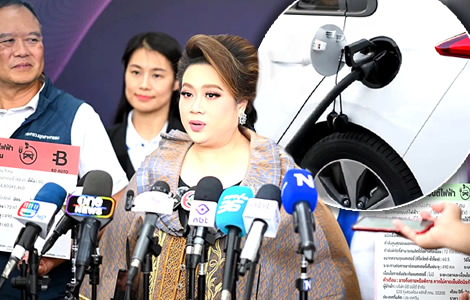
In response to a spike in complaints relating to EV vehicles, the government took action this week. Prime Minister’s Office Minister Ms. Supamas Isaraphakdi inspected electric vehicle showrooms in Bangkok on Tuesday. She issued a direct warning to manufacturers and dealers over product labelling violations.
Businesses that fail to comply with labelling laws face up to six months in prison, fines reaching 100,000 baht, or both. At 1.30 pm on May 12, Ms Supamas led officials to the BYD Hi-Class showroom in Ladprao.
Afterwards, the delegation inspected the OMODA & JAECOO showroom in the same district. The inspections focused heavily on electric vehicle labels, especially driving range claims and warranty disclosures. Accordingly, authorities demanded clearer disclosures covering testing standards, operating conditions, pricing, and battery information.
Government inspectors target EV showrooms as complaints over labels and warranties continue rising
Ms. Supamas serves as Minister attached to the Prime Minister’s Office and supervises the Office of the Consumer Protection Board, or OCPB. Joining the inspections were Mr. Pradermchai Boonchuaylue, adviser to the minister attached to the Prime Minister’s Office, and Dr. Patcharin Samsiripong, secretary to the minister attached to the Prime Minister’s Office.
Moreover, Mr. Ronnarong Poolpipat, secretary-general of the Consumer Protection Board, joined the inspections alongside representatives from the Thai Industrial Standards Institute and the Thailand Consumers Council.
The visit followed an urgent meeting held one day earlier between government officials, EV manufacturers, and consumer representatives. During that meeting, officials discussed rising complaints involving defective vehicles, abandoned service networks, and sharp post-purchase price reductions.
Ms. Supamas said complaints had surged after consumers purchased EVs under the government’s clean energy campaign. However, many buyers later encountered serious problems involving repairs, service support, and vehicle quality.
Officials link rising EV complaints to defective vehicles, failed support networks and price cuts
“Consumers bought EVs to support the government’s alternative energy campaign during the energy crisis,” she said. “However, many are now dealing with defective vehicles, abandoned service networks, and rapid price cuts soon after purchase.”
She added that complaints had expanded beyond pricing concerns and now covered vehicle safety, spare parts shortages, assembly standards, and after-sales service failures. Furthermore, she stressed that vehicles remain major household assets and consumers deserve proper protection under the law.
Between 2024 and 2026, the OCPB received 556 EV-related complaints. Meanwhile, the Thailand Consumers Council received another 792 complaints. Combined complaints therefore reached 1,348 cases.
Authorities reported that 402 disputes, or 72.3%, have already been resolved. Vehicle defects and malfunctions formed the largest category of complaints, accounting for 47.3% of all reported cases.
Meanwhile, failures to refund booking deposits represented 18.2% of complaints. Sharp price reductions after purchases accounted for another 14.7%. In addition, failures to provide promised promotional items represented 13.1% of complaints, while accidents and delayed repairs added another 2.9%.
Authorities report most EV disputes resolved, while defects remain the largest source of complaints
Consumers also reported widespread after-sales failures across dealership and service networks. In total, 329 complaints involved service centre closures, representing 41.5% of reported cases.
Moreover, consumers filed 164 complaints involving defective or damaged equipment. Those cases accounted for 20.7% of reports. Another 94 complaints involved long waits for spare parts. Consequently, many vehicle owners faced delays in repairs and servicing. In 52 cases, consumers could not return vehicles because companies had ceased operations.
Those complaints represented 6.6% of reported cases. The Consumer Protection Committee has already approved civil lawsuits against operators, with authorities seeking more than 103.1 million baht in damages.
Tuesday’s inspections directly targeted EV labels because authorities consider labels the first checkpoint before consumers make purchases. Therefore, Ms. Supamas instructed businesses to comply strictly with three major consumer protection laws.
Government orders stricter EV labelling compliance under Thailand’s consumer protection regulations
First, she said electric vehicles are regulated products under mandatory labelling rules. Businesses must display complete and legible information directly on vehicles. Required details include product names, model names, trademarks, manufacturer or importer information, and technical specifications.
In addition, labels must contain battery information, performance figures, driving range details, usage instructions, safety warnings, pricing information, and warranty conditions.
Ms. Supamas placed particular emphasis on driving range claims because they heavily influence purchasing decisions. Accordingly, businesses must clearly disclose the testing standard used for range calculations.
Approved standards include EPA, WLTP, NEDC, and CLTC measurements. Furthermore, businesses must disclose testing conditions linked to those figures. Those conditions include average speed, temperature, road conditions, and driving style.
Businesses warned to clarify EV promotions, warranties and real-world driving range limitations fully
Authorities also ordered businesses to clarify advertising conditions tied to promotions and warranties. Therefore, advertisements involving free gifts, benefits, or battery warranties must clearly specify eligibility requirements, terms, methods, start dates, and end dates.
Secondly, Ms Supamas emphasised advertising regulations and warned businesses against unclear or exaggerated claims involving EV performance. She specifically warned manufacturers not to exaggerate driving range figures because consumers often encounter different results during real-world driving.
“Do not let consumers be disappointed when they use the vehicle in real-world conditions,” she said. Thirdly, the minister focused on vehicle reservation contracts. She stated that EV sellers must use standard reservation contracts approved by the Consumer Protection Board.
Those contracts must clearly specify vehicle type, brand, model, manufacturing year, purchase price, delivery dates, and conditions governing contract termination.
Authorities warn EV makers that labels represent binding promises made directly to consumers nationwide
Ms. Supamas said preliminary inspections showed broad cooperation from businesses. Nevertheless, officials continued to closely monitor compliance across the industry. Electric vehicles became products subject to labelling regulations after publication in the Royal Gazette on Sept 22, 2025.
The Announcement of the Labelling Committee on Automobiles and Electric Vehicles formally established the regulations. The rules are enforced under the Consumer Protection Act B.E. 2522 (1979). Under Section 52 of the law, violators face imprisonment of up to six months. Alternatively, offenders may face fines reaching 100,000 baht. Courts may also impose both penalties simultaneously.
During the inspections, Ms. Supamas issued another direct warning to EV manufacturers. “Labels are not just stickers attached to cars,” she said. “They are promises made to consumers.”
Therefore, she demanded complete, accurate, and non-exaggerated information on every vehicle label. She again singled out driving range claims for scrutiny. Businesses, she said, must clearly state testing standards behind every published figure.
Consumers urged to examine EV labels carefully and retain documents before completing purchases safely
The minister also instructed consumers to scrutinise labels before purchasing vehicles. Accordingly, buyers should verify testing standards used in driving range calculations and examine reservation contracts carefully before making payments.
Furthermore, buyers were told to retain receipts, reservation slips, brochures, and advertising materials as evidence. Ms. Supamas urged consumers to report incomplete labels, inaccurate information, or unfair treatment directly to authorities.
Complaints can be submitted through the OCPB Hotline 1166. In addition, consumers can use the OCPB Complaint System and the OCPB Connect application.
Government prepares EV label e-book as pressure grows over defects and service failures nationwide
Complaints may also be filed through the ocpb.go.th website and the “Government” application. Meanwhile, consumers in provincial areas can submit complaints through Damrongtham Centres located in provincial halls nationwide.
The OCPB also received orders to compile an “EV Labels” e-book covering every EV model sold in Thailand. Additionally, the publication will contain consumer rights guidance and pre-purchase inspection information. The government’s intervention comes amid rising pressure on Thailand’s expanding EV sector.
Oil and energy crisis deepens in Thailand as Prime Minister Anutin shows off new EV car to reporters
Thaksin wants higher excise duties on EV cars that are simply assembled in Thailand by Chinese firms
Complaints involving defects, service centre closures, spare parts shortages, and price collapses continue increasing alongside rapid market growth. Authorities have now signalled stricter enforcement against misleading labels, weak after-sales support, and contract violations across the industry.
Join the Thai News forum, follow Thai Examiner on Facebook here
Receive all our stories as they come out on Telegram here
Follow Thai Examiner here
Further reading:
Thaksin wants higher excise duties on EV cars that are simply assembled in Thailand by Chinese firms
EV sector crisis as Chinese firms are trapped between lack of demand and government tax penalties
Thailand changes tack as EV revolution turns into a damp squib with warehouses full of unsold cars
Top Thai insurer says no more new policies for EV cars. Later, it emphasised renewals case by case
Lack of coherence in government policy is the root cause of Thailand’s massive economic problems
Disturbing questions that must be confronted over Thailand’s reeling economy are China and EV cars
First-quarter GDP growth surprises analysts based on higher tourism and consumer spending growth