Anutin faces a political showdown as the People’s Party targets 18 Bhumjaithai ministers. Pheu Thai is challenged over Senate collusion and coalition loyalty. Yotsanan backs him, as the Prime Minister insists his government will survive the showdown.
Prime Minister Anutin Charnvirakul faces a no-confidence showdown targeting 18 Bhumjaithai ministers amid promised bombshell corruption disclosures. However, the People’s Party is also challenging coalition partner Pheu Thai to choose between national interests and political power. Opposition deputy leader Wiroj Lakkhanaadisorn claims Pheu Thai knows more about the Senate collusion scandal than his party. On Monday, Deputy Prime Minister Yotsanan Wongsawat declared there were no enemies in politics while pledging coalition loyalty. Meanwhile, Anutin dismissed fears of a split, expressing confidence in Pheu Thai and welcoming parliamentary scrutiny as a badge of honour.
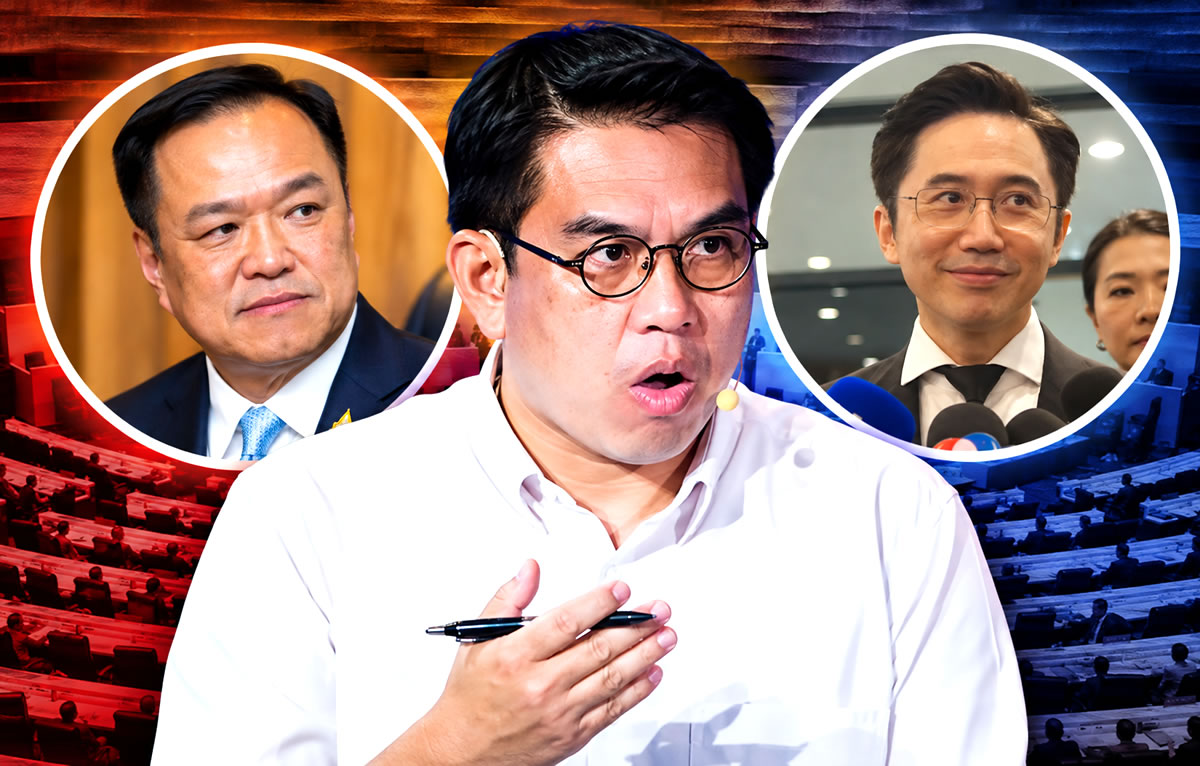
Prime Minister Anutin Charnvirakul faces a fierce parliamentary showdown as the People’s Party prepares a no-confidence debate against 18 Bhumjaithai ministers. The opposition promises damaging revelations involving corruption, political interference and the manipulation of state institutions.
However, the confrontation has shifted attention towards coalition partner Pheu Thai. Senior opposition figures are challenging the former ruling party to choose between national interests and political power. On Monday, Deputy Prime Minister Yotsanan Wongsawat responded by declaring that nobody was an enemy in politics.
Meanwhile, Anutin dismissed concerns about his government’s survival. He expressed confidence in Pheu Thai and portrayed parliamentary scrutiny as a badge of honour.
Wiroj challenges Pheu Thai over Senate collusion as opposition targets 18 Bhumjaithai ministers in debate
The confrontation intensified over the weekend following a direct challenge from People’s Party deputy leader Wiroj Lakkhanaadisorn. On Saturday, October 10, Wiroj questioned whether Pheu Thai would support Bhumjaithai when serious accusations reached Parliament.
In particular, he highlighted the controversial Senate collusion investigation. He claimed Pheu Thai possessed extensive information about suspected interference in the selection of senators. Indeed, Wiroj suggested the former ruling party might know more about the affair than the People’s Party itself.
His intervention followed the opposition’s submission of a no-confidence motion on Thursday, October 8. The motion carries 145 opposition MPs’ signatures and invokes Section 151 of the Constitution.
It targets 18 ministers individually, including Prime Minister Anutin. Crucially, every minister named belongs to Bhumjaithai. No Pheu Thai ministers face individual censure motions, despite the party’s participation in the coalition. Consequently, the selection has triggered questions about Pheu Thai’s position and the opposition’s political intentions.
The People’s Party denies protecting Pheu Thai or preparing a political arrangement with the former ruling party. Instead, its leaders insist ministers were selected according to evidence concerning their conduct in office.
Wiroj questions whether Bhumjaithai has left Pheu Thai ministers with little power in government
Nevertheless, Wiroj used the occasion to challenge Pheu Thai’s position within the coalition. He questioned whether the party could exercise its ministerial responsibilities independently. Furthermore, he asked whether Bhumjaithai had restricted Pheu Thai’s political influence so extensively that its ministers could achieve little.
Wiroj argued that the absence of Pheu Thai ministers did not necessarily indicate preferential treatment. Rather, he suggested their limited influence might explain why they had escaped serious opposition scrutiny.
He cited Deputy Prime Minister Yotsanan Wongsawat, Minister of Higher Education, Science, Research and Innovation. According to Wiroj, the opposition had not received damaging information from civil servants concerning Yotsanan’s conduct. He suggested officials had not encountered misconduct serious enough to prompt them to approach opposition MPs.
However, Wiroj stressed that this did not mean Pheu Thai ministers were beyond criticism. Instead, he returned to the distribution of power inside Anutin’s government. He questioned whether Bhumjaithai controlled government mechanisms so extensively that Pheu Thai could exercise little meaningful influence.
The People’s Party deputy leader also acknowledged the difficulties facing coalition partners during parliamentary confrontations. He said politicians understood the conventions governing relationships between parties serving in the same government.
Senate collusion case puts Pheu Thai under pressure as Wiroj questions its coalition commitments
Moreover, Wiroj recognised that a brief debate might not provide sufficient time for coalition partners to reconsider their positions. He suggested parties might need additional time to assess evidence and public reaction.
In practice, withdrawals from coalition governments could occur after parliamentary debates rather than during them. Wiroj said the People’s Party understood Pheu Thai’s position in this respect. Nevertheless, his strongest challenge concerned the Senate collusion investigation and Pheu Thai’s previous involvement in the case.
Wiroj argued that Pheu Thai possessed considerable knowledge of suspected wrongdoing surrounding the Senate selection process. Notably, he pointed to the party’s earlier role in pursuing allegations concerning the selection of senators.
He suggested Pheu Thai politicians might possess more detailed information than their People’s Party counterparts. He also referred to the seriousness of the accusations, including organised crime and conspiracy. Furthermore, he argued that Pheu Thai had previously recognised the gravity of the Senate controversy.
The opposition politician questioned whether joining Bhumjaithai in government had changed the party’s willingness to pursue the matter. His remarks challenged Pheu Thai’s consistency on corruption and political interference.
Wiroj challenges Pheu Thai to choose between tackling corruption and retaining government power
Specifically, Wiroj asked whether Pheu Thai would continue pursuing wrongdoing after joining politicians it had previously challenged. He also questioned whether action against corruption should depend upon which party held government power. Previously, Pheu Thai had promised voters that it would address serious problems when given the opportunity to govern.
Wiroj argued that confronting corruption should not depend upon gaining or retaining ministerial office. He challenged Pheu Thai to explain whether its present coalition commitments had changed its approach.
In pointed remarks, he questioned whether political cooperation had replaced the party’s previous determination to pursue suspected wrongdoing. He asked whether Pheu Thai would now refuse to act against people it had previously accused. Ultimately, he challenged the party to decide whether national interests or political power would determine its parliamentary response.
The People’s Party deputy leader did not predict how Pheu Thai MPs would vote. Instead, he said the decision belonged to Pheu Thai itself. He also referred to speculation about another political party potentially entering government if the coalition changed. However, Wiroj presented no confirmed arrangement for a replacement coalition. His challenge remained directed at Pheu Thai’s response to the evidence expected during the debate.
Sutin says Pheu Thai will assess evidence as Yotsanan rejects the idea of permanent political enemies
Separately, senior Pheu Thai MP Sutin Klangsang addressed the controversy on Sunday, October 11. Sutin indicated that his party would consider the evidence before determining its position. He said ministers facing serious accusations would need to provide satisfactory explanations.
Otherwise, they could encounter difficulties retaining public confidence. However, Sutin questioned suggestions that the opposition had deliberately excluded Pheu Thai ministers to divide the government. He suggested the People’s Party might simply lack sufficient evidence against ministers from his party.
Accordingly, Sutin argued that the exclusion did not necessarily establish a wider political strategy. His comments came amid speculation about the future relationship between Pheu Thai and Bhumjaithai.
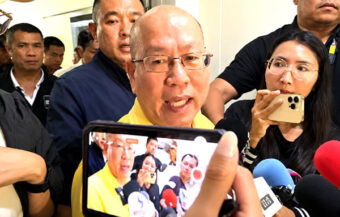
The controversy intensified again on Monday morning, October 12, when Deputy Prime Minister Yotsanan Wongsawat spoke at Government House. At approximately 9 am, Yotsanan answered reporters’ questions about the no-confidence motion and Pheu Thai’s position. He said the opposition had established the parliamentary process. Ministers must now await the debate’s contents.
At the same time, Pheu Thai remained responsible for several urgent government priorities. Yotsanan stressed that the party intended to concentrate on fulfilling its responsibilities. Its ministers would continue performing their assigned duties within Anutin’s government.
Reporters then questioned whether the opposition’s decision to exclude Pheu Thai ministers suggested a possible future alliance. In response, Yotsanan rejected the idea of permanent political enemies. He declared that politicians could cooperate despite belonging to different parties.
Yotsanan cites flood relief cooperation while reaffirming Pheu Thai support for Anutin’s coalition
His response avoided portraying the People’s Party as a permanent political adversary. Nevertheless, he offered no indication that Pheu Thai intended to abandon its coalition agreement.
Instead, Yotsanan referred to recent flood relief operations as an example of cooperation between political opponents. He said politicians from different backgrounds had worked together during the emergency. Likewise, he argued that parliamentary politics operated through established checks and balances. The opposition and government had different responsibilities, but both were expected to perform their duties.
Yotsanan also reaffirmed Pheu Thai’s responsibilities as a coalition partner. He stressed that the party would continue contributing to the government’s work. His remarks rejected permanent political hostility while confirming continued coalition cooperation.
Subsequently, reporters pressed him about Pheu Thai ministers’ involvement in the coming debate. They asked whether his colleagues would help explain matters raised against Bhumjaithai ministers. Although none faced individual motions, their ministries could become involved in questions concerning government decisions.
Pheu Thai ministers pledge to help answer questions as Anutin dismisses threats to coalition unity
Yotsanan confirmed that ministers would cooperate when parliamentary questions involved overlapping responsibilities. He said government members shared responsibility for their work. Therefore, ministers whose departments were connected to matters under scrutiny would help provide explanations.
He emphasised that all coalition partners had a common responsibility to assist. As a result, Pheu Thai ministers could participate in the government’s defence without facing individual censure motions. His comments confirmed that the party intended to remain involved in the parliamentary response.
On another front, Prime Minister Anutin Charnvirakul displayed confidence as the opposition prepared its attack. Speaking to reporters on Monday, he dismissed suggestions that targeting Bhumjaithai alone would fracture the coalition. He pointed to the distribution of ministerial positions within his government.
Bhumjaithai held 27 of the Cabinet’s 35 ministerial positions, he said. Given that dominance, he considered it unsurprising that the opposition had concentrated its scrutiny on Bhumjaithai ministers. The prime minister also welcomed the exclusion of Pheu Thai ministers.
Anutin welcomes scrutiny as a chance to defend ministers and insists Pheu Thai will remain loyal
Anutin said their absence from the motion allowed them to continue working without facing individual parliamentary accusations. Reporters questioned whether he remained confident that Pheu Thai would support Bhumjaithai throughout the debate. He replied that he was confident.
Additionally, Anutin rejected suggestions that the opposition’s tactics had created an immediate threat to government unity. His response followed earlier comments portraying the parliamentary confrontation as an opportunity for ministers.
Rather than treating the debate as a political humiliation, Anutin suggested that ministers should welcome the scrutiny. He argued that parliamentary questioning allowed government members to explain their performance directly to MPs and the public.
Moreover, ministers could present their achievements, answer accusations and clarify decisions made during their time in office. Anutin suggested that being selected for opposition scrutiny was a distinction rather than a setback. On Saturday, he even joked that Bhumjaithai ministers wanted to face parliamentary questioning.
The prime minister teased Deputy Interior Minister Polpee Suwanchawee for escaping inclusion on the opposition’s list. His remarks contrasted with the opposition’s warnings about the evidence it intended to present.
Even so, Anutin acknowledged that ministers needed to prepare thoroughly. He accepted that legitimate criticism should receive serious consideration. The prime minister’s confidence comes as parliamentary arrangements remain unsettled.
Opposition seeks five days for censure debate as ministers prepare to answer corruption accusations
The opposition submitted its motion on October 8, but no final dates have been announced. House Speaker Sophon Zaram must first complete the procedural examination of the submission. The debate is expected in late October, although proceedings could extend into early November.
Meanwhile, the opposition and government disagree over the time required for questioning. The People’s Party wants five days to examine the conduct of the 18 ministers. Government representatives have proposed three days.
Consequently, the parliamentary timetable remains another point of disagreement before proceedings begin. The dispute concerns numerous individual ministers and a wide range of accusations. The opposition intends to examine claims involving corruption, political influence and interference with state institutions.
In addition, People’s Party figures have promised significant disclosures when the debate reaches Parliament. However, the detailed evidence has not yet been presented during parliamentary proceedings.
The accusations will require examination when the named ministers respond. The People’s Party must establish its case against each minister targeted by the motion. Meanwhile, government members will have the opportunity to challenge the accusations and present their explanations.
The eventual confidence votes will determine whether the targeted ministers retain parliamentary support. Separately, People’s Party deputy leader Parit Wacharasindhu addressed speculation about the exclusion of Pheu Thai ministers on Monday.
Parit denies secret deal with Pheu Thai as Senate collusion questions sharpen the coalition dispute
Parit insisted that the opposition had selected its targets according to available evidence. He rejected suggestions of a secret political understanding between the People’s Party and Pheu Thai. Furthermore, he denied claims that the opposition was preparing a future alliance with the coalition partner.
His comments followed speculation that targeting Bhumjaithai alone might be intended to isolate Anutin politically. However, Parit maintained that the decision concerned individual ministers’ conduct rather than party affiliations.
The People’s Party’s stated position remains that those facing serious accusations must answer them in Parliament. Nevertheless, the exclusion of Pheu Thai ministers has become a major political issue before the debate itself.
Pheu Thai previously led the government and now serves under Anutin’s leadership. Its ministers have escaped individual scrutiny in the present motion. However, its MPs will still participate in deciding whether the targeted Bhumjaithai ministers retain parliamentary confidence.
That decision places the former ruling party directly within the coming confrontation. Wiroj’s remarks have sharpened attention on its previous involvement in the Senate collusion controversy. He argues that Pheu Thai possesses substantial information concerning the suspected interference.
Moreover, he has challenged the party to explain whether coalition membership affects its willingness to pursue the matter. His questions concern the relationship between Pheu Thai’s previous position and its present government responsibilities.
Yotsanan pledges coalition support while Anutin awaits a debate targeting 18 Bhumjaithai ministers
Yotsanan’s response on Monday emphasised a different aspect of the political dispute. He reaffirmed the party’s coalition commitments while rejecting the idea of permanent political enemies.
Furthermore, he confirmed that Pheu Thai ministers would assist in answering relevant parliamentary questions. Anutin, meanwhile, insisted that his government remained united. He expressed confidence in Pheu Thai and said Bhumjaithai ministers were ready to defend their records.
The prime minister also maintained that parliamentary scrutiny provided an opportunity to explain the government’s achievements. However, the opposition continues preparing accusations against 18 ministers from his party.
PM says he can explain. Denies power over impartial agencies as a no confidence motion is filed in House
Licenced online gambling site abroad linked to the husband of a government MP raises legal quandary
The People’s Party wants five days to present its case, while government representatives favour three. In addition, the Speaker must complete the procedural examination before the debate can be scheduled. For now, no final parliamentary dates have been announced.
The confrontation is expected later this month, with proceedings potentially continuing into November. Meanwhile, Pheu Thai remains inside the government, despite opposition challenges over its political independence. Its ministers continue working, and Yotsanan has confirmed their willingness to assist during the debate.
The People’s Party has denied any secret arrangement with the former ruling party. Nevertheless, its senior figures continue pressing Pheu Thai over the Senate investigation and its previous commitments.
The decisive parliamentary proceedings have yet to begin. The opposition must present its evidence, while the targeted ministers will have the opportunity to answer. MPs must then decide whether to retain confidence in each minister. Until then, Anutin remains confident of coalition support, while Pheu Thai maintains its place in government.
Join the Thai News forum, follow Thai Examiner on Facebook here
Follow Thai Examiner on Google here
Receive all our stories as they come out on Telegram here
Follow Thai Examiner here
Further reading:
Licenced online gambling site abroad linked to the husband of a government MP raises legal quandary
House Committee chair Rome to call Bhumjaithai MP and Australian husband on Wednesday over wealth
Bhumjaithai MP files police report against People’s Party’s Rangsiman Rome over scammer link remarks
Former cabinet minister and Pheu Thai highflyer clarifies Ben Smith and luxury Gulfstream jet story
PM Paetongtarn suspended from duties while Deputy Prime Minister Suriya Jungrungruangkit takes power