Monkey mayhem is back in Lopburi as escaped macaques storm a police station, damage homes and reignite Thailand’s extraordinary five-year battle to tame the former royal capital’s notorious monkey population, despite last year’s mass capture crackdown.
More than 130 escaped monkeys have been recaptured after a dramatic breakout from a municipal shelter sent marauding troops into homes, businesses and a police station in Thailand’s “Monkey City”. The escape has reignited Lopburi’s extraordinary five-year battle with its macaques, just two years after a landmark campaign subdued thousands that had overrun the historic city following the COVID-19 tourism collapse. With emergency repairs under way and wildlife officers still hunting remaining escapees, the latest breakout shows the fight to control Lopburi’s notorious monkey population is far from over.
More than 130 escaped monkeys have been recaptured after a dramatic breakout from a municipal animal shelter sent marauding troops into homes, businesses and a police station in Lopburi.
The escape has reignited a five-year battle between authorities and the city’s notorious macaque population. It also revived memories of the sweeping 2024 campaign that removed thousands of monkeys after they overwhelmed parts of the historic city, a former capital, following the COVID-19 tourism collapse. Although order gradually returned, this week’s escape showed the conflict is far from over.
The latest incident unfolded on July 1 at the Lopburi Municipal Animal Shelter in Pho Kao Ton Subdistrict in Mueang Lopburi District. Officials said a large troop escaped from a newly built enclosure before spreading rapidly through nearby neighbourhoods.
Monkey troop breaks free from municipal shelter before raiding homes and a police station across Lopburi
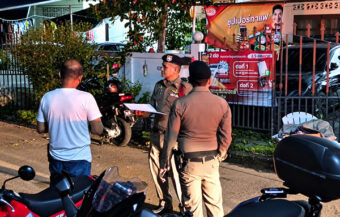
Around 15 houses and surrounding property suffered damage as the monkeys searched for food. Moreover, several animals entered Tha Hin Police Station, climbing across desks, windows and office equipment before disappearing into nearby streets.
Authorities quickly traced the escape to Cage A, one of the shelter’s newer enclosures. According to officials, the monkeys repeatedly shook part of the roof structure until a gap appeared.
They then squeezed through the opening before dispersing across nearby communities. Consequently, provincial officials launched a large-scale operation to recover the animals before they travelled further into residential areas.
Acting Sub-Lieutenant Songpol Paenkaew, Deputy Governor of Lopburi Province, coordinated the response. He worked alongside officers from the Department of National Parks, Wildlife and Plant Conservation, the Lopburi Provincial Office of Natural Resources and Environment, the Conservation Area Administration Office 1, Saraburi Branch, and the Khao Somphot Wildlife Sanctuary. Together, they deployed teams across a one-kilometre radius surrounding the municipal shelter. Their objective was to contain the escape before the monkeys scattered across the city.
Wildlife teams abandon pursuit and switch to ambush tactics after elusive monkeys evade capture repeatedly
Initially, officers attempted to surround and capture the monkeys in open areas. However, the animals quickly avoided search teams and repeatedly slipped away. Wildlife officers found direct pursuit both difficult and inefficient. As a result, commanders abandoned the original plan and adopted a strategy based on the monkeys’ natural feeding behaviour.
Instead of chasing the animals, officers established observation points around nearby communities. They expected hungry monkeys to descend from rooftops and trees while searching for food. Once the animals approached, capture teams moved into position. The revised strategy reduced unnecessary movement and improved the chances of a safe recovery.
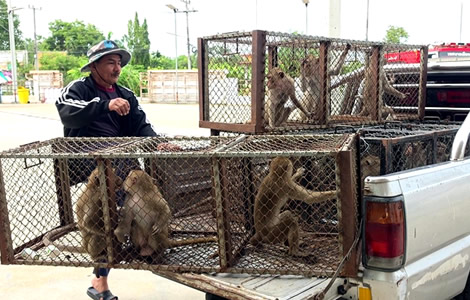
Tranquiliser guns became the principal tool during the operation. In parallel, officers positioned specially prepared cage traps at strategic locations throughout affected neighbourhoods.
Corn, lotus seeds and cartons of milk were placed inside as bait. Officials said the combination proved effective because it relied on the monkeys approaching naturally rather than being forced into capture.
The revised operation soon produced results. Over the past two days, officers have recaptured more than 130 monkeys. Each animal has been returned safely to its enclosure. Nevertheless, officials continue searching the surrounding communities in case additional monkeys remain at large. Residents have also been urged to report sightings immediately.
More than 130 monkeys recaptured as officials urge residents to report sightings and support the operation
The Department of National Parks has distributed contact numbers for local wildlife officers responsible for the operation. This allows residents to notify authorities as soon as escaped monkeys are seen. Separately, people experiencing property damage or ongoing disturbances have been advised to contact the Lopburi Provincial Damrongtham Centre. Reports can be made through Hotline 1567 or by calling 0 3677 0134.
Attention has now turned towards preventing another escape. Lopburi Mayor Chamroen Salachip has ordered emergency repairs throughout the municipal shelter. Technicians are reinforcing damaged sections using much stronger materials.
According to the mayor, the monkeys repeatedly shook cage bars and roof sections until openings developed, allowing large numbers to force their way outside.
The municipality currently houses approximately 3,500 monkeys at the Pho Kao Ton shelter. Therefore, officials are treating the repairs as an urgent priority. Crews are replacing older cage sections with heavy-duty steel mesh containing much smaller openings.
Unlike the previous design, the new mesh prevents monkeys from pushing their hands through the wire. Officials believe this will make future escapes significantly more difficult.
Stronger steel mesh and emergency repairs aim to stop another mass monkey escape from the municipal shelter
The reinforcement project is being funded entirely by Lopburi Municipality. Workers are strengthening the damaged enclosure while examining neighbouring cages for similar weaknesses.
At the same time, officials are reviewing the overall security of the shelter. They hope the upgraded design will withstand the strength of dominant male monkeys that repeatedly pulled apart the previous structure.
Although the immediate operation has recovered most escaped animals, officials remain on alert. Search teams continue monitoring nearby communities while repair work proceeds inside the shelter.
The latest incident has again highlighted the challenge of managing one of Thailand’s largest urban monkey populations. For Lopburi, the battle has entered another chapter rather than reached its conclusion.
While recovery operations continued, Lopburi Municipality also moved to address a separate problem surrounding the monkey shelter. Officials have erected signs banning photography and video recording without prior permission.
Municipality bans filming after monkey live streams prompted public cash donations to private accounts
The restriction follows repeated incidents involving people filming monkey feeding sessions before broadcasting live streams online. According to the municipality, some viewers mistakenly believed the broadcasts were official fundraising campaigns organised by the shelter.
Municipal officials said the live streams had encouraged members of the public to transfer money into private bank accounts. However, the municipality stressed it has never accepted cash donations for caring for the monkeys. Instead, it only accepts donations in the form of food.
In response, officials introduced the photography ban to prevent further misuse of images from the shelter. The municipality also confirmed that one individual responsible for previous live-streaming activity has been permanently prohibited from entering the facility.
The latest escape is the newest twist in one of Thailand’s most unusual urban conflicts. For decades, Lopburi’s long-tailed macaques were celebrated rather than feared. Large colonies lived around the ancient Prang Sam Yot Khmer temple and the nearby San Phra Kan Shrine. Tourists and local residents regularly fed the animals. Consequently, the monkeys became inseparable from the city’s identity, earning Lopburi the nickname “Monkey City”.
COVID-19 tourism collapse transformed Lopburi’s famous monkey attraction into a growing urban crisis
That relationship changed dramatically during 2020 as the COVID-19 pandemic brought international tourism to an abrupt halt. Visitor numbers collapsed almost overnight. One of the monkeys’ principal food sources disappeared with them.
As hunger spread through the troops, the animals expanded far beyond their traditional territory. Soon, they were moving through markets, restaurants, homes and government buildings in search of food.
Before long, residents found themselves sharing the city with increasingly aggressive macaques. Hundreds occupied roads, rooftops and electricity cables. Businesses responded by installing metal screens and reinforced doors.
Shopkeepers armed themselves with sticks, slingshots and water pistols simply to keep monkeys away from customers. Meanwhile, visitors frequently lost food, drinks, handbags, mobile phones and spectacles to the increasingly bold animals.
The population also continued to grow. With breeding largely unchecked, thousands of monkeys were concentrated around the city centre. Rival troops regularly fought over territory, creating chaotic scenes in commercial districts. Residents complained they could no longer leave food unattended. Even opening windows became a risk as monkeys entered homes searching for something to eat.
Authorities launched a huge monkey capture campaign after years of chaos overwhelmed central Lopburi streets
As complaints mounted, provincial authorities prepared an unprecedented response. Rather than culling the animals, officials chose to capture them humanely. Beginning in 2024, large baited cages were deployed across affected areas.
Captured monkeys were transferred to specially constructed enclosures at the municipal shelter. Many also underwent sterilisation to slow future population growth.
The campaign gradually changed daily life in Lopburi. Within months, roughly half of the city’s roaming monkey population had been removed from the streets. Businesses regained access to commercial areas that had become difficult to operate.
Residents also reclaimed neighbourhoods where monkeys had previously dominated public spaces. Although the operation did not eliminate the problem, it restored a measure of normality to the historic city.
This week’s breakout has demonstrated that the challenge remains. A single weakness in the shelter’s enclosure allowed a large troop to escape into surrounding communities. The incident quickly damaged homes, disrupted residents and reached the local police station before capture teams could respond. Nevertheless, authorities moved rapidly to contain the situation using tranquiliser darts, baited traps and coordinated wildlife operations.
Officials now hope stronger cages will prevent another escape. New steel mesh with smaller openings is replacing older sections throughout the shelter.
At the same time, security procedures are being reviewed while neighbouring enclosures undergo inspection. The municipality believes the redesigned cages will better withstand repeated attempts by powerful monkeys to shake or pull the structures apart.
Despite the 2024 crackdown, Lopburi’s extraordinary battle with its monkey population continues unabated
Even so, the latest incident underlines how difficult Lopburi’s monkey management programme remains. The municipality continues caring for approximately 3,500 monkeys at the Pho Kao Ton shelter while monitoring those that still roam freely.
More than 130 escaped animals have already been returned to captivity. However, wildlife officers remain on standby until every escaped monkey has been accounted for and the strengthened enclosures are fully secured.
Killer monkey left 6 year old boy with life threatening injuries on his chest and legs causing his death
Lopburi, a Thai city in crisis as local monkeys force the local population to cage themselves in
For Lopburi, the confrontation between people and monkeys has evolved over five years from an unusual tourist attraction into one of Thailand’s most distinctive public management challenges.
The dramatic capture campaign of 2024 restored much of the city after the monkeys had overrun streets, businesses and public buildings. However, this week’s escape and raid on Tha Hin Police Station show that the battle is still being fought, even after thousands of animals have been brought under control.
Join the Thai News forum, follow Thai Examiner on Facebook here
Receive all our stories as they come out on Telegram here
Follow Thai Examiner here
Further reading:
Lopburi, a Thai city in crisis as local monkeys force the local population to cage themselves in
Rival monkey kingdoms fought a pitched battle in the Thai city of Lopburi on Wednesday morning
Thai government acts to deal with a coconut crisis as price of the crop has plunged sharply