Thailand’s ฿1.6 billion TH-AI Passport faces growing pressure after Karndee Leowpairoj said tests found free AI models outperform it. She cites procurement concerns, costly spending, technical flaws and calls for the project to be cancelled.
Thailand’s ฿1.6 billion TH-AI Passport project faces a mounting political and technical storm after Democrat Party deputy leader Karndee Leowpairoj demanded its cancellation. Tests found the state-backed platform trails free international AI models in key functions, while experts raised concerns over file limits, unclear targets, inflated costs, data sovereignty and possible procurement irregularities. Ms Karndee is now preparing a formal petition to Digital Economy and Society Minister Chaiyanok Chidchob as pressure builds for the government to halt the project before further public money is spent.
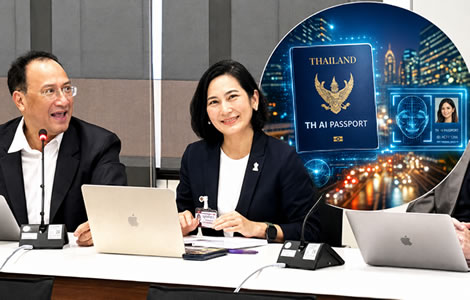
Deputy leader of the Democrat Party Karndee Leowpairoj has demanded the government cancel the ฿1.6 billion TH-AI Passport project after tests identified what she described as major technical shortcomings.
The Democrat Party list MP said the government-backed artificial intelligence platform lacks functions already available in free AI models offered by leading international providers. She argued the system will struggle to achieve its stated objectives. Instead, she warned, it risks becoming an expensive burden on taxpayers.
Speaking at Parliament on July 20, Ms Karndee presented the findings of an examination of the TH-AI Passport platform during a question-and-answer session. The review focused on its features, functionality and practical performance.
Contract revisions leave major loopholes as Karndee questions the project’s value and procurement
She said the project is currently undergoing revisions to its contractual appendices. However, those amendments still contain significant loopholes, she argued. In her view, those weaknesses could prevent the platform from delivering its intended outcomes.
Ms Karndee also questioned why the government should continue funding what she described as an inferior AI model. Free alternatives, she noted, already offer broader functionality.
She argued the project fails the basic test of value for money. “I reiterate that this project should be cancelled and the ฿1.6 billion budget reconsidered because I have concerns regarding cost-effectiveness, suspicions, and potential corruption, rigged specifications and procurement irregularities,” she said. She also questioned why taxpayers should finance technology that performs below freely available systems.
Notably, Ms Karndee challenged several individual spending items within the project. She highlighted costs linked to user registration and satisfaction surveys. As a digital technology specialist, she said many figures appeared unusually high.
She described them as a poor use of public funds. She also argued the project fails to maximise Thailand’s digital development budget. In response, she urged ministers to reconsider whether the expenditure can be justified.
Data sovereignty fears deepen as Karndee prepares petition urging ministers to halt the AI project
Separately, the Democrat Party deputy leader raised concerns over data sovereignty. She said the issue deserves greater scrutiny before further money is committed.
She argued the government should suspend the programme and conduct a comprehensive review. “If the country’s leaders understand this risk sufficiently, they would terminate the project and review it for the long-term benefit of the nation,” she said. She maintained that proceeding without such a review would expose the state to unnecessary financial risk.
Ms Karndee also warned against allowing the project to become an expensive policy failure. “I don’t want the ฿1.6 billion to be a costly lesson for Thailand, or a foolish mistake that the country gains nothing from,” she said.
As part of this, she confirmed she is preparing a formal petition for Digital Economy and Society Minister Chaiyanok Chidchob. The letter will urge him to halt the project. It will also request a full review before additional public money is spent.
Meanwhile, independent digital experts supported many of Ms Karndee’s technical criticisms. Thanachart Numnon, director of the IMC Institute, said artificial intelligence is advancing rapidly as increasingly capable models enter the market. He said the effectiveness of any AI platform depends on the functions it can perform. Free AI systems, he noted, already complete many advanced tasks. Choosing the right model remains essential.
Experts say AI now supports complex work while Thailand’s prototype falls behind free global models
According to Mr Thanachart, artificial intelligence has evolved beyond traditional chatbots. Many systems now operate as digital assistants or co-pilots. They summarise lengthy documents, prepare presentations and generate videos.
They also automate increasingly complex work. Consequently, AI is changing workplace requirements across many industries. He said both upskilling and reskilling have become increasingly important.
Turning to AI-Pass, the prototype within the TH-AI Passport project, Mr Thanachart said its capabilities should at least equal free AI models.
Instead, he found several important limitations. For example, AI-Pass struggles to upload large files. By contrast, free versions of ChatGPT can process much larger documents. He said that limitation alone reduces the platform’s usefulness for professional work.
AI-Pass file limits weaken professional use. ChatGPT handles larger files and more uploads
On another front, Mr Thanachart highlighted restrictions affecting presentation software. AI-Pass allows users to upload only three files when creating PowerPoint presentations. ChatGPT, meanwhile, accepts more than 10 files.
He said the difference is significant. It limits productivity for students, businesses and professionals. It also reduces the platform’s usefulness for training and education.
“If AI-Pass is only designed for lifestyle use, it will not be able to upskill or reskill the public,” he said. He argued that a government-funded AI platform should at least match the functionality of free alternatives.
Specifically, it should upload large document files. It should also download documents in multiple formats. Equally important, it should analyse audio and video data. Without those functions, he questioned its practical value.
Restrictions raise doubts over AI-Pass value for education, training and workplace skills
Elsewhere, Ms Pichchaphen Prateepavanich, founder of Bangkok AI Builder Hub, questioned the project’s strategic direction. She said Thailand has significant potential to expand its domestic AI sector.
However, she argued the ฿1.6 billion budget should be invested differently. Rather than providing free AI access, she said the funding should strengthen Thailand’s own AI capabilities, develop local expertise and support Thai startups.
She also criticised how the project measures success. The Key Performance Indicators, she said, remain unclear. Although the Terms of Reference mention capacity building, the objectives lack practical detail. She argued they should be more concrete and measurable. They should also reflect available resources and realistic outcomes.
Abhisit Vejjajiva calls for scrutiny of flagship AI project being pursued by Digital Economy ministry
Former Pheu Thai leader welcomes return of Ex Democrat Party PM Abhisit back to frontline politics
Taken together, the criticism marks one of the strongest political challenges yet directed at the TH-AI Passport programme. Opponents argue the project requires ฿1.6 billion while still trailing free international AI models in basic functionality.
Ms Karndee maintains the programme should be halted before further spending occurs. She also wants its procurement process, technical capability and overall value for money subjected to a comprehensive review.
Join the Thai News forum, follow Thai Examiner on Facebook here
Receive all our stories as they come out on Telegram here
Follow Thai Examiner here
Further reading:
Ministry fails to halt ฿25.4 billion payment order to Hong Kong based firm linked to 1990 contract
Microsoft accepts charges of corrupt payments in Thailand as it makes a deal with US investigators
Provincial agency boss arrested in Mukdahan after trying to extort ฿2 million from a businessman
Parliamentary vote on constitutional reform is questioned, court says referendum may be needed
Bangkok MP on Phuket mission to investigate controversial local condo project before the courts
Drinks giant Thai Beverage to resume expansion with Singapore IPO for Asean regional beer operation