Prime Minister Anutin reshapes Thailand’s transport strategy after Beijing talks, putting China rail links and new seaports ahead of the trillion-baht Land Bridge. Top banker Kobsak says the move could reshape trade across Asia.
Thailand’s transport strategy is undergoing its most significant shift in years following Prime Minister Anutin Charnvirakul’s talks with Chinese leaders and business executives in Beijing, as the government moves to prioritise rail, road and port links with China while ordering a fresh review of the proposed one-trillion-baht Land Bridge. Backed by senior Bangkok Bank executive Kobsak Pootrakool after joining last week’s delegation, the new approach could reshape regional trade by creating faster freight routes from China’s industrial heartland to India, the Middle East and Europe, deepen Chinese investment in Thailand and strengthen the kingdom’s role as Southeast Asia’s logistics hub.
After Prime Minister Anutin Charnvirakul’s official visit to China last week with a business delegation, the government has reshaped its transport strategy. The new emphasis is on completing strategic rail, road and port links with China. Officials also want faster progress on projects already ready for construction.
The shift follows a review of Thailand’s long-term logistics priorities. Rather than relying on a single megaproject, the government is concentrating on closing critical infrastructure gaps. The strategy targets stronger connections with China, Laos, Malaysia and Singapore. It also aims to improve freight movement between Thailand and China’s industrial regions.
In parallel, the government is reassessing the one-trillion-baht Land Bridge project. The proposal would connect the Gulf of Thailand with the Andaman Sea across Chumphon and Ranong. It was designed to provide an alternative to shipping through the Strait of Malacca.
Prime Minister Anutin has now ordered a full review before further commitments are made. Officials will examine feasibility, investment costs and expected economic returns.
Government accelerates rail, road and port links as the future of the Land Bridge is reviewed
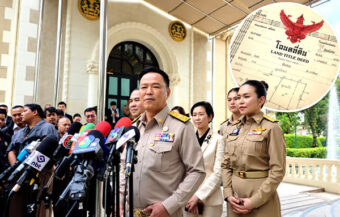
Government spokeswoman Rachada Dhnadirek said the prime minister had instructed agencies to revise the Land Bridge while accelerating projects already capable of delivery.
Instead, ministers will prioritise road, rail and port developments that complete “missing links” across existing transport corridors. “This will speed up cargo transport, cut logistics costs, increase competitiveness and attract investment without having to wait for a mega project,” she said.
As part of this strategy, Thailand will push ahead with extending railway links from Chiang Khong district in Chiang Rai to Nateuy station in Laos. Nateuy connects directly with Mohan in China through the Chinese-Laos high-speed railway.
During his visit, Mr Anutin reaffirmed Thailand’s commitment to completing that section. The government also plans rapid improvements to Ranong Port while strengthening rail and road links with Chumphon.
Those projects would create another freight corridor between the Indian Ocean and the Gulf of Thailand. They would also strengthen the wider North-South Economic Corridor stretching from China through Laos and Thailand to Malaysia and Singapore.
The government believes those investments can deliver quicker economic benefits than waiting for the full Land Bridge.
Kobsak backs western seaports and says a new Ranong deep-sea port offers a stronger alternative
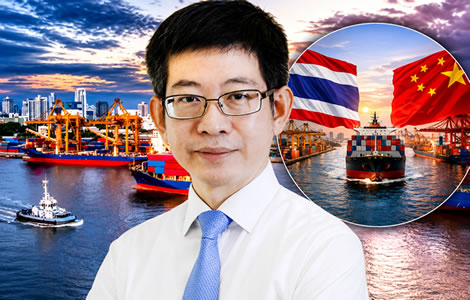
Separately, Bangkok Bank senior executive vice-president Kobsak Pootrakool strongly endorsed the revised direction on Wednesday. The former Prime Minister’s Office minister under General Prayut Chan-o-cha accompanied the government delegation to China.
He is widely regarded as one of Thailand’s leading economic commentators. Last year, he was also among the candidates considered for governor of the Bank of Thailand.
Mr Kobsak said Thailand should focus on building stronger western seaports if the full Land Bridge proves difficult to implement. He argued that improving ports and connecting infrastructure has long offered a practical alternative. According to him, investment should first target projects with clearer commercial returns and greater implementation certainty.
Notably, Mr Kobsak proposed a revised transport network centred on a new deep-sea port in Ranong. He said expanding the existing port would be less effective because it sits on a river. Larger vessels face access constraints, limiting future development. Consequently, he recommended constructing a completely new deep-sea facility at a more suitable location.
Chongqing route and Chinese investment reshape logistics ambitions and industrial outlook
Mr Kobsak also identified Chongqing as one of Thailand’s most important future logistics markets. Cargo from the inland Chinese municipality could move through western Thailand before continuing to India, the Middle East and Europe.
He said that route would offer exporters a more convenient alternative than shipping through Shanghai. It would also strengthen Thailand’s role in regional maritime trade.
Meanwhile, Chinese investment continues reshaping Thailand’s economy. Mr Kobsak said China has become the country’s largest source of foreign direct investment during the past three years. He attributed that trend to the China Plus One strategy and broader geopolitical developments. Together, they have encouraged manufacturers to diversify production outside mainland China.
Chinese companies establishing operations in Thailand initially require working capital, trade finance and local banking services. However, domestic financing should become increasingly important as investments mature.
Bangkok Bank expects those later phases to create significant opportunities for Thai lenders. The bank is also working to strengthen domestic supply chains supporting Chinese manufacturers.
EV supply chains and new technology seen driving Thailand’s next phase of economic growth
Already, several Thai companies produce vehicle bodies and components for Chinese electric vehicle manufacturers. Those relationships are expected to expand as more factories enter Thailand.
Mr Kobsak said the country should capitalise on China’s growing strengths in electric vehicles, information technology, solar energy and artificial intelligence. He also noted that Japanese technological dominance has gradually weakened across several industries.
Thailand is increasingly serving as China’s regional distribution hub for Southeast Asia. Many Chinese cities already use the country as a logistics base for regional trade.
Although Chinese manufacturers may initially rely on financing from home, that pattern is expected to evolve. Expanding supply chains should eventually generate greater demand for Thai banking services.
Looking ahead, Mr Kobsak estimated that continued Chinese investment and completed infrastructure projects could support economic growth of between 3% and 5% over the next three to four years.
Warning for incoming government that it may face a clash between the United States and China in Asia
Wake up and smell the coffee, says Finance Minister and top Bangkok Bank executive. War is a Mug’s game
He also warned that Thailand’s traditional industries must modernise to remain competitive. Factories operating with decades-old technology will struggle against increasingly efficient Chinese manufacturers. Investment in newer production facilities and technologies will therefore become increasingly important.
Finally, Ms Rachada said every project will undergo detailed assessment before implementation. The government will weigh feasibility, investment levels and economic returns before approving action plans.
She said the emphasis will remain on practical investments producing faster benefits for businesses and the wider economy.
Join the Thai News forum, follow Thai Examiner on Facebook here
Receive all our stories as they come out on Telegram here
Follow Thai Examiner here
Further reading:
Warning for incoming government that it may face a clash between the United States and China in Asia
Thaksin does not rule out joining talks in US as Thai team finalises plans. They fly out on Thursday