Thailand’s tourism bosses are battling a perfect storm as social media controversies, headline-grabbing crimes, weaker European arrivals and Middle East disruption hit confidence. TAT warns online rows could damage the kingdom’s reputation.
Thailand’s tourism industry is facing a growing crisis as the Tourism Authority of Thailand (TAT) seeks to curb the social media fallout from a string of high-profile incidents involving foreign visitors, warning that inflammatory online commentary risks inflicting lasting damage on the kingdom’s reputation abroad just as arrivals from key European markets weaken. The warning comes as TAT pivots away from simply chasing visitor numbers towards attracting higher-spending travellers, while officials also contend with the international fallout from headline-grabbing criminal investigations, diplomatic controversies and geopolitical disruption that has sharply reduced Italian and Spanish tourist arrivals.
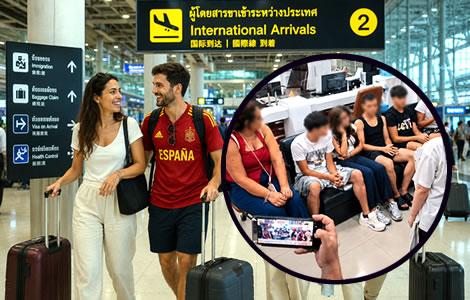
Thailand’s tourism industry is facing renewed pressure after a string of high-profile incidents involving foreign visitors coincided with weakening arrivals from several important overseas markets.
At the same time, the Tourism Authority of Thailand (TAT) is warning that inflammatory social media commentary risks causing lasting damage to the country’s reputation abroad.
The warning comes as the agency pursues a revised tourism strategy. Rather than focusing primarily on visitor numbers, TAT is placing greater emphasis on tourism income and higher-value travellers. Officials say that approach depends heavily on maintaining confidence in Thailand’s international image.
Tourism officials fear online disputes involving visitors are harming confidence in Thailand’s image
According to TAT, isolated incidents involving foreign visitors should not be allowed to define the country or its tourism industry. Instead, the agency says public discussion must distinguish between individual behaviour and the wider image of Thailand as a destination.
Those concerns follow a succession of widely reported incidents that have attracted attention both domestically and overseas. Several have generated millions of online views while prompting official responses from government agencies, foreign embassies and police.
The first controversy centred on Bangkok’s BTS Skytrain. A Thai passenger, identified as Ms Sugus, uploaded a video showing a group of Italian students behaving in a rowdy manner while allegedly insulting another passenger. The footage spread rapidly across social media platforms and quickly attracted widespread criticism.
In response, Ms Sugus lodged a police complaint. The Italian students later apologised, while police imposed fines following the incident. Although the matter was resolved, the story continued circulating online and received extensive coverage in both Thailand and Italy.
Italian student controversy raises concern as falling arrivals heighten focus on Thailand’s reputation
Notably, the episode unfolded as Thailand was already experiencing a significant decline in Italian visitor arrivals. That coincidence has heightened concern among tourism officials about the potential effect of negative publicity in overseas markets.
Separately, another incident involving a Chinese visitor generated international attention. An altercation between security personnel and the tourist at a book fair quickly spread across Chinese social media, triggering widespread discussion beyond Thailand.
The dispute also prompted an official response from the Chinese Embassy in Bangkok. Afterwards, the Ministry of Foreign Affairs ordered an investigation into the circumstances surrounding the confrontation.
Minister of Tourism and Sports Surasak Phancharoenworakul later addressed the growing controversy. He firmly defended the rights of Thai citizens while emphasising that every visitor must respect Thai laws and local customs.
He also rejected any suggestion that foreign visitors could expect preferential treatment. “No tourist can buy ‘privilege’ in Thailand,” the minister said.
Minister insists all visitors must obey Thai law as government responds to mounting international attention
His remarks reflected the government’s effort to balance visitor confidence with public expectations that Thai laws apply equally to everyone.
On another front, two major criminal investigations involving foreign nationals have continued attracting international attention.
Police are still searching for two missing Russian siblings who disappeared during a pre-dawn motorcycle ride in Pattaya. Detectives have reconstructed much of their route using CCTV footage gathered from multiple locations.
However, investigators have yet to determine what happened after the brother and sister disappeared from camera coverage. Officers continue reviewing surveillance recordings while interviewing witnesses as the investigation progresses.
In parallel, police are pursuing another major case involving three Indian tourists allegedly kidnapped after travelling to Pattaya. Investigators say the victims were lured to Thailand before being held captive while their captors demanded ransom payments.
Russian disappearance and Indian kidnapping add fresh international scrutiny to Thailand’s tourism story
Five Indian suspects have already been arrested after police intercepted them before they could leave the country. Meanwhile, detectives continue searching for an alleged mastermind believed to be directing the operation from Dubai.
Although the Russian disappearance and Indian kidnapping cases are entirely unrelated, both have attracted significant international media attention. Together, they have extended an already difficult period for Thailand’s tourism industry.
Against that backdrop, TAT Governor Thapanee Kiatpaiboon has appealed for restraint when discussing incidents involving foreign visitors. She said the actions of individuals should never be generalised to represent an entire nationality.
Instead, Ms Thapanee urged the public to consider each case independently. She said allowing online disputes to escalate could unnecessarily damage Thailand’s tourism image and credibility.
According to the governor, discussions on social media require particular care because opinions spread rapidly across borders and multiple languages. Consequently, relatively small incidents can quickly develop into international controversies.
TAT urges restraint as online disputes threaten relations with key tourism markets including China and Italy
She specifically warned that prolonged arguments could affect relations with key visitor markets, particularly China and Italy. For that reason, she urged all parties to avoid extending online disputes after official action has already been taken.
As part of this approach, Ms Thapanee said recent incidents should become practical lessons for both organisers and visitors. The objective, she said, is to reduce the likelihood of similar disputes during future events.
The governor also revealed another area of concern. TAT is monitoring whether third parties could exploit social media trends to undermine Thailand’s tourism reputation overseas.
Officials warned that irresponsible online commentary could weaken confidence among prospective visitors and eventually affect tourism revenue. Even so, the agency’s current assessment has found no evidence that recent controversies have produced wider damage to overall tourism demand.
Nevertheless, TAT has instructed organisers to exercise greater caution when handling sensitive situations involving foreign visitors. Officials believe careful management can prevent local disputes from becoming international issues.
While social media has dominated recent headlines, TAT is also confronting mounting economic challenges in several overseas markets.
Italian and Spanish visitor declines deepen as geopolitical disruption hits southern Europe’s travel market
Here’s Part 2, preserving your wording and paragraph structure. I have corrected only genuine mistakes and inserted the remaining H3 headlines in sentence case.
Italian and Spanish arrivals have recorded the steepest declines among European countries during the first half of this year. Those figures represent a marked reversal after southern Europe delivered one of Thailand’s strongest regional performances during 2025.
Prakaipruek Damrongvadha, director of TAT’s Rome office, said southern Europe generated approximately 1.1 million visitors last year. That represented annual growth of 22% and produced around 71 billion baht in tourism revenue.
Importantly, the positive trend continued throughout the opening quarter of this year. Conditions changed only after the Gulf crisis disrupted international aviation networks during the second quarter.
The disruption proved particularly significant for southern Europe because many travellers depend on Middle Eastern airlines when flying to Thailand. Around 60% of Italian visitors use those carriers. The proportion rises to 80% among Spanish tourists and reaches about 90% for Portuguese travellers. As a result, the reduction in flight availability immediately affected booking patterns across the region.
Middle East flight disruption triggers steep declines in Italian, Spanish and Portuguese visitor arrivals
As of July 15, Spain recorded the steepest decline among all European markets. Visitor arrivals fell 15.1% to 80,089. Italy followed with a 10.5% decline, reducing arrivals to 135,572. Portugal also posted a 7.75% fall, leaving arrivals at 27,098.
Even so, TAT believes the current downturn does not fully reflect underlying demand. July and August remain important travel months because schools are on holiday across much of southern Europe. Consequently, large numbers of Italian and Spanish families continue travelling during that period, helping hotels fill rooms throughout Thailand’s traditional low season.
At the same time, airlines have gradually begun restoring capacity between Europe and Thailand. However, TAT says many travellers remain cautious before making new bookings. Instead, they increasingly seek flexible booking conditions because of continuing uncertainty surrounding international travel.
In addition, higher airfares continue affecting demand. Rising living costs have also reduced discretionary spending across southern Europe. According to Ms Prakaipruek, travellers from the region are generally more price-sensitive than many other European visitors. That pattern is especially evident among Italians.
Weak economies and higher travel costs push TAT towards wealthier southern European visitor segments
Italy is forecast to record economic growth of only 0.5% to 0.8% this year. Inflation is expected to remain between 2.5% and 2.6%. Meanwhile, household energy prices have increased sharply during the past five years. Overall household energy costs have risen by roughly 60%, placing additional pressure on disposable income available for overseas travel.
In response, TAT has adjusted its marketing strategy. Rather than competing for volume alone, the agency is concentrating on higher-spending visitors who are less affected by economic pressures. Those groups include affluent retirees, luxury travellers and wellness tourists.
Despite current headwinds, Ms Prakaipruek remains optimistic about Thailand’s long-term position. She said the country continues to enjoy a strong brand image among southern European travellers. “Thailand has a strong brand image among southern European tourists. Once the geopolitical situation returns to normal, more tourists will return to Thailand,” she said.
Official figures underline the long-term value of the Italian market. Around 25 million Italians, or roughly 40% of the population, hold passports. Last year they made more than 68 million overseas trips, including approximately 17 million long-haul journeys.
Direct flights and strong long-term demand offer hope despite the current downturn in southern Europe
Italian visitors spend an average of 53,600 baht per trip and typically remain in Thailand for 12 nights. By comparison, Spanish tourists spend an average of 62,132 baht per visit. TAT also noted that more than 70% of recent Italian arrivals were visiting Thailand for the first time, highlighting continued interest in the destination despite current challenges.
On the aviation front, direct connectivity is expected to improve during the second half of the year. Thai Airways continues operating direct services between Milan and Bangkok. Meanwhile, ITA Airways maintains direct flights between Rome and Bangkok.
Earlier this year, ITA temporarily reduced flights during May and June after reallocating aircraft to routes serving the Americas. However, the airline plans to increase services to five flights a week from August in response to continuing demand for Thailand.
Separately, Neos plans to introduce seasonal charter flights linking Milan and Phuket. Those services are scheduled to operate from November until April 2027, providing additional capacity during the peak European winter travel season.
Alongside market challenges, TAT is continuing efforts to protect confidence in Thailand as a destination. Ms Thapanee stressed that the recent online disputes involving Italian and Chinese visitors remained personal matters. She said they should not be allowed to develop into broader diplomatic or tourism issues.
TAT says social media dispute sare isolated despite worries over Thailand’s global tourism reputation
She also cautioned against allowing online debate to continue unnecessarily. According to the governor, prolonged arguments could affect Thailand’s image in overseas markets even after the original incidents have been resolved.
Furthermore, TAT said it remained alert to attempts by competing tourism destinations or other third parties to exploit social media trends for commercial advantage.
Officials warned that irresponsible online commentary could undermine confidence in Thailand’s tourism industry if left unchecked.
Even so, the agency stressed that its latest assessment showed no indication that the recent controversies had affected overall tourism performance. Nevertheless, event organisers have been instructed to exercise greater caution when handling sensitive situations involving foreign visitors to reduce the likelihood of similar incidents.
TAT sticks with quality tourism strategy despite weaker arrivals and mounting international challenges
Looking ahead, TAT says it will maintain its strategy during the second half of the year despite the recent setbacks. The agency will continue promoting Thai culture and soft power as key attractions while pursuing higher tourism income rather than simply larger visitor numbers.
For tourism officials, the immediate challenge extends beyond restoring flight capacity and rebuilding arrivals from southern Europe.
Tourism in ‘Transformation’ as the Ministry pivots to a quality agenda and away from a focus on numbers
Minister and Tourism Authority of Thailand (TAT) boss travel to Belgium in pursuit of Tomorrowland event
It also includes protecting Thailand’s international reputation during a period when local incidents can rapidly become global stories through social media.
That combination of weaker European demand, geopolitical disruption and sustained international attention has created one of the sector’s most testing periods in recent years. Even so, TAT believes Thailand’s established reputation, expanding air links and focus on higher-value travellers will support the industry’s recovery once international conditions become more stable.
Join the Thai News forum, follow Thai Examiner on Facebook here
Receive all our stories as they come out on Telegram here
Follow Thai Examiner here
Further reading:
Government to reopen Hua Hin to international flights as it pushes Thai Airways on more flights
Thai Airways suffers turbulence in the boardroom as government exercises powers to appoint directors
Thai Airways union protests government ‘interference’ in its recovery plan at a critical juncture.
People’s Party economic head questions the government’s plans for Thai Airways after new moves
Thai Airways to refloat on Stock Exchange in June 2025 with a renewed mission as national carrier
Passenger complaint turbulence as Thai Airways appears to plot sky-high Dreamliner expansion