Anutin tells foreign media Thailand’s school massacre was “not a crime” under juvenile law as he vows tougher gun controls, tighter school security and says the meticulously planned attack stemmed from mounting stress.
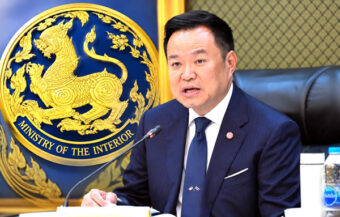
Prime Minister Anutin Charnvirakul sparked international attention on Friday after telling foreign reporters that Thailand’s deadliest school shooting in years was “not a crime” under Thai law, making the remark at the devastated Depsirin Nonthaburi School as police reconstructed a meticulously planned massacre that left eight people dead and more than 30 injured. He said Thailand’s juvenile justice system generally shields children under 15 from criminal punishment, defended his firearms policy, pledged tougher gun laws and stronger school security, and revealed investigators believe the teenage gunman acted under mounting stress after carefully planning one of the country’s worst modern school tragedies.
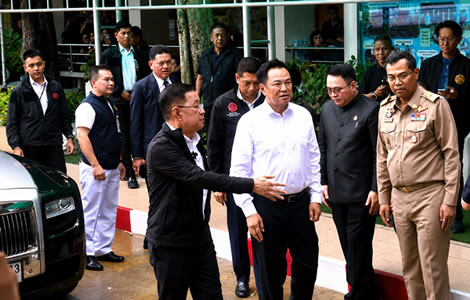
Prime Minister Anutin Charnvirakul surprised foreign reporters on Friday by describing Thailand’s worst school shooting in years as “not a crime” under Thai law after arriving at Debsirin Nonthaburi School in his navy blue Rolls-Royce to oversee the government’s response.
The remark immediately drew attention because eight people, including the gunman’s grandparents, had been killed and more than 30 others injured. However, the Prime Minister’s comments reflected Thailand’s juvenile criminal law, which distinguishes between the commission of an offence and the criminal liability of a child.
Under that framework, children under 15 generally cannot receive criminal punishment despite committing offences including murder. Instead, they fall under the jurisdiction of the Juvenile and Family Court, which applies protective and rehabilitative measures rather than criminal penalties.
Anutin arrives at devastated school as foreign media focus on legal meaning of “not a crime” remarks
Mr Anutin arrived at the school shortly before 4.25 pm as forensic officers, detectives and senior officials continued working across the campus. Meanwhile, police investigators were reconstructing the teenager’s movements before and during the attack.
Families remained gathered outside the school awaiting updates. In parallel, doctors continued treating dozens of wounded victims at hospitals across Bangkok and Nonthaburi. Nine patients remained in critical condition at Phra Nangklao Hospital and Phra Mongkut Hospital as medical teams closely monitored their condition.
Against that backdrop, the Prime Minister chose the school grounds to address international media and explain both the government’s response and the legal framework surrounding the case.
Speaking to foreign correspondents, Mr Anutin said investigators had identified several factors behind the attack. Most notably, he pointed to accumulated stress connected with the teenager’s education.
Police interviews with the suspect’s close friends indicated the boy had experienced sustained pressure over time. The Prime Minister also said the teenager’s grandparents expected him to perform well academically and had been strict with him.
One grandparent worked as a teacher. Even so, Mr Anutin rejected any suggestion that the killings resulted solely from an emotional outburst. Instead, he said investigators had already established that the attack was carefully planned. Police reconstruction, he added, demonstrated clear objectives and deliberate preparation before the shootings began.
PM urges patience over inquiry while defending firearms controls and promising tougher gun legislation
Even so, the Prime Minister cautioned against reaching premature conclusions. He said several factors combined to produce the tragedy. Therefore, investigators must complete their work before assigning precise weight to each one.
He also expressed confidence that the Royal Thai Police would establish the complete chain of events before presenting its findings. According to Mr Anutin, only a full investigation can explain exactly how one of Thailand’s deadliest school shootings unfolded.
In response to questions about existing firearms controls, the Prime Minister insisted Thailand already prohibits carrying firearms and other weapons in public. He stressed that the current law remains in force nationwide.
However, he said the Nonthaburi massacre involved issues extending beyond firearms legislation alone. As a result, he urged reporters to await the outcome of the police investigation before drawing wider conclusions. Nevertheless, he reaffirmed that unlawful public carrying of weapons would continue to be enforced without exception.
The Prime Minister also defended the government’s record on firearms policy. He said that while serving as Interior Minister, he proposed tighter regulations governing firearm ownership and public carrying.
As part of that programme, ministerial announcements restricted the carrying of firearms in public and tightened conditions surrounding new firearm purchases. Now serving as Prime Minister, he said his government intends to strengthen those measures further.
Thai juvenile law distinguishes murder from criminal liability for children under 15 in serious offences
Accordingly, new legislation imposing stricter firearms controls is already being prepared. He again declared that ordinary citizens will not be permitted to possess or carry weapons in public areas under his government’s policy.
One statement nevertheless dominated the exchange with foreign journalists. Mr Anutin described the massacre as “not a crime” but rather the consequence of one individual suffering accumulated stress and pressure.
Legally, however, Thailand distinguishes between the criminal nature of an act and the criminal responsibility of the offender. Murder remains a criminal offence under the Criminal Code regardless of the offender’s age.
Separate provisions, however, determine whether a child can be prosecuted and punished through the criminal justice system. That distinction forms the basis of Thailand’s juvenile criminal law and helps explain the Prime Minister’s remarks.
Under Thai law, children under the age of 10 cannot be held criminally responsible. By contrast, children aged 10 to under 15 are generally exempt from criminal punishment. Instead, the Juvenile and Family Court may order supervision by parents or guardians, counselling, educational programmes or placement in welfare institutions.
Children aged 15 to under 18 may be prosecuted through the juvenile justice system. Even then, courts must take account of the offender’s age before imposing sentence. Consequently, substantially reduced penalties apply, and rehabilitation remains the principal objective. Adults aged 18 and above are fully criminally liable under the Criminal Code.
Thai law shields children under 15 from criminal punishment even for serious offences including murder
Accordingly, a child who remains under 15 generally cannot be subject to criminal punishment, regardless of the seriousness of the offence. By contrast, a child who has already turned 15 may face prosecution through the juvenile justice system, although substantially reduced penalties still apply.
In Friday’s case, however, the suspect died during the incident. Consequently, no criminal proceedings can occur regardless of his precise age. Legal specialists distinguish between the commission of an offence and the criminal responsibility of the offender. Against that legal background, the Prime Minister’s remarks are understood as referring to criminal liability rather than the legal status of the killings themselves.
Thailand’s approach differs significantly from many Western legal systems. In England and Wales, the age of criminal responsibility is 10. Therefore, children aged 10 and above may be prosecuted for murder.
Serious juvenile cases may ultimately proceed before the Crown Court. Young offenders convicted of murder may receive detention at His Majesty’s pleasure rather than an adult life sentence. Scotland follows different procedures. Even there, however, children from the age of 12 may generally be prosecuted for the most serious offences.
The United States, for instance, adopts a different model because no nationwide age of criminal responsibility exists. Instead, each state establishes its own legal framework. Many states permit prosecution of children as young as 10 or 12 in exceptional cases.
US and UK laws allow prosecution of young offenders at much earlier ages than Thailand’s legal framework
In addition, prosecutors frequently seek to transfer juvenile defendants into adult courts following multiple murders or mass shootings where state law allows. Although United States Supreme Court rulings prohibit mandatory life imprisonment without parole for juvenile offenders and prohibit capital punishment for offences committed before the age of 18, lengthy prison sentences remain available in many jurisdictions.
By comparison, Thailand provides broader legal protection against criminal punishment for children under 15 than the United Kingdom or most American jurisdictions.
Separately, Mr Anutin confirmed that the firearm used in Friday’s attack had been legally registered. He said it had been stored inside the family home where it remained accessible to children.
Notably, he stressed that the weapon had not previously been carried unlawfully in public. Even so, he argued that stronger firearms controls remain necessary. He said one objective of the government’s response is to reduce opportunities for weapons to reach vulnerable individuals, particularly children.
On another front, the Prime Minister outlined plans to strengthen security inside schools. He said parents must have confidence that educational institutions can better protect students and teachers.
At the same time, he acknowledged practical limitations. Airport-style X-ray screening or weapon detection systems for every student would not be practical during daily school operations. Instead, schools should introduce stronger screening measures that remain effective without disrupting normal education. He said improving security procedures would become an important part of the government’s broader response.
PM outlines tougher school security as investigators continue inquiry and hospitals treat the critically injured
As part of the discussion, foreign reporters also asked about violence involving young people. Mr Anutin said every serious incident involving juveniles requires careful examination of the child’s mental condition.
However, he cautioned against assuming that every offender suffers from mental illness. Rather, he said many incidents involve accumulated pressure followed by sudden emotional or impulsive reactions triggered by specific circumstances. He maintained that investigators must distinguish between underlying mental health disorders and temporary emotional crises when examining such cases.
15-year-old killer hit back after being bullied at school, say police investigating Friday’s horrific act of evil
Prime Minister Anutin vows to continue his tough policy on gun ownership after Friday’s mass shooting near Bangkok
Meanwhile, the Prime Minister updated the latest casualty figures. He said eight people, including the suspect’s grandparents, had died. More than 30 others were injured. Of those victims, nine remained in critical condition. They continue receiving intensive treatment at Phra Nangklao Hospital and Phra Mongkut Hospital while doctors closely monitor their progress.
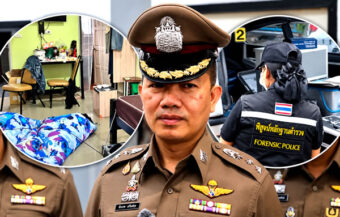
As darkness approached, forensic officers continued examining classrooms and other areas across Debsirin Nonthaburi School. Detectives also continued interviewing witnesses and reconstructing the teenager’s movements before, during and after the shootings.
In parallel, investigators gathered additional evidence from the suspect’s family home as they sought to establish every stage of the attack. The inquiry remains ongoing as police continue piecing together one of Thailand’s deadliest school shootings in recent years while the government prepares new firearms legislation and wider school security reforms.
Join the Thai News forum, follow Thai Examiner on Facebook here
Receive all our stories as they come out on Telegram here
Follow Thai Examiner here
Further reading:
Police search for Russian siblings who disappeared after Sunday morning motorbike ride in Pattaya
Thailand closes its doors to dodgy foreigners and tourists who abuse their welcome through crime
60-day visa regime to be ended confirms Minister responding to rising industry security concerns
Tourism boss warns Thailand it is facing a Chinese blacklist if another security controversy erupts
Visa waiver scheme questioned with another China Crisis for foreign tourism driven by security fears