Chinese EV giants may find it cheaper to build cars at home and ship them to Thailand despite incentives for local production. FTI warns Thai parts cost 30% more, putting the kingdom’s ambitions as a major EV manufacturing base at risk.
Thailand’s costly drive to become a major Chinese EV manufacturing base may yet be seen as a pipedream. The ambition faces a hard economic test as industry leaders warn imported cars can still be cheaper than vehicles built locally. China’s annual car market is about 50 times larger, giving its manufacturers enormous economies of scale, while Thai-made parts can cost around 30% more. Federation of Thai Industries veteran Supoj Sukpisal says EV3 and EV3.5 incentives may not be enough to overcome the gap. Without lower costs, stronger local sourcing and greater export volumes, Chinese manufacturers could keep production at home and ship finished vehicles into Thailand. The result could leave the kingdom with booming EV sales, Chinese brands and showrooms, but without the deep manufacturing base, supplier orders and industrial development policymakers had sought.
Thailand cannot assume it has secured a future as a major electric vehicle manufacturing base despite extensive government support. Chinese EV giants still have a compelling economic reason to import finished cars rather than manufacture them locally.
Above all, China’s vast production scale gives its manufacturers a cost advantage Thailand cannot currently match. Producing an EV in Thailand can cost more than building the same vehicle in China and importing it.
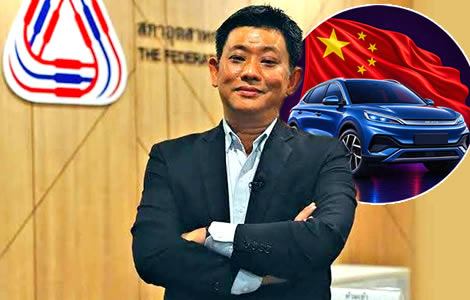
That calculation now sits at the centre of concerns within Thailand’s automotive parts industry. Supoj Sukpisal is Honorary Chairman of the Automotive Parts and Accessories Industry Group at the Federation of Thai Industries (FTI).
He said Thailand must examine what Chinese EV investment will actually deliver. Crucially, investment commitments do not necessarily mean large production volumes will remain in Thailand.
EV3 incentives face scale problem as Chinese imports remain cheaper than local production in Thailand
Thailand has introduced the EV3 and EV3.5 programmes to encourage investment and support domestic EV production. Yet the private sector remains concerned about whether Thai-made vehicles can compete without that assistance. China benefits from mass production across an enormous domestic market. Thailand, meanwhile, produces some individual models in volumes of only several thousand units annually.
“Without the EV3 and EV3.5 measures to help offset the costs, we are concerned that domestically produced cars may not be able to compete with imported cars from China, and this may cause Chinese automakers to choose importing cars rather than establishing actual production bases in Thailand,” Mr Supoj said.
The numbers illustrate the scale of the problem. Thailand’s domestic automobile market is approximately 500,000 vehicles annually. China’s market, by comparison, reaches around 25 million vehicles each year. In effect, the Chinese market is about 50 times larger. That gives manufacturers enormous economies of scale across factories, machinery and production.
China’s vast production scale leaves Thai EV factories struggling to match costs on imported vehicles
Furthermore, Chinese manufacturers can spread costs across vastly larger production runs. Thailand cannot reproduce those economies of scale through domestic demand alone. Consequently, a Thai plant producing several thousand vehicles faces a different cost structure from a massive Chinese factory. The resulting difference can make importing finished vehicles commercially more attractive.
Weak purchasing power in Thailand adds another complication. Mr Supoj said policymakers must consider whether local factories primarily serve domestic customers or export markets. That distinction matters because Thailand’s domestic market alone offers limited production scale. Accordingly, exports could become essential if local factories are to increase output significantly.
The concern reaches beyond vehicle manufacturers. Thailand has built an extensive automotive parts industry around decades of domestic assembly. In turn, those factories support suppliers, technical expertise, machinery investment and component development. A shift towards imported finished EVs would reduce opportunities across that established industrial network.
Mr Supoj warned that Thailand could become primarily a sales market or showroom for foreign electric vehicles. In that scenario, the kingdom would not develop the production and innovation base envisaged. Moreover, fewer locally assembled vehicles would mean fewer opportunities to develop domestic EV parts and expertise.
Thai parts makers face 30% cost disadvantage as imported materials and higher operating costs mount
Thai component manufacturers already face a substantial competitive problem. Mr Supoj estimated that Thai parts can cost around 30% more than comparable Chinese products. Significantly, the difference reflects several underlying expenses rather than one isolated problem. Raw materials, taxes, labour, electricity and machinery all contribute.
Thailand lacks its own upstream supplies of key industrial materials, including steel and aluminium. Therefore, manufacturers must import these materials before producing many components. Import taxes then increase costs further. At the same time, Thai suppliers must absorb domestic labour, electricity and machinery expenses.
“Currently, Thai parts manufacturers are trying to find opportunities to collaborate with Chinese manufacturers, but are still constrained by higher costs. The private sector is in discussions with the government to find a balance and reduce the cost gap.
Currently, Thai parts costs are about 30% higher than Chinese costs. We are analysing the source of these costs, starting with raw materials, as Thailand does not have its own upstream raw materials such as steel and aluminium, which must be imported. This results in import taxes, as well as labour costs, electricity costs, and machinery costs,” said Mr Supoj.
Thai suppliers seek to cut 30% cost gap as local production offers Chinese firms logistics benefits
In parallel, Thai parts companies are seeking direct cooperation with Chinese EV manufacturers operating in the kingdom. However, the 30% cost difference makes those negotiations difficult. Chinese companies already have access to extensive domestic supply chains at home. Therefore, Thai suppliers must overcome a significant price disadvantage to win their business.
Mr Supoj suggested narrowing the gap from approximately 30% to around 15%. At that point, Thailand could make a stronger case based on other advantages. Local manufacturing can reduce logistical and transportation risks. Those savings could partly compensate for higher Thai production costs.
“If we can reduce the gap from 30% to around 15% and discuss with Chinese manufacturers the benefits of using a production base in Thailand, including reducing logistical and transportation risks, it might be a mutually beneficial solution,” Mr Supoj said.
Another front is domestic sourcing. Mr Supoj said Chinese manufacturers investing in Thailand should be encouraged to use locally produced components and raw materials. In particular, purchases should extend across Tier 1, Tier 2 and Tier 3 suppliers. Greater local sourcing would create employment and increase the domestic economic impact of Chinese investment.
Local sourcing and exports emerge as key routes to deepen Chinese EV manufacturing inside Thailand
Without that sourcing, the benefits would be narrower. Vehicle assembly could take place locally while significant component value remains outside Thailand. By contrast, deeper integration with Thai suppliers would provide more opportunities for the existing automotive parts industry. It would also increase demand throughout established domestic supply chains.
Separately, exports could provide Thailand with the volumes unavailable from its relatively small home market. Mr Supoj identified Australia and Europe as potential destinations for Thai-made electric vehicles.
However, manufacturers must comply correctly with international trading requirements. These include World Trade Organisation regulations, free trade agreements and applicable local-content criteria.
As part of this, trade compliance will determine whether Thai-produced vehicles can compete internationally. Mr Supoj said correctly compliant Thai-made EVs can compete in overseas markets. Export production could also provide factories with additional volumes beyond Thailand’s 500,000-vehicle domestic market.
Quality standards and massive Chinese production volumes sharpen pressure on Thailand’s EV industry
Product quality presents another consideration as Chinese EV investment increases. Mr Supoj said quality depends on government supervision and enforcement of existing standards. Thailand already maintains international automotive and component standards. These include safety testing and other established requirements.
Notably, he called for strict enforcement to maintain Thailand’s industrial quality and reputation. Chinese investment itself does not determine the standards applied to vehicles produced locally. Instead, manufacturers operating in Thailand remain subject to the country’s established requirements.
Meanwhile, additional Chinese manufacturers will increase competition within Thailand’s EV market. That competition could also affect vehicle prices. Even so, Mr Supoj cautioned against straightforward comparisons between Thai and Chinese production costs. The enormous difference in manufacturing scale makes direct comparisons difficult.
China’s roughly 25-million-vehicle annual market provides manufacturers with a massive base for mass production. Thailand’s corresponding market is approximately 500,000 vehicles. Consequently, Chinese producers operate at a scale that Thai factories cannot approach through domestic sales. Their unit costs can therefore benefit substantially from larger production runs.
Fair competition and production economics will determine whether Chinese EV factories stay in Thailand
Against this backdrop, fair competition becomes another central issue. Mr Supoj called for appropriate import mechanisms, fair taxation and incentives linked to domestically manufactured components. Such rules would shape competition between imported vehicles and those assembled inside Thailand.
“The key is fair competition. There must be mechanisms for imports, fair taxes, and regulations specifying tax benefits for using domestically produced parts. If it’s a competition like ‘Apple to Apple’ and a fair trade mechanism, I believe that ultimately, businesses will have to adapt. Those who can’t adapt will have to leave the industry,” said Mr Supoj.
Ultimately, Thailand faces two separate tests in developing its EV industry. The first is attracting Chinese manufacturers and investment. The second is ensuring that those companies have sufficient economic reasons to manufacture significant volumes inside the kingdom.
Government support through EV3 and EV3.5 can help offset part of the domestic cost disadvantage. However, those measures operate against a huge difference in production scale. China has an annual vehicle market around 50 times larger than Thailand’s. Furthermore, Thai automotive parts can cost approximately 30% more than Chinese equivalents.
For that reason, Chinese investment does not automatically guarantee Thailand a lasting EV manufacturing base. Companies can invest locally while still comparing Thai production costs with their enormous manufacturing operations in China. If Chinese production remains substantially cheaper, importing finished vehicles can remain the more attractive commercial option.
Thai suppliers fight for Chinese orders as Thailand risks becoming an EV showroom rather than a base
At the same time, Thailand’s existing parts industry faces its own fight for orders from incoming manufacturers. Suppliers must narrow their cost disadvantage while competing against established Chinese supply chains. Local-content demand will therefore determine how deeply Chinese EV investment reaches into Thailand’s existing automotive industry.
In the end, production volumes will be critical. Thailand’s domestic market cannot provide anything close to China’s scale.
Export markets could increase factory volumes, while domestic sourcing could support Thai suppliers. Lower costs could also strengthen the case for producing vehicles inside the kingdom.
Government to use loan funds to push EV conversions for old cars in what could be a niche growth industry
Thaksin wants higher excise duties on EV cars that are simply assembled in Thailand by Chinese firms
Nevertheless, Mr Supoj’s warning identifies the immediate industrial risk. Thailand could attract Chinese EV brands, investment and rapidly increasing sales without securing comparable manufacturing activity. If importing remains cheaper than producing locally, the kingdom could ultimately become a showroom for Chinese EVs rather than their production base.
Join the Thai News forum, follow Thai Examiner on Facebook here
Receive all our stories as they come out on Telegram here
Follow Thai Examiner here
Further reading:
Khon Kaen Police probing a pre dawn blaze caused by a charging EV that burned down a family home
Government sends strong warning to EV industry after a dramatic surge in consumer complaints
Thaksin wants higher excise duties on EV cars that are simply assembled in Thailand by Chinese firms