
Veteran economic journalist and budget committee member Veera Teerapatranon questions ฿36.7bn held by the judiciary at a 2027 budget committee hearing. Courts earned ฿126m in interest while seeking ฿37.3bn as Thailand’s public finances tighten.
Thailand’s worsening fiscal squeeze has collided with a startling parliamentary question on Monday over ฿36.703 billion administered by the Office of the Judiciary. Budget committee member Veera Teerapatranon said he was shocked by the holdings and ฿126 million in annual interest income. He questioned why the judiciary sought ฿37.315 billion for 2027 while controlling vast deposits. However, the judiciary office boss said much of the money belongs to litigants and carries legal obligations. The dispute comes as tax revenue weakens, public debt nears 70% of GDP and long-term state costs keep rising.
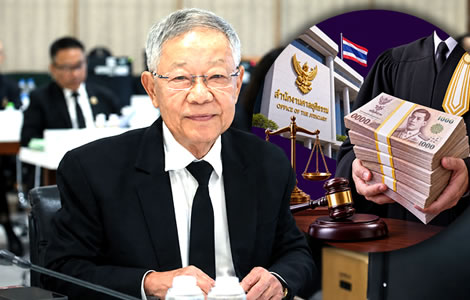
Thailand’s worsening public finances came under unusually sharp scrutiny in Parliament on August 17. The immediate focus was ฿36.703 billion administered by the Office of the Judiciary. Veera Teerapatranon said the scale of the holdings shocked him. Mr Veera sits on the ad hoc parliamentary committee considering the draft 2027 Budget Act.
At issue were billions held in banks and through the government treasury system. Notably, the judiciary’s accounts also showed approximately ฿126 million in interest from central funds. Mr Veera said that suggested deposits running into tens of billions of baht. Yet the Office of the Judiciary was simultaneously seeking another substantial national budget allocation.
For fiscal 2027, the judiciary requested ฿37.315 billion. However, it received an allocation of ฿24.171 billion. Mr Veera consequently demanded a detailed explanation of the money already under its control. He also questioned whether some funds could reduce future demands on the national budget.
Judiciary rejects claim that billions are free reserves as Veera drills into court accounts and interest
In response, the Office of the Judiciary rejected the suggestion that the money represented freely available reserves. Deputy Secretary-General Phop Ekraphanich said billions belonged to litigants and other outside parties. Much of the money was connected with court proceedings. Therefore, it could not simply be redirected towards judiciary spending.
The exchange came during parliamentary scrutiny of Thailand’s fiscal 2027 spending plans. The committee was examining budgets for independent organisations and the Office of the Judiciary. Paradorn Prisnanantakul chaired the meeting at Parliament. Mr Paradorn is Minister attached to the Prime Minister’s Office and the committee’s first vice-chairman.
During questioning, Mr Veera drilled into the judiciary’s financial statements dated September 30, 2025. Initially, he noted that it reported no accumulated off-budget funds. Its accounts, however, showed substantial income alongside enormous cash holdings. That combination immediately became the focus of his examination.
The accounts showed court fees totalling ฿4.187 billion. Separately, fines involving bail guarantors stood at ฿274 million. Another figure particularly attracted Mr Veera’s attention. The statements recorded approximately ฿126 million in interest from central funds.
That interest figure led directly to questions about the underlying deposits. Mr Veera reasoned that annual interest above ฿100 million required substantial money in financial institutions. He then turned to the judiciary’s current assets. There, the scale became clearer.
Veera finds ฿36.7 billion in cash and deposits and demands updated figures on judiciary holdings
Cash and cash equivalents totalled ฿36.703 billion at the end of September 2025. As part of this, approximately ฿48 million was held as cash. Another ฿38 million was recorded as advances. Deposits held with financial institutions, meanwhile, reached ฿26.407 billion.
In parallel, fixed deposits maturing within three months amounted to approximately ฿689 million. Another ฿9.52 billion was held in Treasury Account No. 1. That account operates through the Comptroller General’s Department at the Bank of Thailand. According to Mr Veera, it functions similarly to a current account.
The treasury money earns no interest. Nevertheless, Mr Veera said funds could be withdrawn without requiring permission. He consequently sought updated figures for the much larger deposits held with financial institutions. Specifically, he wanted the balance as of June 30, 2026.
Mr Veera then challenged the structure governing the judiciary’s central funds. “I don’t understand the system for managing the central funds of the Office of the Judiciary,” he said. “Why do they keep so much money there?”
Furthermore, Mr Veera noted that there was not a single baht listed as a contribution. He wanted a clear explanation for the enormous balances. His questioning focused particularly on approximately ฿35 billion held across banks and the treasury system.
Veera questions ฿35 billion holdings and urges state finance agencies to examine future court budgets
“I really want to know what the 30 billion baht, plus the 9 billion baht in the treasury account and the 26.407 billion baht in financial institutions, totalling approximately 35 billion baht, is being used for,” Mr Veera said.
At the same time, the government funds the judiciary’s personnel costs through annual budget appropriations. Mr Veera highlighted that distinction during the hearing. He also questioned whether some money might relate to internal welfare benefits. However, he said he was uncertain whether that explained the holdings.
Mr Veera then proposed bringing the government’s central financial agencies into the issue. He urged discussions with the Comptroller General’s Department and Budget Bureau. Those talks should examine the ฿26.407 billion held with financial institutions. They should also cover more than ฿9 billion held through the treasury account.
Crucially, Mr Veera linked the issue directly with future budget requests. He specifically referred to fiscal years 2028 and 2029. Existing balances should be examined before another large appropriation is requested, he argued. Where permissible, he suggested deposits could supplement future allocations.
His comparison with personnel spending was particularly stark. The judiciary receives approximately ฿17 billion for personnel, Mr Veera told the committee. He suggested its central fund should therefore be around ฿10 billion. Instead, he pointed to holdings approaching ฿35 billion.
“The money that should be in your possession shouldn’t be more than half of your personnel budget,” Mr Veera said. “You receive approximately 17 billion baht for personnel, so the figure for your central fund should be around 10 billion baht, not 35 billion baht like this.”
Judiciary says billions carry legal obligations and cannot be treated as unrestricted court reserves
Mr Veera then connected his questions directly with Thailand’s deteriorating fiscal position. He called for discussions between the judiciary and the government’s financial agencies.
“I want you to talk to the Comptroller General’s Department and the Budget Bureau about whether it’s time for the courts to help the country at a time when the country’s financial and fiscal situation is deteriorating like this,” Mr Veera said.
The judiciary’s answer drew a sharp distinction between possession and ownership. Mr Phop said the ฿36.703 billion had clearly identifiable origins and obligations. Accordingly, the headline amount could not be treated as unrestricted judiciary reserves. Large portions were simply being held by courts on behalf of others.
Mr Phop then provided a detailed breakdown. Around ฿27 billion was held in financial institutions and short-term deposits. These funds were connected with activities across more than 280 courts. Within that amount, approximately ฿907 million represented court fees and fines.
Those funds must be remitted at the end of the fiscal year. Likewise, another ฿51 million came from bail bond fines. That money must also be remitted after the fiscal year ends. Neither amount represented an unrestricted reserve for general judiciary spending.
Central deposits include bail and debt funds that must be returned when court proceedings are completed
More significantly, approximately ฿14.5 billion consisted of central deposits. Mr Phop said these were held in accordance with Office of the Judiciary regulations. The arrangements operate under the Criminal Procedure Act. Litigants and outside parties had deposited the money with courts.
Consequently, those billions did not belong to the Office of the Judiciary. Nor did they constitute court fees or fines. Instead, the deposits were directly connected with judicial proceedings. They included bail money, debt repayment deposits and other money awaiting court decisions.
In practice, the courts hold those funds while proceedings continue. Their eventual destination depends upon individual cases and judicial decisions. Once proceedings conclude, money may have to be returned. Plaintiffs, defendants or other depositing parties may ultimately receive it.
For that reason, Mr Phop said the money could not be treated as court revenue. The judiciary could not simply use it to finance normal expenditure. His explanation directly challenged Mr Veera’s suggestion that the deposits could reduce future budget allocations.
Treasury balances carry specific obligations as Thailand’s weakening fiscal position comes into focus
On another front, Mr Phop explained the money sitting in treasury accounts. Again, he said those balances carried defined purposes and obligations. Approximately ฿195 million consisted of contract guarantees governed by the Public Procurement Act.
Those guarantees may eventually be returned to parties providing security. Alternatively, enforcement can follow the relevant contractual obligations. Either way, the money cannot automatically be absorbed into general judiciary spending.
Meanwhile, approximately ฿9 billion consisted of fees held through the treasury system. Another ฿253 million was linked to enforcement expenses. In addition, ฿93,000 had been deposited for asset restoration. A further ฿489,000 related to competitive examination fees.
Mr Phop said each category had a specific purpose. Thus, the balances were not ordinary revenue available for court expenditure. His explanation placed ownership and legal obligations at the centre of the dispute.
The parliamentary clash comes against an increasingly tight national fiscal backdrop. Thailand’s tax collections have failed to keep pace with economic growth over an extended period. OECD analysis showed GDP grew by 3.5% annually between 2012 and 2022. Thailand’s tax revenue, by contrast, increased by only 2.8% annually.
Tax revenue falls behind GDP growth as public debt moves steadily closer to Thailand’s 70% ceiling
Tax incentives, exemptions and weak tax buoyancy contributed to that gap. More broadly, Thailand’s tax-to-GDP ratio has fallen substantially from its earlier peak. The ratio stood at only 17.1% in 2024. In 2013, it had reached 19.3%.
Accordingly, taxation captured a smaller share of national economic output than eleven years earlier. Thailand also remained below the Asia-Pacific average of 19.7%. The weakness matters as annual government borrowing continues to increase.
Repeated large budget deficits have pushed public debt steadily higher. The World Bank estimated debt at 68.2% of GDP in fiscal 2025. Subsequently, it projected the ratio reaching 69.4% during 2026. For 2027, its projection rises further to 69.8%.
Thailand’s government debt ceiling stands at 70% of GDP. Hence, those projections leave little room below the existing limit. The margin has narrowed while the government continues financing annual deficits and existing obligations.
Borrowing also brings mounting servicing and refinancing requirements. Existing debts must be repaid or refinanced as they mature. New deficits require additional funding. Consequently, large financing demands recur even before new spending programmes are considered.
Debt refinancing, state wages and ageing costs tighten Thailand’s increasingly strained public finances
The International Monetary Fund estimates gross government financing requirements at approximately 12% of GDP over the medium term. That requires substantial continuing access to financing. It covers refinancing existing obligations alongside funding new deficits.
Beyond debt, Thailand also faces large recurrent expenditure commitments. State salaries represent one substantial component. Civil service benefits add further costs. Pension obligations, meanwhile, can continue for decades after government employees retire.
Demographic change adds another layer of pressure. Thailand’s ageing population is increasing demands on healthcare, pensions and social protection. The OECD has specifically warned about increasing healthcare and social protection costs. Simultaneously, Thailand’s working-age population is shrinking.
Government employment therefore carries costs extending beyond an employee’s monthly salary. Permanent appointments can create pension and healthcare commitments lasting well beyond retirement. These obligations accumulate alongside the existing state wage bill.
Against this backdrop, weak revenue growth leaves less room for expanding permanent expenditure. Public debt is also approaching the current fiscal ceiling. Financing requirements remain substantial. Age-related expenditure, meanwhile, continues to rise.
Fiscal squeeze sharpens scrutiny of judiciary balances as Veera presses case for deeper budget review
That combination has sharpened scrutiny of large balances across government institutions. In this case, Parliament’s attention landed on the Office of the Judiciary. Its September 2025 accounts showed ฿36.703 billion in cash and cash equivalents.
Within that total, ฿26.407 billion was deposited with financial institutions. Another ฿689 million sat in short-term fixed deposits. Elsewhere, ฿9.52 billion was held through Treasury Account No. 1. The accounts also showed approximately ฿126 million in interest from central funds.
Mr Veera seized on those figures while examining the judiciary’s fiscal 2027 request. The Office sought ฿37.315 billion but received ฿24.171 billion. He therefore questioned whether such substantial balances should be examined before future appropriations.
The timing is significant because Mr Veera specifically raised fiscal 2028 and 2029. He wants the Comptroller General’s Department and Budget Bureau involved before those future requests. His argument centres on whether any balances can legally reduce demands on the national budget.
The Office of the Judiciary, however, says the headline figures cannot be read that way. Billions belong to litigants, defendants, plaintiffs and other outside parties. Other funds must be remitted to the government. Contract guarantees also carry repayment or enforcement obligations.
In effect, the hearing exposed two different readings of the same balance sheet. Mr Veera focused on the enormous sums under judiciary control. He also highlighted the interest generated and the continuing demand for national budget funding.
Judiciary insists court-held billions belong elsewhere as Thailand’s broader fiscal pressures intensify
Mr Phop, conversely, focused on the legal status of those funds. He said administration of money does not mean ownership of it. Therefore, billions held by courts cannot automatically finance their operations.
Still, the figures put the judiciary’s cash holdings firmly before Parliament. The Office administers more than ฿36 billion in cash and equivalents. More than ฿26 billion was held with financial institutions at the reporting date.
At the same time, Thailand’s national fiscal position continues tightening. Tax revenue has fallen relative to GDP from its earlier peak. Public debt is moving close to 70% of GDP. Borrowing and refinancing requirements remain substantial.
Big Joke brings a new complaint to the Supreme Court claiming an ethics breach by a judge of the bench
Supreme Court Chief sets up panel to investigate bribery claims linked to ฿11 billion tax appeal by Toyota
Separately, state salaries and civil service benefits create major recurring expenditure. Pensions extend those costs beyond retirement. Healthcare and social protection obligations are also rising.
Mr Veera’s intervention therefore placed the judiciary’s finances inside that wider budget examination. He wants its deposits scrutinised before future appropriations are determined. The judiciary says the bulk of those balances cannot be used that way.
For the committee, the central distinction is now clear. The Office of the Judiciary administers tens of billions of baht. Yet, according to its Deputy Secretary-General, much of that money belongs elsewhere.
Join the Thai News forum, follow Thai Examiner on Facebook here
Receive all our stories as they come out on Telegram here
Follow Thai Examiner here
Further reading:
Big Joke case still before Supreme Court. The news comes in a shock statement rebuking media reports
General Kittirat’s appointment as police chief comes under the spectre of legal action by Big Joke
Police Chief’s wife grilled over UK Property and Financial trail for three hours by Inquiry Panel
Police Ethics Committee official denies a decision on Big Joke has already been made. Due next week