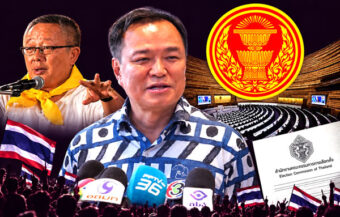
Monday’s Senate showdown could open a new political battle if the Election Commission fails to refer all 229 cases. Parit threatens a parliamentary offensive while Yingcheep warns iLaw is ready to put its evidence before the public.
Thailand’s Election Commission entered a decisive Monday under mounting political pressure over the 2024 Senate collusion case. At stake are 229 people, including 138 serving senators, and whether their cases reach the Supreme Court. A failure to refer all 229 now threatens to ignite a wider political struggle. People’s Party MP Parit Wacharasindhu has pointed towards Parliament and a coming no-confidence offensive against Prime Minister Anutin Charnvirakul’s government. Meanwhile, iLaw director Yingcheep Atchanon has warned that evidence could be released publicly if commissioners close or narrow the case. Seven commissioners must now choose between rival findings, with the consequences set to reach far beyond Monday’s vote. The drums of political conflict are already beating.
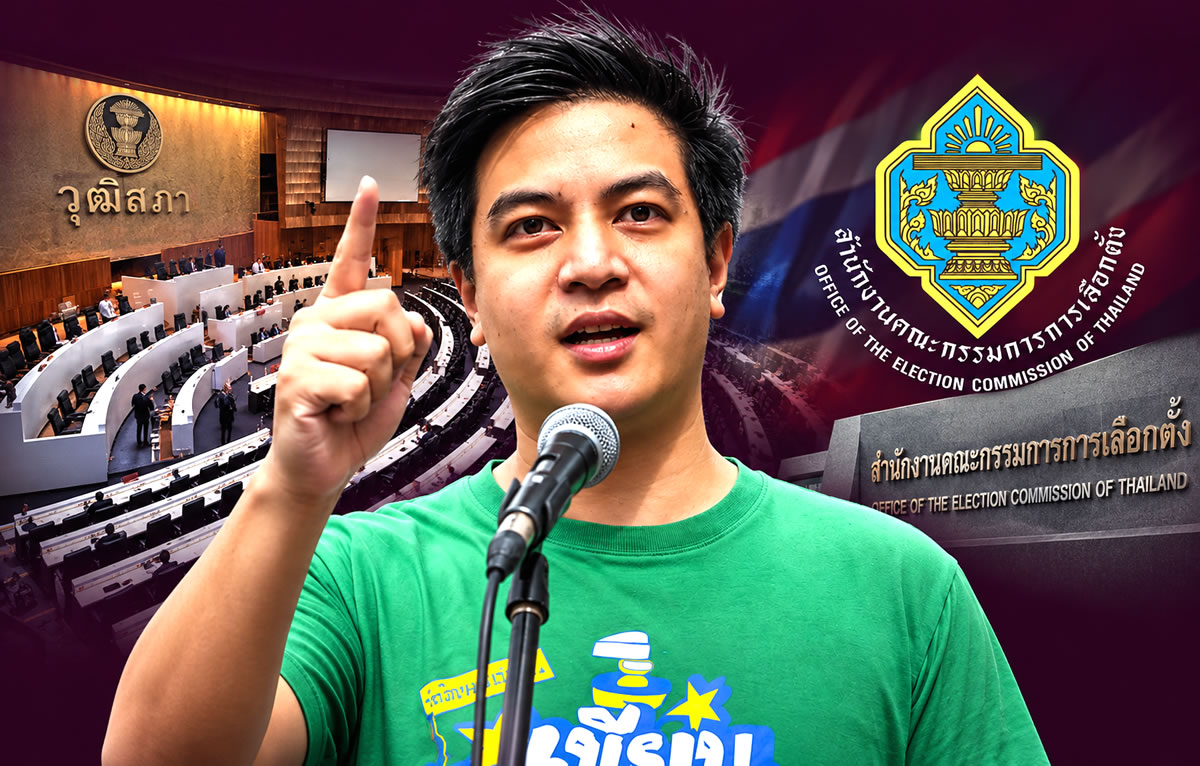
People’s Party MP Parit Wacharasindhu and iLaw director Yingcheep Atchanon threw down the gauntlet to the Election Commission on Sunday. Both demanded that all 229 people in the Senate collusion case be sent to the Supreme Court.
More significantly, both warned that Monday’s vote would not end the affair if commissioners backed away. Parit pointed towards Parliament and a coming no-confidence offensive. Yingcheep, meanwhile, threatened the public release of evidence held by iLaw.
The warnings came during an 11-kilometre mobilisation across Bangkok on Sunday. Participants walked, ran and cycled from iLaw’s Chatuchak office to the Bangkok Art and Culture Centre. People’s Party leader Nattapong Ruangpanyawut joined the event. Parit and former election commissioner Somchai Srisutthiyakorn also participated. In parallel, similar activities were organised elsewhere in Thailand. The central demand was uncompromising: send all 229 cases to court.
iLaw threatens evidence release as opposition prepares no-confidence offensive over the Senate case
Yingcheep delivered the clearest warning over what could follow a dismissal. He said iLaw held extensive information concerning people implicated by the investigation. If commissioners exclude particular suspects, iLaw will disclose evidence concerning those people. Should commissioners terminate everything, the organisation is prepared to release much more. In effect, closing the official case could open a new public battle over its evidence.
Parit opened a separate political front. He confirmed that opposition parties were preparing a no-confidence motion against Prime Minister Anutin Charnvirakul’s government. The motion is expected in September, with the parliamentary debate around October. Separately, opposition parties are compiling accusations and deciding which ministers will face attack. Anutin and Digital Economy and Society Minister Chaichanok Chidchob are already principal targets.
The Senate case could now become part of that offensive. Other issues include the local-government examination scandal and TH-AI Passport controversy. Notably, Parit has indicated that the opposition holds further information which has not been disclosed. Monday’s decision could therefore propel the Senate affair directly onto Parliament’s floor.
Against that backdrop, the Election Commission entered Monday facing pressure from several directions. Its seven commissioners were scheduled to begin their decisive meeting at 10 am. Crucially, the commission has committed to announcing the outcome at 3 pm. That pledge matters because concerns had grown that commissioners might vote without immediately revealing their decision.
Seven commissioners face conflicting findings as all 229 Senate cases reach decisive Monday vote
At stake are 138 serving senators and another 91 political figures and associates. Together, they comprise 229 people identified during the investigation into the 2024 Senate selection. The Election Commission and Department of Special Investigation jointly investigated the affair. Yet two internal processes have produced dramatically different conclusions.
Committee 26 recommended proceedings against all 229 people after an extensive inquiry. Investigators questioned more than 700 witnesses and examined substantial documentary material. By contrast, Committee 36 later voted 5-2 to recommend dismissing every complaint. Seven commissioners must now resolve that fundamental conflict.
Three broad outcomes are available. First, commissioners could refer all 229 cases to the Supreme Court’s Election Cases Division. Alternatively, they could dismiss everything. A third course would send selected individuals forward while clearing others. Increasingly, that has emerged as a possible middle route.
Sunday’s campaigners rejected that option. Their demand was that all 229 cases receive judicial examination. Referral itself would not establish guilt. Rather, the Supreme Court would examine the evidence and determine responsibility individually. Parit made that argument forcefully during Sunday afternoon’s demonstration.
Parit cites financial trails, audio clips and voting evidence as he demands all 229 people face court
At about 4.50 pm, Parit spoke at the Bangkok Art and Culture Centre. He said he attended as a citizen demanding fair and impartial Election Commission action. Above all, he argued that commissioners should follow their own previous standards. Without political interference, he said, all 229 cases should reach court.
Parit gave two principal reasons. The first concerned the scale and nature of the evidence already gathered. He cited voting slips, voting boards and evidence concerning appointments. In addition, he listed financial trails, audio clips and telephone records. Investigators had also examined meetings, communications and organised voting information.
For comparison, Parit cited an earlier Election Commission case involving only several Line messages. Those messages concerned exchanging votes and matching candidates, he said. They contained no references to money or benefits. Even so, the Election Commission sent that case to court.
The Senate investigation contained considerably more material, Parit argued. On that basis, he said commissioners already had sufficient grounds for judicial proceedings. He also challenged suggestions that changed witness testimony undermined the case. According to Parit, the investigation never depended upon one person.
Parit raises conflict concerns over four commissioners approved by senators now among the accused
Instead, the evidence included financial movements, communications, appointments, meetings and voting material. Accordingly, Parit argued that one witness changing testimony could not erase everything else. That question has become important as controversy surrounds evidence given by one particular witness.
Parit’s second argument concerned four Election Commission members. He said at least four of the seven commissioners faced a conflict of interest. Those four reached office after receiving Senate approval. At the same time, senators involved in that process are among people accused in the current investigation.
Parit therefore argued that those commissioners should avoid discretion benefiting people who endorsed them. Sending all 229 cases to court would remove that problem, he said. The Supreme Court could then determine guilt or innocence. As part of this, Parit directly addressed the commissioners ahead of Monday’s meeting.
“I want the Election Commission to perform its duties honestly and straightforwardly,” Parit said.
He then addressed the Senate’s role in appointing four commissioners. “It’s undeniable that the four current commissioners became commissioners because they were approved by the Senators who are on the list of those accused.”
Parit demands transparency from commissioners and warns against a system where blue can do no wrong
Parit followed with another direct warning. “But I don’t want the Election Commission to think about repaying debts of gratitude to those who helped them get into their positions.”
Instead, he urged commissioners to consider the country’s future and legal principles. “I want them to think about the future of the country, to consider legal principles, and to perform their duties honestly and straightforwardly,” Parit said.
Another concern involved how Monday’s decision could be disclosed. Reports suggested commissioners might reveal only the number of people facing proceedings. Under that scenario, individual names might initially remain undisclosed. In response, Parit said he hoped those reports were incorrect.
If commissioners voted fairly, he argued, they should explain their reasoning publicly. That should include why particular people were referred and others were excluded. Furthermore, Parit pointed to transparency as part of the Election Commission’s own public message. Its conduct should therefore reflect that commitment, he said.
The People’s Party deputy leader then addressed a complete dismissal. He said the matter would definitely not end there. For the moment, however, he urged supporters to concentrate on Monday’s vote. Fewer than 24 hours remained before commissioners were due to meet.
Parit said his personal disappointment was not important. Instead, he focused on the political consequences if nobody faced proceedings. He warned against creating a system where those wearing “blue shirts” could do no wrong. Blue is closely associated with Bhumjaithai.
Anutin faces no-confidence offensive as opposition prepares Senate case and other scandals for debate
Prime Minister Anutin and several senior Bhumjaithai figures are among those implicated by the investigation. They have denied involvement. Nonetheless, Parit said the People’s Party would continue pursuing the matter if commissioners stopped the cases.
On another front, preparations for the opposition’s no-confidence motion are already advancing. Parit said opposition parties were drafting the motion and compiling their ministerial targets. They are also assembling the specific accusations for the parliamentary debate. He expects the motion to be submitted within September.
The debate should then take place around October, according to Parit. Anutin and Chaichanok are among the principal targets. The Senate case could form one strand of the opposition attack. Alongside it are the local-government examination scandal and TH-AI Passport controversy.
The opposition also says it possesses further information which has not been released. As a result, Monday’s Election Commission decision could have an immediate parliamentary afterlife. Dismissal would not prevent the opposition from pursuing the affair through other channels.
Minutes after Parit spoke, Yingcheep delivered the civil-society side of that warning. At about 5 pm, the iLaw director addressed demonstrators outside the Bangkok Art and Culture Centre. He described Monday as a crossroads for the Senate case. His demand was equally clear: prosecute all 229 and send the evidence to court.
Yingcheep threatens public evidence release if Election Commission spares suspects in Senate case
Yingcheep argued that the Supreme Court offered a more neutral forum than the Election Commission. He also questioned unequal law enforcement and the origins of independent agencies. However, his sharpest intervention concerned evidence already held outside the commission.
“If the Election Commission decides not to prosecute all or any of them, we have a lot of information in our hands that we are ready to present to the public so that everyone can see who did what.”
Yingcheep then addressed commissioners directly. “Therefore, I would like to urge the Election Commission, which was formed by electing the Senators, that if they don’t want us to perform that duty, then they should just prosecute all 229 people and present the case to the Supreme Court, which is a more neutral body than the Election Commission.”
That warning covered both partial and complete dismissal. If commissioners spare particular people, iLaw says it will release information concerning those individuals. Conversely, clearing everybody could trigger a broader disclosure. Previously unseen material could therefore enter public circulation after Monday’s announcement.
Beyond the immediate case, Yingcheep linked the dispute with Thailand’s constitutional process. He referred to the February 8 referendum on drafting a replacement constitution. More than 21 million voters supported drafting a new charter to replace the 2017 Constitution.
Yingcheep links Senate prosecutions to constitutional change as campaigners threaten a referendum No
Yingcheep outlined two possible paths. Under the first, commissioners would refuse proceedings against the accused senators. The existing Senate group would then retain its positions and influence. He warned that this could affect the process surrounding a new constitution.
If that process produced an unacceptable charter, Yingcheep said campaigners were prepared to vote “No” at a referendum. Under his second scenario, proceedings would move forward. Accused senators would then temporarily cease performing their duties while the legal process continued.
Meanwhile, Yingcheep said the government could continue operating normally. He argued that the constitutional process would then have greater room for broader participation. His immediate focus, however, remained Monday’s Election Commission decision.
Before Sunday’s event ended, participants staged a final display. They formed a human mosaic showing faces connected with the Senate selection. Beside them appeared the number “229”. The event concluded with the call: “Down with dictatorship! Down with the Senate collusion scheme! All 229 people must be prosecuted!”
Street pressure was only one part of the gathering storm. Earlier, academics, economists, former lawmakers and civil-society figures had also intervened. Four civil-society networks joined prominent public figures in demanding Supreme Court scrutiny. They urged commissioners not to terminate the affair internally.
Civil groups demand judicial scrutiny as Election Commission defends independence before decisive vote
Instead, those groups called for the evidence to be examined judicially. Former politicians and constitutional figures have also focused attention on the commissioners themselves. Khunying Sudarat Keyuraphan issued one of the strongest warnings. She said those sitting in judgment could themselves face judgment later.
The Election Commission has resisted those demands. It insists its commissioners exercise their powers independently. Likewise, it says decisions must rest solely upon law and evidence. The commission has also stressed that it is not itself an investigative body.
Even so, the seven commissioners face two irreconcilable recommendations produced within the case. Committee 26 found grounds for proceedings against all 229 people. Committee 36 wants the complaints dismissed. The latter reached that conclusion through a 5-2 vote.
The underlying investigation concerned the nationwide Senate selection completed on June 26, 2024. That process elected 200 senators through a multi-stage system involving 20 occupational groups. Investigators claim an organised network coordinated candidates across those groups.
Specifically, the inquiry examined organised voting and candidate coordination. Investigators also examined meetings, political networks, communications and financial movements. More than 700 witnesses were questioned during the process. Extensive documentary material was also gathered.
Committee 26 seeks action against 229 as rival panel recommends dismissal after a sharply divided process
Ultimately, Committee 26 concluded that 138 serving senators had obtained their positions unlawfully. Another 91 politicians and associates were implicated. The panel therefore recommended proceedings against all 229 people.
Committee 36 subsequently reached the opposite conclusion. Its 5-2 vote recommended dismissing the complaints. That reversal has placed the final responsibility directly upon the seven commissioners. They can accept either recommendation or divide the cases individually.
Hours before Monday’s meeting, another intervention increased the pressure. Former election commissioner Somchai Srisutthiyakorn publicly identified the person previously coded as “Witness 16”. Somchai named him as Ekkarat Changlao, a former Bhumjaithai figure.
According to Somchai, Ekkarat previously gave evidence implicating senior political figures. Somchai claimed that testimony was subsequently changed. Those claims concern evidence which commissioners must assess. Their disclosure nevertheless placed another disputed element of the investigation into public view.
The timing was significant. Somchai made the intervention shortly before commissioners prepared to deliberate. At the same time, security was strengthened around Election Commission headquarters. Police prepared roughly one company of officers for demonstrators and other groups expected outside.
Witness 16 disclosure adds pressure as police tighten security before Election Commission decision
A full referral would immediately change the arena. The central dispute would move from the Election Commission into the Supreme Court. There, evidence concerning 138 senators and 91 other people could receive judicial examination. Individual guilt or innocence would then become a matter for the court.
A partial referral would create different pressure. Commissioners would need to explain why certain people reached court while others escaped proceedings. Parit has already demanded those explanations. Yingcheep, in turn, says iLaw will disclose evidence concerning people who are spared.
Complete dismissal carries the clearest political consequences already threatened publicly. iLaw says it is prepared to release substantial information. At the parliamentary level, the People’s Party says the matter would continue through other accountability mechanisms.
Meanwhile, the no-confidence offensive is moving ahead independently. Opposition parties expect to submit their motion during September. Parit expects the debate around October. The Senate case could consequently move from Election Commission headquarters directly into another confrontation at Parliament.
There are other pressures waiting there. The local-government examination scandal is already among the issues being assembled. So is the TH-AI Passport controversy. Additionally, Parit says opposition parties possess information which has not yet been disclosed.
Sunday street mobilisation leaves seven commissioners facing three stark choices in the Senate case
Sunday therefore transformed the atmosphere surrounding Monday’s decision. The Senate affair moved visibly from investigative files onto Bangkok’s streets. At the same time, academics, economists, former lawmakers and civil-society groups increased their pressure on commissioners.
Yet the formal decision remains with seven people. Before them are conflicting conclusions from Committees 26 and 36. One recommends proceedings against all 229 accused people. The other recommends that every complaint be dismissed.
A third option remains available. Commissioners could divide the cases and send only selected people to court. But that route would immediately place every exclusion under scrutiny. Both Parit and Yingcheep have already made that clear.
Ex Pheu Thai minister warns Commission members that soon they could be judged as crunch vote looms
Former Prime Minister and Democrat Party leader cites a lack of public trust in the Election Commission
By Monday morning, the lines were firmly drawn. Police were ready outside Election Commission headquarters. Civil-society groups were waiting for the outcome. The opposition was preparing its next parliamentary offensive.
Most importantly, Yingcheep had placed the prospect of fresh evidence releases directly before the commissioners. Parit had placed Parliament and the coming no-confidence debate behind it. Neither said the dispute would end with dismissal.
The seven commissioners were due to begin their meeting at 10 am. At 3 pm, the Election Commission has promised its decision.
Join the Thai News forum, follow Thai Examiner on Facebook here
Follow Thai Examiner on Google here
Receive all our stories as they come out on Telegram here
Follow Thai Examiner here
Further reading:
Ex Pheu Thai minister warns Commission members that soon they could be judged as crunch vote looms
Opposition and People’s Party leader attacks ‘blue regime’ on the 12th anniversary of the 2014 coup
Thammasat University legal scholar and 1992 protest leader warns another coup cannot be ruled out