Wrongly arrested at 18, assaulted and pushed to confess, Rittirong Chuenjit wins ฿4.38 million after 17 years. Supreme Court orders police to erase his criminal record and fingerprints after his family battled through more than 50 agencies and courts.
Seventeen years after Royal Thai Police arrested the wrong schoolboy, assaulted him and tried to force a confession, Rittirong Chuenjit has won a decisive and final Supreme Court victory. The court ordered police to pay ฿4.38 million and erase his criminal record and fingerprints. His family had pursued more than 50 government agencies, criminal cases and three levels of civil court. Their fight also unfolded alongside Thailand’s later torture law reforms, while Rittirong continued psychiatric treatment from an ordeal that began when he was only 18.
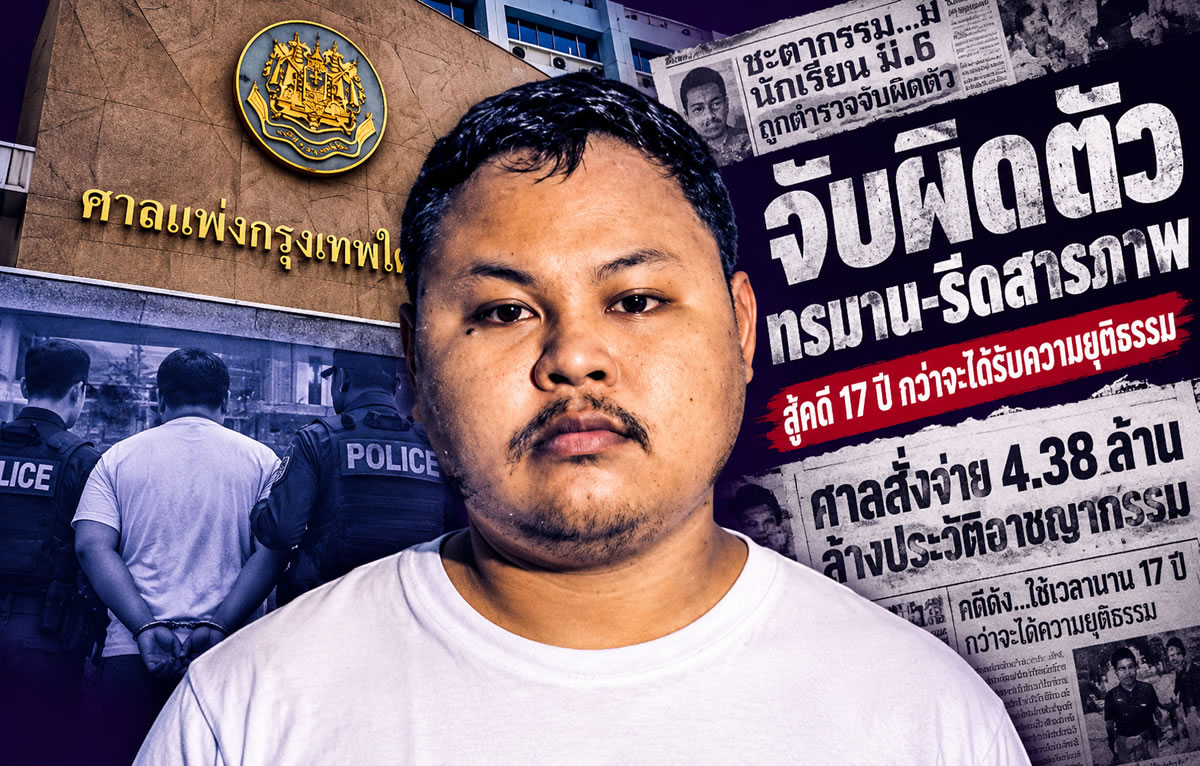
For 17 years, the Chuenjit family fought to undo the consequences of police mistaking their son for a thief. Their struggle crossed more than 50 government agencies, criminal proceedings and three levels of civil court.
Ultimately, the family won. The Royal Thai Police must pay ฿4.38 million and erase records created by Rittirong Chuenjit’s wrongful arrest. The outcome showed that determined Thais can secure justice by tenaciously pursuing their legal rights through the courts.
However, the judgment came almost half a lifetime after Rittirong’s ordeal began. The final hearing took place on Monday morning last at the Bangkok South Civil Court. There, the court read the Supreme Court’s decisive judgment in his long-running compensation case.
The Royal Thai Police was ordered to pay Rittirong ฿4.38 million. Notably, police must also remove his criminal record and fingerprints from their database. Those records arose from a robbery he did not commit.
Police arrest wrong schoolboy before violent interrogation leaves a 17-year fight to clear his name
The extraordinary case began on January 28, 2009, when Rittirong was an 18-year-old Mathayom 6 student. Police in Prachinburi were investigating a robbery involving a snatch theft. Rittirong resembled the suspected offender. That resemblance proved enough to place the schoolboy under suspicion. Officers from the Prachinburi Provincial Police Investigation Division arrested him. Yet police had the wrong young man.
During questioning, officers attempted to force Rittirong to confess. According to evidence later presented in court, they handcuffed his hands behind his back. Officers then forced him onto the floor and physically assaulted him. More seriously, they placed a black plastic bag over his head. His breathing was restricted while police pressed him for a confession. He was also threatened during the interrogation.
Rittirong had not committed the offence. Subsequently, police apprehended the real perpetrator and prosecutors proceeded against the actual offender. The robbery case against Rittirong therefore collapsed. However, establishing his innocence did not undo everything that had happened. Police had already arrested, interrogated and fingerprinted him. His details had also entered the criminal records system.
As a result, his father, Somsak Chuenjit, began seeking accountability for what had happened to his son. It became a struggle lasting 17 years. Initially, the family attempted to pursue complaints through official channels. Somsak later said officials refused to accept complaints on three occasions. Even so, the Chuenjits continued approaching government bodies and seeking action against the officers.
Family turns to the courts after failed complaints as police officers face convictions over Rittirong
In time, the matter reached the Office of the Public Sector Anti-Corruption Commission. That investigation was subsequently dropped because of insufficient evidence. The setback did not end the family’s efforts. Across the entire campaign, the Chuenjits submitted complaints and letters to more than 50 government agencies. Meanwhile, the years of proceedings placed heavy financial and personal pressure on the family.
The prolonged struggle severely affected the family’s economic position and mental well-being. Rittirong also required psychiatric treatment following his ordeal. According to the case information, that treatment continues today. Nevertheless, the family kept pursuing criminal accountability, compensation and removal of his police records.
After more than six years, Rittirong took criminal proceedings directly to court. On June 10, 2015, he filed a case against seven Prachinburi police officers. The proceedings concerned his treatment following the wrongful arrest. Yet the criminal litigation itself required several more years before producing a judgment.
Eventually, Prachinburi Provincial Court convicted police officers in connection with Rittirong’s treatment. The court imposed prison terms of one year and four months. In addition, it imposed fines of ฿8,000. However, the prison sentences were suspended for two years. The convictions established criminal responsibility but did not settle Rittirong’s wider legal battle.
False testimony case fails as Rittirong pursues millions in compensation from the Royal Thai Police
Separately, Rittirong subsequently became a defendant himself. One officer connected with the original case brought proceedings accusing him of false testimony. That case also travelled through Thailand’s courts, adding another legal fight. Ultimately, the Supreme Court dismissed the action against Rittirong.
Meanwhile, Rittirong pursued compensation directly from the Royal Thai Police. He sued under the Act on Tort Liability of State Officials B.E. 2539, or 1996. The case was filed at Bangkok South Civil Court. It carried black case number P949/2560 and red case number P2003/2562.
The civil case then produced three dramatically different outcomes. On June 22, 2022, Bangkok South Civil Court ordered police to pay ฿3.38 million. The damages covered harm to Rittirong’s reputation, health and mental well-being. However, the Court of Appeal later slashed the award to ฿380,000.
The appellate judgment also provided for interest. It set the rate at 7.5% annually through April 10, 2021. From April 11, 2021, the rate became 5%. Consequently, the family decided to take its compensation fight to Thailand’s highest court.
Supreme Court accepts Rittirong’s appeal before raising compensation to ฿4.38 million in final ruling
The Chuenjits rejected the sharp reduction and sought permission to appeal. On April 28, 2026, the Supreme Court agreed to hear Rittirong’s civil appeal. That was a procedural decision allowing the appeal to proceed. It was not the Supreme Court’s final judgment.
The court found that Rittirong’s appeal raised an important issue under Section 249 of the Civil Procedure Code. It stated: “The plaintiff’s appeal raises an important issue that the Supreme Court should decide, in accordance with Section 249 of the Civil Procedure Code. Therefore, permission is granted for the plaintiff to appeal, and the appeal is accepted for consideration.”
The Royal Thai Police was then given an opportunity to respond. Afterwards, the completed case file was returned to the Supreme Court. Four months later, the court reached its final decision.
At 9 am on Monday, August 31, Bangkok South Civil Court convened to read the Supreme Court’s final judgment. Lawyers from the Cross Cultural Foundation attended the proceedings. The ruling brought the 17-year legal battle to its decisive conclusion.
The Supreme Court reversed the drastic reduction imposed by the Court of Appeal. Instead, the Royal Thai Police must pay Rittirong ฿4.38 million. That is ฿4 million above the appellate award. Furthermore, it exceeds the original civil court judgment by ฿1 million.
Supreme Court orders Rittirong’s police records erased after 17 years of litigation over wrongful arrest
Crucially, the final ruling went beyond financial compensation. The Supreme Court ordered Rittirong’s criminal record removed from the criminal records database. His fingerprints must also be erased. Those entries had remained despite police subsequently apprehending the real offender.
The civil chronology is therefore clear. Bangkok South Civil Court first awarded ฿3.38 million in June 2022. The Court of Appeal later reduced that figure to ฿380,000 plus interest. In April 2026, the Supreme Court accepted Rittirong’s appeal for consideration. Finally, on August 31, it awarded ฿4.38 million and ordered his police records erased.
Behind that legal chronology stood the events of January 2009. An 18-year-old schoolboy was arrested because he resembled a suspected thief. Afterwards, officers attempted to extract a confession from him. He was handcuffed behind his back, forced onto the floor and physically assaulted. A black plastic bag was also placed over his head.
Police later apprehended the real offender. Yet that discovery marked the beginning of another struggle for the Chuenjit family. The robbery accusation disappeared, but the consequences of Rittirong’s arrest did not. His family then sought action against the officers, financial compensation and removal of his police records.
Police liability and torture law reforms follow years of complaints, criminal cases and civil litigation
The first route involved government agencies and official complaints. More than 50 agencies eventually received approaches from the family. One investigation reached the Public Sector Anti-Corruption Commission but was subsequently dropped. The family then increasingly turned to direct litigation.
That litigation produced results on several fronts. The criminal case against the police officers produced convictions. Another case forced Rittirong to defend himself against accusations of false testimony. The Supreme Court ultimately dismissed that action against him.
At the same time, the civil proceedings established financial liability against the Royal Thai Police. However, the size of the compensation remained contested until Monday. The Supreme Court has now fixed it at ฿4.38 million and ordered Rittirong’s records erased.
The case also ran alongside major changes to Thailand’s laws covering torture and enforced disappearance. Rittirong’s experience became a case study during efforts to secure dedicated legislation. Thailand subsequently enacted the Prevention and Suppression of Torture and Enforced Disappearance Act B.E. 2565, or 2022. The legislation came into force in 2023.
Under that legislation, torture, cruel or inhumane treatment and enforced disappearance are specifically addressed. In addition, it establishes criminal responsibility for officials covered by its provisions. The law also addresses superior responsibility where negligence permits covered violations in specified circumstances.
Rittirong spends almost half his life fighting the consequences of police arresting the wrong schoolboy
Rittirong’s ordeal, however, began 14 years before that legislation took effect. His arrest occurred in January 2009. Consequently, his family pursued the available complaint mechanisms and ordinary court system. That process ultimately consumed 17 years.
By Monday’s final hearing, Rittirong had spent almost half his life dealing with the consequences. He entered the case as an 18-year-old secondary-school student. Meanwhile, his father spent years pursuing government agencies, investigators and courts on his behalf.
The family encountered rejected complaints and an abandoned anti-corruption investigation. It also faced criminal and civil litigation stretching across years. Even after police found the real offender, its struggle continued. Likewise, a criminal conviction did not resolve the separate compensation fight.
The case ultimately returned to the mistake which started everything. In January 2009, police believed Rittirong Chuenjit was a robber because he resembled the suspect. They were wrong. Before that mistake was corrected, officers used violence while attempting to obtain a confession.
Family’s 17-year fight ends with ฿4.38 million award and order to erase Rittirong’s police records
Police subsequently apprehended the real perpetrator. However, clearing Rittirong of the robbery accusation proved only the first part of his family’s fight. The Chuenjits then spent 17 years pursuing accountability, compensation and correction of his police records.
During that struggle, they approached more than 50 government agencies. Rittirong pursued criminal proceedings against police officers and fought a separate false-testimony case. In parallel, his compensation claim travelled through all three levels of Thailand’s civil court system.
Boss heir free to return to Thailand next year unless he gives himself up or is arrested by Interpol abroad
Thailand’s evil serial killer of women Somkid was released in 2019 and murdered a woman in months
On Monday morning last, that long legal battle finally reached its conclusion. The Supreme Court ordered the Royal Thai Police to pay Rittirong Chuenjit ฿4.38 million. It also ordered police to erase his criminal record and fingerprints.
Seventeen years after police arrested the wrong schoolboy, the official records created by that mistake must finally be removed.
Join the Thai News forum, follow Thai Examiner on Facebook here
Follow Thai Examiner on Google here
Receive all our stories as they come out on Telegram here
Follow Thai Examiner here
Further reading:
Minister cited by the Corruption Commission for ‘minor’ role in Boss Vorayuth corruption scandal
Interpol Red Notice for ‘Boss’ Vorayuth as Police authorities in Bangkok seek to bring him to trial
Assistant Attorney General in Red Bull case named as a senior prosecutor to central Bangkok district
Murder charge against ‘Boss’ Yoravuth should have been weighed after mowing down policeman
Explosive report on the Red Bull scandal exposing ‘corruption’ due at the Prime Minister’s office
Boss Vorayuth case key witness dies riding his motorbike early on Thursday morning in Chiang Mai
Expert stands by evidence that Red Bull Boss Vorayuth’s Ferrari was travelling at 177 km/ph
Strong new evidence suggests that there was no basis to prosecute Red Bull driver ‘Boss’ Vorayuth