Thailand’s economic reset faces an early reality check as Ekniti bets on AI, EVs and clean energy. War drives energy costs higher, Toyota puts fresh money into Vietnam while Bangkok suddenly halts data centre development amid weak growth in the underlying ‘real’ economy.
Deputy Prime Minister and Finance Minister Ekniti Nitithanprapas has put AI, electric vehicles and clean energy at the heart of Thailand’s next economic transition. The strategy comes as war drives up energy costs, weak growth forces continued borrowing and regional rivals fight for investment. Thailand has already halted further data centre development while reviewing policy, even as AI becomes a national priority. Meanwhile, Toyota is committing fresh electrified-vehicle investment to Vietnam as Bangkok battles to protect its automotive base. At the same time, the government’s clean-energy push raises hard questions over grid costs, reliability and dependence on Chinese supply chains. Mr Ekniti says investment creates future income. The stakes are high. The risk lies in whether Thailand is investing in the right technologies and pushing the right economic programmes at the right time.
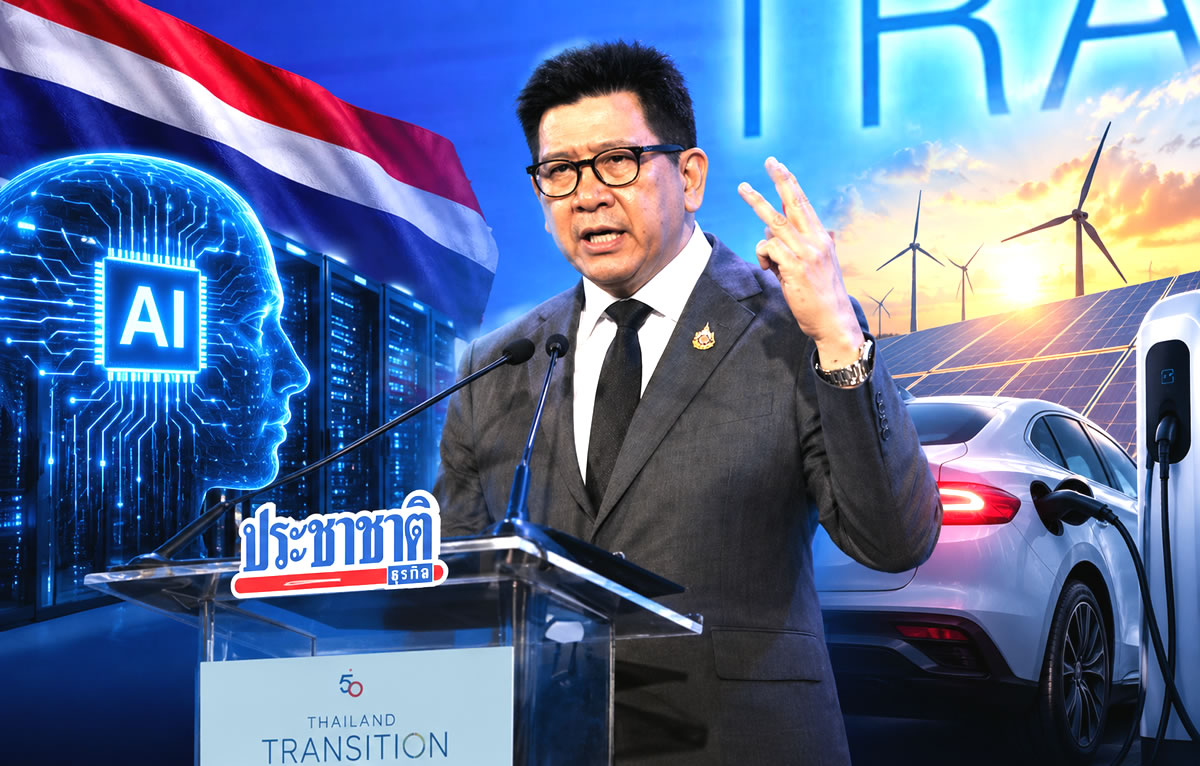
Deputy Prime Minister and Finance Minister Ekniti Nitithanprapas has set out an ambitious economic programme for Thailand. However, each of its three central industrial priorities carries substantial economic and technological uncertainties. Artificial intelligence, electric vehicles and clean energy will form the core of the government’s planned transition. At the same time, Thailand must support households, contain debt and withstand another severe external shock.
Mr Ekniti unveiled the programme on September 3 at the Beyond ESG Thailand Transition event. He described a global economy undergoing rapid and increasingly disruptive change. In particular, he pointed to war in the Middle East and growing international trade conflict. Both developments are already feeding directly into Thailand’s economic calculations.
The Middle East war has driven energy prices sharply higher. Consequently, Thailand faces renewed pressure because of its heavy dependence on imported fuel. The United States is meanwhile tightening economic pressure on Iran and restricting its economic lifelines. Washington’s actions include measures designed to choke off Iranian oil exports.
Middle East shock hits weak Thai growth as Ekniti turns to relief, borrowing and structural change
For Thailand, the crisis has arrived at a particularly difficult moment. The economy was already struggling to generate convincing domestic growth. Once again, an international shock threatens to weaken activity further. In response, the government is borrowing and supporting spending to prevent a deeper slowdown.
Yet Mr Ekniti wants Thailand to look much further ahead. His programme divides economic policy into three broad pillars. These are “Stabilise Today”, “Transition Now” and “Invest for Tomorrow”. Together, they combine immediate relief with an attempt to reshape Thailand’s economic structure.
“Stabilise Today” provides assistance to households and small businesses facing higher costs. One programme is Thai Helps Thai Plus, aimed partly at street vendors. The scheme addresses increased fuel and operating costs. Separately, it will teach small traders how to expand their businesses online.
The digital element is straightforward. Small operators serving limited local markets will be encouraged to sell nationwide. As part of this, the government wants traders to use online platforms more effectively. The programme therefore mixes short-term financial support with basic commercial adaptation.
Ekniti’s three pillars move from immediate relief towards investment-led economic transformation
“Transition Now” carries a wider objective. It calls for businesses and workers to adjust rapidly to technological and economic change. Mr Ekniti warned that refusing to adapt could ultimately leave people outside viable markets. His K-shaped analogy places successful adapters on the rising side of the economy.
“Invest for Tomorrow” is the most ambitious pillar. It puts major infrastructure and industrial investment at the centre of economic policy. Mr Ekniti was emphatic about the argument. “Consumption is finite, but investment creates future income,” he said.
His broader message was equally clear. Thailand must invest repeatedly if it wants to preserve competitiveness. Nevertheless, that raises the central economic question facing the government. It must decide precisely where scarce capital should go.
That choice is becoming harder, not easier. Thailand is committing resources while industries, technologies and international markets are changing rapidly. Moreover, several recent developments have exposed weaknesses around sectors previously promoted as national priorities. The government is therefore adjusting policy while simultaneously demanding faster investment.
Thailand’s export performance is one example. Headline export figures have been exceptionally strong. However, rampant transshipments linked to exports have become a serious problem. The issue matters more as Washington tightens trade enforcement and protectionist measures.
Investment push collides with export transshipment risks and growing uncertainty over future industries
In parallel, another apparent economic success has produced an abrupt policy reversal. Data centres became a principal driver of private sector investment during the last year. For roughly two years, governments actively promoted the sector as a strategic opportunity. This week, however, further data centre developments were halted while policy is clarified.
The timing is striking. Thailand attracted huge investment before fully resolving the infrastructure and regulatory consequences. As a result, the government is reassessing an industry it had aggressively encouraged. That reversal cuts directly across Mr Ekniti’s first major future industry.
Artificial intelligence and smart electronics are supposed to drive part of Thailand’s next economic phase. Few would dispute that AI is already changing businesses worldwide. However, government attempts to accelerate Thai adoption have encountered immediate difficulties. The TH-AI project suffered disruption this week during its early implementation.
Meanwhile, businesses are already increasingly dependent on established commercial AI systems. That creates a sharp distinction between technological adoption and government-led intervention. Furthermore, AI requires far more than access to software platforms. It demands extensive physical and energy infrastructure.
Data centre reversal exposes policy gaps as Thailand promotes AI while infrastructure strains emerge
Large-scale AI computing requires data centres, advanced telecommunications systems and reliable electricity. Cooling, land, grid capacity and enormous capital expenditure are also necessary. Thailand spent two years courting precisely these investments. Yet the resulting boom has already forced the government to halt and reconsider further development.
This creates an awkward sequence. First, Thailand encouraged the investment as a strategic priority. Then, data centres became a major source of private investment growth. Now, the government is pausing further development while deciding how the sector should proceed.
Mr Ekniti nevertheless views advanced technology investment as unavoidable. Notably, he pointed to Thailand’s earlier investment in 5G telecommunications infrastructure. He said the decision helped attract investment and expand opportunities for online merchants. It also supported creators using platforms such as YouTube and TikTok.
The next stage, he argued, will eventually involve 6G. Without another telecommunications upgrade, Thailand could lose competitiveness. His wider contention is that early infrastructure investment can secure future economic opportunities. The data centre experience, however, demonstrates that such investment can also impose unforeseen demands.
AI ambitions depend on power, data centres and telecoms as Thailand prepares for another technology leap
Mr Ekniti’s second major priority involves an even larger existing industry. Thailand’s automotive sector faces one of the biggest structural changes in its history. For decades, the kingdom built industrial strength around internal combustion engine vehicles. Japanese manufacturers created enormous factories and deep domestic supplier networks.
That success made Thailand one of Southeast Asia’s leading automotive production centres. In turn, vehicles became critical to manufacturing, employment and exports. Electrification is now changing the structure of that industry. Meanwhile, neighbouring economies are competing aggressively for new automotive capital.
Thailand is therefore trying to prevent future investment from drifting elsewhere. Toyota and Honda deny they are abandoning their Thai operations. Their existing manufacturing presence remains substantial. Toyota alone illustrates the scale of what Thailand has to protect.
Toyota’s three Thai plants have a combined annual capacity of about 770,000 vehicles. During 2025, the company produced 564,933 vehicles in Thailand. Of those, 358,135 were exported. In addition, Toyota plans about ฿55 billion of investment to expand Thai hybrid production.
Those figures do not show Toyota leaving Thailand. On the contrary, Thailand remains a major production base for the Japanese company. However, a development in Vietnam this week provides a warning about the next investment cycle. Toyota Motor Vietnam has secured approval for more than US$283 million in new investment.
Thailand fights to defend its automotive base as Toyota stays while regional competition intensifies
That amounts to roughly ฿9.3 billion. The investment will expand Toyota’s operation in Phu Tho. Crucially, the revised project includes assembly and manufacture of electrified vehicles. Registered annual capacity will stand at approximately 52,000 vehicles.
Construction of new stamping and paint facilities is scheduled to begin in May 2027. Operations are then expected to begin during 2029. By comparison, the Vietnamese operation remains far smaller than Toyota’s enormous Thai base. Toyota’s planned ฿55 billion Thai hybrid commitment is also almost six times larger.
Even so, the Vietnamese project carries strategic importance. Vietnam has captured fresh Toyota investment directed at next-generation electrified production. Bangkok is simultaneously rewriting automotive policies to attract precisely that type of investment. The competition is therefore about tomorrow’s factories, not merely today’s production.
Toyota says the Vietnamese expansion will increase localisation and strengthen its supplier network. It also expects employment creation and technology transfer. Toyota Vietnam chief Osamu Hirata linked the project with developing Phu Tho as an automotive manufacturing centre. The ambition therefore extends beyond assembling additional vehicles.
For Thailand, that changes the competitive calculation. Existing factories may remain firmly in place while future incremental investments move elsewhere. Over time, those decisions can reshape supplier networks and technological capacity. Hence, retaining existing production is only part of the task.
Toyota’s Vietnam investment raises stakes in Thailand’s battle for next-generation vehicle production
Mr Ekniti wants tax policy to help defend Thailand’s position. ASEAN free-trade agreements restrict the kingdom’s ability to impose broad import tariffs. Accordingly, the government is preparing to use excise taxation instead. The objective is to prevent finished imports from overwhelming locally produced vehicles.
Another component concerns domestic content. The government wants manufacturers to use more Thai-produced parts. Local-content requirements could rise towards 40% or 50%. In principle, that would deepen domestic supply chains rather than simply encouraging final assembly.
Yet the technological problem remains unresolved. No single automotive technology has conclusively won the long-term global market. Toyota itself provides strong evidence of that uncertainty. Rather than betting solely on battery EVs, it continues pursuing several technologies.
Those options include hybrids, plug-in hybrids, battery EVs, hydrogen and conventional vehicles. Consequently, Thailand faces risks in both directions. Moving too slowly could surrender new investment to Vietnam, Indonesia and other rivals. Moving too aggressively behind one technology carries a different exposure.
Thailand turns to excise taxes and local content as uncertainty hangs over future vehicle technology
Oil prices further complicate the decision. There is no certainty that petroleum will become permanently more expensive. Equally, there is no certainty that global oil demand will soon collapse. The International Energy Agency’s Current Policies Scenario illustrates the range of possible outcomes.
Under that scenario, world oil demand reaches 113 million barrels daily by 2050. Importantly, the scenario reflects policies already in force rather than future promises. That leaves open a far more diverse transport market than some transition plans assume. Toyota’s continuing hybrid strategy is particularly relevant under those conditions.
Mr Ekniti’s third major priority concerns clean energy. Here, the government is responding to an immediate and measurable vulnerability. Thailand remains heavily dependent on natural gas for electricity. According to Mr Ekniti, more than 65% of electricity costs are linked to natural gas dependence.
A substantial proportion of that gas is imported. As a consequence, international energy shocks quickly feed into Thai electricity costs. They can also damage the country’s external accounts. The Middle East conflict has made that weakness more visible.
Mr Ekniti said the current account recorded a deficit exceeding ฿600 billion during 2026’s second quarter. He linked energy security directly with the country’s wider economic resilience. On another front, foreign investors are also increasing their demands for cleaner electricity. Reliable power alone is no longer sufficient for some multinational manufacturers.
Oil demand uncertainty complicates EV policy as Thailand confronts dependence on imported natural gas
The government therefore wants faster investment in solar power. Floating solar systems also form part of the strategy. In addition, households could receive subsidies for rooftop solar installations. Lower-income families could then produce part of their own electricity.
Potentially, households could also sell excess electricity into the grid. Such a system could lower bills and provide supplementary income. However, lower renewable generation costs do not settle the wider economic argument. The cost of generating electricity and delivering reliable electricity are different calculations.
Solar and wind have become dramatically cheaper. The International Energy Agency puts new onshore wind near US$34 per megawatt-hour globally. Solar stands at roughly US$43 per megawatt-hour. On those narrow measures, both technologies are highly competitive.
The problem begins when electricity is needed outside favourable generating conditions. Solar production falls when sunlight disappears. Wind production varies with weather conditions. Factories, hospitals, homes and data centres cannot operate around those limitations.
Accordingly, higher levels of intermittent generation create additional infrastructure requirements. Storage is one major requirement. Transmission is another. Reserve capacity, interconnectors and demand management can also become necessary.
Solar push targets energy security, but falling generation costs do not settle the reliability challenge
Dispatchable generating capacity may still be required as well. The International Energy Agency itself acknowledges these pressures. It says higher wind and solar penetration requires greater grid investment and flexibility. Curtailment has also increased in several electricity markets.
Separately, negative wholesale electricity prices are becoming more frequent in some systems. These periods usually appear when abundant generation coincides with weak demand. Several hours later, power can become much more valuable. Storage can exploit that difference, but storage carries a cost.
The agency also says dispatchable plants and storage will increasingly support secure renewable integration. Therefore, headline generation costs cannot represent the whole electricity-system cost. Grid reinforcement, backup capacity and storage must also be included. This distinction is especially important for Thailand.
Mr Ekniti identified stable electricity as one of Thailand’s competitive advantages. Foreign manufacturers may increasingly demand cleaner power. Nevertheless, they still require uninterrupted supplies whenever their factories operate. Thailand therefore has to deliver cleanliness, reliability and competitive prices simultaneously.
The data centre issue intensifies the challenge. These projects require enormous quantities of electricity. They also became a major source of private investment before the government halted new developments. Thailand therefore wants cleaner electricity while encouraging some of the economy’s most power-intensive investments.
Renewables require storage, grids and backup as Thailand works to preserve reliable power for investors
Nuclear energy adds another dimension to the argument. Nuclear is low-carbon and dispatchable. Unlike solar and wind, reactors can produce electricity regardless of weather conditions. They also operate at high capacity factors.
However, nuclear comes with major financial problems. New reactors require enormous upfront capital. Financing costs can be very high. Construction delays can also push total project costs sharply higher.
Thus, nuclear cannot automatically be declared the cheapest alternative. Neither can renewable generation automatically be declared the cheapest complete electricity system. The final calculation depends on system costs, reliability, financing and construction performance. Thailand would have to evaluate those elements together.
Clean energy also creates supply-chain questions. Renewable technologies reduce some foreign dependencies while potentially increasing others. China controls about 90% of rare-earth refining used for wind-turbine permanent magnets. It also controls roughly 90% of rare-earth magnet production.
In addition, China dominates important sections of solar and battery manufacturing. Thailand could therefore reduce dependence on Middle Eastern fuel while increasing Chinese industrial dependence. The vulnerability changes form rather than necessarily disappearing. That matters to any policy presented as improving energy security.
Nuclear adds a low-carbon option while China’s supply-chain dominance creates new energy dependencies
There are nevertheless measurable benefits from renewable deployment. The International Energy Agency estimates renewables avoided about US$1.3 trillion in fossil-fuel imports since 2010. That figure covers importing economies. It demonstrates a substantial economic case for renewable investment.
Even so, it does not establish one optimal electricity mix for every country. Nor does it eliminate the costs of grids, storage and reserve capacity. Thailand’s policy must therefore deal with complete system economics. Cheap generating technology alone does not answer the question.
The three sectors chosen by Mr Ekniti share a striking feature. All are attracting enormous global investment. Yet each is moving rapidly and remains exposed to technological change. Thailand is therefore trying to pick winners while the races are still being run.
AI is advancing rapidly, but Thailand has already paused part of the infrastructure supporting it. EVs are expanding, but Toyota continues to hedge across several competing technologies. Clean energy is becoming cheaper, yet the supporting system creates substantial additional costs. These are not marginal issues for the government’s plan.
Renewables bring import savings, but Thailand still faces hard choices across AI, EVs and clean energy
The programme also sits beside immediate populist spending. Mr Ekniti says consumption is finite while investment creates future income. However, the Bhumjaithai-led government is simultaneously using cash assistance to sustain economic activity. It is also borrowing during another period of external pressure.
Beyond that, the government is intensifying crackdowns involving foreigners and foreign-controlled businesses. At the same time, it is pursuing ambitious clean-energy and technology objectives promoted internationally. These policies are being implemented while Thailand’s traditional economic strengths face increasing regional competition.
International experience also presents conflicting signals. The United Kingdom pursued increasingly ambitious Net Zero policies under successive governments. At the same time, it faced fierce disputes over electricity costs and industrial competitiveness. Grid investment and transition costs also became major political and economic issues.
The British experience does not establish that renewable energy fails. However, it demonstrates that climate targets do not automatically produce low-cost industrial policy. The economic outcome depends on implementation, infrastructure and the underlying energy system. Those are precisely the questions Thailand now faces.
Populist policies and clean-energy goals collide with UK experience and questions over transition costs
The United States is meanwhile taking a markedly different course. Current American policy places greater weight on domestic energy, strategic trade and industrial protection. Protectionism has returned forcefully to Washington’s economic approach. Mr Ekniti himself acknowledged the breakdown of the previous free-trade environment.
Major powers increasingly shape commercial terms around national interests. As a result, Thailand must pursue its transition inside a harder global trading system. Its historical advantages remain considerable. However, those advantages are no longer enough to guarantee future investment.
Thailand still has major factories, skilled industrial workers and extensive infrastructure. Decades of Japanese investment also created deep domestic supply chains. These assets helped make the kingdom an important Asian manufacturing centre. Yet competitors are building their own capabilities rapidly.
Vietnam is seeking next-generation automotive investment. Indonesia is competing for more regional vehicle production. China dominates key EV and clean-energy supply chains. At the same time, Thailand has paused a data centre boom it spent years encouraging.
US policy shifts towards energy and protectionism as Thailand faces tougher competition for investment
Financing presents another constraint. Public debt cannot expand indefinitely while the government continues supporting weak domestic demand. Mr Ekniti therefore wants capital markets to play a greater role. He specifically cited the Thailand Future Infrastructure Fund as a possible mechanism.
Such financing could reduce reliance on direct government borrowing. However, changing the funding vehicle does not change the economic quality of a project. An investment still needs to create the future income Mr Ekniti expects. Poor investment remains poor investment regardless of how it is financed.
That brings his speech back to its central proposition. “Consumption is finite, but investment creates future income.” The statement captures the logic behind the programme. However, the return depends entirely on what receives the investment.
That decision is now exceptionally difficult. Thailand is confronting technological disruption, trade fragmentation and another Middle East crisis simultaneously. Its export boom faces transshipment concerns. Its data centre boom has already forced a policy rethink.
Meanwhile, the automotive industry faces aggressive competition for its next investment cycle. Energy dependence has again exposed the economy to international price shocks. Public finances must also carry the burden of short-term support. These pressures make the quality of investment more important than the quantity alone.
Financing the transition cannot remove investment risk as Thailand weighs where scarce capital should go
Mr Ekniti’s three-stage response is easy to state. “Stabilise Today” deals with immediate pressure. “Transition Now” demands rapid economic adaptation. “Invest for Tomorrow” seeks to build the next generation of infrastructure and industry.
The execution is considerably harder. AI requires infrastructure that Thailand is already reconsidering. EV policy requires choices, while Toyota itself continues to keep several technologies alive. Clean energy requires much more than installing solar panels or wind turbines.
Furthermore, Thailand must preserve the industrial base it already has. It cannot assume new technology automatically replaces the economic value of established production. Nor can it assume every promoted investment will create durable domestic value. The government’s own localisation policy recognises that problem.
Mr Ekniti wants projects that produce more benefits for Thai workers and suppliers. That means investment volumes alone are no longer enough. Data centres can boost investment statistics while raising major electricity and infrastructure demands. Vehicle assembly can increase production while relying heavily on imported components.
Ekniti’s three-stage plan faces a harder test in execution across AI, vehicles, energy and local industry
Likewise, renewable capacity can expand while imposing additional grid costs. AI adoption can rise without creating a domestic technology industry. These distinctions go directly to the government’s attempt to restructure the economy. Headline investment figures cannot answer them.
Thailand is therefore entering its latest economic transition with little room for error. Another external crisis is already pressing on energy costs. Domestic growth remains weak enough to require continued government support. Meanwhile, industrial competition across ASEAN is becoming sharper.
Mr Ekniti’s answer is investment on a large scale. However, his own chosen sectors demonstrate why that prescription requires closer examination. Each promises substantial opportunities, but each carries equally substantial demands. None offers Thailand a simple or guaranteed route.
Paying AI users in Thailand had a nightmare week online just as the government waded into the market
Widening Chinese trade gap cannot be ignored as it distorts economic data of an underlying GDP struggle
The government now has to show that these projects can survive commercial scrutiny. It must also prove they can compete once subsidies and incentives are counted. Infrastructure costs, financing, reliability and supply chains must form part of that calculation.
Thailand has already started the transition Mr Ekniti describes. The question now concerns what the transition actually produces. AI, EVs and clean energy can attract billions in capital. However, investment figures alone will not determine whether Thailand emerges economically stronger.
Join the Thai News forum, follow Thai Examiner on Facebook here
Follow Thai Examiner on Google here
Receive all our stories as they come out on Telegram here
Follow Thai Examiner here
Further reading:
Paying AI users in Thailand had a nightmare week online just as the government waded into the market
Ministry fails to halt ฿25.4 billion payment order to Hong Kong based firm linked to 1990 contract
Microsoft accepts charges of corrupt payments in Thailand as it makes a deal with US investigators
Provincial agency boss arrested in Mukdahan after trying to extort ฿2 million from a businessman