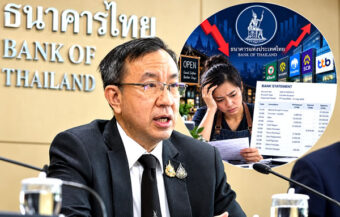
Billions pour into Thailand’s data centres and technology, but households are cutting food. Some 32.83% in a health survey eat less or skip meals as debt, weak incomes and tighter credit expose the country’s K-shaped economy.
Thailand’s economy is splitting in two as billions of baht pour into data centres, technology and foreign-backed industries. Yet household finances are deteriorating fast. Almost one-third of respondents in a government survey are cutting meals or eating less, while nearly two-thirds are hunting cheaper food. At the same time, SME credit is shrinking, household debt remains near 86% of GDP and growth has slowed sharply. Large companies still generate 83% of business revenue, while millions rely on enhanced welfare support. The result is a stark economic divide between headline investment strength and weakening purchasing power across Thai households.

Thailand is attracting billions of baht into data centres, electronics and advanced industries. Yet millions of households face a sharply different economy. Almost one-third of respondents in a government survey are reducing meals or eating less.
Nearly two-thirds are hunting for cheaper food or waiting for discounts. Others are cooking at home, growing vegetables and cutting deliveries. Increasingly, household financial pressure is reaching basic food consumption.
The figures came from Thailand’s Department of Health on September 10. Its Anamai Poll surveyed 941 people between July 1 and July 31. Notably, the survey was titled “How to live in difficult times”. Its findings provide a direct measure of pressure on household budgets. They also contrast sharply with large investment commitments elsewhere in the economy.
Food costs force households to hunt discounts, cook at home and cut meals as incomes come under pressure
Some 64.82% of respondents were buying cheaper food or waiting for discounts. In parallel, 37.51% were cooking at home more frequently. Another 33.58% were growing vegetables themselves. More significantly, 32.83% had reduced their number of meals or were simply eating less. Separately, 25.71% had cut food-delivery orders. Another 18.49% were buying larger quantities for storage.
The squeeze extended directly into nutrition. Some 63.76% said high food prices made nutritious food harder to afford. At the same time, 36.66% specifically identified falling income. Basic foods were increasingly difficult for some households to buy. Meat was identified by 29.76% of respondents. Cooking oil followed at 26.35%, while eggs were cited by 21.15%.
Fuel and transport were adding further pressure. Some 46.23% identified these costs as the biggest problem affecting food purchases. By comparison, 30.29% pointed to inflation and the wider cost of living. Household food budgets were therefore being hit beyond markets and supermarkets. Transport and energy expenses were absorbing money otherwise available for food.
Dr Amporn Benjaponpitak, Director-General of the Department of Health, addressed the findings. In response, the department issued guidance titled “Eat well on a limited budget”. People were advised to plan menus and prepare shopping lists. Households were also encouraged to compare prices and buy locally available seasonal produce.
Health officials urge cheaper proteins and balanced diets as households cut meals amid rising food costs
As part of this, the department recommended cooking at home and using cheaper protein sources. These included eggs, tofu and beans alongside meat. It also encouraged people to grow vegetables and buy seasonal fruit and vegetables. Crucially, Dr Amporn warned against sacrificing essential nutrition. People should continue eating all five food groups. They should not eliminate foods required by the body.
The department’s own numbers, however, show how far the adjustment has already gone. Almost one-third of respondents were reducing meals or eating less. Nearly two-thirds were searching for cheaper food. Almost two-thirds said nutritious food had become harder to afford. Furthermore, more than one-third specifically cited falling income.
Those figures emerged amid increasingly divergent economic conditions across Thailand. The Bank of Thailand has previously described the country’s growth pattern as K-shaped. Its business data shows a huge concentration of revenue among large companies. They comprise only around 2% of businesses. Nevertheless, they generate 83% of total business revenue.
That leaves around 98% of businesses sharing the remaining 17% of revenue. On another front, smaller companies have faced increasingly difficult credit conditions. Earlier this year, SME lending had contracted for 13 consecutive quarters. The credit squeeze was therefore well established before the latest household figures emerged.
Bank of Thailand says growth is low and uneven as SMEs face tighter credit and weaker household demand
In June, the Bank of Thailand returned to the widening economic divide. It described economic growth as “low and uneven”. Large companies had demonstrated greater capacity to adjust to changing conditions. Conversely, SMEs were facing intense competition. Household income growth was also slowing while living costs were rising.
Credit conditions added another problem. SME lending continued contracting, while banks remained cautious towards riskier borrowers. Consequently, Thailand can produce dramatically different economic numbers at the same time. Large corporations can expand while smaller companies struggle. Foreign capital can surge while household consumption remains weak.
The divergence is particularly visible in technology and promoted investment. Thailand is attracting major capital into data centres, artificial intelligence infrastructure and electronics. Other advanced industries are also drawing substantial foreign commitments. As a result, investment figures can remain strong even when domestic household spending is under pressure.
Conditions are markedly different for businesses dependent on Thai consumers. Small traders, restaurants and SMEs rely heavily on domestic purchasing power. Likewise, farmers and lower-to-middle-income households operate much closer to the domestic economy. Weak consumer spending can therefore feed rapidly into business turnover.
High household debt and weak income growth squeeze consumers as access to fresh credit becomes harder
SCB EIC identified similar pressures in June. It said low- and middle-income households remained vulnerable. SMEs were also under strain. Incomes were recovering slowly, while production costs and living expenses remained high. Added to that, debt continued weighing on consumers. Household consumption was therefore recovering only weakly.
Thailand’s household debt figures show the scale of that burden. NESDC put household debt at 86.7% of GDP during 2026’s first quarter. Importantly, it identified the debt burden as a constraint on domestic demand. The ratio subsequently declined during the second quarter. Even so, household debt remained at 85.9% of GDP.
Households therefore entered the latest slowdown with a heavy existing debt load. Simultaneously, income growth was weakening. Vulnerable borrowers were also facing tighter access to new credit. The ability to maintain consumption through further borrowing was becoming increasingly restricted.
Existing debts still require payment when income growth weakens. Mortgages continue each month, alongside vehicle instalments and other loans. Households must also cover rent, electricity, transport and school expenses. Food expenditure, however, can be adjusted almost immediately. That makes it one of the fastest areas available for spending reductions.
Families cut food and other essentials as GDP growth slows sharply and household financial pressure rises
Consumers can switch to cheaper brands and wait for promotions. Alternatively, households can replace meat with cheaper protein. They can stop ordering deliveries, cook at home and grow vegetables. Eventually, they can also reduce how much they eat. The Department of Health figures show each of these responses is already occurring.
Indeed, many respondents appear to be making several adjustments at once. Almost two-thirds were searching for cheaper food or discounts. More than one-third were cooking at home more frequently. One-third were growing vegetables. Most strikingly, almost one-third were reducing meals or eating less.
Separate evidence released weeks earlier showed similar financial pressure. UNICEF published research on August 25 covering 1,227 Thai households with children. Some 61% reported a great or very severe impact from rising living costs. In addition, families were cutting expenditure on food, education and other necessities.
Those findings appeared during a sharp economic slowdown. Thai GDP expanded 2.8% during the first quarter of 2026. Three months later, growth had fallen to 1.9%. UNICEF described families as facing weaker earning power alongside rising financial pressure.
State welfare aid rises as millions face higher costs while foreign capital pours into advanced sectors
The outlook remains subdued. The Bank of Thailand forecasts GDP growth of 2.3% for 2026. Thereafter, it expects growth to weaken further to 1.8% in 2027. The central bank has also identified decelerating household income growth. Living costs, meanwhile, are rising.
Taken together, several institutions are recording pressure at different points across the economy. The Department of Health is recording changes in eating habits. UNICEF is recording families cutting necessities. Elsewhere, the Bank of Thailand is reporting “low and uneven” growth. NESDC is recording household debt equal to 85.9% of GDP.
Credit data supplies another part of the picture. SME lending has remained in contraction, while banks have stayed cautious towards vulnerable borrowers. Hence, households and smaller businesses face pressure from both income and financing. Consumers have less spending power. Businesses dependent on them then face weaker demand.
Government welfare figures provide another measure of conditions closer to the ground. Around 13.18 million people currently receive enhanced assistance through the State Welfare Card programme. Normally, the monthly purchasing allowance is ฿300. Because of energy and cost pressures, another ฿700 was added.
Big investment commitments contrast with weak household spending as bills drain disposable income
Accordingly, the monthly purchasing allowance increased to ฿1,000 from June through September. More than 13 million people are receiving enhanced purchasing support during this period. At the same time, health officials are advising households how to maintain nutrition on limited budgets.
Yet another part of Thailand’s economy is producing vastly different figures. Foreign capital continues targeting promoted industries, with data centres among the clearest examples. Thailand is attracting large commitments linked to cloud computing, artificial intelligence and digital infrastructure. Electronics and other advanced sectors are also drawing substantial investment.
The scale of those commitments can be enormous. Thailand’s data-centre expansion alone has generated investment plans worth hundreds of billions of baht. These projects sit within an economy where many households are simultaneously cutting basic consumption. Thus, strong capital investment and weak household spending are appearing side by side.
The two sets of figures measure different parts of economic activity. GDP measures production across the economy. Investment figures record capital committed or deployed into projects. Neither figure directly measures disposable income remaining after a household pays debts and essential bills.
Large firms dominate revenue and capital access while domestic SMEs depend on cash-strapped Thai consumers
Similarly, a major foreign investment does not show conditions inside a small restaurant or market stall. It says little about an SME dependent on local customers. Large investment commitments can therefore coexist with weak domestic purchasing power.
The Bank of Thailand’s business figures make that divide particularly stark. Around 2% of businesses generate 83% of business revenue. Against that, the Department of Health provides a figure at the household level. Some 32.83% of its respondents are reducing meals or eating less.
Access to capital also differs sharply. Large companies generally have greater financing capacity. Exporters can generate revenue from overseas customers. Multinational technology projects can also draw on international corporate capital. Accordingly, their revenues are less dependent on the spending power of individual Thai households.
Domestic SMEs face a different market. Their customers are frequently Thai consumers. Falling household purchasing power can therefore hit turnover quickly. Initially, consumers can cut discretionary purchases and food deliveries. They can also search for discounts and cheaper alternatives. The latest survey shows the reductions have now reached basic food consumption.
Consumer cutbacks hit shops and restaurants as tighter credit compounds pressure across Thailand’s SMEs
Those spending cuts then pass through the domestic economy. Restaurants receive fewer orders, while small shops face weaker turnover. Other consumer businesses can also lose sales. Compounding the problem, these companies face their own financing pressures. SME lending has already contracted for successive quarters.
Banks remain cautious towards vulnerable borrowers. A small business can therefore face weaker sales and tighter credit simultaneously. Households confront a similar combination. Existing debt limits borrowing capacity, while slower income growth restricts spending from current earnings.
Rising living costs then absorb more of the money that remains. The Department of Health survey captures that pressure in direct terms. Some 64.82% are already seeking cheaper food or discounts. Another 63.76% say high prices make nutritious eating harder. In contrast, 36.66% point directly to falling income.
The foods involved are basic household purchases. Meat tops the list at 29.76%, followed by cooking oil at 26.35%. Eggs are cited by 21.15%. These are everyday products rather than luxury or discretionary items.
Fuel, food and debt squeeze household budgets as Thailand’s K-shaped economic divide becomes visible
Beyond food prices, transport and fuel expenses are intensifying the squeeze. Some 46.23% identified them as the biggest pressure affecting food purchases. Another 30.29% cited inflation and broader living costs. Household budgets are therefore being hit from several directions at once.
Income growth is slowing, while living costs are rising. Household debt remains exceptionally high. Vulnerable borrowers also face restricted credit. Meanwhile, economic growth has weakened sharply. GDP growth dropped from 2.8% to 1.9% between the first two quarters.
Looking ahead, the Bank of Thailand expects growth of only 2.3% this year. It forecasts a weaker 1.8% in 2027. Despite that slowdown, major foreign investment commitments continue. Large companies also retain their overwhelming share of business revenue.
This is the divide contained within Thailand’s K-shaped economy. At the upper end are major corporations, exporters and capital-intensive industries. Foreign money continues flowing into selected advanced sectors. Further down are indebted households and smaller businesses facing weaker domestic demand.
The disparity appears across almost every major set of economic figures. It is visible in the concentration of business revenues. Equally, it appears in contracting SME credit and high household debt. It is also present in slowing GDP growth. Now, the divide is visible in food consumption.
Foreign investment stays strong while welfare support and food cutbacks expose pressure on Thai households
Thailand can record huge foreign investment commitments while household finances remain under pressure. Technology investment does not immediately produce higher disposable income across millions of households. Headline investment figures and household spending can therefore move in sharply different directions.
State Welfare Card figures provide another important measure. Some 13.18 million people are receiving enhanced purchasing assistance through September. Meanwhile, the Department of Health is telling households how to eat properly on tighter budgets. Its own poll shows how consumers are responding.
Almost two-thirds are searching for cheaper food or discounts. More than one-third are cooking at home more often. One-third are growing vegetables. Above all, almost one-third are reducing meals or eating less.
Nutrition figures deepen the picture. Nearly two-thirds say expensive food makes nutritious eating harder. More than one-third cite falling income. Meat, cooking oil and eggs are specifically becoming harder to afford. Alongside this, fuel and transport costs are taking a larger bite from food budgets.
Large companies command 83% of revenue as households cut meals and foreign investment surges
Set against those numbers are figures from the upper end of the economy. Large companies represent around 2% of businesses but generate 83% of business revenue. Major capital commitments are also continuing across technology and other foreign-backed industries.
The contrast is increasingly pronounced. Large investment commitments are arriving alongside contracting SME credit. High-value technology projects are advancing while household income growth slows. Foreign capital is entering selected sectors while millions receive enhanced welfare purchasing support.
Bank of Thailand warns economic potential is falling with a severe crisis in the small business sector
US servicemen left behind a financial windfall in Pattaya but also a spirit of optimism and generosity
For its part, the Department of Health has supplied a direct measure of conditions inside household budgets. Its survey did not measure foreign investment, industrial promotion or corporate capital expenditure. Instead, it asked how people were living during difficult times.
The responses were clear. Consumers are buying cheaper food and waiting for discounts. They are cooking at home, growing vegetables and reducing deliveries. Many are struggling with the price of meat, cooking oil and eggs.
For 32.83% of respondents, however, the adjustment has gone further. They are reducing the number of meals they eat or simply eating less.
Join the Thai News forum, follow Thai Examiner on Facebook here
Follow Thai Examiner on Google here
Receive all our stories as they come out on Telegram here
Follow Thai Examiner here
Further reading:
60-day visa regime to be ended confirms Minister responding to rising industry security concerns
Tourism boss warns Thailand it is facing a Chinese blacklist if another security controversy erupts