Thailand faces mounting economic turmoil as the government pushes a ฿400 billion loan plan amid soaring inflation, rising energy costs, and BoT warnings over weak growth, structural fragility, and the widening fallout from the Middle East conflict.
Thailand is facing its gravest economic pressure in years as the government pushes through a controversial ฿400 billion borrowing plan amid mounting warnings from the Bank of Thailand over rising inflation, weak growth, and deep structural weaknesses. Fresh central bank minutes reveal fears that the Middle East conflict is spreading economic shock through soaring energy costs, weakening demand and rising business failures, while ministers compare current conditions to the 1997 Financial Crisis. At the same time, inflation has hit a three-year high, fresh borrowing is planned and political opposition is escalating over the government’s emergency spending strategy.
Thailand’s economic outlook has deteriorated as the government battles parliament over a controversial ฿400 billion borrowing plan.
Meanwhile, fresh Bank of Thailand minutes revealed deep concern over structural weaknesses, weak credit growth and mounting external pressures from the Middle East conflict involving Iran, the United States and Israel.
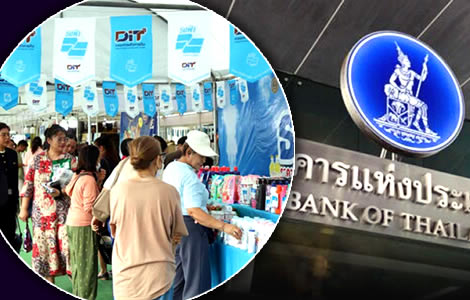
The concerns emerged during the Monetary Policy Committee’s April 29 meeting. At that session, policymakers unanimously voted to keep the one-day repurchase rate unchanged at 1.00%. However, the committee warned that risks to the economy were intensifying rapidly.
BoT warns oil shock and weak demand expose deeper structural flaws across Thailand’s economy
Officials said higher oil prices were already damaging purchasing power. Moreover, businesses were facing sharply higher operating costs. The minutes also showed concern that the conflict’s impact had spread beyond energy markets and become increasingly broad-based.
At the same time, the central bank questioned the effectiveness of consumption-driven stimulus measures. Policymakers said such programmes could provide only temporary support.
Instead, the committee stressed the need for structural economic transformation and preservation of fiscal space. Overall credit growth, meanwhile, was expected to remain subdued throughout the year. The minutes also suggested concern that Thailand’s long-term competitiveness remained weak compared with regional peers.
Those warnings came as the government accelerated emergency spending measures. Last week, the cabinet approved an emergency decree authorising ฿400 billion in additional borrowing.
Government faces mounting pressure as critics challenge Thailand’s new 400-billion-baht loan decree
The funds will support consumer stimulus programmes and green energy investment projects. However, political pressure surrounding the decree has intensified quickly. The opposition People’s Party is now seeking a Constitutional Court ruling on the legality and necessity of the borrowing package. Nevertheless, government officials continue defending the measure as economically necessary.
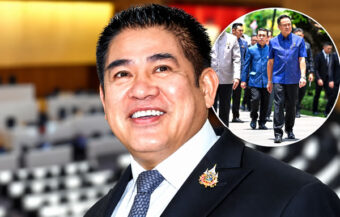
This week, a debate in the House of Representatives had to be postponed after the case was submitted to the Speaker of the House. One hundred and thirty-five MPs, led by People’s Party leader Nattapong Ruangpanyawut, signed the motion.
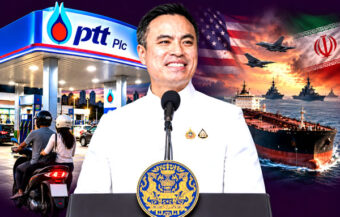
On Friday, Finance Minister Ekniti Nitithanprapas warned that the loan facility had become essential. Furthermore, he compared Thailand’s current pressures to the 1997 Financial Crisis.
Mr Ekniti said rising costs could force many struggling businesses to shut down. In addition, he warned that heavily indebted households were approaching breaking point. He said the economic strain was spreading rapidly through vulnerable sectors as energy prices continued climbing.
Meanwhile, the government confirmed plans to seek approval for an additional ฿200 billion in borrowing. The proposal is expected to reach the cabinet this week. The additional borrowing reflects growing concern inside government over slowing economic momentum and deteriorating consumer conditions.
Bank of Thailand lifts growth outlook while inflation pressures continue building nationwide steadily
Despite mounting uncertainty, the Bank of Thailand raised its short-term growth forecasts. Governor Vitai Ratanakorn revised projected growth for 2026 to 2.1%, up from 1.5% previously. However, the outlook for next year weakened sharply.
The central bank cut its 2027 forecast to 1.6% from 2.0%. Mr Vitai said the upward revision for this year reflected the government’s new borrowing package and planned stimulus spending. Previously, the central bank’s forecasts assumed only ฿300 billion in additional borrowing.
At the same time, inflation expectations have risen significantly. Mr Vitai now forecasts headline inflation at 3.1% this year. By comparison, the Bank of Thailand projected 2.9% inflation in April. Inflation is expected to ease to 1.4% in 2027. Nevertheless, policymakers warned that price pressures were strengthening across several sectors. Thailand’s inflation target range remains between 1% and 3%.
Rising energy costs and subsidy spending push Thailand’s inflation to a three-year high in April
Last week, the Ministry of Commerce confirmed headline inflation reached 2.9% in April. Consequently, inflation climbed to its highest level in more than three years. Officials attributed the increase mainly to rising energy prices linked to the Middle East conflict.
However, the ministry also acknowledged broader upward pressure on domestic prices. For the full year, officials forecast inflation between 1.5% and 2.5%.
Mr Vitai warned that inflation would likely accelerate further during the third quarter. In particular, he pointed to government stimulus spending and subsidies aimed at vulnerable groups affected by higher energy costs.
The government’s “Thai Help Thai Plus” programme is scheduled to begin in June. Under the scheme, eligible recipients will receive ฿1,000 per month for four months. Total payments will therefore reach ฿4,000 per participant. Officials expect the programme to boost short-term consumption during slowing economic conditions.
BoT remains cautious even as Moody’s highlights Thailand’s resilience against global shocks this year
However, central bank policymakers remained cautious throughout the April meeting. The minutes showed officials were unconvinced that temporary spending programmes could solve deeper structural weaknesses. Instead, the committee repeatedly highlighted long-standing economic vulnerabilities, weak productivity and subdued lending conditions.
Thailand’s economy has continued lagging behind several regional competitors since the COVID-19 pandemic. Last year, Southeast Asia’s second-largest economy expanded by only 2.4%. By contrast, neighbouring economies posted stronger recoveries and faster domestic demand growth.
Nevertheless, international ratings agencies continue pointing to Thailand’s financial resilience. Moody’s Ratings recently identified Thailand as one of five emerging economies best positioned to withstand global shocks. The agency grouped Thailand alongside Malaysia, India, Indonesia and Mexico. According to Moody’s, those economies strengthened policy frameworks and improved resilience during the past five years.
Moody’s points to strong reserves and stable markets despite continuing global volatility pressures
The report said Thailand had weathered Covid-19 disruptions, global interest rate tightening, banking sector stress and trade tensions without major funding instability. Moreover, Moody’s said Thailand maintained market access throughout periods of global volatility. Credit risk spreads also remained relatively stable, reflecting investor confidence in macroeconomic management.
Moody’s highlighted inflation targeting, exchange rate flexibility and improved debt management as key strengths. In addition, the agency pointed to deeper local currency markets, which helped absorb external shocks. Thailand’s international reserves also remained a major stabilising factor.
The country currently holds around US$280 billion in reserves. Including forward positions, total reserves rise to roughly US$300 billion. According to Moody’s, that figure equals about 10 months of imports. Furthermore, reserves remain approximately 2.5 times larger than short-term external debt obligations.
Finance minister backs reforms as central bank warns stimulus alone cannot secure recovery long term
Responding to the assessment, Mr Ekniti said the report reflected the government’s economic reform efforts. In particular, he highlighted support for clean energy investment and regulatory easing measures.
He also pointed to the Board of Investment’s Fast Pass scheme. According to the finance minister, actual investment rose 18% year-on-year during the first quarter.
Finance Minister defends 400 billion baht loan decree as opposition files Constitutional Court challenge
Hoteliers and leading foreign tourism entrepreneurs ask government to help as industry crisis worsens
Mr Ekniti additionally noted that unemployment remained below 1%. However, he acknowledged inflation had accelerated because of rising domestic costs linked to the energy crisis. He also said Thai government bonds remained highly resilient and liquid despite growing global uncertainty. According to the finance minister, 99% of government borrowing remains domestic while bond yields continue to stay relatively low.
Even so, the Bank of Thailand’s latest meeting minutes delivered a clear warning. Policymakers said temporary stimulus programmes would provide only limited short-term support. Instead, officials stressed that structural reform and tighter fiscal discipline would become increasingly important as external pressures intensified.
Join the Thai News forum, follow Thai Examiner on Facebook here
Receive all our stories as they come out on Telegram here
Follow Thai Examiner here
Further reading:
60-day visa regime to be ended confirms Minister responding to rising industry security concerns
Tourism boss warns Thailand it is facing a Chinese blacklist if another security controversy erupts