Thaksin fights to halt Revenue seizures over a ฿17.629 billion Shin Corp tax debt, saying the state already took ฿46.37 billion. Officials are hunting assets at home and abroad as bankruptcy looms and a Tax Court showdown nears in October.
Former Prime Minister Thaksin Shinawatra has launched a fresh court battle to stop the Revenue Department from seizing his assets over a ฿17.629 billion tax debt. The liability stems from the 2006 Shin Corp sale and was finally upheld by the Supreme Court in 2025. However, Thaksin’s lawyers say the state already confiscated ฿46.37 billion linked to the same share wealth in 2010. They now argue further seizures amount to overlapping enforcement. Meanwhile, Revenue officials are tracing his assets in Thailand and overseas, with bankruptcy also possible. The Central Tax Court has accepted Thaksin’s new case and will consider an injunction on October 7. The showdown brings two Supreme Court judgments together in a dispute over how far the state can go to collect.
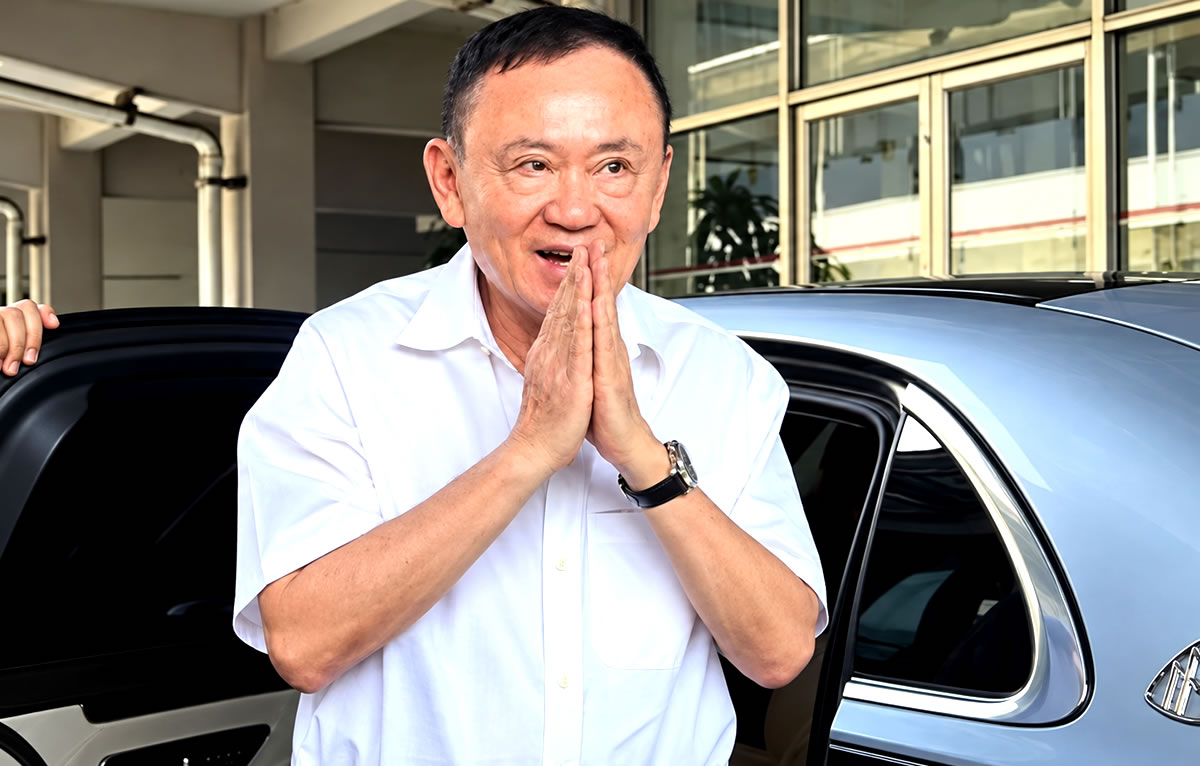
Former Prime Minister Thaksin Shinawatra has opened another major legal battle over the 2006 sale of Shin Corporation. This time, he is not challenging his final ฿17.629 billion tax assessment. Instead, Thaksin wants to stop the Revenue Department from seizing more of his assets to collect it. His lawyers say the state has already taken the money underlying the tax bill.
At the centre of his argument is ฿46.37 billion confiscated under a separate Supreme Court judgment in 2010. Thaksin says the later tax enforcement overlaps with that confiscation. Consequently, he filed a new lawsuit with the Central Tax Court on July 2, 2026. Details of the action emerged publicly on Wednesday, September 16.
The Central Tax Court has accepted the lawsuit and will now consider Thaksin’s request for temporary protection. Specifically, he wants an injunction preventing further seizures and attachments while the case proceeds. The court will hear that application on October 7. A preliminary hearing and witness examination will follow on November 16.
Revenue pursues ฿17.6 billion debt as Thaksin challenges asset seizures after final tax judgment
Meanwhile, the Revenue Department is intensifying efforts to collect ฿17,629,585,191 from the former prime minister. The figure includes tax, penalties and surcharges arising from the Shin Corp transaction. Officials are tracing Thaksin’s assets inside Thailand and overseas. Furthermore, the department has warned that bankruptcy proceedings could follow if seizures fail to recover the debt.
The latest litigation opens another front in a dispute stretching back almost 20 years. Two Supreme Court judgments now sit at the heart of the enforcement fight. The first confiscated ฿46,373,687,454.70 from Thaksin in 2010. The second upheld the ฿17.629 billion tax assessment in 2025.
Thaksin’s lawyer Winyat Chatmontri outlined the new challenge on Wednesday. He was responding to reports that Revenue officials were freezing and seizing his client’s property. Notably, he stressed that Thaksin was not seeking to overturn the final Supreme Court tax judgment. Nor, he said, was his client refusing to respect it.
Instead, the latest case targets the department’s enforcement of that judgment. Supreme Court judgment 6890/2568 was dated August 14, 2025. However, it was formally read on November 17, 2025. The ruling reversed two earlier judgments which had gone in Thaksin’s favour.
The Supreme Court found the Revenue Department’s assessment lawful. As a result, the ฿17.629 billion assessment became a final enforceable debt. Yet Thaksin’s lawyers say a separate question remains. They dispute whether additional assets can be seized after the state confiscated the underlying Shin Corp wealth.
Tax case turns on ฿15.88 billion from Shin shares already caught in 2010 confiscation, lawyers say
The tax judgment concerned 329.2 million Shin Corp shares. It found ฿15,883,900,000 arising from those shares constituted assessable income attributable to Thaksin. Accordingly, that income had to be included in his personal income tax calculation for 2006.
However, Mr Winyat says that the money was already included within assets confiscated by the state. His argument reaches back to February 26, 2010. On that date, the Supreme Court’s Criminal Division for Holders of Political Positions delivered a separate judgment against Thaksin. It ordered ฿46,373,687,454.70 connected with his Shin Corp interests forfeited to the state.
Crucially, Thaksin’s lawyers say the later ฿15.8839 billion taxable amount formed part of that larger confiscated sum. Therefore, they argue the state already possesses the proceeds generating the disputed tax liability. They describe additional seizures as overlapping enforcement against the same underlying wealth.
That argument is now before the Central Tax Court. The court has not ruled that the Revenue Department is collecting the same money twice. Equally, it has not ruled that the 2010 confiscation extinguished Thaksin’s tax liability. Those questions form the substance of his new challenge.
In parallel, Revenue officials continue their collection operation. Revenue Department director-general Somsak Anantawat confirmed the enforcement drive on September 11. He said officials were tracing Thaksin’s assets inside Thailand and overseas. The department is also coordinating with other state agencies.
Revenue keeps bankruptcy option open as Thaksin seeks court protection against further asset seizures
Mr Somsak did not identify which assets had been located. Likewise, he did not disclose what property had already been frozen or seized. Nevertheless, the department has made clear that it intends to recover the outstanding debt. Its enforcement powers potentially extend beyond asset attachment.
Separately, the Revenue Department raised the possibility of bankruptcy proceedings in June. That option could follow if available assets fail to satisfy the full liability. Officials have therefore been investigating property while preparing further legal measures. The department says it is enforcing a debt confirmed by the Supreme Court.
Time is also on the department’s side under its stated enforcement timetable. Officials consider the collection period to run for ten years after the case became final. On that basis, they say enforcement can continue until 2035. Thaksin’s new action seeks to restrict that process before it advances further.
As part of this, his lawyers are seeking temporary protection under Section 254(2) of the Civil Procedure Code. They also cite Section 17 of the Tax Court Establishment and Tax Litigation Procedure Act B.E. 2528. The requested order would prevent further seizures or attachments while the substantive case continues.
Mr Winyat has gone further by challenging where the Revenue Department should seek payment. He argues the department should approach the Ministry of Finance instead of taking additional Thaksin assets. His reasoning rests squarely on the 2010 confiscation. The state already holds the ฿46.37 billion seized under that judgment.
Winyat tells Revenue to seek tax from Finance Ministry as department says final debt remains enforceable
“Previously, the Revenue Department announced they were trying to trace his assets and file for bankruptcy. I suggest the Revenue Department should request the tax money that they claim Mr. Thaksin owes from the Ministry of Finance, instead of seizing or freezing Mr. Thaksin’s assets beyond his liability as per the court judgment. I ask them to do only this much for now, because in reality, there are still facts that I believe the Revenue Department has acted improperly. However, a group of individuals has instructed the Revenue Department to do something else. I can wait for now,” Mr Winyat said.
The reference to unidentified individuals added another claim to his statement. However, Mr Winyat did not name those people or provide further details. The Central Tax Court has made no finding on that claim. His formal case remains focused on the tax liability and enforcement.
The Revenue Department takes a different legal position. It holds a final Supreme Court judgment confirming that its assessment against Thaksin was lawful. Thus, it regards the resulting ฿17.629 billion as an enforceable debt. It has not accepted that the 2010 confiscation satisfied or extinguished that liability.
Behind the latest confrontation lies a complicated chain of share transfers, tax assessments and court rulings. The story began with the Shin Corp sale in January 2006. The Shinawatra family sold its controlling interest to interests linked with Singapore’s Temasek Holdings. One block of 329.2 million shares later became central to the tax dispute.
Ample Rich share transfers to Thaksin’s children at ฿1 each became foundation of long-running tax battle
Those shares were connected with Ample Rich Investments Ltd, established in the British Virgin Islands. They were transferred to Thaksin’s children, Panthongtae and Pintongta Shinawatra. Each received 164.6 million shares. Significantly, the transfer price was only ฿1 per share.
At the time, Shin Corp shares were trading at ฿49.25 on the Stock Exchange of Thailand. The difference between those prices was therefore enormous. Later, that gap became central to the Revenue Department’s case. Panthongtae and Pintongta subsequently participated in the wider Shin Corp transaction.
Initially, the Revenue Department pursued Thaksin’s two children for tax arising from the shares. The legal position changed following the 2010 Supreme Court judgment. That ruling found Thaksin remained the beneficial owner of the relevant Shin Corp interests. His children were treated as holding shares on his behalf.
That finding undermined the tax assessments against Panthongtae and Pintongta. If they were acting for Thaksin, their own tax position was fundamentally different. Subsequently, the Central Tax Court cancelled their assessments. Attention then shifted towards whether the Revenue Department could pursue Thaksin directly.
Seven years later, the department did exactly that. On March 28, 2017, it issued Thaksin with a personal income tax assessment. The demand totalled approximately ฿17.629 billion for the 2006 tax year. It included tax, penalties and surcharges connected with the disputed transaction.
Thaksin wins twice over Revenue procedure before Supreme Court restores full ฿17.629 billion liability
The department relied partly on the legal relationship between principal and agent. Its case treated Panthongtae and Pintongta as acting for their father. Therefore, their actions concerning the shares could legally bind Thaksin as principal. That reasoning later became central before the Supreme Court.
In response, Thaksin challenged the assessment and initially succeeded. On July 18, 2022, the Central Tax Court cancelled it. Importantly, the judgment focused on Revenue Department procedure. The court found officials had failed to issue a required Section 19 summons directly to Thaksin.
The department appealed, but the result initially remained unchanged. On June 2, 2023, the Specialised Appeal Court’s Tax Division upheld the lower court ruling. Thaksin had therefore defeated the assessment at two court levels. The Revenue Department then appealed to the Supreme Court.
That final appeal completely changed the legal position. In 2025, the Supreme Court reversed both earlier rulings. It found the Revenue Department’s assessment lawful. Consequently, the full ฿17.629 billion liability was restored.
The Supreme Court accepted that Panthongtae and Pintongta acted as Thaksin’s agents concerning the disputed shares. Their actions could therefore bind him as principal. The court also examined the Ample Rich transfer. Those 329.2 million shares were transferred for ฿1 each despite their ฿49.25 market price.
Supreme Court finds Thaksin remained real owner as Revenue moves from tax litigation to asset collection
More significantly, the Supreme Court found Thaksin remained the real owner behind the arrangements. It linked the structure to concealment of ownership while he held political office. The court also rejected grounds for cancelling or reducing penalties and surcharges. Thus, the entire assessment survived.
That judgment ended the battle over whether the Revenue Department could lawfully assess Thaksin. It did not, however, end the broader fight over the Shin Corp proceeds. Once the judgment became final, Revenue officials moved from assessment litigation to collection. Asset tracing and enforcement followed.
On another front, Thaksin’s lawyers returned to the consequences of the 2010 confiscation. That earlier judgment concerned 1,419,490,150 Shin Corp shares attributed to Thaksin. The resulting forfeiture totalled ฿46,373,687,454.70. The later tax case concerns only part of those wider share interests.
Specifically, the 2025 tax judgment addressed ฿15,883,900,000 arising from 329.2 million shares. Mr Winyat says that smaller amount sits inside the larger confiscated pool. On this basis, he argues there are no remaining proceeds from those shares for Thaksin to surrender.
His position also addresses claims that Thaksin simply failed to meet his tax obligation. Mr Winyat says his client did not remain indifferent or neglect payment. Instead, he says all relevant share-sale income was confiscated and became state property. That argument now forms a central element of the Tax Court action.
Revenue presses collection of final debt while Thaksin argues 2010 confiscation already covered proceeds
The Revenue Department approaches the issue from the opposite direction. Its starting point is the final Supreme Court judgment delivered last year. That ruling says the assessment was lawful and left the full liability intact. Accordingly, Revenue officials continue tracing assets to satisfy the judgment.
For its part, the department has not accepted that confiscation and taxation constitute duplicate collection. It is pursuing the final debt through normal enforcement procedures. Bankruptcy remains available if ordinary collection fails. Meanwhile, Thaksin is seeking judicial intervention before those measures proceed further.
The legal chronology is now sharply defined. The Shin Corp transaction occurred in 2006. The Supreme Court confiscated ฿46.37 billion connected with Thaksin’s holdings in 2010. Then, the Revenue Department assessed him for ฿17.629 billion in 2017.
Five years later, the Central Tax Court cancelled that assessment. In 2023, the Specialised Appeal Court upheld the cancellation. But in 2025, the Supreme Court reversed both decisions and restored the full liability. Finally, Thaksin filed his latest Central Tax Court case in July 2026.
The legal question has consequently shifted. Previously, Thaksin fought the validity of the Revenue Department’s assessment. That fight ended with the Supreme Court judgment. The assessment itself is now final.
Tax assessment is final after two decades of litigation as Thaksin shifts his court fight to enforcement
Today, the dispute concerns enforcement. Thaksin says the state already took the underlying Shin Corp proceeds under the 2010 judgment. The Revenue Department says it has a final ฿17.629 billion debt to collect. Both positions now converge before the Central Tax Court.
The next immediate decision comes on October 7. The court will consider whether further seizures should be temporarily stopped. That hearing will not determine the entire substantive case. Instead, it will decide whether Thaksin receives protection while the litigation continues.
Thaksin free after electronic bracelet is removed. Plans to fly to Dubai to see Yingluck at end of June
Thaksin faces his latest legal and financial hurdle with Revenue threat to bankrupt him over tax debt
Thereafter, the case moves to its next scheduled stage on November 16. The court has set that date for a preliminary hearing and witness examination. Until judicial relief is granted, the Revenue Department’s enforcement drive continues.
Nearly 20 years after the Shin Corp sale, the legal battlefield has therefore narrowed considerably. The validity of the tax assessment is no longer at issue. The Supreme Court settled that in 2025. The remaining fight is over what the Revenue Department can still take to collect it.