Thailand’s data centre boom hits a regulatory wall as Anutin orders new rules within a month. Some 166 projects face review while Bangkok weighs higher power charges, tougher locations and clean-energy demands against vast foreign investment flows.
Thailand has put one of its biggest foreign investment engines under urgent review after Prime Minister Anutin Charnvirakul ordered new data centre rules within one month. Some 166 projects are caught in the regulatory reset, including 49 already under construction, as Government House examines electricity, water, safety and locations. Higher power charges, clean-energy requirements and tighter scrutiny of Bangkok sites are now on the table. Yet the government cannot afford to choke a sector underpinning cloud computing, artificial intelligence and Thailand’s regional digital ambitions. Deputy Prime Minister Ekniti Nitithanprapas is coordinating the economic response as hundreds of billions of baht in investment hang on rules still being written by officials and committees.
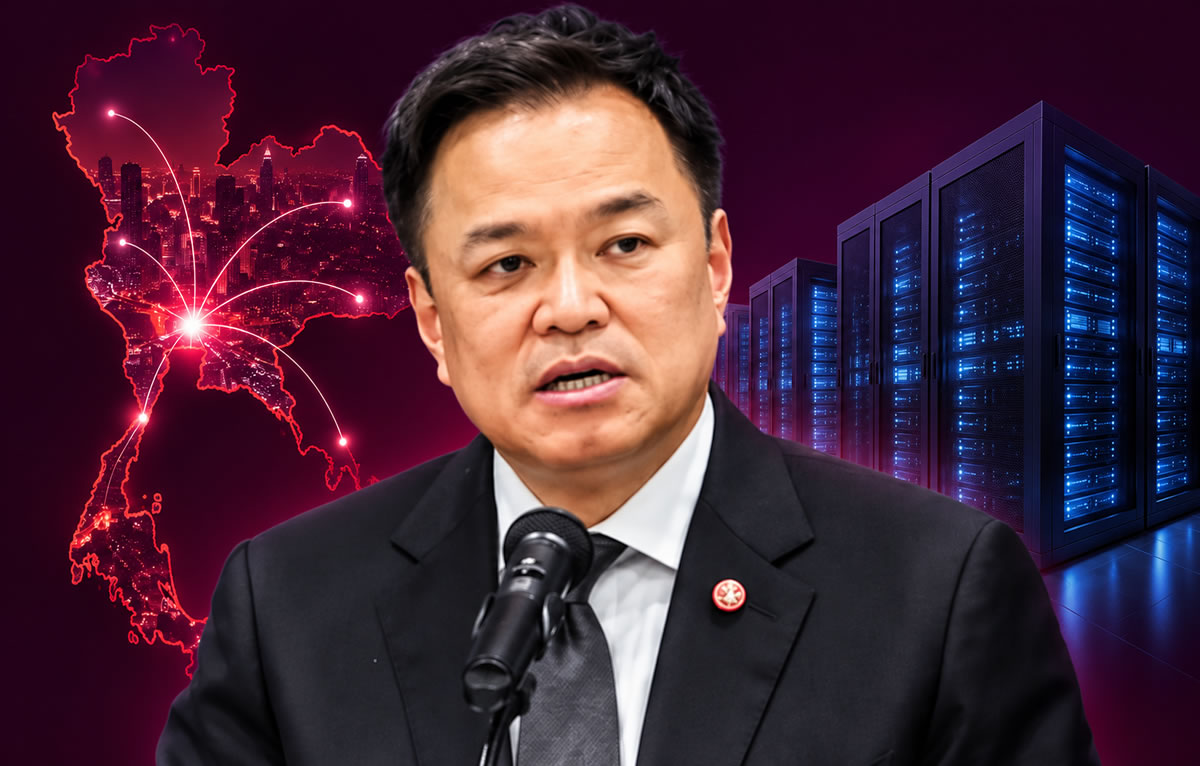
Prime Minister Anutin Charnvirakul on Friday ordered minimum standards for Thailand’s booming data centre industry within one month. The intervention comes as 166 projects face a government review covering electricity, water, locations, safety and economic returns. Deputy Prime Minister and Finance Minister Ekniti Nitithanprapas is coordinating a central part of the regulatory reset. Notably, the government is acting after data centres became one of Thailand’s biggest sources of headline inward investment.
Mr Anutin gave the order after returning to Government House from Parliament on September 11. The Senate had approved the draft Budget Act for Fiscal Year 2027. Earlier, the House of Representatives had passed the legislation.
Mr Anutin thanked senators before travelling back with Mr Ekniti. As their car passed reporters, Mr Anutin lowered his window and pointed towards the waiting media. He then drew Mr Ekniti’s attention towards them before waving.
Government House brings key ministries together as Ekniti sets a one-month deadline for new data rules
By then, another important meeting was already taking shape inside Government House. Energy Minister Ekanat Promphan was waiting before the Prime Minister arrived. Budget Bureau Director Anan Kaewkamnerd also attended.
In parallel, NESDC Secretary-General Danucha Pichayanan joined the discussions. Natural Resources and Environment Permanent Secretary Raveewan Phuridej was present. Digital Economy and Society Permanent Secretary Pachara Anantasilsin also attended.
The meeting brought together officials controlling almost every major element affecting data centre development. More importantly, it followed growing government concern over the industry’s rapid expansion. Thailand still wants the investment. However, Government House now wants tighter conditions surrounding its economic, environmental and infrastructure impact. The task is complicated by the huge investment pipeline already moving through Thailand.
At 4.40 pm, Mr Ekniti emerged and outlined the work underway. He said officials were integrating information gathered across government. As part of this, subcommittees must establish minimum standards covering economic, social and environmental issues. The work should be completed within one month. An economic panel will examine the entire system and calculate the benefits received by Thailand.
Energy, environment and infrastructure rules take shape as Thailand weighs higher data centre power costs
Separately, environmental requirements will be established around Environmental Impact Assessment standards and Codes of Practice. Infrastructure will receive its own examination. Location and security will also become distinct parts of the framework. Energy Minister Ekanat will oversee the infrastructure element. Significantly, higher electricity charges for data centres are already being considered.
Mr Ekniti said additional electricity costs should reduce the burden placed on the wider public. In addition, future investment conditions will examine requirements involving clean energy.
Electricity has become one of the biggest issues surrounding Thailand’s data centre expansion. Large facilities require continuous and exceptionally reliable power. Hyperscale campuses can consume electricity on an industrial scale. At the same time, cooling systems add heavily to their energy requirements.
Water consumption is another issue under examination. Some cooling systems can require substantial supplies. Consequently, officials are examining water alongside electricity when assessing infrastructure demands. Environmental requirements will add another layer to future approvals. The government is therefore examining the full infrastructure cost of supporting enormous computing facilities.
Bangkok locations face tougher scrutiny as officials review safety, infrastructure and 166 projects
On another front, location has become an immediate concern. Mr Ekniti said data centres should not be situated in city centres. Another subcommittee will examine appropriate locations. Security and public safety will also form part of those decisions. The comments place particular attention on Bangkok, where large facilities already operate inside a densely populated metropolis.
Bangkok remains Thailand’s dominant digital and commercial centre. Yet its density creates concerns surrounding substations, generators, fuel storage and emergency planning. Large facilities also require substantial electricity infrastructure.
Mr Ekniti said the government was completely reorganising the system. He said previous arrangements contained weaknesses which data centre developments had exploited. Currently, only three Bangkok data centres have received Board of Investment promotion, according to the Finance Minister.
The government’s urgency is difficult to miss. Some 166 projects have become caught in the wider review. Around 49 are already under construction. Another 117 or more remain at different stages awaiting government decisions. However, stopping projects already under construction is not straightforward. NESDC Secretary-General Danucha Pichayanan has acknowledged that problem.
Regulatory hiatus leaves investors exposed as Thailand races to reset rules around a vast project pipeline
As a result, projects continuing under existing arrangements could later encounter requirements created under the new framework. Thailand therefore faces a regulatory hiatus surrounding one of its fastest-growing investment sectors.
Nevertheless, Government House has imposed a tight timetable for resolving it. The one-month deadline puts immediate pressure on the subcommittees. Investors, meanwhile, remain exposed to rules still being written.
The scale of the investment explains the pressure. Data centres have become an extraordinary component of Thailand’s inward investment figures. Indeed, only months ago, Government House was promoting the sector as a major investment success. In July, the government highlighted 34 data centre and hosting projects approved between 2025 and March 2026. Together, those projects represented ฿715.295 billion in investment.
At that point, officials presented the figures as evidence of strong international confidence. Thailand’s geographical position was cited as one advantage. Likewise, officials highlighted telecommunications infrastructure and expanding digital capabilities.
The sector became increasingly important to Thailand’s campaign for regional digital-hub status. The BOI subsequently reported 36 data centre applications during 2025 alone. Collectively, those applications represented more than ฿728 billion in investment.
TikTok’s ฿842 billion expansion highlights the huge scale of Thailand’s data centre investment surge
Then came a project of an entirely different scale. In May, the BOI approved an ฿842 billion infrastructure expansion by a Thai unit of TikTok. The investment was valued at approximately US$25 billion. Crucially, the planned infrastructure stretches across Bangkok, Samut Prakan and Chachoengsao. The servers and processing systems involved make it one of Thailand’s largest digital infrastructure commitments.
Data centres have therefore become impossible to separate from Thailand’s foreign investment performance. Their capital requirements help produce enormous investment figures. However, the projects do not necessarily create comparable numbers of permanent jobs. A large data centre requires massive expenditure before operations begin. Land must first be secured and specialised buildings constructed.
Operators then require servers, cooling systems and extensive electrical equipment. Furthermore, high-capacity telecommunications connections are essential. Substations can represent another major investment. Backup electricity systems must also be installed. Beyond that, operators need sophisticated security and fire protection. Large campuses consequently require substantial spending beyond the computers inside them.
Staffing requirements are very different from traditional manufacturing. A hyperscale facility can involve billions of baht while employing relatively few permanent workers. By comparison, a major automotive factory can require thousands of employees. That difference now sits near the centre of the government’s economic examination. Mr Anutin and Mr Ekniti want officials to establish what Thailand receives from these projects.
Government shifts focus from headline investment to jobs, technology transfer and wider economic returns
Declared investment value alone will no longer answer that question. Employment will form part of the assessment. Technology transfer will also be examined. Additionally, clean-energy use and greenhouse-gas reductions will feature in the emerging framework.
Officials have also considered wider access to cloud and artificial intelligence capacity. Thai businesses could therefore become another element in calculations surrounding economic benefits.
Despite the tougher approach, Mr Anutin still regards data centres as strategic infrastructure. Earlier this month, he described them as essential infrastructure supporting the digital economy. He also said Thailand should use them to attract associated industries. Technology transfer is another stated objective. Similarly, developing Thai workers forms part of government policy. Mr Anutin also wants a broader digital ecosystem built around the investment.
That wider role distinguishes data centres from conventional factories. Cloud computing depends upon them. Artificial intelligence requires even greater computing and processing capacity.
Meanwhile, banks and financial technology businesses increasingly depend upon secure digital infrastructure. E-commerce companies also require extensive storage and processing capacity. Digital payments and cybersecurity systems depend on the same infrastructure.
Data centres underpin cloud, AI and finance as Thailand weighs their strategic economic importance
Streaming services are another major user. Multinational companies increasingly depend upon cloud systems for daily operations. The BOI has also identified activity surrounding hardware suppliers. Construction provides another economic effect.
After completion, facility management generates continuing demand. Elsewhere, fintech, artificial intelligence and e-commerce can expand around large concentrations of computing capacity.
Thailand is therefore examining both sides of the investment equation. It wants the capital and strategic infrastructure. At the same time, officials are calculating the national resources required to support it. Electricity sits at the centre of that calculation. Data centres operate continuously and require exceptionally reliable supplies. Moreover, artificial intelligence is increasing computing requirements and power demand. Cooling equipment creates another significant load.
Against that background, Mr Ekniti confirmed that higher electricity charges are being examined. The government does not want other consumers carrying additional costs generated by the industry.
Accordingly, operators could face a different electricity cost structure. Clean energy is also moving towards the centre of investment policy. Future conditions could require operators to participate directly in cleaner power development.
Higher power charges and clean energy demands move to the centre of Thailand’s data centre policy reset
Meanwhile, environmental officials will examine the impact of individual projects. Water requirements will receive separate scrutiny. The result is a much broader test for investors than simply obtaining land and electricity. Projects will increasingly face examination of location, resources, environmental impact and their economic contribution.
Bangkok presents perhaps the most difficult location issue. The capital and metropolitan region form Thailand’s principal data centre cluster. There are strong commercial reasons for that concentration.
Above all, Bangkok dominates the country’s corporate and financial activity. The capital contains Thailand’s biggest concentration of corporate headquarters, banks and financial institutions.
Similarly, many major cloud customers operate across Greater Bangkok. That concentration generates substantial demand for nearby computing capacity. The metropolitan area also possesses dense fibre networks. Internet exchange infrastructure provides another attraction. For that reason, data centres close to Bangkok can connect quickly with customers and other facilities.
Bangkok’s fibre networks and customer base keep the capital central despite rising location concerns
Latency matters for some applications. Distance increases the time required for data to travel between servers and users. Although the differences can be tiny, some applications require extremely rapid responses. Financial services are one example. Cloud customers can also benefit from nearby computing capacity. Consequently, Bangkok retains strong commercial advantages despite the government’s concerns about city-centre development.
Six projects have sought permission from Bangkok city officials. Each requires approximately 9MW to 23MW of electricity. Three are already operating. The other three applications have been placed on hold. At the same time, the geography of Thailand’s largest projects is changing. Major developments are increasingly appearing beyond central Bangkok.
Samut Prakan has become particularly important because it remains immediately connected with the capital. Chachoengsao offers another nearby location. Further east, Chonburi and Rayong are attracting major hyperscale developments. Both provinces sit within Thailand’s Eastern Economic Corridor. They also possess extensive industrial infrastructure.
Three True IDC projects approved during 2026 have a combined capacity of 223MW. Those facilities are located in Chonburi and Samut Prakan. Meanwhile, two GSA developments totalling 120MW are planned for Rayong and Samut Prakan. Freyr projects are also planned for Rayong and Samut Prakan. Bangkok nevertheless continues attracting facilities requiring metropolitan connectivity.
Low latency keeps Bangkok attractive as major projects spread into Samut Prakan, Chonburi and Rayong
A 25MW Stellar facility is located in the capital. Thailand’s data centre geography is consequently divided between different development types. Bangkok remains the digital core. In contrast, giant power-intensive campuses are increasingly appearing around surrounding provinces and the eastern seaboard.
There are practical reasons for the shift. Hyperscale campuses require substantial land. Substations occupy significant space. Cooling equipment can also be extensive. In addition, backup generators, fuel storage and security infrastructure increase the physical footprint. Large sites outside central Bangkok can accommodate those requirements more easily.
Yet these campuses can remain connected through high-capacity fibre networks. Samut Prakan therefore offers access to Bangkok without a central-city location. Chachoengsao provides similar advantages. Chonburi and Rayong add established industrial infrastructure. Both also provide access to the Eastern Economic Corridor.
Chonburi possesses another important advantage. The Asia-America Gateway submarine cable lands at Si Racha. As a consequence, the eastern seaboard plays a direct role in Thailand’s international digital connectivity. Thailand is also expanding those international connections. Google’s TalayLink project will create another international subsea route.
The connection will support the country’s growing cloud and data centre infrastructure. International connectivity remains critical because regional competition is intense. Malaysia has become a major data centre investment destination. Indonesia is also expanding quickly. Singapore, meanwhile, remains Southeast Asia’s established premium digital hub.
Data centre growth spreads east as land, fibre and submarine cables strengthen locations beyond Bangkok
Vietnam is competing more aggressively for technology investment. Thus, international operators have several alternatives when selecting their next major computing campus. Thailand possesses significant advantages of its own. Domestic telecommunications infrastructure is extensive. Its electricity system is comparatively reliable. Equally important, Bangkok provides a huge concentration of corporate and digital customers.
Thailand nevertheless has fewer international submarine cable connections than some regional competitors. That can affect route diversity and international connectivity. New subsea infrastructure therefore forms another part of the country’s digital investment drive. Data centres themselves represent only one part of that infrastructure.
International gateways are also necessary. Fibre networks must connect facilities with customers. Internet exchanges, in turn, must handle increasing traffic volumes. Power generation must expand alongside computing demand. Renewable electricity is becoming increasingly important for international operators. Artificial intelligence is adding further pressure by increasing the computing capacity required.
Seen in that context, Friday’s Government House intervention reaches far beyond individual building permits. Officials are rewriting rules governing infrastructure underpinning Thailand’s wider digital economy. The public-facing government message has also become tougher. Data centres consume enormous amounts of electricity. Some facilities use substantial quantities of water.
Regional competition intensifies as Thailand expands digital links and faces weaker subsea connectivity
They can additionally require large generators, fuel storage and heavy electrical infrastructure. Mr Anutin has therefore placed public safety inside the new regulatory framework. Locations will face closer examination. Security requirements will also be considered. Environmental standards will become part of the minimum requirements.
The investment policy, however, remains intact. Thailand continues seeking hyperscale computing facilities and artificial intelligence infrastructure. International cloud providers remain important. The government also wants related industries to develop around those investments. The BOI has already adjusted incentives in response.
More advanced facilities can qualify for stronger tax privileges. Operators, however, must satisfy tougher efficiency and technical requirements. Projects seeking eight-year corporate income tax exemptions face stronger standards. Advanced computing capabilities also form part of those conditions. In return, applicants must explain how their projects contribute to Thailand’s economy.
At the regulatory level, another initiative points towards faster approvals. The NBTC Office has drafted a seven-working-day fast-track licensing route. It would apply to qualifying data centres submitting complete applications. Two policies are therefore moving simultaneously. Thailand is tightening minimum standards while trying to accelerate projects meeting those requirements.
Safety, incentives and faster licensing reshape Thailand’s approach to hyperscale data centre investment
The difficult period is the transition between the old and new systems. Data centre developments require years of planning. Electricity availability must be established before construction. Investors also need certainty about connection dates and future power prices. Water availability can determine site selection. Construction permits affect development schedules.
Similarly, BOI tax incentives can alter the financial viability of major investments. Environmental requirements must be understood before final designs are completed. A location change can also transform the economics of a project. For investors, regulatory details therefore affect decisions made years before servers begin operating.
This makes the speed of the government’s work important. Investors need to know which projects can proceed. They also need clarity about the conditions attached. Thailand is not competing for this investment alone. Malaysia, Singapore, Indonesia and Vietnam are seeking the same international capital. Data centre investment also remains highly mobile before construction begins.
Singapore has already faced similar resource pressures. It previously restricted data centre development because of electricity and environmental concerns. Subsequently, it reopened capacity under tighter conditions. Efficiency became central to that process. Cleaner power was another requirement. Wider economic contributions were also considered when allocating new capacity.
Investors face a difficult transition as Thailand rewrites power, planning and environmental requirements
Thailand is now building its own framework around similar pressures. The scale of its existing pipeline, however, adds urgency. Some 166 projects are already caught up in the review. A short regulatory pause can be absorbed into some development schedules. Prolonged uncertainty creates greater problems.
Investors require power allocations, connection dates, planning rules and environmental standards before committing enormous sums. They also need certainty surrounding investment incentives. For this reason, Friday’s one-month deadline carries considerable weight. Mr Anutin has not ordered an end to Thailand’s data centre expansion. Instead, he has ordered minimum conditions governing its next phase.
Electricity pricing will form part of that system. Clean-energy investment will also be considered. Alongside this, water consumption and environmental requirements will face greater scrutiny. Locations will be controlled more closely. Public safety and security will become formal considerations. Economic officials will simultaneously calculate the benefits Thailand receives from each project.
Investment value will remain significant. Employment and technology transfer will also enter the calculation. Broader economic contributions will become another factor. Bangkok remains central to those decisions. The government can restrict giant hyperscale campuses inside congested districts. The capital, however, remains Thailand’s dominant digital and commercial centre.
Thailand races to finish new rules as 166 projects remain caught in the government’s regulatory review
Bangkok contains customers, banks and corporate headquarters. Fibre networks and internet exchanges are concentrated across the metropolitan area. Some facilities therefore have strong commercial reasons for remaining nearby. Surrounding provinces provide room for the largest developments. Samut Prakan is already becoming a major data centre location.
Chachoengsao provides another option close to Bangkok. To the east, Chonburi and Rayong offer industrial infrastructure and Eastern Economic Corridor access. Their growing role is already visible in recently approved projects. The enormous TikTok-linked investment itself stretches across Bangkok, Samut Prakan and Chachoengsao.
Other major projects are concentrated around Samut Prakan, Chonburi and Rayong. Smaller facilities, meanwhile, continue operating within Bangkok. The new location standards will shape the next stage of that development. They will also determine how projects caught in the regulatory review can proceed.
For now, 166 projects remain inside a sector undergoing a rapid regulatory reset. Around 49 are already under construction. More than 117 others await decisions. Hundreds of billions of baht in declared investment are tied to the sector.
Bangkok stays central to Thailand’s data centre push as major developments spread into nearby provinces
The ฿715.295 billion highlighted in July demonstrates its scale. The ฿728 billion represented by 2025 applications reinforces that picture. Then came the ฿842 billion TikTok-linked expansion. That single commitment pushed Thailand’s digital infrastructure investment figures to another level.
Data centres have consequently become one of Thailand’s largest sources of headline inward investment. Their expansion, however, has moved faster than rules governing electricity, water and urban locations. Government House is now racing to close that gap. Mr Anutin’s Friday order places a one-month deadline on the work.
Huge investments in Thai data centres draw warning from leading industry leader about scarce resources
Data centre projects on hold in Bangkok as officials scramble to examine the impact of the industry on resources
Mr Ekniti is coordinating the economic response. Mr Ekanat is handling the crucial energy component. NESDC is involved in assessing the wider economic framework. Elsewhere, environmental officials are establishing impact requirements. Digital economy officials are also involved. The Budget Bureau has joined the discussions.
The regulatory reset now reaches across central government. Its outcome will directly affect one of Thailand’s fastest-growing investment sectors. It will also determine how quickly the 166 projects caught in the current hiatus can move again.
Thailand spent recent years building its case as a regional digital hub. Data centres became a central component of that investment drive. Now, Government House is rewriting the rules governing the infrastructure behind it. On Friday, Mr Anutin ordered that work be accelerated. Mr Ekniti put the timetable at one month, while an enormous investment pipeline remains caught in the transition.
Join the Thai News forum, follow Thai Examiner on Facebook here
Follow Thai Examiner on Google here
Receive all our stories as they come out on Telegram here
Follow Thai Examiner here
Further reading:
CP boss says Thailand must engage US and become Southeast Asia’s top data centre with cheap energy
Thailand’s obscure negotiation strategy with United States an outlier as PM promises a ‘secret deal’
Thaksin does not rule out joining talks in US as Thai team finalises plans. They fly out on Thursday
Trump’s remaking of World trade, if it works, will force Thailand to decide between the US and China