Thailand’s debt races towards its 70% ceiling as chief economic planner Danucha Pichayanan demands 2–3 years of tight budgets. Debt servicing tops ฿400 billion yearly and weak growth, falling revenue and ageing costs tighten Bangkok’s fiscal squeeze.
Thailand is rapidly burning through its financial firepower as public debt hits 67.5% of gross domestic product, close to the 70% ceiling. The country entered Covid-19 near 41%, but much of that borrowing cushion is gone. National Economic and Social Development Council chief Danucha Pichayanan wants two to three years of tight budgets to rebuild it. His warning comes as growth weakens, revenue falls and ageing costs rise. Meanwhile, debt servicing already exceeds ฿400 billion annually, while some projections breach the ceiling by 2028. Thailand can service its debts, but another major shock could hit with Bangkok holding far less room to fight back.
Thailand is running short of fiscal room as public debt closes rapidly on the government’s statutory ceiling. The country’s chief economic planner now wants two to three years of tight budgets.
His aim is to rebuild financial capacity before another economic shock arrives. Public debt has reached approximately 67.5% of gross domestic product, against a 70% ceiling. As a result, Thailand has only three to four percentage points of fiscal space remaining.
National Economic and Social Development Council Secretary-General Danucha Pichayanan delivered the warning this week. He spoke at the council’s Macro Seminar 2026 on September 16. Importantly, he did not predict a fiscal crisis within two or three years. Instead, he wants that period used to restore Thailand’s depleted fiscal buffer. Another crisis could otherwise arrive when the government has much less room to borrow.
Thailand’s public debt surges from 41.1% before Covid-19 as revenue falls and spending pressures rise
The contrast with Thailand before Covid-19 is substantial. Public debt then stood at approximately 41.1% of gross domestic product. It has since climbed by more than 26 percentage points. Meanwhile, economic growth remains weak and government revenue has declined relative to national output. Thailand therefore enters the next period of economic uncertainty from a considerably tighter fiscal position.
Mr Danucha identified three major and interconnected pressures. First, public debt has increased rapidly while economic growth remains weak. Second, government revenue has declined relative to the economy. Third, an increasing proportion of expenditure is difficult to reduce. Together, these factors are restricting the government’s freedom to respond to another major economic shock.
Government revenue illustrates the deterioration. Net revenue stood at 16.7% of gross domestic product in fiscal 2016. However, by fiscal 2025, the figure had fallen to approximately 15%. Bangkok is therefore carrying substantially more debt while collecting proportionately less revenue. At the same time, weak economic growth makes the higher debt burden harder to reduce relative to national output.
Meanwhile, pensions, healthcare and welfare commitments are absorbing increasing amounts of public money. Many of these costs cannot easily be cut. Moreover, demographic change means several will continue rising over the coming years. Consequently, approaching the 70% debt ceiling is only one part of Thailand’s fiscal problem. An increasing share of annual expenditure is already committed before governments consider new programmes.
Debt servicing tops ฿400 billion as Danucha calls for two to three years of tighter Thai budgets
Debt servicing adds another substantial burden. Mr Danucha put the annual cost above ฿400 billion. More than ฿200 billion goes towards interest payments, while more than ฿100 billion covers principal repayments. Furthermore, those costs cannot quickly disappear through tighter future budgets. Existing debt remains outstanding and must continue to be serviced for years.
Against that backdrop, Mr Danucha called for another two to three years of fiscal restraint. He also wants unnecessary government expenditure reduced. The fiscal 2027 budget process already indicates the scale of the squeeze. Government agencies faced spending reductions averaging approximately 30–40%. Notably, he also raised the possibility of reducing the government workforce and shifting labour towards private employment.
Mr Danucha also wants available government money used more aggressively to reduce existing debt. He proposed redirecting remaining funds from the 2026 central budget towards additional debt repayments. Therefore, unspent allocations would not automatically finance additional programmes. Instead, available money could reduce outstanding government liabilities and create more space beneath the statutory ceiling.
There is also an international dimension to the proposal. Mr Danucha said additional debt repayments could demonstrate fiscal discipline to global credit-rating agencies. Such action would show that Thailand was actively rebuilding its fiscal position. In parallel, lower outstanding debt would provide greater room for borrowing if another economic emergency occurred.
Danucha urges wider tax base, targeted welfare and tighter scrutiny of loss-making state projects
Yet spending restraint represents only one part of the proposed adjustment. Mr Danucha also wants Thailand to collect more revenue by broadening the tax base. One proposal involves using digital-payment transaction information to identify businesses outside the formal tax system. Those businesses could then be brought into the tax net. The approach would expand taxpayer numbers rather than simply increase existing tax rates.
Separately, state enterprises face closer scrutiny. Mr Danucha called for inefficient or loss-making investment projects to be reviewed. Where necessary, projects could be postponed or cancelled. The objective is to prevent continuing commercial losses from becoming additional government liabilities. Such liabilities would place further pressure on already restricted public finances.
Welfare expenditure is another area targeted for change. Mr Danucha favours directing assistance according to economic need rather than relying extensively on universal programmes. Government databases could also be connected to identify duplicated benefits. As part of this, overlapping payments through separate government schemes could be reduced. Limited public money could then be directed more closely towards intended recipients.
However, Thailand’s demographic position presents a longer-term fiscal problem. The National Economic and Social Development Council expects Thailand to become a super-aged society around 2034. By then, people aged 60 and older could represent approximately 28.4% of the population. Pension, healthcare and welfare costs will consequently rise as the elderly population expands.
Ageing population squeezes Thailand’s tax base as international bodies warn fiscal space is narrowing
At the same time, the working-age population supporting economic output and taxation will shrink. That combination places pressure on both sides of the government’s accounts. Expenditure demands rise while the pool supporting future tax revenue becomes smaller. Therefore, annual departmental cuts alone cannot remove Thailand’s longer-term fiscal pressures.
Mr Danucha consequently wants government expenditure redirected towards areas capable of increasing productivity. He identified education, healthcare, infrastructure and technology among those priorities. Under that approach, less emphasis would fall on repeated short-term economic injections. Instead, more public money would support investments capable of strengthening Thailand’s longer-term economic capacity.
The warning from Thailand’s economic planning agency is not isolated. Earlier this year, the International Monetary Fund reached a broadly similar assessment. It warned that Thailand’s “fiscal space is narrowing”. The Fund assessed sovereign debt-stress risk as moderate rather than high. Nevertheless, it warned about public debt continuing to move towards the country’s fiscal ceiling.
In response, the International Monetary Fund called for fiscal consolidation and stronger government revenue collection. It also supported better-targeted assistance instead of broad spending programmes. Meanwhile, its assessment highlighted the continuing scale of Thailand’s annual budget deficit. The fiscal 2026 budget targeted a deficit of ฿860 billion, equivalent to approximately 4.5% of gross domestic product.
Thailand’s large deficits and rising debt draw fresh warnings as projections approach the 70% ceiling
The combination is important. Thailand’s public debt is approaching its statutory ceiling while the government continues running a substantial annual deficit. Consequently, reducing future deficits is central to stabilising the debt ratio. Continued large deficits would instead require further borrowing and consume more of the remaining fiscal buffer.
More recently, the ASEAN+3 Macroeconomic Research Office delivered another warning. Its assessment of Thailand ran from August 24 until September 4. The regional economic surveillance body also called for Thailand to rebuild fiscal space. Additionally, it recommended credible deficit reductions, stronger revenue collection and more effective government expenditure.
However, the ASEAN+3 Macroeconomic Research Office also stressed the need to protect important investment projects. The Bank of Thailand published its assessment on September 7. Thus, three major economic bodies have recently focused on Thailand’s shrinking fiscal room. Their recommendations differ in detail, but their assessments point towards similar pressures.
Thailand’s own medium-term projections show how narrow the margin has become. Public debt was projected at 65.1% of gross domestic product in fiscal 2025. For fiscal 2026, the ratio was projected to rise to 68.2%. Thereafter, it reaches 69.4% during fiscal 2027 and 69.8% during fiscal 2028.
Fiscal consolidation becomes critical as emergency borrowing pushes Thailand closer to its debt ceiling
At 69.8%, only 0.2 percentage points would remain beneath the statutory ceiling. The official projections subsequently show a gradual improvement. Public debt eases to 69.5% during fiscal 2029 and 68.2% during fiscal 2030. However, that improvement depends heavily on future governments reducing annual budget deficits.
The government’s projected deficit path is therefore crucial. The fiscal deficit was put at 4.4% of gross domestic product during fiscal 2026. It was then expected to decline to 3.9% during 2027 and 3.3% during 2028. By fiscal 2029, the projected deficit falls to 2.7%.
In effect, staying beneath the existing debt ceiling already assumes substantial fiscal consolidation. Failure to deliver those deficit reductions would change the projected debt path. Moreover, weaker-than-expected economic growth could independently push the debt ratio higher. The government’s margin is therefore sensitive to both spending decisions and economic performance.
Emergency borrowing approved earlier this year has tightened the position further. In May, the government approved borrowing of up to ฿400 billion following the energy crisis. Public debt had stood at approximately ฿12.59 trillion in February. At that point, it represented approximately 66.07% of gross domestic product.
Emergency borrowing and weaker growth threaten to push Thailand’s public debt through the 70% ceiling
Full use of the emergency borrowing was estimated to push the ratio to approximately 68.18%. Accordingly, one borrowing programme could consume more than two percentage points of fiscal space. Government calculations surrounding the measure produced an even tighter projection for fiscal 2027. Public debt was estimated to reach approximately 69.88% of gross domestic product.
That figure would leave only 0.12 percentage points beneath the present ceiling. By comparison, Thailand entered the Covid-19 period with public debt around 41% of national output. The difference illustrates how much of the country’s previous borrowing buffer has disappeared.
Fiscal-risk assessments have produced even tighter scenarios. One baseline scenario reported this summer projected debt at 70.20% of gross domestic product during fiscal 2028. It then put public debt at approximately 70.37% during fiscal 2029. Although the ratio subsequently declines, those figures cross the existing statutory ceiling.
Those projections are also worse than the government’s official medium-term fiscal framework. However, economic growth plays a critical role in both sets of calculations. Public debt is measured against the size of Thailand’s economy. Therefore, weaker growth can increase the ratio without any unexpected surge in government borrowing.
Weak growth, larger deficits and rising debt leave Thailand with far less fiscal room than before Covid
By contrast, stronger expansion increases the economic base against which public debt is measured. Yet Thailand’s potential growth has weakened. Consequently, the country cannot comfortably depend on rapid economic expansion to reduce its debt burden. Fiscal adjustment must therefore carry more of the pressure.
Thailand is now dealing with several constraints simultaneously. Public debt is elevated while annual government deficits remain substantial. Economic growth remains weak, while government revenue has declined relative to national output. Alongside this, ageing-related expenditure is increasing and existing debt already costs more than ฿400 billion annually to service.
The Thailand Development Research Institute has separately documented the scale of the fiscal change. Between 2015 and 2019, public debt averaged 41.8% of gross domestic product. However, between 2021 and 2024, that average had risen to 61.1%. Fiscal deficits also widened substantially between those periods.
Deficits averaged approximately 2.6% of gross domestic product between 2015 and 2019. During 2021–2024, the average increased to 4.1%. Thailand therefore emerged from the pandemic period carrying substantially more debt and larger annual deficits. At the same time, underlying economic growth remained weak.
Thailand can service its debt but Danucha warns the government’s fiscal freedom is rapidly disappearing
Despite those pressures, neither Mr Danucha nor international institutions are describing an immediate sovereign debt crisis. Thailand remains capable of servicing its public debt. A substantial proportion of government borrowing is domestically financed and denominated in baht. Furthermore, Thailand maintains substantial foreign exchange reserves and a current-account cushion.
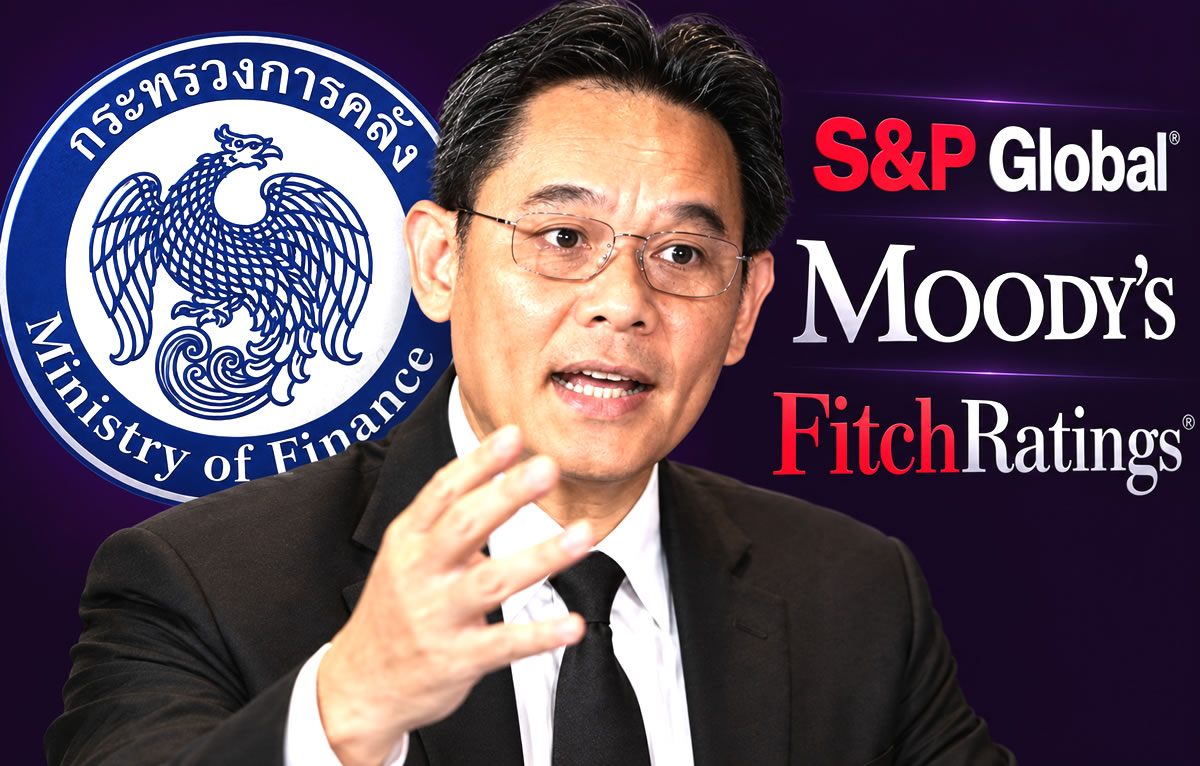
The International Monetary Fund therefore assesses Thailand’s sovereign debt-stress risk as moderate rather than high. International credit-rating agencies also maintain Thailand’s investment-grade sovereign ratings. S&P reaffirmed Thailand’s BBB+ sovereign rating in June 2026 and maintained a stable outlook.
The agency cited Thailand’s external position and economic fundamentals among factors supporting the rating. Meanwhile, Moody’s has maintained Thailand’s Baa1 sovereign rating. In April, it restored the country’s outlook from negative to stable. Thailand’s immediate problem is therefore not an inability to service its government debt.
Instead, Mr Danucha’s concern centres on the rapid loss of fiscal freedom. Before Covid-19, public debt stood at approximately 41.1% of gross domestic product. Today, he puts the figure at approximately 67.5%. More than 26 percentage points now separate Thailand’s pre-pandemic position from its current debt burden.
Meanwhile, the statutory ceiling remains 70%. Yet the government continues to face pressure to support an economy experiencing weak growth. Economic stimulus requires public money and can require additional borrowing. Each large deficit-financed programme can therefore reduce the remaining buffer further.
Emergency loans, debt costs and ageing pressures show how quickly Thailand’s fiscal room is shrinking
The ฿400 billion emergency borrowing approved in May demonstrates how quickly that room can disappear. February debt stood at approximately 66.07% of gross domestic product. Full borrowing was estimated to lift it to approximately 68.18%. One government calculation then put fiscal 2027 debt at 69.88%.
Separately, the fiscal-risk scenario puts Thailand above 70% during fiscal 2028 and 2029. At the same time, government revenue has weakened relative to the economy. Net revenue has fallen from 16.7% of output in fiscal 2016 to approximately 15% in fiscal 2025.
Debt servicing compounds the pressure. More than ฿400 billion is already required annually. Over ฿200 billion goes towards interest, while more than ฿100 billion covers principal repayments. Those commitments consume budget resources before new programmes or another emergency are considered.
Demographics add another layer. By around 2034, approximately 28.4% of Thailand’s population could be aged 60 or older. Pension, healthcare and welfare demands will therefore increase. At the same time, the working-age population supporting growth and taxation will decline.
Danucha calls for restraint as official debt projections leave Thailand with almost no room below ceiling
Taken together, those numbers explain Mr Danucha’s call for immediate restraint. Debt is substantially higher than before Covid-19, while annual deficits remain large. Revenue is proportionately lower and economic growth remains weak. Meanwhile, long-term expenditure commitments continue rising.
Official projections still show Thailand remaining beneath the current 70% debt ceiling. However, several leave almost no margin. The medium-term framework puts debt at 69.8% during fiscal 2028. Another calculation puts it at 69.88% during fiscal 2027.
Beyond that, a separate fiscal-risk scenario crosses 70% during fiscal 2028 and 2029. Consequently, the financial cushion available to future governments has narrowed sharply. Another large shock would arrive against a very different fiscal backdrop from Covid-19.
Mr Danucha’s proposed response therefore covers spending, debt, taxation and public-sector reform. He wants tight budgets maintained for another two to three years. Unnecessary expenditure would be reduced, while available central-budget money could finance additional debt repayments.
In parallel, the government workforce could be reduced and inefficient state-enterprise investments reviewed. Welfare assistance would become more closely targeted towards economic need. Government databases could also identify duplicated payments across separate schemes.
Tax reform and productivity spending form final parts of Danucha’s plan to rebuild Thailand’s fiscal room
On the revenue side, digital-payment information could help identify businesses operating outside the tax system. Those businesses could subsequently be brought into the tax base. Meanwhile, public expenditure would increasingly target education, healthcare, infrastructure and technology to support productivity.
Mr Danucha’s warning is not that Thailand cannot service its debts today. Nor did he predict a fiscal crisis within two or three years. Rather, those two or three years are the period he wants used to rebuild fiscal capacity.
Thailand joins minimum tax regime aimed at large global corporations as it hooks into world networks
Bank of Thailand warns economic potential is falling with a severe crisis in the small business sector
Thailand entered Covid-19 with public debt around 41% of gross domestic product. Today, Mr Danucha puts it at approximately 67.5%, against a 70% statutory ceiling. Another major economic shock would therefore hit Thailand with far less borrowing room than it possessed before the pandemic.
Join the Thai News forum, follow Thai Examiner on Facebook here
Follow Thai Examiner on Google here
Receive all our stories as they come out on Telegram here
Follow Thai Examiner here
Further reading:
Thailand joins minimum tax regime aimed at large global corporations as it hooks into world networks
Tax and welfare revolution as Thailand moves ahead with Negative Income Tax that expands reporting
Thumbs up from economic gurus for 2027 Negative Income Tax plan. It’s a game-changer for progress
Expert warns foreign tourism has become Thailand’s curse, fueling inertia and a widespread malaise