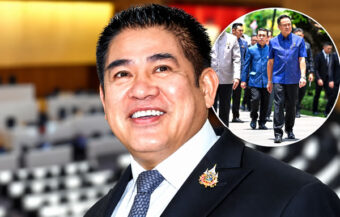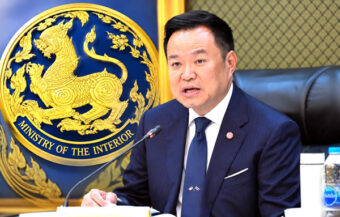
Prime Minister Anutin Charnvirakul plunges to 13.76% in a dramatic NIDA Poll as Nattapong leads at 24.72%. People’s Party towers over rivals at 35.40%, while Pheu Thai rebounds and 19.80% of voters say no PM candidate is suitable.
Thailand’s political battle took a dramatic turn on Sunday as Prime Minister Anutin Charnvirakul’s support crashed to 13.76% in the latest NIDA Poll. People’s Party leader Nattapong Ruangpanyawut still leads at 24.72%, while his party towers over rivals at 35.40%. Yet Nattapong is also sliding. Meanwhile, Pheu Thai is surging back, with Deputy Prime Minister Yotsanan Wongsawat closing fast on Anutin. Most ominously for every major contender, 19.80% now reject the entire field as unsuitable for prime minister. That figure has more than doubled this year as economic pressure bites and political uncertainty raises the prospect of another electoral showdown.

Thailand’s latest NIDA Poll has delivered a sharp warning to Prime Minister Anutin Charnvirakul and the country’s major political forces. Support for the Prime Minister has fallen dramatically during 2026. His Bhumjaithai Party has suffered a similar reversal.
However, People’s Party leader Nattapong Ruangpanyawut has problems of his own. He remains Thailand’s leading choice for prime minister. Yet his personal support has fallen for two consecutive quarters. Meanwhile, Pheu Thai has recovered substantial ground. Deputy Prime Minister Yotsanan Wongsawat has also emerged as a significant contender.
More strikingly, the biggest movement is towards none of them. Almost one Thai in five now says there is no suitable candidate for prime minister. That group has more than doubled since the beginning of 2026. Notably, it now ranks second in the NIDA survey. It stands ahead of Prime Minister Anutin and every named politician except Mr Nattapong.
NIDA poll puts Nattapong first as Anutin slides and nearly one in five voters reject all candidates
The findings came from NIDA Poll’s third-quarter political popularity survey, released on Sunday. The National Institute of Development Administration questioned 2,500 people nationwide between September 18 and 23. Respondents were aged 18 or above. In addition, they represented different regions, education levels, occupations and income groups.
NIDA used probability sampling from its Master Sample database. Researchers also employed multi-stage sampling and conducted telephone interviews. Overall, the poll was conducted at a 97% confidence level.
People’s Party leader Nattapong Ruangpanyawut remained the leading named choice for prime minister with 24.72%. However, that headline figure conceals a steady decline throughout 2026. Mr Nattapong began the year with 30.60% support during the first quarter. Subsequently, his rating fell to 26.08% during the second quarter. It has now fallen again to 24.72%.
As a result, Mr Nattapong has lost 5.88 percentage points since the first quarter. Nevertheless, he remains comfortably ahead of every other named politician. The sharper contrast comes from his own party. The People’s Party stands at 35.40%, more than ten percentage points above its leader.
Prime Minister Anutin Charnvirakul has suffered a considerably more severe fall. At the beginning of 2026, he stood at 29.40%. At that stage, only 1.20 percentage points separated him from Mr Nattapong. Combined, the two politicians commanded exactly 60% support.
Anutin tumbles to third as voters choosing no suitable prime minister surge to almost one in five
Since then, the political picture has changed sharply. Prime Minister Anutin fell to 21.68% during the second quarter. His support has now dropped again to only 13.76%. Accordingly, he has lost 15.64 percentage points since the first quarter. The gap with Mr Nattapong has widened from 1.20 points to 10.96 points.
Prime Minister Anutin has also fallen from second to third place. Crucially, another politician did not overtake him. Instead, voters unable to find any suitable prime minister moved ahead.
Some 19.80% of respondents now say they have not yet found the right person. This represents one of the survey’s most dramatic movements. Only 8.20% gave that answer during the first quarter. Three months later, the figure increased to 10.24%. Now it has surged to 19.80%.
Consequently, the group without a suitable candidate has more than doubled since the beginning of 2026. It has also almost doubled during the latest quarter alone. Furthermore, it now exceeds Prime Minister Anutin’s support by 6.04 percentage points. It exceeds Deputy Prime Minister Yotsanan’s rating by 8.52 points.
Only Mr Nattapong remains ahead of that group. Even then, the difference is just 4.92 percentage points. Earlier this year, the corresponding gap stood at 22.40 points. The narrowing has therefore been dramatic.
Another comparison exposes the scale of the movement. Mr Nattapong and Prime Minister Anutin commanded 60% during the first quarter. Now their combined support stands at only 38.48%. In nine months, their combined rating has fallen by 21.52 percentage points.
Pheu Thai regains ground as Yotsanan closes on Anutin while Bhumjaithai falls back to third place
Yet no single rival has captured anything approaching that loss. Mr Nattapong has not benefited from Prime Minister Anutin’s collapse. On the contrary, his own support has also fallen. Other named contenders remain far behind.
Pheu Thai has moved in a different direction. Deputy Prime Minister Yotsanan Wongsawat ranked fourth among preferred prime ministerial candidates with 11.28%. His latest result is slightly below the 11.64% recorded during the second quarter. Even so, he began the year considerably lower.
Deputy Prime Minister Yotsanan received 8.08% during the first quarter. Thus, his support remains 3.20 percentage points above its early-2026 level. He now trails Prime Minister Anutin by only 2.48 percentage points. That margin places the two politicians relatively close in the latest survey.
Pheu Thai itself has made considerably stronger gains. The party now stands second nationally with 18.44%. It began 2026 with only 12.04%. In turn, Pheu Thai has gained 6.40 percentage points since the first quarter.
By contrast, Bhumjaithai has moved sharply backwards. The party now stands third with only 12.08%. Earlier this year, it held a substantial advantage over Pheu Thai. That position has now reversed. Pheu Thai leads Bhumjaithai by 6.36 percentage points.
People’s Party holds commanding national lead even as Nattapong’s personal support continues to fall
In parallel, the personal ratings show contrasting fortunes for their leading figures. Prime Minister Anutin has fallen heavily during 2026. Deputy Prime Minister Yotsanan remains above his first-quarter position. Pheu Thai has therefore returned to second place among the parties measured by NIDA.
Still, the People’s Party remains far ahead of both. It received 35.40%, compared with Pheu Thai’s 18.44%. Its support has also remained remarkably stable during 2026. The party has stayed around 34-35% throughout the three quarterly surveys.
That stability creates one of Sunday’s clearest political contrasts. Mr Nattapong’s personal rating has fallen from 30.60% to 24.72%. The People’s Party, however, continues to command more than one-third of respondents. Indeed, its support has edged upwards from 34.80% in the previous quarter.
Hence, Mr Nattapong’s personal decline has not produced a comparable fall in party preference. A 10.68-point gap now separates his rating from his party. The People’s Party remains dominant nationally while its leader has lost personal ground.
For the People’s Party, national polling represents only one measure of electoral strength. The NIDA survey measures nationwide political preferences. It does not measure local canvassing organisations, constituency machinery or provincial political networks.
People’s Party faces test converting national polling strength into constituency votes across provinces
Separately, those factors become important during electoral contests outside Bangkok and the wider metropolitan area. Parties must compete across the North, Northeast, Central region, West and South. National popularity must then translate into votes within individual constituencies.
Recent local contests have raised questions about that conversion. However, the latest NIDA survey cannot answer those questions. Its 35.40% figure establishes national party preference. It does not establish constituency-level organisational strength.
The distinction matters because national and local political contests operate differently. Provincial candidates can rely on longstanding political organisations and constituency networks. National party identification remains important. However, constituency elections also require effective local candidates and organisations.
Against that background, Mr Nattapong faces a clear numerical issue within the NIDA findings themselves. His party remains exceptionally strong while his personal rating continues falling. The gap between the People’s Party and its leader has consequently widened.
Bhumjaithai faces a different problem. Prime Minister Anutin and his party are both losing support. The Prime Minister stands at 13.76%, while Bhumjaithai stands at 12.08%. Only 1.68 percentage points separate the leader from his party.
Pheu Thai presents another pattern. Deputy Prime Minister Yotsanan receives 11.28% as a prime ministerial choice. Pheu Thai, however, commands 18.44% as a party. Party support therefore exceeds his personal rating by 7.16 percentage points.
Abhisit tracks Democrat support as smaller parties and prime ministerial contenders remain far behind
The Democrat Party shows much closer alignment. Former Prime Minister Abhisit Vejjajiva received 9.60% as a prime ministerial choice. The Democrat Party received 9.80%. Accordingly, only 0.20 percentage points separate Mr Abhisit from his party.
Below the leading contenders, support becomes considerably more fragmented. Dr Warong Dechgitvigrom of the Thai Bhakdi Party received 5.68%. Khunying Sudarat Keyuraphan of Thai Sang Thai followed with 2.64%.
Elsewhere, Police Lieutenant General Rewat Klinngesorn of the Rak Muang Thai Party received 2.36%. Police General Seripisut Temiyaves of the Seri Ruam Thai Party received 2.24%. Former Prime Minister General Prayut Chan-o-cha stood at 1.52%.
Further down, General Rangsi Kitiyansap of the Economic Party received 1.48%. Peerapan Salirathavipak of Ruam Thai Sang Chart received 1.40%. Pheu Thai politician Chulaphan Amornvivat stood at 1.08%.
Another 2.44% selected other political figures. These included Treenuch Thianthong of the Palang Pracharath Party and Captain Thamanat Promphao of Kla Tham. Jatuporn Buruspat of the Okas Mai Party was also named.
On another front, some respondents selected other People’s Party politicians. These included Parit Wacharasindhu and Rakchanok Srinok. Police Colonel Tawee Sodsong of the Prachachart Party also received mentions. Former Prime Minister Chuan Leekpai was another choice.
Bhumjaithai figures join wider field as voters reject prime ministerial choices more than parties
Several figures associated with Bhumjaithai also appeared among the other choices. They included Deputy Prime Minister and Foreign Minister Sihasak Phuangketkaew. Commerce Minister Suphajee Suthumpun was also named, alongside Jetsada Thaiseth.
Additionally, Bangkok Governor Chadchart Sittipunt and General Prawit Wongsuwan appeared among the other responses. None, however, secured enough support to enter NIDA’s principal ranking.
The party figures were similarly fragmented below the four leading parties. Some 7.64% said they had not found a suitable political party. That figure is far below the 19.80% unable to identify a suitable prime minister.
Importantly, the difference separates attitudes towards politicians from attitudes towards parties. Many respondents rejecting the available leadership choices still identify with a political party. Rejection of the prime ministerial field is therefore substantially higher.
Thai Bhakdi received 4.68%. Ruam Thai Sang Chart followed with 2.16%. Thai Sang Thai and Rak Muang Thai each received 1.80%. The Seri Ruam Thai Party received 1.72%, while the Economic Party stood at 1.52%.
Beyond those parties, another 2.76% selected other political groups. These included Kla Tham, Palang Pracharath and the Opportunity Party. Prachachart, Thai Ruam Palang, New Alternative and Phonlawat were also mentioned.
Anutin loses over half his support as Nattapong also slides and voters increasingly choose neither leader
Only 0.20% declined to answer or expressed no interest. Thus, the survey does not show widespread rejection of political parties themselves. Its sharpest rejection appears among the available prime ministerial choices.
Taken together, the figures show markedly different movements between personalities and parties. The People’s Party remains dominant despite Mr Nattapong’s personal decline. Pheu Thai has recovered while Deputy Prime Minister Yotsanan remains stronger than in the first quarter.
Bhumjaithai, conversely, has moved sharply backwards alongside Prime Minister Anutin. The Prime Minister has suffered the largest personal fall among the leading candidates. His decline has transformed what was previously an extremely close contest with Mr Nattapong.
During the first quarter, Mr Nattapong stood at 30.60%. Prime Minister Anutin stood close behind at 29.40%. Only 1.20 percentage points separated them.
Nine months later, neither reached 25%. Mr Nattapong stands at 24.72%. Prime Minister Anutin has fallen below 14%. At the same time, 19.80% say no candidate is currently suitable.
For Prime Minister Anutin, the decline is particularly stark. He has lost more than half his first-quarter support. His rating has fallen from 29.40% to 13.76%. That represents a 15.64-point fall.
Those voters, however, have not moved en masse towards Mr Nattapong. The People’s Party leader has simultaneously lost 5.88 points. Nor have they transferred overwhelmingly towards Deputy Prime Minister Yotsanan.
No suitable candidate surges above Anutin as economic pressure forms backdrop to shifting voter choices
Instead, the “no suitable candidate” category has gained 11.60 percentage points. It rose from 8.20% to 19.80%. In proportional terms, that represents growth exceeding 140%.
More recently, the shift has accelerated. The figure stood at only 10.24% three months ago. It has now almost doubled to 19.80%.
During the same quarter, Mr Nattapong slipped from 26.08% to 24.72%. Prime Minister Anutin plunged from 21.68% to 13.76%. Deputy Prime Minister Yotsanan edged down from 11.64% to 11.28%.
Strikingly, none of those three leading named candidates gained during the latest quarter. The group rejecting every available choice surged by 9.56 percentage points.
That is among the hardest numbers in Sunday’s survey. It also changes the shape of the prime ministerial field. A category that ranked well behind the leading politicians earlier this year now stands second.
The economic backdrop remains difficult. Thailand continues to face weak domestic demand and heavy household indebtedness. Household debt continues restricting spending and domestic economic activity.
At grassroots level, economic pressure remains an important part of the wider national environment. The NIDA Poll, however, did not ask respondents why their political preferences changed.
Election would test People’s Party national lead against constituency networks across provincial Thailand
Accordingly, the survey does not establish that economic conditions caused the movement. Nor does it establish why 19.80% cannot identify a suitable prime minister. It instead records political preferences during September.
The numbers nevertheless arrive while the government continues efforts to strengthen economic activity. They also come amid the potential for renewed political instability and another return to the polls.
Should that happen, national polling would meet the realities of constituency politics. The People’s Party would enter such a contest with the strongest national preference.
Its 35.40% rating provides a commanding advantage over Pheu Thai and Bhumjaithai. Yet national support must ultimately translate into individual constituency victories.
Outside Bangkok and the wider metropolis, that means competing throughout provincial Thailand. The battlefield stretches across the North, Northeast, Central region, West and South.
There, constituency candidates and local organisations become critical. Established provincial networks can also carry significant electoral weight. The NIDA survey does not measure those capabilities.
Pheu Thai strengthens into second as Bhumjaithai retreats and smaller rivals remain heavily fragmented
Even so, it establishes the scale of the People’s Party’s national advantage. At 35.40%, it stands 16.96 percentage points ahead of Pheu Thai. It leads Bhumjaithai by 23.32 points.
Pheu Thai would enter any such contest from a markedly improved polling position. Its support has risen from 12.04% to 18.44% during 2026. It has also overtaken Bhumjaithai to reclaim second place.
At the leadership level, Deputy Prime Minister Yotsanan remains substantially stronger than during the first quarter. His 11.28% rating, however, remains below Pheu Thai’s party support.
Bhumjaithai faces the opposite direction of travel. Its party rating has fallen to 12.08%. Prime Minister Anutin’s personal support has collapsed to 13.76%.
As a consequence, the governing party now trails Pheu Thai by more than six points. Its leader also trails the “no suitable candidate” group by more than six points.
The Democrat Party remains a mid-sized force in the survey. It commands 9.80% party support. Mr Abhisit’s personal rating is almost identical at 9.60%.
Below that level, the political field becomes heavily fragmented. No other party reaches 5%. Likewise, no other named prime ministerial candidate reaches 6%.
People’s Party stays dominant but Nattapong slides as Pheu Thai recovers and Anutin suffers sharp reversal
Sunday’s survey therefore produces three markedly different pictures among Thailand’s largest political forces. The People’s Party retains overwhelming polling strength compared with its rivals. However, Mr Nattapong’s personal support continues moving downwards.
Pheu Thai has recovered significant ground. Deputy Prime Minister Yotsanan also remains well above his first-quarter position. Bhumjaithai, by comparison, has suffered a major reversal.
Prime Minister Anutin has suffered an even more dramatic personal fall. Yet support lost by Thailand’s leading politicians has not consolidated behind another leader.
Instead, the largest growth has occurred among voters who cannot find anyone suitable. At the beginning of 2026, barely one respondent in twelve gave that answer. Now almost one in five does.
Furthermore, that group is larger than the support commanded by Thailand’s sitting Prime Minister. It also substantially exceeds support for Deputy Prime Minister Yotsanan.
Only People’s Party leader Nattapong Ruangpanyawut remains ahead. Even his lead over the “no suitable candidate” group has narrowed below five percentage points.
NIDA poll leaves People’s Party far ahead while nearly one in five voters find no suitable prime minister
The latest NIDA Poll consequently leaves Thailand with a clear party leader but no comparable dominant prime ministerial candidate.
The People’s Party remains first at 35.40%. Pheu Thai follows on 18.44%, while Bhumjaithai has fallen to 12.08%. The Democrat Party stands at 9.80%.
The leadership field is considerably tighter. Mr Nattapong leads with 24.72%. Yet 19.80% choose nobody.
Prime Minister Anutin follows with 13.76%. Deputy Prime Minister Yotsanan stands close behind at 11.28%. Mr Abhisit follows with 9.60%, while everyone else remains below 6%. Ultimately, the strongest political party retains a commanding national polling lead. However, its leader has lost almost six points since the beginning of 2026.
NIDA opinion poll puts ‘Teng’ on top in choice for PM and the People’s Party way ahead of Bhumjaithai
Poll shows public jaded with politics. Technocratic office holders are viewed more positively by public
Pheu Thai, meanwhile, is rebuilding support while Bhumjaithai is losing it. Prime Minister Anutin has suffered the steepest personal decline among the leading figures.
Above all, the numbers record a sharp increase among voters unwilling to choose any current candidate for prime minister.
That group has climbed from 8.20% to 19.80% in nine months. Meanwhile, Thailand’s two leading candidates at the start of 2026 have lost 21.52 percentage points between them.
No rival politician has captured most of that support. Instead, almost one-fifth of respondents now look across the prime ministerial field and select nobody.
Join the Thai News forum, follow Thai Examiner on Facebook here
Follow Thai Examiner on Google here
Receive all our stories as they come out on Telegram here
Follow Thai Examiner here
Further reading:
People’s Party candidate in Bangkok arrested on Monday over links to money laundering network