High-season alarm for Thailand as direct international flights to Hat Yai, Krabi and Koh Samui plunge. Foreign arrivals are down 4%, while Kasikorn cuts its tourism forecast by 2.74 million and Malaysia and Vietnam surge ahead in new aviation growth.
Thailand’s tourism industry faces mounting pressure as foreign arrivals fall 4.12% and international airlines expand far faster into Malaysia, Vietnam and China. New Kasikorn Research Centre figures expose sharp cuts in flights to Krabi, Koh Samui and Hat Yai ahead of the high season. Meanwhile, Thai AirAsia is slashing capacity as fuel costs soar and airline profits shrink. Kasikorn has already cut its 2026 tourist forecast by 2.74 million visitors. The worsening outlook gives fresh weight to warnings issued by senior economists in November 2025 about Thailand’s declining tourism competitiveness and persistently weak visitor spending since the COVID-19 pandemic closures of 2020 and 2021.
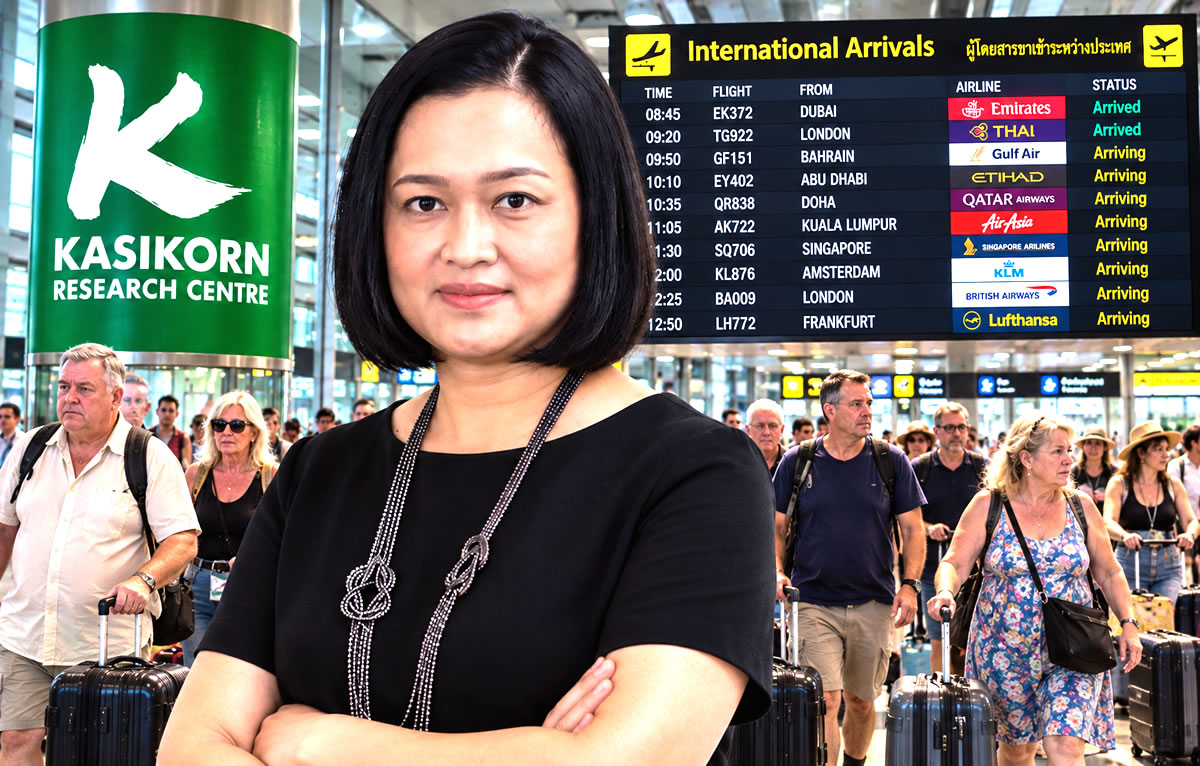
Thailand is losing ground in Asia’s aviation market as international airlines expand services far more rapidly into competing destinations. New Kasikorn Research Centre figures show Thailand trailing Malaysia, Vietnam and China in scheduled international flight growth.
Meanwhile, foreign tourism arrivals have fallen by approximately 4% this year, compounding pressure on the country’s tourism industry. The latest figures reinforce warnings issued by senior Kasikorn economists in November 2025. They also expose sharp reductions in direct international services to Krabi, Koh Samui and Hat Yai.
The research, published on 12 October, forecasts 5.8% growth in incoming international flights during the final quarter of 2026. Although this exceeds worldwide growth of 2.5%, Thailand trails six of the nine Asian destinations examined. Malaysia leads with 15% growth, followed by Vietnam at 13.6% and China at 13.4%. Indonesia, South Korea and Singapore are also expanding faster. Consequently, Thailand ranks seventh despite remaining one of Southeast Asia’s largest aviation and tourism markets.
Kasikorn slashes tourism forecast as Varithorn’s earlier warnings on weak visitor spending gain force
The findings come as Thailand’s tourism outlook has deteriorated sharply since last November. Kasikorn has already reduced its 2026 foreign visitor forecast from 34.1 million to 31.36 million.
That represents 2.74 million fewer expected arrivals than previously projected. In addition, the centre forecasts international tourism receipts of approximately ฿1.54 trillion, down around 3%. The latest aviation figures now reveal further weaknesses ahead of the peak tourism season.
The deterioration was anticipated by Varithorn Sirisattayawong, Head of Research at Kasikorn Research Centre, in November 2025. She warned that Thailand’s tourism recovery remained below its potential, despite expectations of returning Chinese visitors.
More importantly, she identified weak spending per tourist and receipts that had failed to regain pre-pandemic levels. Her assessment challenged the industry’s dependence on increasing arrival numbers without securing stronger financial returns.
Varithorn urged higher-value tourism before arrivals forecasts fell and receipts weakened in 2026
At the time, Kasikorn expected 34.1 million foreign visitors during 2026, representing growth of 4%. That followed an estimated 7% contraction in 2025. Nevertheless, Varithorn cautioned that higher visitor numbers alone would not restore the industry’s financial performance. Instead, Thailand needed to develop tourism products capable of attracting travellers who spent more during their visits.
She identified major international concerts, sporting events and global theme parks as potential attractions. Furthermore, international conferences, exhibitions, medical tourism and wellness services offered opportunities for higher-value spending.
However, Varithorn acknowledged that developing these markets would require substantial investment and effective international marketing. Her comments were made before Kasikorn’s forecasts deteriorated during 2026.
By August, the centre had abandoned its earlier expectation of renewed visitor growth. Its revised forecast anticipated 31.36 million foreign arrivals, representing a projected annual decline of 4.9%. Meanwhile, expected international tourism receipts fell to approximately ฿1.54 trillion. The latest year-to-date visitor figures show a contraction of approximately 4%, steeper than the August full-year forecast.
Tourism forecasts diverge from actual arrivals as Kasikorn warns of declining tourism competitiveness
The difference between the two estimates is important. Kasikorn’s 4.9% decline represents its forecast for the entire year. In contrast, the approximately 4% reduction reflects arrivals recorded so far during 2026. Nevertheless, both figures demonstrate the deterioration since November 2025, when the centre still anticipated a recovery.
Varithorn’s earlier assessment has therefore gained significance as Thailand’s tourism performance has weakened. However, her documented remarks concerned the November 2025 outlook, not the latest October aviation study. The new research provides further evidence of the commercial pressures she identified almost a year earlier.
Another senior Kasikorn economist issued a more explicit warning alongside Varithorn’s assessment. Kevalin Wangpichayasuk, Deputy Managing Director of Kasikorn Research Centre, identified growing signs of declining international tourism competitiveness.
She also highlighted the narrowing gap between foreign tourism receipts and Thai spending on overseas travel. Moreover, growth from Europe and India was failing to compensate fully for weaker Chinese and ASEAN arrivals.
Kasikorn data expose uneven regional growth as secondary destinations struggle for international flights
Kevalin identified another longstanding problem affecting Thailand’s tourism industry. Foreign visitors remained heavily concentrated in established destinations, while secondary cities received insufficient benefits.
Consequently, tourism growth was failing to spread more evenly across the country. The latest aviation figures now reveal substantial differences between Thailand’s principal tourist centres.
Kasikorn’s October research examines scheduled international flights between October and December 2026. The figures are based on Bloomberg airline schedules available on 7 October. Importantly, they measure planned services rather than completed flights or confirmed passenger arrivals.
Airlines may still revise schedules before departure. Nevertheless, the figures provide a detailed comparison of international aviation expansion across major Asian destinations.
Malaysia’s incoming international flights are scheduled to increase by 15% compared with the corresponding quarter of 2025. Vietnam follows with growth of 13.6%, while China is expanding by 13.4%.
Indonesia is recording an 8.9% increase, followed by South Korea at 7.9% and Singapore at 6.6%. Thailand follows at 5.8%, ahead of the Philippines at 2.5%. Japan is the only destination recording a contraction, with scheduled international flights declining by 1.7%.
Malaysia and Vietnam outpace Thailand as Chiang Mai gains flights but other resorts lose connections
The gap between Thailand and its strongest competitors is substantial. Malaysia’s growth rate is more than two and a half times Thailand’s figure. Similarly, Vietnam is expanding international flights at more than twice Thailand’s pace.
China is also recording growth exceeding double Thailand’s rate. Even Singapore, an established regional aviation hub, is increasing incoming services more rapidly.
Thailand’s performance remains stronger than the worldwide average. However, the regional comparison exposes a weaker position among several important competing destinations. Airlines are scheduling substantially faster expansion into Malaysia, Vietnam and China. Meanwhile, Thailand’s national increase conceals significant reductions in services to several tourist centres.
Chiang Mai is recording the strongest growth among the Thai destinations examined. Scheduled international flights into the northern city are increasing by 14.3% during the fourth quarter. Bangkok follows with growth of 6.8%, while Phuket is expanding by 6.4%. In contrast, Hat Yai, Krabi and Koh Samui face steep reductions in direct overseas connections.
Hat Yai, Krabi and Koh Samui face deep international flight cuts ahead of the peak tourism season
Hat Yai is recording the largest contraction, with scheduled international flights falling by 29.2%. Krabi follows with a decline of 22.3%, while Koh Samui faces a 20.6% reduction. These losses contrast sharply with the overall national increase of 5.8%. Indeed, Hat Yai is losing almost three in ten scheduled international services compared with last year.
Krabi and Koh Samui are also experiencing reductions exceeding one fifth. Consequently, three established tourist destinations face substantially fewer direct international connections ahead of the high season. The reductions affect access to hotels, resorts and other tourism businesses dependent on overseas customers.
Direct flights allow international visitors to reach destinations without additional domestic connections or lengthy road transfers. When services are withdrawn, passengers may need alternative routes through Bangkok or other airports.
Furthermore, competing holiday destinations offering convenient direct connections can become more attractive. The loss of international services therefore presents a commercial problem for affected tourism businesses.
However, the figures concern direct international flights rather than total visitor arrivals. Travellers reaching Krabi through Bangkok or Phuket would not appear as direct international arrivals at Krabi Airport. Similarly, foreign visitors reaching Koh Samui through domestic connections would not be included in its international flight figures. Nevertheless, the reductions indicate weaker direct access from overseas markets.
Thai Hotels Association warns on Krabi connections as passenger growth fails to match added flights
The Thai Hotels Association has already expressed concern about Krabi’s international aviation connections. Its president, Thienprasith Chaiyapatranun, warned about the implications for accommodation businesses ahead of the high season.
Separately, he reported that Phuket was retaining important Middle Eastern connections. However, passenger growth was considerably weaker than the increase in scheduled flights.
That difference is significant for the tourism industry. Additional aircraft services do not necessarily produce equivalent increases in passenger numbers. Likewise, higher visitor arrivals do not automatically generate proportional growth in tourism receipts. These issues reflect the concerns raised by Varithorn about visitor spending and the industry’s financial performance.
Kasikorn’s breakdown of incoming flights by origin market reveals further weaknesses. China and Europe are supplying much of Thailand’s projected aviation growth. However, services from India, South Korea and Russia are declining. The contrasting figures demonstrate how expansion from selected markets is compensating for reductions elsewhere.
Chinese and European flights rise sharply while India, South Korea and Russia record falling services
Scheduled flights from Europe are increasing by 28.6% compared with the final quarter of 2025. Meanwhile, incoming services from China are expanding by 21.6%. Kasikorn identifies these markets as the principal contributors to Thailand’s overall growth. China alone is expected to provide 13,035 incoming international flights during the quarter.
Nevertheless, stronger Chinese flight schedules do not guarantee equivalent growth in Chinese visitor arrivals. Passenger occupancy, ticket prices and travel patterns influence the eventual results. Furthermore, some travellers may use international flights for purposes other than tourism. The increase in scheduled services therefore cannot be treated as a direct measure of additional holidaymakers.
Elsewhere, the figures are considerably weaker. Scheduled flights from India are declining by 4.6% to 5,344 services. Malaysia is recording modest growth of 1.9%, with 4,544 incoming flights. In contrast, South Korea and Russia face much sharper reductions.
Incoming flights from South Korea are scheduled to fall by 20.5%, leaving 2,222 services during the quarter. Russia faces an even larger contraction of 22.5%, with 1,408 scheduled flights. These declines affect two established international visitor markets. Moreover, the South Korean reduction follows a prolonged deterioration in tourist arrivals.
South Korean arrivals weaken as regional rivals gain tourists seeking better value and cheaper trips
Kasikorn previously identified weakening South Korean visitor numbers beginning in January 2025. The latest flight schedules now show a substantial reduction in direct aviation services from that market.
Meanwhile, fewer flights from India and Russia add to the difficulties facing Thailand’s tourism industry. Stronger Chinese and European services must therefore offset weakness across several established markets.
Kasikorn’s August research also identified changing international travel preferences. Tourists were increasingly selecting destinations according to affordability and perceived value. Notably, Chinese travellers were showing greater interest in Vietnam and South Korea. Malaysia and Indonesia were also benefiting from changing regional travel patterns.
These developments have intensified competition for international visitors. Thailand remains a major destination, but several regional rivals are attracting faster aviation expansion. Furthermore, weaker arrivals from established markets have complicated the country’s recovery. The October figures show that increased services from Europe and China are occurring alongside substantial contractions elsewhere.
OAG figures show Thailand losing airline seats while Vietnam and Indonesia expand aviation capacity
Separate figures from aviation data specialist OAG reinforce concerns about Thailand’s performance. For October 2026, Thailand remains Southeast Asia’s second-largest aviation market by scheduled airline seats. However, its total scheduled capacity has declined by 1.7% compared with October 2025. Thailand has approximately 7.43 million scheduled airline seats during the month.
Vietnam presents a contrasting picture. Its scheduled airline seat capacity has increased by 10.6% to approximately 6.52 million. Meanwhile, Indonesia remains Southeast Asia’s largest aviation market, with 10.94 million scheduled seats. Its capacity has increased by 4.7% compared with October last year.
The comparison reveals another difference between Thailand and its regional competitors. Thailand is recording a contraction in total scheduled airline seats, while Vietnam and Indonesia continue expanding. Nevertheless, OAG’s figures measure a different aspect of aviation activity from Kasikorn’s research.
OAG counts domestic and international scheduled airline seats during October. Kasikorn measures incoming international flights across the entire fourth quarter. Consequently, the figures cannot be compared directly. However, both sets of data show Thailand performing more weakly than several competing aviation markets.
The distinction between flight numbers and passenger capacity is also important. Airlines can increase scheduled flight frequencies without increasing available seats by the same proportion. Aircraft size, seating arrangements and domestic services all influence total capacity. Furthermore, actual passenger numbers depend on how many seats airlines ultimately fill.
Thai AirAsia cuts seats sharply as fuel costs, aircraft shortages and regional pressures hit carriers
OAG’s figures reveal particularly difficult conditions for some low-cost carriers. Thai AirAsia has reduced its October scheduled seat capacity by 17.7%, equivalent to approximately 364,400 seats. In contrast, Vietnam Airlines has increased capacity by 9.7%. The difference highlights contrasting capacity decisions among important regional carriers.
Across Southeast Asia, low-cost airline seat capacity has contracted by 3.7%. Meanwhile, full-service carriers have expanded their capacity by 5.5%. Thai AirAsia’s reduction is therefore considerably sharper than the regional low-cost average. The figures reveal substantial pressure on budget aviation services during 2026.
Higher operating costs are another important factor affecting the industry. Kasikorn identifies geopolitical tensions, flooding in some Thai provinces and persistently high jet fuel prices as immediate risks. These pressures could prompt airlines to postpone additional services or withdraw existing routes. Furthermore, expensive fuel can make weaker routes less commercially attractive.
Separately, Krungsri Research has identified wider operational problems affecting Thailand’s aviation industry. Aircraft delivery delays, maintenance constraints and airport infrastructure limitations are restricting capacity expansion. Weaker domestic purchasing power is also affecting the operating environment. In addition, the Middle East conflict has increased airline costs and disrupted some international routes.
Higher fuel bills and aircraft constraints squeeze airline profits and threaten services into Thailand
Some carriers have altered flight paths to avoid affected airspace. Consequently, longer journeys have increased fuel consumption and operating expenses. Higher costs place additional pressure on airline profitability, particularly where passenger demand remains weak. Airlines must also consider aircraft availability and expected occupancy before adding services.
Krungsri expects the Thai aviation industry’s net profit margin to decline from 4.2% in 2025 to approximately 2% in 2026. That represents a substantial deterioration in profitability. Furthermore, aircraft delivery delays and maintenance restrictions could constrain expansion for another two to three years. Some major airport infrastructure projects are not expected to be completed until after 2028.
These restrictions affect airline capacity decisions even where passenger demand remains relatively healthy. Aircraft availability, maintenance requirements and airport infrastructure determine how quickly carriers can expand. Meanwhile, higher operating expenses can encourage reductions on less profitable routes. Krungsri expects some airlines to adjust frequencies to protect occupancy rates and earnings.
The commercial consequences extend beyond airlines and airports. International tourism supports hotels, restaurants, transport operators, tour businesses and retailers across Thailand. When direct overseas connections decline, local businesses face reduced access to important international markets. Furthermore, weaker visitor growth can affect employment and working hours across tourism-related industries.
Tourist centres face lost direct flights as Kasikorn cuts its forecast by 2.74 million expected arrivals
The pressure is particularly relevant to destinations experiencing sharp reductions in international flights. Krabi, Koh Samui and Hat Yai are all recording contractions exceeding 20%. Meanwhile, Hat Yai’s decline approaches 30%. These figures reveal substantially weaker direct international connectivity despite Thailand’s overall aviation growth.
However, Kasikorn has not calculated a specific financial loss attributable to slower flight expansion. Nor can differences in scheduled aviation growth be converted directly into lost visitors or tourism receipts. Actual arrivals depend on passenger demand, aircraft capacity and airline occupancy. Nevertheless, the reductions present clear commercial difficulties for destinations dependent on international visitors.
The wider tourism forecasts show how substantially expectations have deteriorated. In November 2025, Kasikorn anticipated 34.1 million foreign arrivals during 2026. By August, that estimate had fallen to 31.36 million. Meanwhile, projected international tourism receipts stood at approximately ฿1.54 trillion, down around 3%.
The revised arrivals forecast represents 2.74 million fewer visitors than originally anticipated. Furthermore, the latest year-to-date decline of approximately 4% shows that foreign tourism remains under pressure. This is steeper than Kasikorn’s August full-year forecast of a 4.9% contraction. However, the two figures concern different reporting periods.
Varithorn and Kevalin’s 2025 warnings gain force as Thailand trails rivals in scheduled flight growth
These developments have reinforced the relevance of the November 2025 warnings from Varithorn and Kevalin. Varithorn identified weak spending per visitor and the need for higher-value tourism products.
Kevalin warned about declining competitiveness and insufficient distribution of tourism beyond established destinations. Both assessments preceded the latest deterioration in aviation schedules and visitor forecasts.
The October research now shows Thailand trailing six Asian destinations in scheduled international flight growth. Moreover, several important Thai tourist centres are losing direct overseas connections. Meanwhile, Malaysia, Vietnam and China are recording increases exceeding twice Thailand’s rate.
Thailand nevertheless retains an extensive international aviation network. Bangkok remains an important regional gateway, while Phuket continues attracting additional services. Chiang Mai is also recording strong double-digit growth. However, these gains contrast with the reductions affecting Krabi, Koh Samui and Hat Yai.
For the remainder of 2026, Kasikorn identifies geopolitical uncertainty, flooding and high fuel costs as immediate threats. Airlines may still revise schedules as operating conditions change. Meanwhile, stronger Chinese and European services have yet to establish how many additional passengers will arrive during the high season.
Krabi hotels face high-season flight losses as airlines reassess routes and rising operating costs
The Thai Hotels Association remains particularly concerned about Krabi’s reduced international connections. Its president has warned about the implications for local accommodation businesses.
On another front, Krungsri’s aviation outlook points to weaker airline profitability and continuing capacity restrictions. Aircraft shortages and infrastructure limitations are expected to remain problems beyond 2026.
Airlines begin axing flights as jet fuel supplies dwindle. Massive impact on the foreign tourism sector
AirAsia boss calls on government to postpone 53.4% hike in airport charges for a year over fuel costs
The next important evidence will come from completed flights, actual visitor arrivals and hotel performance during the peak tourism season. Airlines will also continue adjusting schedules according to demand, operating costs and aircraft availability. For Krabi, Koh Samui and Hat Yai, the immediate issue is whether direct international services can recover.
Kasikorn’s November 2025 tourism forecast has already undergone a major downward revision. Its October aviation research now provides another measure of Thailand’s weakening competitive position. Meanwhile, Malaysia, Vietnam and China are expanding international flights considerably faster. The remaining months of 2026 will establish whether stronger Chinese and European connections can offset reductions elsewhere.
Join the Thai News forum, follow Thai Examiner on Facebook here
Follow Thai Examiner on Google here
Receive all our stories as they come out on Telegram here
Follow Thai Examiner here
Further reading:
60-day visa regime to be ended confirms Minister responding to rising industry security concerns
Tourism boss warns Thailand it is facing a Chinese blacklist if another security controversy erupts
Visa waiver scheme questioned with another China Crisis for foreign tourism driven by security fears
Tourism cryptocurrency sandbox payment plan is bound to face stiff opposition from the central bank