Xi Jinping faces Thailand’s arsenic crisis as Anutin demands help for poisoned northern rivers. China promises cooperation but no mine closures. Meanwhile, both leaders advance a Singapore rail link, Thai rice exports and a crackdown on scam gangs.
Chinese President Xi Jinping has pledged to help Thailand confront toxic arsenic poisoning in its northern rivers after Prime Minister Anutin Charnvirakul challenged him in Shenzhen on Friday, November 20. Crucially, Xi acknowledged possible Chinese business involvement in environmental damage and promised technical assistance. Meanwhile, both leaders backed accelerating a China-to-Singapore railway through Laos, Thailand and Malaysia. Talks also advanced a 500,000-tonne Thai rice deal, Chinese investment, tourism and joint action against international scam gangs. With poisoned rivers threatening communities, fisheries and farmland, Thailand is preparing urgent talks with Burma and China next week. However, no agreement was reached to shut suspected polluting mines.
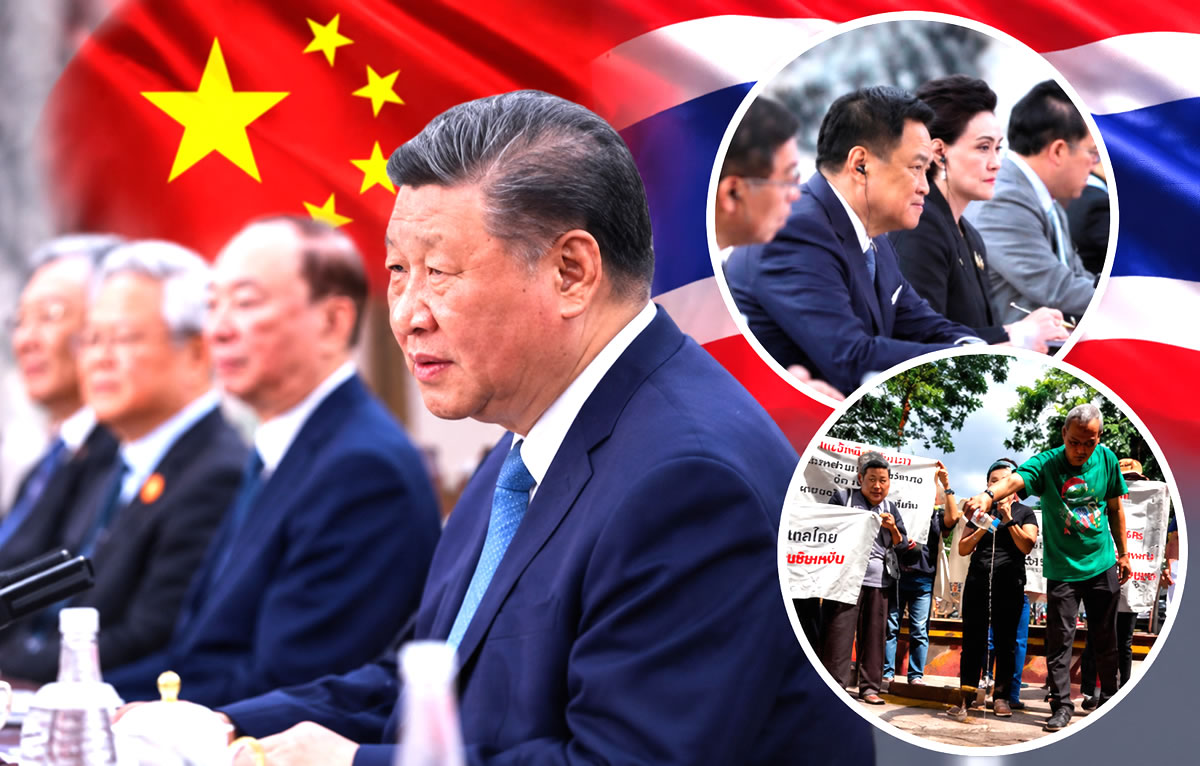
Chinese President Xi Jinping has pledged urgent assistance to Thailand over dangerous arsenic pollution contaminating the country’s northern rivers. The commitment followed talks with Prime Minister Anutin Charnvirakul in Shenzhen, China, on Friday, November 20.
Significantly, Xi also backed accelerating a railway corridor linking China with Singapore through Laos, Thailand and Malaysia. The meeting followed the 33rd APEC Economic Leaders’ Meeting and brought together senior Thai ministers and Chinese officials.
The discussions delivered a major diplomatic advance for Bangkok as toxic contamination threatens northern communities, agriculture and fisheries. Anutin raised pollution affecting the Sai, Kok, Ruak and Mekong rivers directly with the Chinese President.
Xi pledges Chinese help on poisoned Thai rivers as Anutin secures support for major regional rail links
In response, Xi declared that Beijing opposed environmentally damaging activities and was ready to provide technical assistance. China also agreed to strengthen water-quality inspections, environmental monitoring and systematic measures to address contamination.
At the same meeting, both leaders agreed to accelerate railway connections extending from China through Thailand towards Singapore. The proposed network would strengthen Thailand’s position at the centre of Southeast Asian trade and transport.
Crucially, discussions covered a second railway bridge connecting Nong Khai with Vientiane, the capital of Laos. Another priority was the Chiang Khong–Nateuy–Mohan route linking northern Thailand with Laos and China’s railway system.
The talks followed Chinese Premier Li Qiang’s official visit to Thailand the previous week. Friday’s meeting therefore advanced several priorities already under consideration between the two governments.
These included infrastructure, Chinese investment, agricultural exports, technology and regional security. However, the most immediate concern was the contamination of Thailand’s northern waterways and the need for international cooperation.
Beijing promises technical support as Thailand confronts arsenic contamination in four northern rivers
Thai government spokesman Ekkapob Pianpises confirmed the outcome following the bilateral meeting. Both leaders reaffirmed their commitment to the Thailand-China comprehensive strategic cooperative partnership.
Notably, Xi expressed Beijing’s readiness to assist Thailand in confronting cross-border river pollution. The Chinese government also agreed to strengthen technical cooperation with Thai authorities investigating the contamination and its sources.
The environmental emergency has become a serious problem for communities along Thailand’s northern rivers. Arsenic contamination threatens water supplies, fisheries and agricultural activities dependent on these waterways.
Furthermore, concerns extend beyond Thailand’s borders to upstream mining operations in neighbouring countries. Thai environmental inspections cannot directly control industrial activities taking place outside the country’s territory.
Anutin pressed Xi for cooperation in addressing the contamination at its source. He identified the Sai, Kok, Ruak and Mekong rivers as waterways requiring urgent attention.
The Chinese President responded by reaffirming Beijing’s opposition to environmentally damaging activities. He also expressed readiness to assist Thailand through technical monitoring and coordinated environmental measures.
Xi acknowledges possible Chinese business links to pollution as Thailand seeks action on upstream mines
Importantly, Deputy Prime Minister and Foreign Minister Sihasak Phuangketkeow later disclosed further details of the exchange. Xi had acknowledged the possibility of Chinese private-sector involvement in environmentally damaging activities.
Nevertheless, the Chinese leader stressed that Beijing opposed improper practices and operations breaching environmental standards. His acknowledgement did not establish responsibility for any particular mining company or industrial operation.
The discussion brought suspected upstream pollution directly before China’s President. Bangkok has sought stronger international cooperation as contamination continues to affect northern waterways.
The Chinese commitment provides a basis for joint scientific investigations and closer environmental coordination. However, neither government announced an agreement to close suspected polluting mines or a timetable for eliminating the contamination.
Anutin also proposed raising the emergency at December’s Mekong–Lancang Cooperation Leaders’ Meeting in Guilin, China. The forum brings together China and countries sharing the Mekong River system.
As a result, the contamination problem will receive further attention through regional diplomatic discussions. Thailand wants stronger cooperation among governments responsible for upstream and downstream water management.
Thailand, Burma and China prepare urgent talks as scientists investigate sources of toxic river pollution
Meanwhile, preparations are advancing for separate discussions involving Thailand and Burma. Sihasak confirmed that a Thai-Burmese working group will meet on November 25–26, following preliminary discussions on November 24.
Significantly, China’s ambassador to Thailand is expected to participate in the earlier talks. This will bring Chinese diplomatic representation into discussions concerning pollution affecting Thailand’s northern waterways.
The meetings follow discussions between Thai officials and Burma’s leadership concerning contamination entering Thailand from across its borders.
The working group will provide another channel for examining upstream pollution and environmental cooperation. In parallel, Chinese academic institutions are preparing technical cooperation with Mae Fah Luang University and Thai authorities. This will support scientific investigations into the origins and movement of dangerous pollutants.
Deputy Prime Minister Yotsanan Wongsawat outlined further measures following the Shenzhen discussions. Yotsanan oversees higher education, science and research within the Thai government.
He confirmed plans for a joint technical working group investigating contamination at its source. Thai scientists intend to employ chemical measurements and isotope analysis to examine arsenic entering northern river systems.
Thai scientists pursue arsenic testing and sediment removal to protect northern rivers and farmland
The investigations will focus on identifying where dangerous substances enter the waterways. Scientists will also examine contamination patterns using specialised analytical techniques.
Consequently, the research could provide technical evidence for discussions with neighbouring governments. The findings would support efforts to establish the origins of pollution affecting Thai communities and agricultural areas.
Separately, the government is developing emergency measures to protect drinking water and agricultural land. Officials are examining experimental sediment-trapping technology designed to capture arsenic attached to fine particles.
The proposed system targets contaminated sediment carried downstream by river currents. Its purpose is to reduce the movement of dangerous material through affected waterways while wider environmental measures are developed.
One proposed system has produced computer-modelled results indicating arsenic removal rates reaching 94.6%. However, that figure remains a modelling result rather than demonstrated full-scale operating performance.
Thailand prepares 18-month arsenic removal trial covering 27,000 rai as ministers report on Xi talks
The government is preparing an 18-month pilot project to examine the technology under practical conditions. The proposed programme is intended to protect approximately 27,000 rai of agricultural land.
The project forms part of Thailand’s response while international discussions continue. Water-quality monitoring and scientific analysis remain central to identifying contamination sources.
Alongside this, the pilot programme will examine whether sediment removal can provide effective protection. Its results will establish how the proposed technology performs outside computer simulations and under operating conditions.
The environmental discussions involved several senior members of Anutin’s delegation. Deputy Prime Minister and Foreign Minister Sihasak Phuangketkeow played a central role in diplomatic coordination. Deputy Prime Minister Yotsanan Wongsawat addressed the scientific and technical response. Commerce Minister Supachai Sutthumpun also participated in the government’s APEC programme.
Anutin’s ministers return from China with river pollution commitments and plans for regional rail links
Following the talks, the ministers appeared alongside Anutin at Don Mueang Airport to explain the diplomatic results. Their statements outlined the environmental commitments, railway discussions and wider economic cooperation.
Notably, the pollution issue will return to the diplomatic agenda within days. The scheduled meetings involving Burmese and Chinese representation provide the next stage of international discussions.
Beyond the environmental emergency, Xi and Anutin advanced a major programme of regional railway development. Both leaders agreed to accelerate connections linking China, Laos and Thailand with Malaysia and Singapore.
The proposed network would create stronger transport links across mainland Southeast Asia. Thailand would occupy a central position along the corridor connecting Chinese industrial centres with markets further south.
The first major project involves a second railway bridge between Nong Khai and Vientiane. Nong Khai lies on Thailand’s northeastern border with Laos, opposite the Lao capital. The additional crossing is intended to strengthen railway connections between the two countries.
Moreover, it would support wider efforts to improve transport links between Thailand and China’s existing railway network.
China and Thailand advance Chiang Khong rail route to strengthen trade links across Southeast Asia
The second project concerns the Chiang Khong–Nateuy–Mohan railway route. This proposed connection would strengthen links between northern Thailand, Laos and China.
Together, the projects would improve cross-border transport capacity and support regional freight movements. They also form part of efforts to connect existing railway infrastructure across national borders and reduce transport bottlenecks.
For Thailand, the proposed corridor carries substantial economic importance. Improved railway connections would support agricultural exporters, industrial manufacturers and logistics operators.
In addition, stronger transport links could improve access to Chinese manufacturing centres and Southeast Asian distribution networks. The network would also support investment along major regional trade routes and strengthen commercial connections.
The proposed route extends beyond Thailand towards Malaysia and Singapore. Consequently, it would strengthen connections between China’s southern transport network and markets across Southeast Asia.
Both governments regard railway development as an important component of regional economic integration. However, Friday’s meeting did not produce a final construction timetable, a completed railway agreement or comprehensive financing package.
China and Thailand accelerate rail plans while Beijing backs purchase of 500,000 tonnes of Thai rice
The leaders instead agreed to accelerate existing connectivity plans. Further construction, coordination and infrastructure development remain necessary before continuous services can operate along the proposed corridor.
Even so, the agreement renewed political support for projects central to Thailand’s transport ambitions. The Nong Khai and Chiang Khong connections remain important elements of those plans.
Trade also featured prominently in the bilateral meeting. China and Thailand agreed to promote more balanced commercial exchanges and improve market access for Thai products.
Significantly, both governments advanced plans involving China’s purchase of 500,000 tonnes of Thai rice. The proposed transaction would support Thailand’s agricultural export sector and strengthen commercial ties with Beijing.
On another front, the leaders discussed expanding Chinese market access through geographical indication registration and online trading platforms. These measures would provide further opportunities for Thai agricultural producers and exporters.
Both governments also supported wider efforts to strengthen commercial cooperation. The discussions formed part of their commitment to developing a more balanced trading relationship.
Beijing supports Thai investment in electric vehicles, clean energy and technology as scam talks advance
Chinese investment was another major subject. Beijing expressed support for high-quality investment in Thailand, particularly in advanced industrial sectors. These included digital technology, clean energy, space technology and electric vehicles.
Furthermore, both governments discussed expanding cooperation in artificial intelligence and aerospace development as part of their economic partnership.
Xi also called for stronger cooperation in disaster management, water resources and scientific development. The Chinese President supported closer exchanges between government institutions and greater coordination on regional security.
As part of this, the discussions extended beyond traditional trade into technology, infrastructure and environmental management. These areas form part of the broader Thailand-China strategic partnership.
Security cooperation received particular attention as both countries confront international criminal networks. Anutin and Xi agreed to strengthen joint efforts against transnational crime.
Specifically, the discussions covered online scam networks, telecommunications fraud and illegal online gambling. Both governments supported closer coordination against criminal operations affecting people across national borders.
Anutin seeks Chinese tourist confidence as Xi offers help with Cambodia and regional peace discussions
At the same time, Anutin reaffirmed Thailand’s commitment to protecting foreign visitors, including Chinese tourists. He stressed that the government placed the highest priority on tourist safety regardless of nationality.
Thailand also expressed readiness to cooperate with China in providing accurate information to travellers. The discussions included efforts to restore confidence among Chinese visitors.
Regional diplomacy formed another part of Friday’s agenda. Xi offered Chinese assistance towards improving relations between Thailand and Cambodia.
In response, Anutin reaffirmed Bangkok’s commitment to resolving disputes through peaceful dialogue and international law. Both leaders also discussed efforts to support peace in Burma and strengthen cooperation through ASEAN.
Elsewhere in the talks, the governments addressed cooperation through other international organisations. They discussed the development of safe and accessible artificial intelligence and wider environmental protection.
Thailand also expressed support for China’s role in biodiversity conservation. Bangkok additionally confirmed plans to proceed with domestic steps towards joining the Agreement on Biodiversity Beyond National Jurisdiction.
Thailand prepares fresh pollution talks with Burma and China after Xi pledges technical cooperation
The Shenzhen meeting followed another important diplomatic engagement between Bangkok and Beijing. Chinese Premier Li Qiang had visited Thailand the previous week.
Accordingly, Anutin’s discussions with Xi provided a further opportunity to advance their economic and strategic partnership. The talks covered transport infrastructure, investment, agricultural trade, environmental protection and regional security.
The immediate focus will now return to the contamination affecting Thailand’s northern rivers. Preliminary discussions involving Chinese diplomatic participation are scheduled for November 24. The Thai-Burmese working group will then meet on November 25–26. Anutin also intends to raise the issue again at December’s Mekong–Lancang summit in Guilin.
The next stage will involve scientific cooperation, water-quality monitoring and discussions over upstream contamination. Thai authorities are also preparing their proposed sediment-trapping pilot project.
Meanwhile, Chinese academic institutions are expected to work with Thai researchers investigating pollution sources. These measures follow Xi’s commitment to provide assistance against environmental damage.
China and Thailand press ahead with regional railway links as arsenic talks enter their next stage
For the railway programme, attention will turn to the Nong Khai–Vientiane bridge and Chiang Khong–Nateuy–Mohan connection. Both projects are intended to strengthen links between Thailand, Laos and China’s existing transport infrastructure. The wider objective remains a railway corridor connecting China with Malaysia and Singapore through Thailand. The leaders have agreed to accelerate these connections as part of their regional economic cooperation.
Friday’s talks produced commitments covering two major Thai priorities. Xi pledged Chinese cooperation over the arsenic pollution emergency threatening northern waterways.
Simultaneously, both leaders backed faster development of railway connections across Southeast Asia. The discussions also advanced rice exports, Chinese investment, technological cooperation and joint action against international crime.
Anutin returned to Thailand with Beijing’s agreement to assist on river contamination and accelerate regional transport links. Crucially, the first diplomatic follow-up is scheduled for November 24, when discussions on the pollution emergency resume. The Thai-Burmese working group will meet on November 25–26, followed by further regional discussions in China during December.
Join the Thai News forum, follow Thai Examiner on Facebook here
Follow Thai Examiner on Google here
Receive all our stories as they come out on Telegram here
Follow Thai Examiner here
Further reading:
River Kok in Chiang Rai poisoned with arsenic from Wa state-controlled gold mining across the border
Rangsiman Rome MP calls for stiffer response to Myanmar’s junta over the jailing of Thai sailors
Myanmar Junta meltdown threatens to end Bangkok’s condominium sales boom as Kyat currency fails