Thaksin faces bankruptcy after losing his bid to halt a ฿17.629 billion tax chase. Officials target five cars, including two bulletproof vehicles, and freeze ฿90 million. His mansion remains untouched as a December court date looms next.
Former Prime Minister Thaksin Shinawatra faces asset seizures and possible bankruptcy after a crushing court defeat on Monday. Judges rejected his bid to block enforcement of a ฿17.629 billion tax bill, leaving his fortune exposed. Already, ฿90 million in bank deposits has reportedly been frozen. Five luxury cars face seizure, including two bulletproof vehicles Thaksin says protect him after four assassination attempts. His Thonburi mansion could also face scrutiny, although no seizure is confirmed. Meanwhile, Thaksin claims the state is pursuing money already covered by a ฿46.37 billion confiscation. His next hearing is December 21, with litigation potentially continuing into 2027. However, tax officials can keep seizing assets and may pursue bankruptcy if recovery falls short.
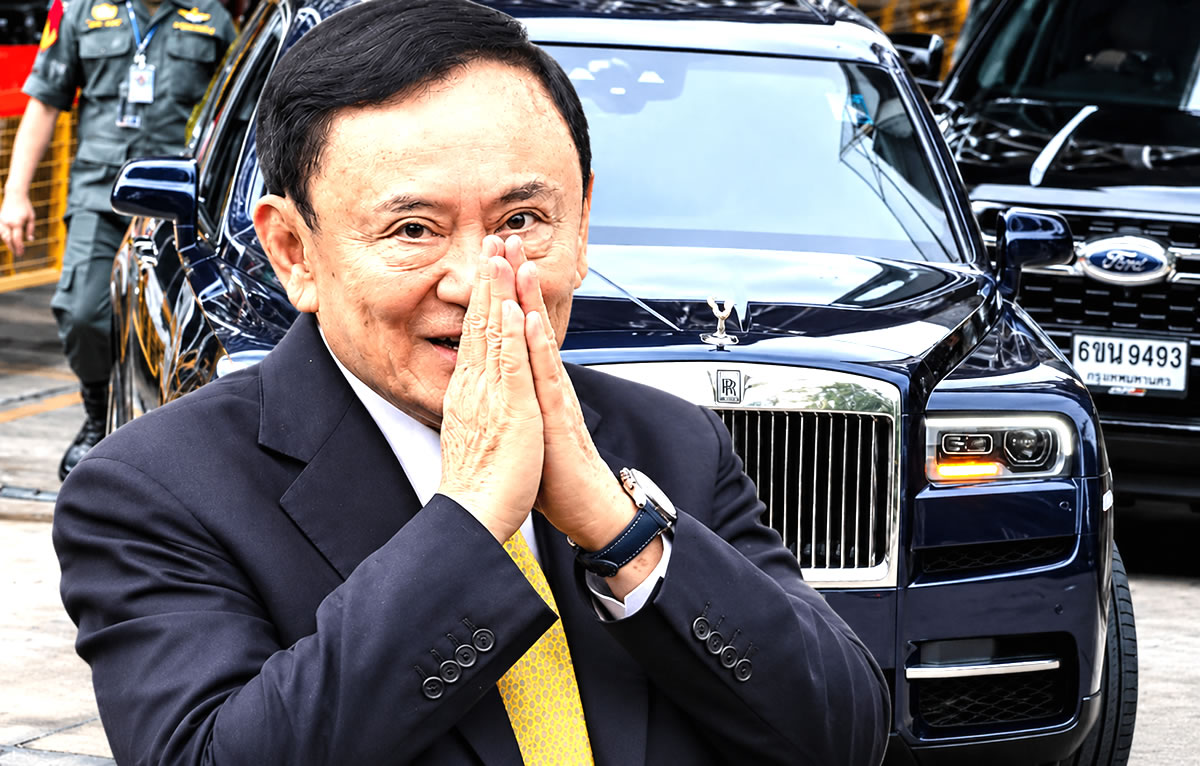
Former Prime Minister Thaksin Shinawatra suffered a major legal defeat on Monday, November 16, as his ฿17.629 billion tax battle intensified. The Central Tax Court rejected his bid to stop the Revenue Department seizing his assets.
Consequently, officials can continue pursuing bank accounts, land and luxury vehicles while his court challenge remains unresolved. Five cars face seizure orders, including two bulletproof vehicles which Thaksin says are essential for his personal safety.
In addition, approximately ฿90 million in bank deposits has reportedly been frozen. The Revenue Department has warned that bankruptcy proceedings could follow if enforcement fails to recover the debt. Thaksin’s lawyers are preparing an appeal, while his separate lawsuit returns to court on December 21. However, that legal battle could continue into 2027 as the authorities pursue his fortune.
Tax Court rejects Thaksin’s injunction bid as Revenue Department enforces his outstanding tax debt
The Central Tax Court delivered its ruling in Bangkok on Monday in case No. 59/2569. Thaksin brought the proceedings against the Revenue Department after officials began enforcing the enormous tax assessment.
His lawyer, Winyat Chatmontri, attended the hearing at the Government Complex on Chaeng Watthana Road. The judges dismissed his application for temporary protection against further asset seizures and attachments. Crucially, they found that his legal team had used the wrong procedure to challenge enforcement.
The ruling leaves the Revenue Department free to continue collecting the outstanding debt. Meanwhile, Thaksin faces further pressure over property already identified for recovery.
However, the judges did not decide whether the authorities were unlawfully collecting money previously confiscated by the state. That remains the central argument in his continuing lawsuit. His lawyers maintain that the government is attempting to recover the same underlying money twice.
Instead, Monday’s judgment concerned the distinction between temporary protection before judgment and enforcement of an existing debt. The court examined Sections 254 and 264 of the Civil Procedure Code alongside Section 12 of the Revenue Code.
Under its interpretation, the Revenue Department was exercising statutory powers to recover an established tax liability. Accordingly, the department occupied the legal position of an enforcing creditor, while Thaksin was the debtor.
Judges reject temporary protection as Thaksin prepares appeal and further hearings over tax collection
The judges ruled that Thaksin could not invoke Section 254(2) to restrain the department’s enforcement measures. That provision concerns temporary protection before judgment. By contrast, the disputed collection measures had already reached the enforcement stage.
The court also identified Section 289 as a possible route for challenging enforcement, subject to its legal requirements. Nevertheless, Monday’s decision did not resolve the separate dispute over alleged duplicate collection.
The immediate consequences are substantial. The Revenue Department can continue enforcement while Thaksin’s underlying lawsuit proceeds.
Winyat said the court had decided a legal question without examining the disputed facts. Those matters are expected to be considered during subsequent hearings. He confirmed that Thaksin had been informed of the ruling and instructed his lawyers to continue fighting.
His legal team intends to appeal the refusal of temporary protection. Separately, the substantive lawsuit returns to court on December 21. The judges are expected to define the issues in dispute before witness proceedings begin. Evidence may be examined during 2027.
Revenue Department targets bank deposits, five luxury cars and Chiang Mai land despite ongoing court case
However, the continuing lawsuit does not automatically suspend enforcement of the tax debt. Officials therefore retain their collection powers unless another court order changes the position.
Details disclosed by Winyat reveal the extent of the existing measures against Thaksin’s property. Approximately ฿90 million in bank deposits has reportedly been frozen. Furthermore, five vehicles are subject to seizure orders, including two bulletproof cars.
Land in Chiang Mai, reportedly jointly owned by Thaksin and his sister, has also been targeted. Yet no auction of the assets had taken place by Monday, according to his lawyer.
A seizure or attachment order does not necessarily mean the property has already been sold. Nevertheless, such measures can restrict an owner’s ability to transfer or dispose of assets. The Revenue Department can subsequently pursue sales under the applicable enforcement procedures.
For Thaksin, the two bulletproof vehicles present a particularly serious personal concern. He raised their possible loss during an earlier court hearing on October 7.
At that hearing, Thaksin told the judges that he had survived four assassination attempts while serving as prime minister. He maintained that the armoured vehicles were necessary for his personal security.
Thaksin’s bulletproof cars face enforcement as frozen deposits barely dent the ฿17.629 billion tax bill
Consequently, he presented their seizure as a threat to his protection rather than simply a financial loss. However, personal security concerns do not automatically exempt expensive vehicles from lawful debt enforcement. No separate court order protecting the bulletproof cars has been identified.
The vehicles therefore remain exposed to enforcement following Monday’s ruling. Their eventual disposal and the timing of any sale remain uncertain. Likewise, the Revenue Department has not disclosed their estimated recovery value.
The five cars form part of a wider collection effort against one of Thailand’s wealthiest former political leaders. Yet the assets publicly identified represent only a fraction of the outstanding demand.
The reported ฿90 million in frozen deposits amounts to approximately 0.51% of the ฿17.629 billion liability. Even if fully recovered, that money would leave approximately ฿17.54 billion outstanding.
This excludes proceeds from other property and any subsequent changes to the amount due. Consequently, the Revenue Department faces a substantial recovery task. The vehicles and Chiang Mai land could provide further funds, but their values remain undisclosed.
Thaksin’s Thonburi mansion remains a potential target but no seizure or auction has been confirmed
Nor has the department published a comprehensive inventory of assets sufficient to satisfy the assessment. That uncertainty raises questions about Thaksin’s other property, including his famous Chan Song La mansion.
The residence stands in Bangkok’s Thonburi district and has long been associated with the Shinawatra family. It also remains closely identified with Thaksin’s political activities. However, no verified report establishes that the Revenue Department has seized the property.
Neither has an attachment against the mansion been confirmed. No auction has been announced. Nevertheless, the residence could become relevant if Thaksin holds a legally identifiable ownership interest. Its exposure depends on registered ownership and the applicable enforcement rules. If he personally owns the mansion, or a share, that interest could potentially be pursued.
Property legally belonging to another family member cannot automatically be seized for Thaksin’s personal tax debt. Instead, the Revenue Department would need to establish a lawful basis for reaching assets held by another person.
Transfers designed to defeat creditors may also face legal challenges where sufficient evidence exists. For now, the Thonburi mansion remains a potential enforcement target rather than a confirmed seizure.
Bankruptcy threat grows as Revenue Department considers further action if asset seizures fail to pay debt
On another front, the possibility of bankruptcy presents a much wider threat to Thaksin’s financial position. The Revenue Department has already indicated that bankruptcy proceedings could follow if ordinary enforcement fails.
In June, then acting director-general Somsak Anantawat publicly outlined that possibility. Officials indicated that seizures and other collection measures would be pursued before bankruptcy was considered.
Monday’s judgment does not initiate bankruptcy proceedings. However, it allows enforcement to continue without the temporary protection Thaksin requested.
Under Thailand’s Bankruptcy Act, a creditor can generally petition for an individual’s bankruptcy when statutory conditions are satisfied. Those conditions include insolvency and a definite debt of at least ฿1 million. Thaksin’s liability exceeds that monetary threshold by an enormous margin.
Nevertheless, a large unpaid debt does not automatically establish insolvency. The Revenue Department would still need to demonstrate that the legal requirements had been met. Any bankruptcy application would therefore require separate proceedings before the Central Bankruptcy Court. No such petition against Thaksin has been confirmed in the available reporting. Nor has any court declared the former prime minister bankrupt.
Bankruptcy could place Thaksin’s assets under an official receiver and trigger full financial inquiries
The prospect remains significant because of the debt’s size and the limited recovery disclosed. Notably, Winyat acknowledged on Monday that bankruptcy could depend on the proceeds from asset sales.
He also referred to the applicable legal criteria, which remain contested. If the department eventually files a petition, the bankruptcy court would examine the supporting evidence. The proceedings would then move beyond enforcement against individual assets.
Where the statutory conditions are established, the court can place the debtor’s property under an official receiver. Such an order would substantially restrict Thaksin’s control over his financial affairs.
The receiver could investigate bank accounts, investments, property holdings and business interests. As part of this process, officials could examine relevant transactions and identify assets held through other structures.
The receiver could also require financial information and explanations concerning property ownership. Eligible assets could then be collected and sold for the benefit of creditors. The proceeds would be distributed according to bankruptcy law.
However, property belonging to Thaksin’s children, siblings or associated companies would not automatically enter his bankruptcy estate. Officials would need to establish the relevant ownership interests or successfully challenge particular transactions.
Potential bankruptcy raises wider questions over Thaksin’s overseas wealth and foreign investments
Bankruptcy proceedings could therefore involve a considerably wider examination of Thaksin’s wealth than the present seizures. They could also bring previously unresolved ownership questions before the courts.
Further proceedings might involve creditor claims, arrangements with creditors and eventual discharge. Thai personal bankruptcy law generally provides a three-year discharge framework, subject to exceptions and extensions. Importantly, certain liabilities, including some tax-related debts, may survive discharge.
Consequently, bankruptcy would not necessarily eliminate Thaksin’s outstanding tax obligations. It could instead place his finances under official supervision while creditors pursue recoverable assets. The implications could extend beyond his property in Thailand.
Thaksin spent approximately 15 years abroad following his removal from office in September 2006. During that period, he lived for extended periods in Dubai and maintained international business interests.
His wealth has also been associated with investments outside Thailand. Forbes estimated his fortune at approximately $2.1 billion in 2025. However, that figure does not establish how much is personally owned by Thaksin.
Nor does it provide an audited inventory of property available to satisfy the Thai tax judgment. Publicly identified overseas investments have included interests associated with British health technology companies DNANudge and Owlstone Medical.
Foreign assets remain beyond automatic enforcement as officials face legal barriers to overseas recovery
Nevertheless, the existence of those investments does not establish their current ownership or value. It also does not demonstrate whether they could be reached through the present enforcement proceedings.
There is no verified public inventory of Thaksin’s overseas bank deposits, property holdings or beneficial interests. More significantly, no confirmed evidence establishes that the Revenue Department has frozen or recovered specified overseas assets.
The distinction between domestic and foreign property is legally important. Thai enforcement orders do not automatically operate outside Thailand. In November 2025, Legal Execution Department Deputy Director-General Penrawee Masang explained the limitations on enforcing Thai civil judgments overseas.
Officials cannot simply present a domestic enforcement order to a foreign bank and demand payment. Instead, recovery abroad would generally require proceedings under the laws of the relevant jurisdiction.
Such proceedings could involve identifying assets, establishing ownership and obtaining recognition or other legal relief. Furthermore, foreign courts may distinguish ordinary civil debts from another country’s tax demands.
Overseas recovery obstacles deepen as Thaksin challenges tax collection tied to 2006 Shin Corp sale
Consequently, substantial overseas wealth would not automatically become recoverable property for the Revenue Department. Officials would need to establish ownership and a lawful means of enforcement. Thaksin’s long period abroad makes those legal distinctions relevant to any wider recovery effort.
However, there is no verified evidence that foreign authorities have already sequestered significant assets under the current proceedings. The Revenue Department’s confirmed recovery efforts remain focused on property identified through the Thai enforcement process.
Meanwhile, the underlying tax dispute stretches back two decades to the 2006 sale of Shin Corporation. That transaction triggered a series of legal battles concerning Thaksin’s fortune.
In 2010, the Supreme Court’s Criminal Division for Holders of Political Positions ordered the confiscation of approximately ฿46.37 billion. The ruling concerned assets associated with Thaksin’s Shin Corporation holdings. His lawyers now argue that approximately ฿15.88 billion underlying the later tax assessment was already covered by that confiscation. They maintain that the government should not recover the same underlying money twice.
That argument forms the centre of Thaksin’s current challenge to the Revenue Department’s enforcement measures.
However, the tax authorities rely on a separate Supreme Court judgment delivered in November 2025. On November 17, the Supreme Court’s Tax Division reinstated the assessment of approximately ฿17.6 billion. The amount included personal income tax, penalties and surcharges arising from the 2006 Shin Corp share sale.
Supreme Court tax ruling underpins Revenue enforcement despite Thaksin’s double recovery claim
The court found that shares held through Thaksin’s children were attributable to him for tax purposes. Accordingly, the Supreme Court upheld the assessment against the former prime minister.
That judgment established the liability which the Revenue Department is now seeking to recover. Thaksin subsequently brought a fresh lawsuit before the Central Tax Court in July 2026. His action challenges enforcement rather than simply reopening the original dispute over the assessment.
At the October 7 hearing, Thaksin indicated that he accepted the Supreme Court’s ruling on liability. However, he maintained that the subsequent collection measures were unlawful. His lawyers argue that the earlier confiscation and later tax recovery concern the same underlying funds. The Revenue Department’s position rests on the distinction between confiscation under one judgment and personal income tax under another.
Those are separate legal consequences arising from proceedings connected with the Shin Corporation transaction. Nevertheless, whether the earlier confiscation legally restricts subsequent recovery remains unresolved.
Monday’s ruling did not decide that question. Instead, the judges considered whether Thaksin qualified for temporary protection through the procedure he invoked. They concluded that he did not.
Thaksin faces asset sales during his court case as Revenue Department retains enforcement powers
Consequently, the substantive lawsuit continues without the injunction his lawyers requested. The Revenue Department retains its enforcement powers while the underlying legal dispute remains before the court.
This leaves Thaksin facing two simultaneous processes over the coming months. His lawyers will continue challenging the collection measures, with the next hearing scheduled for December 21. In parallel, the department can continue identifying, seizing and potentially selling assets.
Any appeal against Monday’s ruling would not automatically suspend enforcement. Further protection would require an appropriate legal order. Therefore, Thaksin remains exposed to asset recovery despite his continuing challenge. The immediate targets include five vehicles, particularly the two bulletproof cars. He has told the court that those vehicles are necessary because of previous attempts on his life.
Yet Monday’s decision provides no protection against their enforcement under the procedure he invoked. The approximately ฿90 million in frozen deposits also remains part of the recovery process. In addition, the reported Chiang Mai land interests remain exposed.
The position of his Chan Song La residence has not been established as part of any confirmed seizure. Nor has the Revenue Department disclosed sufficient identified assets to cover the outstanding assessment.
The prospect of further recovery measures therefore remains substantial. Separately, the department has already raised bankruptcy as a possible next step if ordinary enforcement proves insufficient. Such proceedings would require a petition and proof of the statutory conditions.
Thaksin remains exposed to bankruptcy and further asset seizures while tax dispute moves towards 2027
Nevertheless, they could place Thaksin’s personal finances under much wider official scrutiny. His overseas interests could also become relevant, although foreign enforcement would face additional legal requirements.
For the moment, Thaksin retains his right to challenge the collection measures. His lawyers have confirmed that they intend to continue. However, the Central Tax Court has refused to shield his assets through the temporary procedure used in Monday’s application. The ฿17.629 billion liability remains enforceable, and no completed auction has yet been reported.
Thaksin has not been declared bankrupt, and no confirmed bankruptcy petition has been filed. Nevertheless, the Revenue Department has identified assets for recovery and publicly raised the possibility of bankruptcy.
Thaksin’s mansion and bulletproof cars on the line as court reserves decision on tax debt injunction
Thaksin comes to Tax Court in Bangkok seeking temporary injunction to halt Revenue Department’s enforcement
The next hearing on December 21 will advance his substantive challenge, with further evidence potentially examined during 2027. Meanwhile, enforcement can continue unless another court order changes the position.
Monday’s defeat therefore leaves Thaksin facing the possible loss of valuable property, including vehicles he says protect his life. Beyond those seizures, the former prime minister remains exposed to potential bankruptcy proceedings over a tax liability exceeding ฿17.6 billion.
His lawyers continue to contest the collection process, but the Revenue Department retains its enforcement powers. The legal challenge may continue for months. However, the authorities need not await its conclusion before pursuing recoverable assets.
Join the Thai News forum, follow Thai Examiner on Facebook here
Follow Thai Examiner on Google here
Receive all our stories as they come out on Telegram here
Follow Thai Examiner here
Further reading:
Thaksin’s mansion and bulletproof cars on the line as court reserves decision on tax debt injunction