Anutin warns the world has entered a “New World Disorder” as he unveils an AI-driven blueprint to remake Thailand through civil service reform, regional growth, innovation and infrastructure while pledging stable government amid global uncertainty.
Prime Minister Anutin Charnvirakul has unveiled an ambitious blueprint to reshape Thailand for what he calls a chaotic “New World Disorder,” arguing that only sweeping government reform, rapid AI adoption, stronger research investment, regional economic expansion and a smarter civil service can keep the country competitive. In a wide-ranging address, he outlined a new 4P framework for artificial intelligence, backed major infrastructure spending, pledged welfare reform and declared that Thailand must rely on “political engineering” to navigate growing global uncertainty while building a more resilient, technology-driven economy capable of determining its own future.
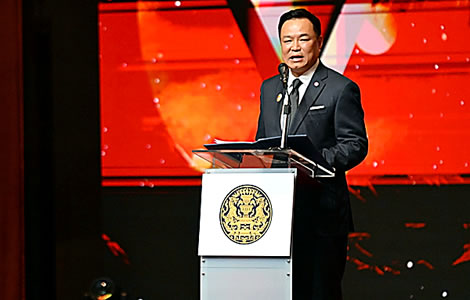
Prime Minister Anutin Charnvirakul on Friday called for what he described as political engineering to steer Thailand through an increasingly unpredictable global environment.
He urged faster technological adoption, civil service reform and stronger investment in innovation. He argued that those changes would strengthen economic growth while preparing the country for prolonged international uncertainty.
Speaking at the Faculty of Engineering auditorium at Chulalongkorn University, Mr Anutin delivered a special lecture entitled Overcoming the Crisis, Coping with the New World Order.
The address formed part of The Intania Forum: Surviving Under the New World Order. He used the event to outline the government’s long-term strategy for the economy, technology, public administration and human capital.
Anutin says political change and flexible governance are vital as global uncertainty reshapes the future
Notably, Mr Anutin rejected the idea that the world had entered a stable “New World Order.” Instead, he described the international environment as a “New World Disorder.” He said the world had become increasingly volatile.
Old assumptions, he added, no longer provided reliable answers. Rapid change demanded a different style of government based on flexibility, self-reliance and evidence-based decision-making.
In response, he said Thailand must adapt more quickly than in previous decades. Governments could no longer depend on fixed formulas or conventional policy tools. Policy decisions, he said, must increasingly reflect changing circumstances. At the same time, resilience had become as important as economic growth.
Looking at Thailand’s development, Mr Anutin said decades of expansion had been driven by globalisation, manufacturing, exports and tourism. Those sectors would remain important. However, he identified research and development as the country’s weakest strategic link.
Research investment and AI adoption seen as essential to strengthen Thailand’s industries and future
He said advances in technology were bringing countries closer together. Consequently, nations investing wisely today would gain stronger competitive advantages tomorrow.
Mr Anutin argued Thailand still had time to modernise its industrial base. That opportunity, he said, should not be missed. Investment decisions made today would determine future competitiveness. Faster innovation would also reduce dependence on older economic models.
Artificial intelligence featured prominently throughout his address. Mr Anutin said Thailand could not avoid AI. Instead, the country should embrace it under clear national safeguards. He unveiled what he called the government’s 4P framework to guide future AI policy and technological development.
Under the framework, Prevention seeks to minimise harmful consequences from emerging technologies. Prosper focuses on generating broader economic growth and national wealth. Potential aims to strengthen Thailand’s capabilities and productivity.
Protection, meanwhile, seeks to ensure technology does not harm people, society or the natural environment. Mr Anutin said future AI development should remain consistent with those four principles.
Government promotes critical path planning and resilience while backing major long-term investments
As part of this strategy, Mr Anutin said the government was also examining the Critical Path Method, or CPM. The planning model prioritises projects delivering the greatest value from limited resources.
It also seeks to reduce implementation time while controlling costs. He said disciplined project selection would improve public investment decisions across government.
Ultimately, the objective extends beyond efficiency alone. Mr Anutin said Thailand must build stronger resilience while moving towards what he described as a “Steady State.” He defined that goal as long-term stability, stronger national security and sustained capacity for future growth.
On another front, Mr Anutin outlined the government’s principal policy priorities. They include the economy, national security, social development and disaster management. He acknowledged that several initiatives required substantial investment despite their immediate cost.
Flood prevention was among his examples. Thailand has previously spent about 50 billion baht annually responding to flood damage. Earlier investment in permanent flood protection, he said, would have reduced long-term losses significantly. Strategic infrastructure spending therefore offered greater long-term value than repeated disaster recovery.
Anutin pushes regional growth, workforce skills and economic hubs to spread prosperity beyond Bangkok
Turning to the economy, Mr Anutin insisted Thailand remained economically strong. Nevertheless, he said the country’s biggest challenge was wealth distribution rather than overall growth. Economic success, he argued, remained concentrated in relatively few locations.
Accordingly, he said Thailand should no longer depend exclusively on Bangkok as its principal economic centre. The government instead wants to develop additional regional growth hubs.
Modern transport networks would connect production, manufacturing, industry, employment and income across those areas. Broader economic development would, in turn, strengthen national resilience.
Mr Anutin repeatedly described people as Thailand’s most valuable national resource. Technology, he said, could always be purchased. Human capability required continuous investment. Thai workers must therefore learn more quickly, adapt more effectively and continue developing throughout their careers.
In parallel, the government plans to mobilise what Mr Anutin called the power of the Thai people. Education, new skills and lifelong learning would become central priorities. He said Thailand should produce creators of technology rather than remaining only consumers of it.
Innovation, civil service reform and smarter government placed at the centre of Thailand’s strategy
Innovation formed another major pillar of the government’s strategy. Mr Anutin said support would extend from universities and startup companies to industrial research programmes. Military equipment research and development would also receive backing. He argued that innovation required commercial pathways as well as scientific success.
Separately, he stressed that research should not remain inside laboratories. If Thailand developed competitive products, the government should help create markets for them. Commercial application, he said, would transform research into a new source of national economic growth.
Civil service reform also featured prominently in his address. Mr Anutin said government agencies must become more agile, transparent and accountable.
Unnecessary procedures should be removed wherever possible. Digital technology should also improve efficiency throughout the public sector. Officials, he added, should perform work matching their expertise and capabilities.
Rather than reducing government alone, Mr Anutin said the objective was to make it smarter. Faster administration would also allow businesses to operate more efficiently. Better resource allocation, he argued, would improve public services while supporting economic expansion.
Welfare reform targets those in need while government pursues long-term growth despite uncertainty
Elsewhere, Mr Anutin announced changes to the state welfare card programme. The government is reorganising the system to ensure support reaches those genuinely in need.
Working-age recipients will also be encouraged to return to employment wherever possible. The policy aims to increase workforce participation while reducing long-term dependence on welfare assistance.
Shift in the Thai economy sees the lowest baht value in 15 months as imports rise far faster than exports
Landbridge scheme shunted after review as plan emerges to strengthen rail connectivity and Ranong Port
Concluding his address, Mr Anutin said the government remained stable and committed to serving the country despite growing international uncertainty. “The government is stable and committed to working for the country.
Even though the new world is chaotic, Thailand must not be without direction. The government will use its engineering skills to find solutions, its business acumen to find opportunities, and the energy of all Thai people to support the country’s stable and sustainable growth, enabling it to determine its own future,” he said.
Join the Thai News forum, follow Thai Examiner on Facebook here
Receive all our stories as they come out on Telegram here
Follow Thai Examiner here
Further reading:
US Ambassador Seán O’ Neill briefed Prime Minister Anutin Charnvirakul at Government House on War
Visa waivers, discounted hotel stays and 2,000 baht a person per day for stranded tourists announced