Middle East fighting has pushed the baht down 5-6%, yet the Bank of Thailand says the weaker currency is supporting exports and tourism. Officials are keeping growth forecasts unchanged while watching oil prices, inflation and the Strait of Hormuz.
The Thai baht has weakened by 5% to 6% as renewed conflict in the Middle East rattles global markets, yet the Bank of Thailand says the slide is supporting exports and tourism rather than threatening financial stability. While Governor Mr Vitai Ratanakorn warned that a prolonged conflict could lift oil prices, inflation and slow economic growth, he insisted it remains too early to revise official forecasts as policymakers closely monitor the escalating crisis and its potential impact.
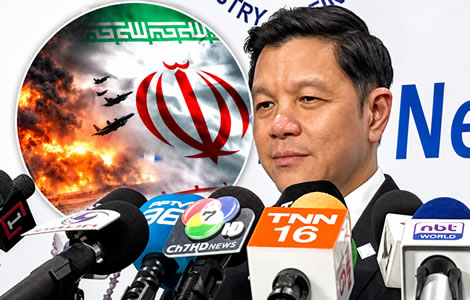
The Bank of Thailand is closely monitoring renewed conflict in the Middle East as tensions threaten inflation and economic growth.
Governor Mr Vitai Ratanakorn said on Tuesday the central bank was tracking events continuously. He described the situation as highly fluid. However, he stressed that no immediate changes had been made to Thailand’s economic outlook.
Mr Vitai said the latest clashes had only resumed within the past two to three days. As a result, the Bank of Thailand believes it is too early to measure the broader economic impact.
If the conflict subsides quickly, Thailand’s overall outlook should remain largely intact. By contrast, a prolonged confrontation would present more serious risks. Those risks centre on higher energy prices, rising inflation and weaker economic growth.
BOT holds forecasts steady while assessing early Middle East risks and possible economic effects
Speaking on July 14, the governor said policymakers were relying on evidence rather than speculation. For now, the central bank has left its forecasts unchanged. Officials will instead continue evaluating incoming data. Any revisions will depend on how the crisis develops over the coming weeks.
Particular attention is focused on the Strait of Hormuz, one of the world’s most important oil shipping corridors. Reports of a 20% increase in transit fees have intensified scrutiny. Even so, Mr Vitai said the Bank of Thailand could not yet determine the consequences for Thailand. Both the renewed fighting and the reported fee increase remain recent developments. Accordingly, officials want clearer evidence before assessing the effects on exports or economic activity.
“It may be too early to assess the overall impact on the Thai economy, as both sides have only recently resumed clashes a few days ago,” Mr Vitai said. He added that the Bank of Thailand was closely monitoring the situation and was not currently overly concerned.
Nevertheless, he said the central bank would continue following developments closely. The greatest uncertainty remains whether the conflict proves temporary or becomes prolonged.
Prolonged conflict could lift oil prices, inflation and economic risks while GDP outlook remains unchanged
Should hostilities continue, the Bank of Thailand expects the main pressure to come through global energy markets. Sharply higher oil prices would increase business costs across the economy. In turn, transport costs would rise.
Manufacturers would also face higher production expenses. Ultimately, stronger inflationary pressures could weigh on Thailand’s growth outlook. Despite those risks, the governor emphasised that such outcomes remain conditional.
Mr Vitai also rejected suggestions that the central bank could already estimate the impact on second and third quarter economic performance.
At present, he said the available information remains insufficient. Consequently, there is no basis for revising GDP projections. Officials will continue examining exports, inflation and international trade before making any adjustments. Until then, the existing forecasts remain in place.
In parallel, the governor addressed recent movements in the Thai baht. He said the currency had depreciated by around 5% to 6%.
That movement broadly mirrors other currencies across the region. Some neighbouring currencies have weakened by more. Others have declined by less. Notably, the baht remains within the regional range and is not showing unusual weakness.
Weaker baht seen supporting exports and tourism as officials continue monitoring global pressures
The Bank of Thailand also sees no immediate concern over exchange rate stability or capital flows. Instead, Mr Vitai described the weaker baht as supportive for key sectors. Thai exports become more competitive in overseas markets.
At the same time, Thailand becomes more affordable for international visitors. Both developments strengthen two important drivers of the economy.
“The current depreciation of the Thai baht by 5% to 6% is a factor that helps support and promote Thailand’s export and tourism sectors,” Mr Vitai said. He added that the currency’s movement reflected broader regional trends rather than Thailand-specific pressures. Therefore, the Bank of Thailand sees no immediate reason for concern over the exchange rate.
Bank of Thailand boss defends the central bank’s low interest rate policy aimed at boosting the economy
Bank of Thailand leaves interest rates unchanged, raises growth projection with the baht set to go lower
Separately, officials continue tracking movements in oil markets, freight costs and global financial conditions. They are also monitoring inflation, exports and wider business activity. On another front, policymakers remain alert to any further disruption affecting international trade. Each factor could alter Thailand’s economic outlook if the conflict intensifies.
For the moment, however, the central bank is maintaining its existing forecasts. Instead, it will continue evaluating developments as they unfold. Any future policy response will depend on whether the Middle East conflict remains brief or develops into a sustained threat to energy prices, inflation and Thailand’s economic growth.
Join the Thai News forum, follow Thai Examiner on Facebook here
Receive all our stories as they come out on Telegram here
Follow Thai Examiner here
Further reading:
US Ambassador Seán O’ Neill briefed Prime Minister Anutin Charnvirakul at Government House on War
Visa waivers, discounted hotel stays and 2,000 baht a person per day for stranded tourists announced