Thailand’s economy faces a new warning as the baht slumps to a 15-month low, imports outstrip record exports and the current account swings to a US$14 billion deficit. AI-driven trade is booming, but ministers are racing to contain mounting external risks.
Thailand’s economy is entering a more dangerous phase as the baht slumps to a 15-month low, a widening current account deficit overtakes record export growth and imports surge at more than twice the pace of overseas sales. Ministers are scrambling to contain mounting external pressures as booming artificial intelligence and data centre investment transforms the kingdom into a manufacturing and transit hub serving developed economies, particularly the United States. Meanwhile, Bangkok is pressing ahead with an investment-led recovery while confronting rising inflation, new US trade threats, volatile Middle East energy prices and warnings that Thailand could still record its biggest trade deficit on record despite one of its strongest export performances in years.

Thailand’s weakening baht has thrust the country’s external finances back into the spotlight as imports outpace exports despite record overseas sales. The shift has rapidly elevated the current account deficit into one of the economy’s most closely watched indicators.
Notably, the imbalance has emerged alongside a surge in electronics imports tied to artificial intelligence and data centre investment. The figures also suggest Thailand is increasingly serving as a manufacturing and transit hub supplying developed economies, particularly the United States.
The changing trade picture coincides with renewed pressure on the currency. The baht fell to a 15-month low on Thursday, briefly touching ฿33.848 against the US dollar before closing near ฿33.80. The decline followed broad US dollar strength as investors reacted to rising geopolitical tensions in the Middle East.
Weakening baht and current account deficit emerge as new concerns despite record exports
In turn, demand shifted towards safe-haven assets. Asian currencies weakened broadly. The Japanese yen also declined. Analysts said uncertainty surrounding the Red Sea and the Strait of Hormuz remains a major influence because any threat to shipping or energy supplies quickly strengthens the dollar.
Against that backdrop, Deputy Prime Minister and Finance Minister Ekniti Nitithanprapas said the government is monitoring both inflation and the current account deficit while accelerating investment to drive growth.
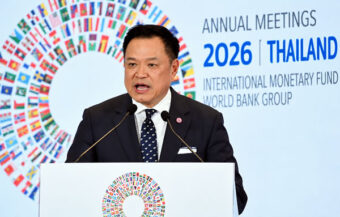
He outlined the strategy during the 2026 Advanced Economic Journalists’ Capacity Building Programme organised by the Economic Journalists Association. According to Mr Ekniti, investment must replace consumption as the principal engine of the economy. The government has therefore spent the past seven months redirecting policy towards stronger public and private investment.
Mr Ekniti said Thailand has depended heavily on exports for decades. As a result, every global slowdown quickly affects domestic growth. Domestic consumption has also remained subdued. Private investment has likewise struggled to generate sufficient momentum.
Over the same period, repeated stimulus programmes have steadily increased public debt. The government now believes investment offers a more durable path to expansion because it strengthens productive capacity rather than temporary demand.
Ministers shift economic strategy towards investment while watching inflation and external balances
Early results are beginning to appear. Private investment expanded by about 10% during the first quarter of 2026. Public sector and state enterprise investment is also targeted to grow by 9.4%. Mr Ekniti said investment-led growth creates greater long-term economic potential than consumption-led stimulus.
It expands production, improves competitiveness and attracts higher-value industries. In response, economic policy is increasingly focused on capital investment instead of short-term spending measures.
However, Mr Ekniti identified two immediate risks. The first is inflation. Consumer prices moved from negative territory during the first quarter to 2.7% in the second quarter. Higher energy prices drove much of that increase.
Consequently, households could face rising living costs and weaker purchasing power if price pressures continue. The second concern is the current account deficit, which has quickly become a central measure of economic stability.
Inflation and widening current account deficit become key risks in the pursuit of growth
Thailand recorded a current account deficit exceeding US$14 billion, or about ฿600 billion, over the past two months. The figure means payments flowing overseas exceeded receipts entering the country.
Although exports remain exceptionally strong, import growth has overtaken them by a wide margin. That shift has transformed the external accounts into an immediate government priority. Maintaining stability while sustaining growth has therefore become a central objective.
Separately, new trade data highlighted both the economy’s strength and its growing imbalance. Kasikorn Research Centre said merchandise exports climbed 20.8% in June from a year earlier. Electronics generated more than half of that increase.
The sector benefited from strong worldwide demand for technology products. Artificial intelligence investment and rapid global data centre expansion continued lifting orders throughout the quarter.
Electronics exports power exports as AI demand and global data centre investment accelerate
Electronics exports alone surged 66%. Computers and computer components recorded particularly strong gains. Hard disk drives also expanded sharply. Communications equipment continued rising as well.
The United States remained Thailand’s strongest growth market. Electronics exports to America jumped 73% because several electronic products remained exempt from US import duties. Exports to China and Singapore also strengthened, reflecting solid regional demand across technology supply chains.
Outside electronics, export growth remained broad. American importers accelerated purchases before Section 122 tariff measures expired on July 24. Processed seafood shipments rose strongly. Pet food exports also increased.
Electrical appliances recorded further gains. At the same time, higher oil prices supported exports of refined petroleum products to ASEAN markets. Those prices reflected continuing tensions in the Middle East.
Yet the strongest numbers appeared on the import side. Kasikorn Research Centre said imports expanded 38% during the first half of 2026. Export growth reached 17.6% over the same period. That gap has become one of the year’s defining economic developments. The figures show imports increasing at more than twice the pace of exports despite record overseas demand.
Import boom may mean Thailand has become less of a manufacturing base than a transit hub
Much of that surge reflects the same technology industries driving export growth. Thailand is importing advanced machinery, electronic components and specialised equipment needed for artificial intelligence projects and data centres.
Those imports support domestic manufacturing before finished products are shipped abroad. On another front, they also increase payments leaving the country. The pattern reinforces concerns that Thailand is functioning as a production platform serving developed markets, particularly the United States.
Kasikorn Research Centre expects some moderation later this year. Electronics imports are likely to slow alongside exports. Even so, another pressure remains. Higher global energy prices continue lifting Thailand’s import bill.
Those costs could remain elevated if Middle East tensions persist. The research centre warned that Thailand could ultimately record its largest trade deficit on record.
Forecast upgrades tempered by US trade risks and fears of Thailand’s biggest ever trade deficit
As part of this reassessment, Kasikorn Research Centre upgraded its trade forecasts sharply. Export growth for 2026 is now expected to reach 14%, compared with the previous estimate of 8.2%. Import growth is forecast at 27%, up from an earlier projection of 13.9%. Both revisions reflect much stronger trade activity than economists anticipated only months ago.
Meanwhile, US trade policy remains another important risk. Following the expiry of Section 122 measures, Washington implemented Section 301 measures concerning forced labour covering 60 economies, including Thailand.
Thailand now faces a 12.5% tariff. Kasikorn Research Centre nevertheless expects the direct impact to remain limited because competing exporters face similar rates. Electronic components also remain largely exempt.
Attention is also turning to another American investigation. Washington is examining structural excess production capacity across 16 economies, including Thailand. The measures could begin during the fourth quarter of 2026. Unlike existing tariffs, the investigation carries no upper limit on future duties. Consequently, it could become a stronger negotiating tool in future trade discussions.
Financial markets reflected that uncertainty. Foreign investors purchased ฿1.891 billion of Thai equities on Thursday. Bond markets told a different story. Investors sold ฿5.715 billion of Thai bonds during the same session. Equity buying suggested confidence in listed companies. Bond selling, however, indicated continued caution over broader economic conditions.
Government pursues reforms as weaker baht, trade shifts and demographics reshape options
Looking beyond immediate risks, the government continues pursuing longer-term reforms. Mr Ekniti described free trade agreements as increasingly important as global supply chains evolve. Board of Investment applications have also risen sharply.
Most involve future industries linked to advanced manufacturing and technology. Those projects are steadily integrating Thailand into new international production networks.
Energy policy is also changing. Mr Ekniti said international investors increasingly demand clean electricity and reliable water supplies. The government has therefore removed quota restrictions under Direct Power Purchase Agreement regulations.
Lower baht by 5-6% caused by US Iran War says Bank of Thailand. Officials monitor the unfolding crisis
Fitch continues to warn about weaker bank profits in Thailand amid a lacklustre economy with low growth
The reforms will accelerate clean energy development. They also support compliance with Europe’s Carbon Border Adjustment Mechanism while complementing expanding investment in artificial intelligence and data centres.
Finally, Mr Ekniti highlighted Thailand’s structural demographic challenges. Economic growth once averaged between 5% and 7%. Today it stands at about 2.7%. Birth rates continue falling while the elderly population keeps growing.
The government will therefore focus on three priorities. It will improve workforce skills. It will encourage older people to remain economically active. It will also attract more skilled workers into Thailand. Alongside those measures, the Skill Bridge programme, education reform, regional investment and greater use of domestic raw materials will support the government’s target of restoring annual growth above 3%.
Join the Thai News forum, follow Thai Examiner on Facebook here
Receive all our stories as they come out on Telegram here
Follow Thai Examiner here
Further reading:
US Ambassador Seán O’ Neill briefed Prime Minister Anutin Charnvirakul at Government House on War
Visa waivers, discounted hotel stays and 2,000 baht a person per day for stranded tourists announced