Middle East war escalates as the US signals possible ground troops in Iran and Israeli units operate in Tehran. Strait of Hormuz effectively shuts, oil jumps and global flights stall. Thailand calls emergency meetings as GDP forecasts are trimmed and markets turn volatile.
As the Middle East crisis spirals into all-out war between the United States, Israel and their Gulf allies and the regime in Tehran, Thailand’s Prime Minister Anutin Charnvirakul on Monday called for calm. The global flight network is in chaos and world trade faces major disruption with the Strait of Hormuz effectively closed. Thailand has already recorded hundreds of cancelled flights and a drop in foreign tourists in its eastern provinces. The central risk is a surge in oil prices that could erase recent export gains and stall late-2025 economic momentum. Meanwhile, widening geopolitical fallout threatens to destabilise global financial markets as the conflict intensifies.
Thailand is tracking a rapidly escalating conflict in the Middle East as military operations intensify and shipping lanes close. The Ministry of Foreign Affairs is monitoring developments on both military and diplomatic fronts.
Meanwhile, Prime Minister Anutin Charnvirakul has moved to contain concern over the economic fallout. On Monday and Tuesday, he sought to reassure the public and business leaders. At the same time, global tensions continued to rise.
In Washington DC, President Donald Trump confirmed a military operation against Iran that could last four to five weeks. Moreover, he did not rule out US troops appearing on the ground. However, Secretary of Defence Pete Hegseth stated that regime change was not the mission’s goal.
Us signals possible ground presence in Iran as Israeli units operate inside Tehran
Nevertheless, President Trump’s remarks suggested a broader scope. Indeed, both men confirmed that US soldiers may appear in Iran before the operation concludes. As a result, uncertainty has deepened across the region.
The attacks began on Saturday and quickly expanded. Israel is widely believed to be driving the scale of the campaign. On Monday, Prime Minister Benjamin Netanyahu confirmed that elite Israeli units are operating in Tehran.
Specifically, he said they are active in the centre of the Iranian capital. In addition, reports from the Gulf indicate that highly trained US units are also involved. These forces are described as targeting Iran’s leadership. Consequently, the operational footprint now extends beyond air strikes.
Over the weekend, Reza Pahlavi appeared on the US programme 60 Minutes, broadcast by CBS. He is the son of the last Shah and Crown Prince of Iran. During the interview, he described the death of Ali Khamenei as “earth shattering.” Furthermore, he referred to what he called a humanitarian intervention by the United States. His remarks added to mounting international reaction.
Symbolic protests in Iran as Hormuz shipping lane shuts and global oil flows face disruption
Inside Iran, public responses have drawn attention. In Tehran and other cities, signs of support for regime change have surfaced. For example, thousands of students at a university refused to tread on an American flag placed at a busy doorway.
Meanwhile, the Iranian women’s football team refused to sing the national anthem. The incident occurred in Australia during an Asian Cup match against South Korea. However, beyond symbolic acts, the military campaign continues to expand.
At the same time, Iran’s Revolutionary Guard issued a direct warning. It said any vessel transiting the Strait of Hormuz would be targeted. The Strait handles about 20% of global oil shipments.
In practice, it is now effectively closed to standard shipping traffic. Insurers have withdrawn cover for vessels entering the area. As a result, major shipping lines have activated risk management strategies. Therefore, global energy transport faces immediate disruption.
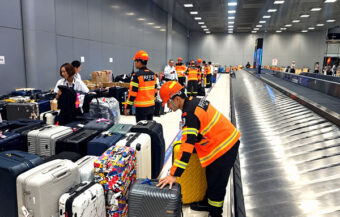
Consequently, freight rates are rising and supply chains are tightening. Thailand has already felt secondary effects. Flight disruptions have occurred as key transit hubs in Dubai and Qatar were put out of action.
Airlines have altered routes and extended travel times. Moreover, operating costs have increased. These disruptions are feeding into broader economic assessments.
Thailand convenes emergency security and economic meetings as regional conflict spreads
On March 2, 2026, at 3:40 pm, Prime Minister Anutin convened a high-level meeting at Government House. Earlier that morning, an urgent session of the National Security Council had taken place.
Subsequently, economic agencies were instructed to assess potential impacts. In attendance were senior ministers responsible for finance, transport, foreign affairs, commerce and labour. Together, they reviewed energy security, trade exposure and financial stability.
The Prime Minister stated that Thailand is experiencing some impact from the conflict. However, he described the situation as manageable. He said urgent measures are underway to prevent severe consequences.
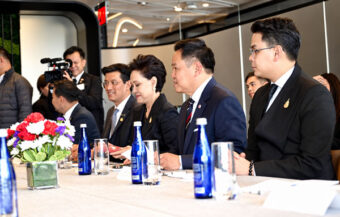
Furthermore, he met private sector leaders to coordinate responses. These included the Chairman of the Federation of Thai Industries and the Chairman of the Thai Chamber of Commerce. In addition, the Chairman of the Thai Bankers’ Association was consulted. The Prime Minister requested advice and operational recommendations.
Oil price volatility and Opec output increase shape Thailand’s energy risk outlook
Before the meeting, projections were prepared by the Ministry of Finance and the National Economic and Social Development Council. Both described the situation as uncertain. If the conflict continues, transportation and production costs will rise.
Likewise, global oil prices will remain under pressure. Initially, oil prices surged by about 10% following the outbreak of hostilities. Later, they moderated to roughly a 5% increase. Even so, volatility remains elevated.
Finance Minister Ekniti Nitithanpraphas confirmed that Thailand holds oil reserves sufficient for 60 days. He described this level as adequate to secure alternative supplies if needed. However, prolonged closure of the Strait of Hormuz would intensify pressure.
On March 1, OPEC+ held an online meeting led by Saudi Arabia and Russia. Members agreed to increase crude oil production by 206,000 barrels per day starting in April. The move aims to stabilise markets. Nevertheless, analysts estimate the increase may not offset losses if Hormuz remains closed.
Limited direct trade exposure masks rising freight costs and tourism slowdown risks
Thailand’s direct trade exposure to the region is limited. About 4% of exports go to the Middle East, while 8% of imports originate there. Exports to Israel account for 0.2% of total shipments. Meanwhile, exports to Iran represent just 0.02%.
Consequently, direct trade disruption is minimal. However, indirect effects are becoming visible. Shipping rates have risen by 4% to 5%. Therefore, freight costs are feeding into domestic supply chains.
The tourism sector faces moderate exposure. Visitors from the Middle East account for about 4% of international arrivals. Nevertheless, eastern Thailand has already recorded a decline in tourism activity. Moreover, travel disruptions may deter long-haul visitors from other regions. As a result, first-quarter tourism performance is under scrutiny.
The Trade Policy and Strategy Office described the situation as a negative supply shock. Higher oil prices are increasing transportation and electricity costs. Consequently, production expenses are rising across sectors.
Remittance losses, market volatility and baht swings heighten pressure on the Thai economy
Consumer goods prices are also under upward pressure. Furthermore, over 77,000 Thai workers are located in at-risk areas. If they are forced to return, remittance income would stop immediately. That loss would affect agricultural and local economies. In addition, the government would face increased domestic employment pressure.
Financial markets have responded cautiously. Gold prices have risen as investors seek safe-haven assets. Meanwhile, the Thai stock market fell 2% after earlier gains. At the same time, the baht has shown volatility.
Currency swings complicate hedging strategies for importers and exporters. Nevertheless, Thailand’s foreign exchange reserves stand at approximately US$300 billion. Officials describe this as a strong financial buffer.
Danucha Pichayanan outlined two economic scenarios. In the first, the conflict ends within one month but the Strait of Hormuz remains closed. Under that scenario, oil prices could rise to between US$95 and US$105 per barrel.
Gdp growth projections cut as prolonged Hormuz closure threatens deeper slowdown
Thailand’s projected GDP growth would fall from 2% to 1.6%. In the second scenario, the conflict extends beyond one month with continued closure of the strait. Oil prices could climb to between US$115 and US$125 per barrel. Under those conditions, GDP growth would decline to 1.3%.
Meanwhile, geopolitical uncertainty may delay foreign direct investment decisions. Some investors may postpone or reassess planned projects. Consequently, capital flows could fluctuate. Authorities are therefore monitoring liquidity and exchange rate stability closely.
In Bangkok, the Iranian Embassy issued a statement condemning US and Israeli actions. It described them as acts of aggression that violated the United Nations Charter. The statement accused both countries of breaching Iran’s sovereignty. Diplomatic tensions remain visible.
Government insists energy reserves are stable as evacuation plans are prepared for Thai nationals
Despite these pressures, the Prime Minister maintains that the situation is under control. He said fuel reserves are sufficient and energy security is stable. Moreover, preparations are underway to evacuate Thai citizens if necessary.
The Ministry of Foreign Affairs has instructed embassies to assist nationals abroad. Those who wish to remain will receive support. However, those who want to return will be assisted promptly, including through coordination with the military if aircraft deployment becomes urgent.
Visa waivers, discounted hotel stays and 2,000 baht a person per day for stranded tourists announced
US fighting for regime change in Tehran as the Middle East conflict throws airline industry into chaos
Thailand faces Middle East instability as Khamanei is killed and US Israeli forces push regime change
For now, the government states that the impact remains manageable. Nevertheless, officials continue to monitor military developments, oil markets and shipping routes. The duration of the conflict and access to the Strait of Hormuz will determine the scale of economic consequences. Until then, Thailand is operating in a heightened state of vigilance.
Join the Thai News forum, follow Thai Examiner on Facebook here
Receive all our stories as they come out on Telegram here
Follow Thai Examiner here
Further reading:
Visa waivers, discounted hotel stays and 2,000 baht a person per day for stranded tourists announced
Liquidity crisis or shortage of cash on the ground is shrinking Thailand’s economic growth prospects
Thai Minsters engage with US trade chief Jamieson Greer in Paris at global OECD ministerial meeting
Commerce Minister meets US trade boss Jamieson Greer in Korea. Paul Chambers case still dogs talks