Thailand’s OECD dream faces a tough reality check. Prime Minister Anutin Charnvirakul orders new reforms for 2028 entry, but foreign ownership curbs, corruption rules and 52 OECD review bodies threaten delays. Former ambassador Pisan Manawapat warns it could take five to seven years with major hurdles to overcome.
Prime Minister Anutin Charnvirakul is pressing ahead with Thailand’s bid to join the OECD by 2028, despite formidable legal and economic obstacles. At Government House in Bangkok on November 13, he ordered fresh coordination to accelerate the country’s accession. However, Thailand faces scrutiny from 25 OECD committees and 27 working groups, with major reforms still unfinished. Crucially, foreign investment restrictions, corruption, political interference in competition policy and weak government coordination threaten the timetable. Former ambassador Pisan Manawapat has warned the process could take five to seven years. Meanwhile, OECD Secretary-General Mathias Cormann has praised Thailand’s preparations, but membership remains unapproved. The ambition also has political implications. China stands outside the exclusive 38-member economic organisation founded in 1961, with the United States among its founding members.
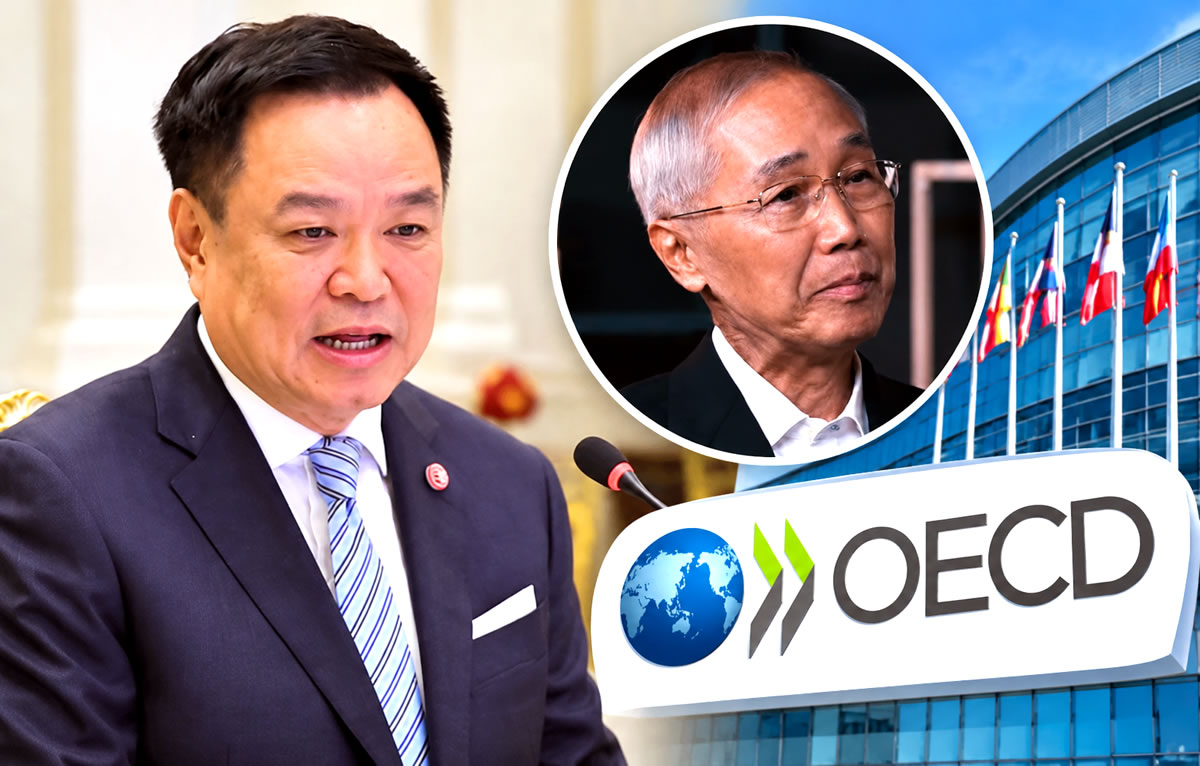
Thailand’s ambitious bid to join the Organisation for Economic Co-operation and Development (OECD) by 2028 faces serious obstacles. Former Thai ambassador to Washington Pisan Manawapat has warned that membership could take another five to seven years.
His assessment directly challenges Prime Minister Anutin Charnvirakul’s timetable. Meanwhile, Thailand faces examinations by 25 OECD committees and 27 working groups. Major reforms covering corruption, foreign investment, competition policy and government administration remain unfinished.
Despite strong encouragement from OECD Secretary-General Mathias Cormann, Bangkok has yet to secure the approvals required for membership.
Pisan Manawapat challenges 2028 OECD target after backing Pita in Thailand’s 2023 parliamentary vote
The warning from Mr Pisan carries considerable diplomatic and political weight. He previously served as Thailand’s ambassador to the United States before becoming a senator. Notably, Mr Pisan was among just 13 senators who backed Pita Limjaroenrat for Prime Minister on July 13, 2023.
Pita’s Move Forward Party had won the most seats in Thailand’s May 14, 2023 general election. However, the military-appointed Senate overwhelmingly withheld support, preventing him from securing the premiership.
His intervention now brings renewed attention to Thailand’s administrative weaknesses and the scale of the OECD accession process.
In comments published on September 5, Mr Pisan challenged the government’s ability to deliver membership by 2028. He identified serious shortcomings in Thailand’s administration, legislation and regulatory institutions.
Furthermore, he said officials familiar with the accession process expected membership to take at least five to seven years. That timetable contrasts sharply with the government’s stated objective.
Mr Pisan identified poor coordination between government ministries as a major obstacle. He also highlighted weaknesses in anti-bribery legislation and enforcement. Crucially, the former ambassador warned that competition policy must become more independent of political interference.
Thailand faces demanding OECD institutional tests as Anutin launches a new push for 2028 membership
His concerns involve three central areas examined during OECD accession. They concern the effectiveness of Thailand’s institutions, not simply its diplomatic relations with existing members.
The OECD examines whether prospective members maintain effective institutions, enforce regulations and operate credible economic policies. Moreover, applicants must demonstrate compliance with demanding international standards covering legislation, administration and corporate governance.
Thailand’s accession process therefore extends far beyond international meetings and declarations of support. It requires extensive technical examinations, legislative amendments and effective enforcement across numerous government agencies.
Despite these difficulties, Prime Minister Anutin Charnvirakul has reaffirmed his determination to secure membership by 2028. His government has established additional administrative machinery to accelerate preparations.
On Friday, November 13, Mr Anutin chaired the first meeting of Thailand’s OECD membership oversight committee. Proceedings began at 9.30 am at Government House in Bangkok. Significantly, the gathering brought together senior ministers, economic planners, legal officials and representatives from relevant government agencies.
Senior ministers and legal officials join Anutin at Government House to accelerate Thailand’s OECD bid
Deputy Prime Minister and Finance Minister Ekniti Nitithanprapas attended alongside Deputy Prime Minister and Foreign Minister Sihasak Phuangketkaew. In parallel, Deputy Prime Minister for Legal Affairs Pakorn Nilapraphan joined discussions concerning the country’s accession requirements.
Other participants included Civil Service Commission Secretary-General Onfa Vejjajiva and National Economic and Social Development Council Secretary-General Danucha Pichayanant.
Council of State Secretary-General Noppadol Peeriruek also attended. Assistant Minister of Foreign Affairs Sarun Charoensuwan joined the meeting alongside other senior officials and OECD development experts.
The Prime Minister opened proceedings by declaring OECD membership a government priority. He pledged full support for the administrative, legislative and international work required.
Furthermore, Mr Anutin said he had met OECD executives several times since assuming office. Those discussions had strengthened his commitment to achieving membership approval in 2028. He linked accession to Thailand’s economic development, international competitiveness and the adoption of higher standards.
Thailand faces scrutiny from 25 OECD committees as government creates three new accession subcommittees
In particular, Mr Anutin identified stronger investor confidence and improved competitiveness as important benefits. The Prime Minister also reported encouraging responses from foreign governments and international business leaders.
According to Mr Anutin, leaders he had met praised Thailand’s efforts and supported its membership ambitions. However, the November 13 meeting also exposed the scale of the outstanding work. The government must complete numerous technical assessments while coordinating reforms across several ministries.
Thailand remains subject to examination by 25 OECD committees and 27 working groups. These bodies assess the country’s economic policies, legislation, institutions and regulatory arrangements. Consequently, the government approved three new subcommittees to strengthen coordination and accelerate preparations.
Their responsibilities cover domestic coordination, international negotiations and legislative reform. The arrangements divide essential accession work among the relevant government agencies.
As part of the changes, Assistant Minister of Foreign Affairs Sarun Charoensuwan was appointed Thailand’s OECD Chief Coordinator. His appointment establishes a central official responsible for coordinating the country’s engagement with the organisation.
Foreign Ministry orders detailed reform plans as Thailand’s OECD accession reviews continue into 2027
Meanwhile, government ministries and agencies were instructed to prepare concrete reform plans. These must address requirements identified through the OECD’s technical assessments. The decisions strengthen the government’s administrative framework while confirming that substantial legislative and institutional work remains outstanding.
Separately, the Ministry of Foreign Affairs issued another statement on November 18. It reiterated the decisions taken at the November 13 meeting and the government’s commitment to accession.
However, no subsequent announcement through November 20 confirmed completion of a major technical review. There was also no announcement of final committee approval or a decisive package of accession-related reforms. Thailand therefore approaches the end of 2026 with its membership target intact but major requirements unfinished.
Thailand’s formal accession process began in 2024, following the OECD’s decision to open discussions in June. The organisation subsequently adopted Thailand’s accession roadmap in July 2024.
That established the framework for examining the country’s readiness for membership. In December 2025, Thailand submitted its Initial Memorandum, marking another important stage in the process. Since then, the country’s policies and regulatory arrangements have faced detailed examination against OECD standards.
Thailand’s 2028 OECD target faces foreign investment restrictions and demanding technical approval
Importantly, formal acceptance into the accession process does not guarantee eventual membership. Nor does the OECD establish a fixed timetable for completing negotiations.
Prospective members must satisfy technical requirements and secure agreement from existing member countries. Consequently, Thailand’s 2028 deadline remains a government target rather than an approved accession date. The distinction matters because the remaining examinations involve extensive domestic reforms.
Among the most difficult challenges are Thailand’s restrictions on foreign investment. The country maintains extensive controls on foreign ownership and participation in several service industries.
These restrictions affect market access and competition across parts of the economy. The OECD has recommended reducing barriers to foreign investment, particularly in services. However, implementing substantial changes would require amendments to existing Thai legislation.
Such reforms involve several ministries and regulatory agencies. Where legislative amendments are necessary, parliamentary approval would also be required. Moreover, changes to foreign investment rules affect established arrangements governing business ownership and participation.
Competition independence and anti-bribery action emerge as major hurdles to Thailand’s OECD bid
The government must therefore address these requirements through its domestic legislative and regulatory processes. International support cannot replace the necessary legal changes.
Competition policy presents another significant obstacle. The OECD examines whether markets operate under effective and transparent rules. It also assesses whether competition authorities can perform their duties independently.
Mr Pisan specifically warned about political interference in this area. His concerns place the independence and effectiveness of Thailand’s competition framework under scrutiny. Furthermore, changes to competition policy require more than revised government statements. They involve the laws, institutions and enforcement arrangements governing commercial activity.
On another front, anti-corruption legislation and enforcement present a major challenge. Thailand must demonstrate effective anti-bribery measures, credible enforcement and strong public governance arrangements.
Passing legislation alone does not establish that the required standards have been achieved. Instead, the accession process examines how laws and administrative safeguards operate in practice. The effectiveness of government institutions therefore remains central to Thailand’s membership application.
Corporate governance, education and productivity reforms add to Thailand’s demanding OECD work
Corporate transparency also forms part of the assessment. The OECD examines regulatory standards affecting companies, government institutions and their dealings with the private sector.
Furthermore, Thailand faces longer-term economic weaknesses involving education and productivity. These remain important areas within the country’s wider economic reform agenda. Together, the requirements cover far more than trade policy or international investment.
The organisation does not require every member to maintain identical legislation. Certain exceptions can be negotiated, while restrictions may remain in sensitive sectors. Nevertheless, applicants must demonstrate sufficient compliance with the OECD’s overall requirements.
Final membership depends on successful assessments, necessary reforms and approval by existing members. There is no automatic route to accession simply because a government announces a target date.
Against this demanding background, Thailand has received strong diplomatic encouragement from the organisation’s leadership. On October 16, OECD Secretary-General Mathias Cormann met Prime Minister Anutin Charnvirakul in Bangkok.
OECD chief Mathias Cormann praises Thailand’s accession preparations during high-level Bangkok talks
The meeting took place during Thailand’s hosting of International Monetary Fund and World Bank meetings. According to the Thai government’s account, Mr Cormann expressed considerable confidence in Thailand’s preparations. He also praised the country’s cooperation and willingness to respond to OECD recommendations.
In addition, the Secretary-General commended efforts to improve administrative arrangements and accelerate accession. Mr Anutin returned to those remarks during the November 13 meeting at Government House.
The Prime Minister said Mr Cormann had described Thailand as a model country. He also reported that the OECD chief recognised the high standards of Thailand’s preparations. Significantly, Mr Anutin said he had not expected such strong praise from the organisation’s Secretary-General.
The Prime Minister subsequently instructed NESDC Secretary-General Danucha Pichayanant to arrange a transcription of the remarks. He wanted officials working on accession to hear the assessment.
Anutin cites OECD chief’s praise, but technical reviews and legal reforms remain essential for membership
Mr Anutin emphasised Mr Cormann’s senior position and access to detailed information. He considered the comments an important endorsement of Thailand’s preparations. However, the Secretary-General’s confidence does not amount to formal membership approval. Technical committees must still complete their examinations and assess the country’s compliance.
There is also a clear distinction between completing technical reviews and implementing the changes those reviews require.
Where committees identify shortcomings, Thailand must address them through appropriate legislative, regulatory or administrative measures. The timetable therefore depends on progress across numerous government departments.
It also depends on the complexity of the reforms identified during the assessments. These requirements remain in force regardless of the political support expressed for Thailand’s candidacy.
Mr Pisan’s warning places particular emphasis on these domestic obstacles. His five-to-seven-year assessment contrasts sharply with the government’s determination to secure approval within two years.
Pisan warns Thailand’s ministries face difficult reforms despite fresh coordination and 2028 ambitions
The former ambassador’s concerns focus on institutional weaknesses rather than diplomatic relations. Poor coordination between ministries could delay responses to technical requirements. Likewise, changes involving competition policy and anti-bribery enforcement require cooperation across several government bodies.
Meanwhile, restrictions on foreign investment present difficult legislative questions. These cannot be resolved solely through meetings with OECD executives or expressions of international support.
The November 13 decisions show that Bangkok is strengthening its central coordination arrangements. However, the newly established subcommittees must still deliver results. Their effectiveness will be measured through completed assessments, reforms and the implementation of OECD requirements.
The government’s reform plans will become particularly important during 2027. By then, Thailand will need to demonstrate concrete progress through the OECD’s technical committees.
Legislative amendments, regulatory improvements and effective enforcement will influence the pace of accession. In addition, the government must maintain coordination between the Foreign Ministry, economic agencies, legal authorities and other departments. The National Economic and Social Development Council has a central role in that work.
New subcommittees face pressure to deliver legislative changes and keep Thailand’s OECD bid moving
The Council of State also remains important where existing laws require amendment. Meanwhile, the Foreign Ministry must continue international negotiations and engagement with OECD officials.
The three new subcommittees are intended to bring these responsibilities into a more coordinated structure. Their establishment represents the government’s latest effort to meet its demanding deadline. However, establishing committees is only one part of the accession process. The necessary reforms must still be completed and assessed.
Thailand has already secured a formal accession roadmap and submitted its Initial Memorandum. It has also received public encouragement from the OECD Secretary-General. Nevertheless, the country remains under extensive examination.
Its most difficult challenges concern the effectiveness of domestic institutions and the implementation of reforms. The government’s own decisions confirm that substantial coordination and legislative work remain ahead.
Thailand pursues 2028 OECD entry despite major reforms. China remains outside the 38-member club
As of Friday, November 20, the government continues to pursue OECD membership by 2028. No final approval has been announced, and major technical assessments remain active. Mr Pisan’s warning has placed a sharply different timetable alongside the Prime Minister’s target.
The former ambassador believes the process could require five to seven years, reflecting the scale of Thailand’s institutional challenges.
Even then, the government faces some tough decisions and challenges to bring the kingdom’s laws and economy into alignment with Organisation for Economic Co-operation and Development (OECD) norms and standards.
For instance, China is not a member of this exclusive economic club, established with the United States as a founding member in 1961. The Organisation for Economic Co-operation and Development (OECD) comprises 38 predominantly advanced economies.
However, Beijing has never entered the organisation’s formal accession process. Membership requires demanding standards covering market competition, corporate governance, investment, transparency and public administration.
China’s state-directed economy and foreign investment barriers remain at odds with OECD membership rules
Crucially, China’s state-directed economy and extensive government ownership of enterprises differ significantly from OECD principles. In addition, restrictions on foreign investment present substantial obstacles.
Furthermore, industrial subsidies, regulatory independence and corporate transparency remain major areas of concern. Nevertheless, China maintains working relationships with the OECD through policy discussions and economic research. Without major institutional reforms and a formal application, Chinese membership remains unlikely.
Thailand joins minimum tax regime aimed at large global corporations as it integrates into world networks
Thailand’s stiff restrictions on small foreign investors a significant problem for its OECD aspirations
For Bangkok, the immediate task is delivering the changes demanded by the accession process. The government’s diplomatic campaign has advanced, but its legislative and administrative programme remains unfinished.
The decisive period will come in 2027, when progress through OECD committees must be matched by concrete domestic reforms. Thailand’s membership ambition is firmly established. However, the 2028 deadline remains unconfirmed, with substantial legal, regulatory and institutional requirements still to be completed.
Join the Thai News forum, follow Thai Examiner on Facebook here
Follow Thai Examiner on Google here
Receive all our stories as they come out on Telegram here
Follow Thai Examiner here
Further reading:
Tax and welfare revolution as Thailand moves ahead with Negative Income Tax that expands reporting
Thumbs up from economic gurus for 2027 Negative Income Tax plan. It’s a game-changer for progress
Expert warns foreign tourism has become Thailand’s curse, fueling inertia and a widespread malaise