Thailand’s baht has crashed through the ฿33 barrier as markets bet on more US rate hikes, capital flees to the dollar and current account deficits return. Industry leaders warn borrowing costs may rise while analysts see further pain ahead for the currency.
Thailand’s weakening baht has become a fresh warning signal for the economy, falling to its lowest level this year as markets bet on further US rate hikes, current account deficits return, capital flows head overseas and geopolitical tensions drive investors into the dollar. With industrial leaders warning that borrowing costs may yet rise, analysts forecasting further currency weakness and businesses facing higher import and financing costs, the break beyond ฿33 to the dollar has become a critical test for Thailand’s economy and the Bank of Thailand.
The Thai baht has slipped to its weakest level this year, breaking through the ฿33 mark against the US dollar as investors increasingly wager on higher American interest rates before year-end. The currency closed at ฿33.21 on Tuesday before weakening further to ฿33.38 on Wednesday. As a result, attention has shifted from the Federal Reserve’s recent pause to the prospect of renewed monetary tightening in the United States.
The move comes despite last week’s decision by the US Federal Reserve to leave its policy rate unchanged at 3.50-3.75%.
Nevertheless, markets remain unconvinced that the tightening cycle has ended. Instead, investors continue to focus on inflation risks, resilient economic growth and a strong US labour market. Consequently, expectations of further rate increases have strengthened across global markets.
Fed rate expectations strengthen the dollar and intensify pressure on Thailand’s weakening currency
Fed funds futures now imply a 54% probability of two additional 25-basis-point rate increases before the end of 2026. In turn, the dollar has continued to strengthen against most major and regional currencies.
Meanwhile, the dollar index has pushed above 101, extending recent gains. For Thailand, the impact has been immediate as capital flows increasingly favour higher-yielding dollar assets.
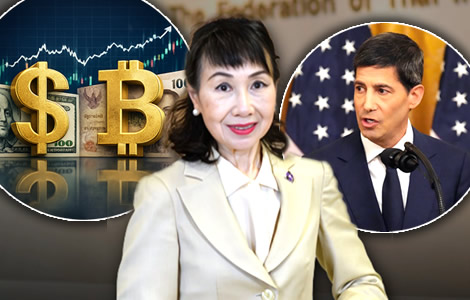
Against this backdrop, Federation of Thai Industries (FTI) President Ms Pimjai Leeissaranukul warned businesses not to interpret the Fed’s pause as a sign that financing costs will soon fall. Rather, she said companies should prepare for continued uncertainty in financial markets. According to Ms Pimjai, inflationary pressures, volatile energy prices and geopolitical risks continue to cloud the outlook.
“The Fed hasn’t raised interest rates further, but businesses shouldn’t be complacent because the global financial situation remains highly uncertain, especially due to inflationary pressures, energy prices and geopolitical risks, which could keep global interest rates high for longer than expected,” she said.
Current account deficits and capital outflows add fresh pressure on Thailand’s external position
Notably, the baht’s weakness is no longer being driven solely by US monetary policy. Analysts are increasingly focusing on developments within Thailand’s own economy.
In particular, a pattern of current account deficits is attracting growing attention among investors. For years, Thailand benefited from strong tourism earnings and sizeable foreign currency inflows. However, those conditions have begun to shift.
Foreign tourism receipts have softened. At the same time, higher oil prices have increased import costs. Separately, capital outflows have accelerated as investors seek stronger returns elsewhere. Together, these factors have created fresh pressure on the currency and altered market perceptions of Thailand’s external position.
Although the baht has weakened sharply in recent weeks, it remains well above the lows recorded four years ago. On October 14, 2022, the currency fell to ฿38.25 against the dollar. Even so, analysts argue that the current decline warrants attention because it coincides with changing global capital flows and widening interest rate differentials.
Widening rate gap between Thailand and the United States has again become a key market concern
The gap between Thai and US interest rates has become a central market theme. Thailand’s policy rate stands at 1.00%. By comparison, US rates remain substantially higher. Consequently, international investors have stronger incentives to hold dollar-denominated assets. That dynamic has placed persistent downward pressure on the baht.
Kasikorn Research Centre believes the trend may continue. The research house says the currency is unlikely to stage a sustained recovery unless the Bank of Thailand adopts a more hawkish stance. Specifically, analysts are looking for signals that policymakers may consider future rate increases if inflation risks intensify.
Ms Kanjana Chockpisansin, Head of Banking and Financial Sector Research at Kasikorn Research Centre, said the baht weakened to a 13-month low of ฿33.18 on Tuesday from Monday’s close of ฿32.93. She said growing expectations of future Fed tightening were a major factor behind the move.
Furthermore, investors remain concerned that inflation could prove more persistent than previously expected. While the Fed has paused, policymakers continue to prioritise price stability. Therefore, markets increasingly believe interest rates may stay elevated for longer than anticipated.
Regional currencies weaken as investors reassess Thailand’s trade and capital flow outlook
That outlook is already influencing currency markets across Asia. Since the start of the year, the baht has depreciated by 4.9%. However, other regional currencies have recorded even larger declines. The Indonesian rupiah has fallen by 6.6%. Likewise, the Korean won has weakened by 6.4%. Meanwhile, the Indian rupee has declined by 5.1%.
Even so, the baht remains under particular scrutiny because of Thailand’s changing external balances. Historically, strong tourism revenues helped offset periods of global uncertainty.
Now, investors are paying closer attention to trade flows, capital movements and current account data. As part of this shift, currency traders are reassessing long-standing assumptions about Thailand’s economic position.
On another front, developments in the Middle East continue to influence financial markets. Although progress has been reported in negotiations between the United States and Iran, uncertainty remains elevated. Washington has temporarily allowed Iran to resume oil exports for 60 days. However, several critical issues remain unresolved.
Dollar gains ground over gold as geopolitical uncertainty reshapes global investment flows
As a consequence, investors continue to seek safety in the US dollar. Gold, which traditionally attracts defensive flows, has recently lost ground. Gold prices fell 1.6% to US$4,118 an ounce. Meanwhile, the dollar continued attracting capital from investors concerned about geopolitical risks.
“Instead of gold, which is a safe-haven asset and normally used to hedge against inflation, massive capital flows have recently been drawn to the dollar given unease surrounding the US-Iran peace agreement,” Ms Kanjana said.
Should tensions flare again, energy prices could rise sharply. In response, inflation expectations could strengthen. That scenario would likely reinforce expectations of further Federal Reserve tightening. As a result, emerging market currencies, including the baht, could face renewed selling pressure.
Kasikorn Research Centre expects the baht to weaken towards ฿33.30 or even ฿33.50 unless negotiations between Washington and Tehran show clearer progress. Conversely, a breakthrough could reduce demand for the dollar and support a recovery in the Thai currency.
Businesses face rising import costs and renewed pressure from exchange rate volatility
Mr Poon Panitchpibun, a money market strategist at Krungthai Global Markets, shares a similar assessment. He believes the baht will remain under pressure until investors reduce expectations of additional Fed rate increases. Although Middle East tensions have eased, he said those developments have already been largely reflected in market pricing.
Back in Thailand, industrial leaders are increasingly focused on the practical implications of currency volatility. A weaker baht raises the cost of imported raw materials. It also increases energy expenses for manufacturers. Moreover, businesses carrying foreign currency obligations face higher repayment costs when the dollar strengthens.
For exporters, the picture is more complex. While a weaker baht can improve price competitiveness abroad, it also raises production costs through more expensive imported inputs. Therefore, exchange rate volatility creates both opportunities and risks.
According to Ms Pimjai, businesses should focus on resilience rather than assume volatility has passed. She described the current period as a critical moment for Thai industry. In particular, she urged firms to review financing structures, manage currency exposure and strengthen operational efficiency.
Industry group urges productivity gains and lower structural costs to boost competitiveness
The FTI believes companies should pay closer attention to exchange rate risks. Additionally, it encourages greater use of technology and innovation to improve productivity. At the same time, businesses are being urged to diversify export markets to reduce dependence on any single destination.
For smaller firms, the challenge may be greater. Although Thailand’s policy rate remains relatively low, financing conditions are becoming more complex. Movements in US interest rates can affect borrowing costs, exchange rates and overseas demand simultaneously. Therefore, liquidity management remains a priority.
The FTI has also called on the government to address broader structural issues affecting competitiveness. Among its recommendations is maintaining baht stability in line with economic fundamentals. Separately, the organisation wants improved access to funding and hedging tools for small and medium-sized enterprises.
In addition, it is urging faster action to reduce structural costs. Energy remains a significant burden on manufacturers. Likewise, logistics costs continue to affect competitiveness. Regulatory expenses also remain a concern across many sectors.
FTI says stronger productivity and resilient SMEs are key to long-term industrial growth
According to Ms Pimjai, long-term competitiveness depends on more than monetary stability. Instead, it requires stronger productivity, lower structural costs and more resilient businesses.
“Financial stability is only one key factor. However, what will make Thai industries competitive in the long term is reducing structural costs, improving efficiency, and strengthening entrepreneurs, especially SMEs, to be ready to cope with any fluctuations in the global economy,” she said.
Finance Minister defends 400 billion baht loan decree as opposition files Constitutional Court challenge
Analysts urge the government to prepare for higher oil prices as top bank predicts 33 baht to dollar rate
For now, however, markets remain focused on the dollar. The Federal Reserve may have paused, yet investors continue positioning for tighter conditions ahead. Consequently, the baht remains exposed to global interest rate expectations, capital flows and geopolitical developments.
The currency’s break beyond ฿33 has become more than a technical milestone. Rather, it reflects a broader reassessment of monetary policy, economic fundamentals and investment risk. In the weeks ahead, traders will be watching Washington, Tehran and Bangkok closely. Until those uncertainties ease, pressure on the baht is unlikely to disappear.
Join the Thai News forum, follow Thai Examiner on Facebook here
Receive all our stories as they come out on Telegram here
Follow Thai Examiner here
Further reading:
US Ambassador Seán O’ Neill briefed Prime Minister Anutin Charnvirakul at Government House on War
Visa waivers, discounted hotel stays and 2,000 baht a person per day for stranded tourists announced
Liquidity crisis or shortage of cash on the ground is shrinking Thailand’s economic growth prospects
Thai Minsters engage with US trade chief Jamieson Greer in Paris at global OECD ministerial meeting