A UN warning has cast new doubt on Cambodia’s anti-scam drive, saying victims still face a “living hell” inside prison-like compounds despite mass raids, international pressure and the extradition of billionaire Chen Zhi.
Cambodia’s campaign to dismantle one of the world’s largest cyber scam industries has come under renewed international scrutiny after a senior United Nations investigator warned that victims continue to endure a “living hell” inside heavily guarded scam compounds despite mass raids, thousands of arrests and the dramatic extradition of billionaire Chen Zhi to China. In a wide-ranging assessment, UN Special Rapporteur Tom Andrews questioned whether the government’s highly publicised crackdown has fundamentally dismantled the criminal infrastructure behind a multibillion-dollar global fraud industry, while also raising concerns over allegations of corruption, official complicity and continuing human trafficking.
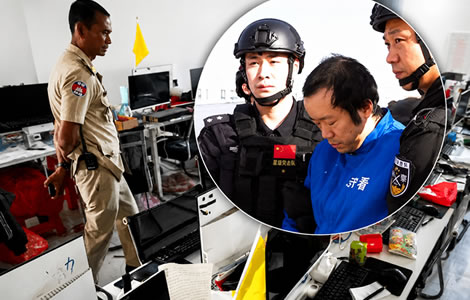
United Nations Special Rapporteur Tom Andrews warned on July 31 that victims trapped inside Cambodia’s vast online scam compounds continue to endure a “living hell” despite months of highly publicised government crackdowns.
Andrews said the country’s cyber scam industry remains one of Southeast Asia’s gravest human trafficking crises. He also voiced concern over allegations that Cambodian officials had been implicated in criminal networks which allowed the industry to flourish.
The intervention represented one of the strongest international condemnations of Cambodia’s scam economy this year. It followed growing evidence that trafficked workers from across Asia, Africa and beyond were lured by fraudulent job offers before being imprisoned inside heavily guarded compounds. Once inside, many were allegedly forced to defraud victims worldwide under constant threats of violence.
Victims describe torture as Cambodia launches its biggest crackdown on billion-dollar scam compounds
Moreover, international investigations have portrayed the compounds as industrial-scale centres of organised crime. Victims have described beatings, torture, electric shocks, sexual violence and forced labour.
Others reported being sold between criminal gangs after failing to meet fraud quotas. The industry has generated billions of dollars annually while targeting victims across North America, Europe, Australia and Asia.
Against that backdrop, Cambodia dramatically shifted course at the beginning of 2026.
The government launched its most publicised campaign against the scam industry to date. Officials invited international media to witness raids on notorious scam compounds.
They also announced the closure of numerous centres linked to transnational cybercrime. In addition, Phnom Penh claimed hundreds of thousands of foreign scam workers had been rescued, deported or repatriated.
UN warning raises fresh doubts despite Cambodia’s assurances its scam industry is being dismantled
Nevertheless, Andrews’ assessment suggested international concern had not eased. His warning came despite Cambodia’s repeated assurances that the criminal infrastructure was being dismantled.
Instead, the UN intervention reinforced growing international doubts over whether the campaign had fundamentally disrupted the networks responsible for one of the world’s largest cyber fraud industries.
Meanwhile, independent analysts questioned the scale and permanence of the crackdown. Several argued many criminal organisations had merely dispersed or relocated. Others warned the industry had become too deeply embedded within Cambodia’s economy to disappear quickly.
The pressure on Phnom Penh had been building for months.
Governments including the United States, China, Britain and South Korea had intensified demands for decisive action. Their concerns centred on industrial-scale cyber fraud, money laundering, human trafficking and organised crime operating openly across Cambodia.
International pressure intensified as major powers demanded action against Cambodia’s scam networks
Against this international backdrop, one arrest transformed the campaign against Cambodia’s scam industry.
On January 7, Cambodian authorities arrested and extradited Chinese-Cambodian billionaire Chen Zhi to China. The founder and chairman of Prince Group had long ranked among Cambodia’s most influential businessmen. He had also received the prestigious “Neak Oknha” title, placing him among the country’s most honoured business figures.
For years, Chen cultivated exceptionally close ties with Cambodia’s political establishment. His business empire expanded rapidly across property, banking, tourism and special economic zones. Critics repeatedly questioned how that remarkable growth had occurred. However, no significant domestic criminal proceedings emerged until international pressure intensified.
His extradition therefore marked a remarkable reversal.
Earlier, United States prosecutors accused Chen of leading one of Asia’s largest transnational cybercrime organisations. Federal investigators alleged his corporate empire concealed a vast network of scam compounds, forced-labour facilities and money laundering operations spanning Southeast Asia.
FBI case and Chen Zhi extradition became defining moments in Cambodia’s links with cyber fraud
According to the U.S. indictment, more than 100 companies operating across over 30 countries formed part of the alleged criminal enterprise. Prosecutors claimed billions of dollars in criminal proceeds flowed through casinos, luxury property developments, cryptocurrency transactions and international investments.
In parallel, the Federal Bureau of Investigation assembled one of its largest cybercrime investigations. Agents traced international financial transactions, complex corporate structures and money flows spanning multiple jurisdictions. Their investigation ultimately produced sweeping indictments seeking the forfeiture of billions of dollars in alleged criminal assets.
As part of Cambodia’s cooperation with Beijing, authorities revoked Chen’s Cambodian citizenship shortly before his transfer. That decision enabled Chinese prosecutors to pursue him solely as a Chinese national.
Soon afterwards, Chinese state television broadcast footage showing Chen arriving in Beijing under heavy police escort. China’s Ministry of Public Security accused him of directing a massive criminal organisation engaged in online fraud, illegal gambling and money laundering.
China and Cambodia stepped up cooperation as prosecutions ramped up and victims sought repatriation
Notably, Chinese prosecutors subsequently filed multiple serious criminal charges. Several offences under Chinese law can carry the death penalty. Any sentence, however, will depend entirely upon the evidence presented and the outcome of judicial proceedings.
In response, Cambodia presented the extradition as proof of its determination to dismantle organised cybercrime. Officials argued cooperation with Chinese law enforcement demonstrated a genuine commitment to ending the scam industry.
Separately, thousands of foreign nationals reportedly fled scam compounds or sought protection from their embassies. Indonesia, China and several other governments organised repatriation flights for citizens believed to have been trafficked into Cambodia through fraudulent recruitment schemes.
Even so, human rights organisations remained cautious. They warned many victims likely remained trapped inside criminal compounds. They also cautioned that organised crime groups possessed sufficient financial resources to relocate operations unless regional enforcement continued.
Allegations involving Cambodia’s political elite remain disputed as UN scrutiny intensifies once again
The relationship between Cambodia’s political leadership and the scam industry remains deeply controversial.
Investigative organisations, including the Organised Crime and Corruption Reporting Project, together with U.S. sanctions and legal filings, have alleged politically connected individuals benefited from businesses associated with the scam economy. American investigators have likewise alleged corruption enabled these operations to flourish for years with limited interference.
Claims have also circulated that former Prime Minister Hun Sen, widely regarded as Cambodia’s de facto leader, held financial interests connected to businesses within the scam economy.
Scam networks reorganising on Thailand’s borders and targeting its banking network for laundering
Party leader makes explosive claims linking Hun Sen to Cambodian slave camp run as a scamming centre
However, those allegations have not been established by any court or substantiated through publicly available official evidence.
While investigations have documented close relationships between politically connected elites and major business conglomerates, there is no verified public evidence proving Hun Sen personally held shareholdings in the criminal enterprises allegedly operated by Chen Zhi. Consequently, those allegations remain unproven.
Ultimately, Andrews’ warning placed Cambodia back under intense international scrutiny. His description of a continuing “living hell” suggested that, despite highly publicised arrests and raids, the world’s attention remains focused not on what has been dismantled, but on whether one of the largest centres of organised cybercrime and modern slavery has truly been broken.
Join the Thai News forum, follow Thai Examiner on Facebook here
Receive all our stories as they come out on Telegram here
Follow Thai Examiner here
Further reading:
Scam networks reorganising on Thailand’s borders and targeting its banking network for laundering
Party leader makes explosive claims linking Hun Sen to Cambodian slave camp run as a scamming centre
Police top brass push back on claims by Cambodia’s Hun Sen that scammers enter through Thailand
Money Laundering Office seizes assets with money trail linked to South African financier Ben Smith
Kla Tham MP dismisses unproven scam centre claims about Deputy Prime Minister Thamanat Prompow
People’s Party warns Anutin of a No Confidence move over cabinet links to Cambodian scam networks
United States, South Korea and United Kingdom act against Cambodian scam industry with Thai tie-ins