Historic countdown begins as Thailand prepares to send its first scientific payload to the Moon aboard China’s Chang’e 7. The mission crowns years of Thai engineering and launches the Kingdom into the global race for lunar exploration.
Thailand will make history on August 24 when its first domestically developed lunar scientific payload launches aboard China’s Chang’e 7 spacecraft, marking the Kingdom’s entry into global Moon exploration after Thai engineers achieved the once-unthinkable by meeting international space-flight standards. The landmark mission reaches far beyond lunar science, placing Thai technology among just seven international payloads selected for the mission while advancing plans for future Moon landings, a possible Thai spaceport and a new generation of home-grown engineers expected to drive the country’s ambitions in advanced technology, deep-tech innovation and the global space economy.
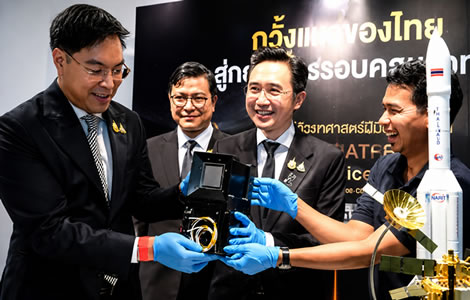
Thailand is preparing for its first lunar exploration mission, with a Thai-developed scientific payload scheduled to travel to the Moon on August 24. The launch will mark the country’s first participation in a major international lunar research programme.
For the first time, a scientific instrument designed and built in Thailand has passed international qualification standards and secured a place aboard China’s Chang’e 7 spacecraft.
The achievement places Thailand among a small group of nations contributing scientific hardware to one of the world’s most ambitious lunar missions.
Deputy Prime Minister and Minister of Higher Education, Science, Research and Innovation Yotsanan Wongsawat announced the country’s readiness on August 4 during a press conference titled Thailand’s First Mission to Explore the Moon.
Thai-developed payload wins place on China’s Chang’e 7 mission after passing global space standards
The Chang’e 7 spacecraft will lift off aboard a Long March-5 Y14 rocket from the Wenchang Spacecraft Launch Site in China’s Hainan province. On launch day, the mission will be broadcast live from the space centre for audiences in Thailand and overseas.
The CE-7 MATCH payload was developed by researchers and engineers at the National Astronomical Research Institute of Thailand (NARIT). The instrument was jointly developed with Mahidol University under the International Lunar Research Station (ILRS) programme.
Only seven international scientific instruments will fly aboard Chang’e 7. Notably, the Thai payload secured one of those places after completing demanding international qualification tests. Officials said the selection confirms Thai-developed technology now meets recognised space-grade standards.
Yotsanan said the mission represents far more than a scientific success. Instead, he described it as proof that Thailand is building advanced engineering capability and highly skilled personnel.
He said the programme strengthens the country’s transition towards an innovation-driven economy. Equally important, it lays foundations for future industries requiring precision engineering and deep technology.
Chang’e 7 launch will carry Thailand’s lunar payload into orbit after years of joint engineering work
The spacecraft will operate roughly 200 kilometres above the Moon’s surface. Conditions in lunar orbit remain exceptionally hostile. As a result, every component underwent extensive testing before receiving flight approval.
Engineers evaluated resistance to extreme heat, friction, vibration and long-distance communications. Thai and Chinese specialists worked together throughout the programme to satisfy strict international requirements. Only after completing every qualification stage was the payload cleared for launch.
The CE-7 MATCH instrument will continuously monitor the space environment in lunar orbit. At the same time, it will measure cosmic radiation and study the relationship between the Earth, the Sun and the Moon.
Scientists expect the payload to observe solar storms continuously for at least three years. Those measurements could strengthen satellite monitoring and early warning systems worldwide. In parallel, the mission will provide valuable scientific data for future lunar research programmes.
Thai payload faces harsh lunar conditions while gathering radiation and solar storm data for three years
The project also gives Thai engineers direct operational experience with space-grade technology. Beyond the scientific objectives, it exposes researchers to every stage of an international lunar mission.
They have participated in design, manufacturing, testing and systems integration. They will also gain experience supporting equipment operating hundreds of thousands of kilometres from Earth.
Yotsanan said the mission’s greatest achievement would not simply be the hardware. Rather, he said the lasting success would be the expertise gained by Thai scientists and engineers.
He noted that deep technology research regularly creates innovations extending well beyond its original purpose. Space technologies frequently generate practical civilian applications. Medical-grade sensors adapted from spacesuit technology illustrate that process.
He added that a single scientific payload can lead to more than 100 subsequent innovations. Those advances often spread across engineering, communications, manufacturing and healthcare. Consequently, countries with strong economic growth continue investing heavily in space research. The technological benefits frequently extend across entire economies.
Mission builds Thai engineering expertise while creating technology beyond space research programmes
NARIT Director Wiphu Rujopakan said the CE-7 MATCH payload will measure cosmic radiation while supporting preparations for the International Lunar Research Station. Separately, the mission will deepen understanding of the Earth-Sun-Moon relationship through continuous scientific observation.
He said Thailand’s inclusion demonstrates that domestic technology has reached international standards. “The most valuable outcome of this mission is not only the instrument itself, but the potential of Thai people who have grown through the challenge,” he said.
Thailand’s ambitions already extend beyond the Chang’e 7 mission. Looking ahead, officials are preparing to participate in the Chang’e 8 programme, which aims to land scientific equipment on the lunar surface. NARIT is developing additional supporting hardware expected to be completed around 2029. The agency has already accelerated work on those systems.
On another front, the government has begun studying the feasibility of establishing a spaceport in Thailand. The proposed facility would support future research launches and international partnerships.
Officials also expect it to attract private investment and specialised technology companies. A domestic launch capability could strengthen Thailand’s position in the expanding global space economy. Private participation could also reduce long-term pressure on government funding.
Chang’e 8 plans and proposed Thai spaceport signal broader ambitions beyond the first lunar mission
Human resource development remains another central objective. As part of this, the Ministry of Higher Education, Science, Research and Innovation is working with the Ministry of Education to broadcast the launch nationwide.
More than three million young people are expected to watch the mission live. Officials view the programme as a practical tool for expanding science, technology, engineering and mathematics education.
Education Minister Akaranan Kannkittinan said the Ministry of Education has promoted STEM learning for many years. However, he said the larger objective is inspiring students through a real national achievement.
Thai children will watch technology developed by Thai researchers travel into lunar orbit. In doing so, they will see that internationally recognised scientific work can be produced in Thailand. The ministry also plans workshops and follow-up classroom activities after the launch.
Nationwide education drive aims to inspire millions through Thailand’s first mission to lunar orbit
Students will study real engineering processes used throughout the programme. Meanwhile, the project team is producing documentaries covering every stage of development.
The material follows the mission from design and manufacturing to testing, launch and operations. Officials expect the content to provide students with direct insight into complex engineering projects.
Thai PBS will provide live coverage from the Wenchang launch site on August 24. Alongside the broadcast, experts will deliver real-time mission analysis throughout the launch sequence. Thai PBS is also preparing an online learning hub containing news, technical articles, educational videos and detailed space science content linked to the mission.
Private-sector partners are expanding the educational campaign. In support of that effort, Sea (Thailand) will distribute mission information through Shopee.
Garena Free Fire’s Craftland mode will also introduce an “Into the Universe” themed map. Users can explore the virtual environment while following a live countdown to launch. The campaign is expected to reach more than 20 million digital users across Thailand.
Live broadcasts and digital platforms will bring Thailand’s first lunar mission to millions nationwide
The Ministry of Higher Education, Science, Research and Innovation has invited schools, students and the public to watch the launch live on August 24. Coverage will be available through NARIT, the Ministry of Education, Thai PBS and the Thai PBS Sci & Tech Facebook pages.
Additionally, viewers can follow the mission through NARIT Thailand and the OBEC Channel on YouTube. Mission updates and educational activities will continue throughout the programme.
Thailand ramps up space ambitions with a bold new partnership with China to be signed during PM’s visit
Thailand to launch a moon space programme to boost efforts to become a high-income economy
The Chang’e 7 mission marks Thailand’s first successful participation in lunar exploration using domestically developed scientific equipment.
Ultimately, it provides Thailand with direct experience in one of the world’s leading lunar programmes. It also establishes a technological foundation for Chang’e 8, future engineering projects and broader international cooperation in space science.
Join the Thai News forum, follow Thai Examiner on Facebook here
Receive all our stories as they come out on Telegram here
Follow Thai Examiner here
Further reading:
Ex Energy Minister supports oil and arms supplies blockade against Cambodia in the Gulf of Thailand
War to continue says PM Anutin. Dismisses President Trump’s ceasefire talk as a ‘misunderstanding’
Confusion after Trump’s 20 minute phone call with PM Anutin. US side claimed a ceasefire was agreed