Thailand launches its biggest investment drive in years as the baht hits a 15-month low, trade and current account deficits surge, imports overwhelm record exports and new US tariffs threaten the economy despite an AI-led growth plan.
Thailand’s biggest investment drive in years was unveiled on Friday as fresh Bank of Thailand data exposed a sharply deteriorating trade position, a US$3.5 billion current account deficit and a baht at its weakest level in 15 months. While Prime Minister Anutin Charnvirakul warned of a “New World Disorder”, Deputy Prime Minister and Finance Minister Ekniti Nitithanprapas responded with an ambitious five-part blueprint centred on AI, infrastructure and industrial transformation. However, soaring imports, record trade deficits, new US tariffs and weakening external accounts are raising urgent questions over whether the government’s long-term vision can deal with economic pressures reshaping Thailand’s outlook.
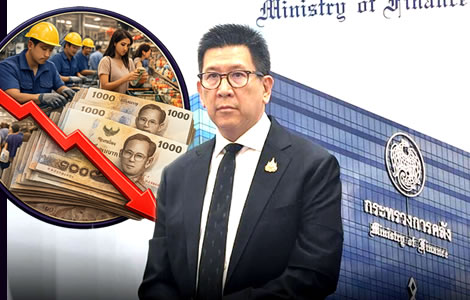
Thailand’s government on Friday unveiled an ambitious investment strategy as worsening trade deficits and a weakening baht exposed growing strains across the economy.
Earlier, Prime Minister Anutin Charnvirakul warned of a “New World Disorder” during a speech at Chulalongkorn University. Meanwhile, Deputy Prime Minister and Finance Minister Ekniti Nitithanprapas outlined plans to lift investment to almost 30% of gross domestic product within four years.
However, the programme comes as Thailand’s external accounts continue to deteriorate. Exports remain at record levels. Yet imports are rising much faster. Consequently, the country’s trade balance has moved sharply into deficit, raising concern that the trend is becoming structural rather than temporary.
BoT deficit and soaring imports expose worsening trade imbalance as Ekniti launches investment drive
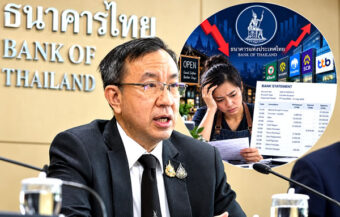
Those concerns deepened on Friday after the Bank of Thailand reported a current account deficit of US$3.5 billion for June. The central bank also said exports increased 21.1% from a year earlier. Imports, by contrast, surged 48.9%.
Separately, Commerce Ministry figures reinforced the picture. Exports rose 20.8% in June, beating market expectations of 15.2%. Imports, meanwhile, jumped 50.3%, well above forecasts of 35.8%. As a result, Thailand recorded a merchandise trade deficit of US$6.57 billion.
The imbalance is now placing sustained pressure on the baht. Although a weaker currency can support exporters, it also reflects weaker foreign currency inflows. Moreover, tourism receipts are no longer sufficient to offset soaring import bills and weaker investment income.
The Bank of Thailand also reported that the economy remained broadly steady during June compared with the previous month. Private investment edged up 0.5%. Private consumption increased 1.1%. Even so, the central bank said economic activity slowed during the second quarter compared with the opening three months of the year.
Against that backdrop, Mr Ekniti unveiled a programme designed to reshape the economy through investment, technology and infrastructure. The strategy seeks to strengthen competitiveness while creating new sources of long-term growth.
On Friday, the Subcommittee on New National Investment Development approved a framework built around five major strategies. The plan aims to transform Thailand into one of the region’s leading investment destinations.
New investment committee begins work as government targets stronger growth and regional investment
The subcommittee operates under the Joint Public-Private Sector Committee for Economic Problem Solving. It is one of four specialist committees established to tackle economic challenges through cooperation between government agencies and private businesses.
Narut Teodsathirasak, secretary-general of the Board of Investment and secretary to the subcommittee, said the framework would accelerate competitiveness, restructure the economy and strengthen Thailand’s investment environment.
“The BOI, as the secretariat of the subcommittee, is ready to join forces with government and private sector agencies to push forward various measures under all five strategies to achieve concrete results,” Mr Narut said.
He added that the objective was to make investment approvals faster and more predictable. At the same time, the government wants to create an ecosystem supporting future industries while delivering sustainable economic growth.
Mr Ekniti said the world economy was undergoing rapid structural change. He cited geopolitical conflict, the digital economy, artificial intelligence, ageing populations and the transition towards greener industries.
In parallel, many countries are competing aggressively to attract investment while companies reorganise global supply chains. Thailand, he said, must use this period to overhaul its economic structure.
“This period presents a crucial opportunity for Thailand to undergo a major restructuring to overhaul its economy through investment, build readiness, reduce investment barriers, and instil investor confidence,” Mr Ekniti said.
Ekniti says global upheaval offers Thailand a rare chance to rebuild its economy through reforms
“If we can successfully utilise this opportunity to transform Thailand, we can become a key investment hub in the region and create long-term economic opportunities for the Thai people.”
The subcommittee is responsible for proposing investment promotion policies, improving infrastructure, removing investment barriers and monitoring implementation. It also coordinates public and private sector cooperation to ensure policies deliver measurable results.
As part of this, the committee supports three wider national objectives. The first is to push annual economic growth above 3%. The second is to lift Thailand into the world’s top 20 economies for competitiveness. The third is to increase total investment to almost 30% of GDP.
The government also wants Thailand to achieve high-income status by 2037.
Priority sectors include modern agriculture, processed food, advanced technology, future mobility, healthcare, tourism, the creative economy and trade.
First, the committee approved an Investment and Industry Transformation Hub. The proposal combines industrial upgrading with the creation of entirely new manufacturing bases.
FastPass and infrastructure upgrades form the backbone of Thailand’s first investment hub strategy
Under the plan, officials will introduce a Thailand FastPass mechanism to reduce approval times for investment projects and business permits. Developers would also benefit from faster decisions across government agencies.
At the same time, infrastructure development will accelerate. The programme covers electricity, water supplies and industrial land needed for future investment.
Equally important, the government plans to strengthen workforce skills. The Skill Bridge programme will prepare Thai workers for industries requiring advanced technical expertise.
The strategy also targets sectors expected to drive future growth. These include clean energy, Bio and Green industries, electric vehicles, advanced semiconductors, electronics, digital technology, artificial intelligence, automation, robotics, medical technology and future foods.
Beyond that, officials want Thai businesses to become more deeply integrated into global supply chains. The government also plans to increase domestic content across targeted industries.
Fiscal support will reinforce those measures. Companies will gain access to special loan programmes, tax incentives and improvements to government procurement designed to strengthen domestic businesses.
The second strategy establishes an AI and Digital Hub.
Continuing from the next xxxsub:
Thailand targets AI leadership with ฿100bn investment and adoption across business and government
Here, the government wants Thailand to become a regional centre for artificial intelligence, semiconductor production and chip design. The target is to attract 100 billion baht of investment by 2027.
In turn, officials expect AI-related industries to contribute 5% of gross domestic product. The programme also includes investment in digital infrastructure, research, intellectual property and workforce development.
Artificial intelligence will also be promoted throughout government agencies and private businesses. Officials expect wider adoption to increase productivity, reduce operating costs and create new digital services.
The third strategy focuses on building a Green Hub.
The government plans to accelerate investment in clean energy while expanding smart electricity grids, electric vehicle infrastructure and environmentally focused transport systems.
Notably, the programme also includes carbon accounting, carbon markets, emissions trading and green financial instruments. Officials believe those measures will improve competitiveness as international markets increasingly reward sustainable production.
On another front, the fourth strategy seeks to establish Thailand as a regional financial services hub.
Financial services and medical manufacturing complete government’s five-part blueprint for future growth
The proposal covers banking, capital markets, insurance and wealth management. It also aims to strengthen financing opportunities for innovative companies, start-ups and high-potential Thai businesses capable of competing internationally.
Finally, the fifth strategy centres on medical manufacturing and innovation.
The government wants Thailand to become a regional hub for high-value medical production. The plan covers research, pharmaceutical manufacturing, medical devices and advanced healthcare products.
Likewise, Thai manufacturers will receive support to strengthen links with international medical supply chains. Officials also want to increase domestic production of medical components and healthcare innovations.
Yet the government’s ambitious programme unfolds as Thailand’s external accounts remain under sustained pressure.
Businesses are importing unprecedented volumes of machinery, advanced electronics and technology. Much of that equipment supports artificial intelligence projects and new data centres. Consequently, imports are growing much faster than exports despite record overseas sales.
Thailand also remains heavily dependent on imported crude oil, natural gas and refined fuels. Elevated global energy prices have therefore pushed import costs sharply higher. Combined with record capital equipment purchases, those costs have widened the country’s trade deficit despite exceptionally strong export performance.
Rising imports and energy costs drive widening current account deficit and sustained pressure on the baht
Those rising imports are reshaping Thailand’s external accounts. The current account measures trade in goods and services alongside investment income and international transfers. Throughout 2026, that balance has steadily weakened.
Previously, sizeable current account surpluses helped support the baht. Now, that position has reversed. Instead, persistent trade deficits are feeding directly into a growing current account shortfall.
Tourism receipts continue to provide support. Even so, they have failed to offset rising import costs and weaker investment income. Consequently, the surplus that once underpinned the currency has largely disappeared.
The Bank of Thailand has already acknowledged that earlier expectations for a sizeable current account surplus have been revised sharply lower. Instead, policymakers now accept that a deficit remains possible if adverse global conditions continue.
That shift has increased pressure on the baht throughout 2026. The currency has weakened by more than 6% against the US dollar since the beginning of the year. It has also fallen to its lowest level in about 15 months.
A weaker current account naturally reduces foreign currency inflows. At the same time, importers require increasing amounts of US dollars to pay overseas suppliers. In turn, that combination has intensified depreciation pressures.
Weaker baht, higher US tariffs and slower global trade threaten Thailand’s export outlook in late 2026
Thailand’s relatively low interest rates have added to those challenges. By comparison, higher rates in the United States have encouraged capital to flow abroad, placing further pressure on the currency.
Looking ahead, the outlook will depend heavily on global energy prices, trade conditions and tourism performance.
If oil prices remain elevated, imports could continue to outpace exports. Should that occur, the current account deficit would likely persist, limiting any sustained recovery in the baht.
Conversely, lower energy costs, continued export growth and stronger tourism receipts would improve foreign exchange inflows. Even then, most analysts expect the baht to remain under pressure through the second half of the year.
Fresh uncertainty has also emerged from the United States.
Earlier this week, Washington imposed a 12.5% tariff on Thai exports under its Section 301 trade measures. The new rate exceeds the 10% tariffs imposed on regional competitors, including Malaysia and the Philippines.
In response, Asia Plus Securities warned that the higher tariff burden could weaken Thailand’s export competitiveness during the second half of the year.
Asia Plus warns higher US tariffs could slow exports and trigger further American trade measures
Therdsak Taveeteeratham, executive vice-president at Asia Plus Securities, said the measures created new uncertainty despite recent export strength.
“The higher tariff burden could erode Thailand’s competitive position in key export markets and slow export growth during the second half of the year,” Mr Therdsak said.
He also warned that Thailand’s growing trade surplus with the United States increased the likelihood of additional American trade measures.
“Thailand’s increasing trade surplus with the US requires vigilance for potential ‘excess production’ tariffs from the US, which could pressure the shipment sector,” the brokerage noted.
Accordingly, Asia Plus Securities urged investors to monitor possible tariffs targeting industries linked to excess manufacturing capacity. Washington has yet to announce such measures. However, they could create additional headwinds for Thailand’s export-driven economy.
The brokerage identified several sectors facing the greatest exposure.
These include pet food, processed food, beverages and electronics. By contrast, several major export categories remain exempt from the latest tariffs.
Energy exports escape new US tariffs as electronics continue powering Thailand’s strongest export growth
Oil, natural gas and fertiliser products imported by the United States are excluded. As a result, Thai energy companies including PTT, PTT Exploration and Production, Thai Oil, IRPC and Bangchak Corporation avoid the latest measures.
Likewise, products already covered under separate Section 232 measures remain outside the new tariff regime. Those exemptions include automobiles, steel, aluminium and copper. Steel processors and pipe manufacturers therefore avoid additional duties under the latest announcement.
KGI Securities also advised investors to monitor developments closely.
The brokerage noted that Thailand’s export structure remains heavily dependent on the United States. The American market now accounts for 26.3% of Thailand’s total exports.
Excluding oil-related products, gold and strategic materials, June exports would have increased 23.1% year-on-year, according to KGI.
Notably, electronics continued to outperform nearly every other export category.
Electronics exports surged 66% from a year earlier. Within that sector, other electronics climbed 118%. Computer equipment and components also rose 57%.
KGI said sustained expansion would reflect technological adoption and production relocation driven by geopolitical risks.
Meanwhile, several traditional export sectors also maintained strong momentum.
Pet food, rubber and chicken exports remain resilient despite record imports widening the trade deficit
Pet food exports increased 22.3% during June. That marked a tenth consecutive month of annual growth.
Rubber exports rose 12.5%. Significantly, that represented the sector’s first expansion in 14 months.
Processed chicken exports also strengthened. Shipments climbed 6.1%, extending growth into a seventh straight month.
Despite those gains, imports continued to dominate the overall trade picture.
June’s 50.3% surge reflected more than consumer demand. Instead, it highlighted the scale of investment now flowing into machinery, electronics and advanced technology.
Much of that spending supports artificial intelligence infrastructure, semiconductor capacity and new data centres. Although those imports may strengthen long-term productivity, they require immediate foreign currency payments.
At the same time, elevated energy prices continue to inflate Thailand’s import bill.
The country remains heavily dependent on imported crude oil, natural gas and refined fuels. Consequently, global commodity prices continue to exert a powerful influence on the trade balance.
That combination explains why record exports have failed to produce stronger external accounts.
Ambitious investment plans confront weakening external accounts, a softer baht and trade pressures
Instead, surging imports have overwhelmed export gains, widening both the merchandise trade deficit and the current account deficit.
For policymakers, that creates two competing economic realities.
On one hand, Thailand is pursuing one of its most ambitious investment drives in years. The government hopes faster approvals, stronger infrastructure, artificial intelligence, green industries, advanced manufacturing and medical innovation will reshape the economy and attract new capital.
On the other hand, deteriorating external balances are creating immediate financial pressure.
Prime Minister says Thailand is navigating a ‘New World Disorder’ and sets out a new economic agenda
Shift in the Thai economy sees the lowest baht value in 15 months as imports rise far faster than exports
The Bank of Thailand has already confirmed a US$3.5 billion current account deficit for June. Meanwhile, the Commerce Ministry reported a US$6.57 billion merchandise trade deficit as imports expanded at more than twice the pace of exports.
Those figures underline the scale of the challenge facing policymakers.
Mr Ekniti’s five-part investment strategy aims to strengthen competitiveness, remove investment barriers and position Thailand as a leading regional investment hub.
However, the programme will unfold against a more difficult international environment marked by weaker external accounts, sustained pressure on the baht and growing uncertainty over global trade.
Join the Thai News forum, follow Thai Examiner on Facebook here
Receive all our stories as they come out on Telegram here
Follow Thai Examiner here
Further reading:
Prime Minister says Thailand is navigating a ‘New World Disorder’ and sets out a new economic agenda
US Ambassador Seán O’ Neill briefed Prime Minister Anutin Charnvirakul at Government House on War
Visa waivers, discounted hotel stays and 2,000 baht a person per day for stranded tourists announced