Thailand’s cannabis free-for-all faces its biggest challenge yet as ministers prepare a landmark law restricting use to medicine, enforcing nationwide licensing, banning promotion and introducing tougher criminal penalties for illegal sales and use.
Thailand is poised for its biggest reversal of cannabis policy since the drug was decriminalised four years ago, with ministers preparing to consider a sweeping new Cannabis Control Bill that would confine its use to medicine, impose strict licensing across the entire industry and introduce significantly tougher criminal penalties. The landmark legislation would replace years of piecemeal regulation with Thailand’s first comprehensive cannabis law, responding to mounting criticism over weak enforcement, widespread recreational sales and a booming commercial market that expanded far beyond the original vision of medical cannabis.
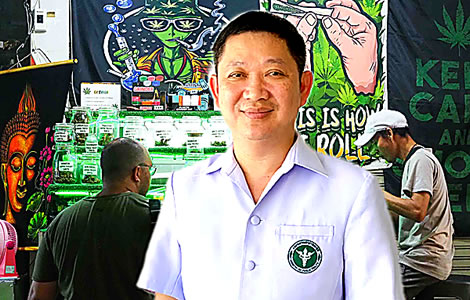
Four years after Thailand decriminalised cannabis, the government is preparing its strongest legislative response yet. A draft Cannabis Control Bill is expected to reach the cabinet shortly.
If approved, it would confine cannabis to medical use, tighten licensing and introduce tougher criminal penalties. Crucially, it would replace the regulatory approach that has dominated since June 2022 with a comprehensive statutory framework.
The Department of Thai Traditional and Alternative Medicine (DTAM) prepared the legislation after completing public consultations. Subsequently, DTAM Director-General Dr Pongsathorn Phokphermdee submitted the draft to Public Health Minister Pattana Promphat on July 20.
It is now awaiting cabinet consideration. According to DTAM Deputy Director-General Dr Thewan Thaneerat, the bill establishes a single legal framework covering cultivation, production, imports, exports, retail sales and public health protection. As part of this, it establishes a national cannabis committee, chaired by the public health minister, to oversee policy, licensing, and enforcement.
Government prepares comprehensive Cannabis Control Bill to replace regulations with a medical-only law
The proposal reflects a clear change in direction. Following decriminalisation, ministers relied largely on regulations to steer the industry. However, comprehensive legislation never followed. Instead, successive governments introduced a series of administrative measures to curb recreational use.
Nevertheless, enforcement remained inconsistent as the commercial market expanded. Consequently, ministers are now seeking permanent legal powers to regulate every stage of the industry.
Anyone wishing to cultivate, produce, import, export or sell cannabis would require a DTAM licence. Each licence would remain valid for three years. Notably, exemptions would continue for roots, branches, stems, leaves and seeds.
Medical practitioners would also remain exempt when treating patients under existing laws. Collectively, those provisions would place the industry’s commercial activities under one licensing system.
The draft also tightens retail restrictions. Cannabis could not be sold to anyone under 20 years old. Sales would also remain prohibited to pregnant women and breastfeeding mothers. In parallel, retailers would be barred from operating in temples, schools, dormitories, public parks, zoos and amusement parks. Those restrictions significantly narrow the locations where legal sales may occur.
Licensing, retail limits and national oversight would place every stage of cannabis trade under one law
Advertising would face equally sweeping controls. Promotion of cannabis flowers, cannabis resin and smoking devices would be prohibited. Likewise, marketing intended to encourage consumption would be banned.
Under the draft, cannabis and its extracts could only be used for medical treatment under professional supervision or authorised research. Recreational use would therefore fall outside the proposed legal framework.
The legislation also introduces substantially stronger penalties. Producing, importing, exporting or selling cannabis without a licence could result in imprisonment and fines. Similarly, selling cannabis to prohibited groups would attract criminal sanctions.
Unauthorised use would also become punishable by financial penalties. In response, officials say the legislation provides clearer enforcement powers than those available under existing regulations.
The bill follows four years of profound change. Cannabis was removed from Thailand’s narcotics list in June 2022 under a flagship Bhumjaithai Party policy. Anutin Charnvirakul served as public health minister at the time.
The move aimed to promote medical cannabis while creating new agricultural and commercial opportunities. Yet the legal framework remained incomplete as the market expanded.
Draft law proposes tougher penalties, advertising bans and medical-only cannabis use across Thailand
Thousands of cannabis businesses subsequently opened across the country. At the same time, comprehensive legislation repeatedly failed to advance. Recreational use also expanded as regulators relied on ministerial rules rather than primary legislation.
As a result, officials repeatedly revised regulations in an effort to tighten control. Even so, those measures produced only limited practical impact.
Current rules require customers to obtain a medical prescription before purchasing cannabis products. Separately, businesses are expected to verify compliance before completing a sale.
Yet cannabis remains widely available in many tourist districts, according to workers and industry representatives. That gap between regulation and practice has become one of the central arguments for comprehensive legislation.
Years of weak enforcement and inconsistent regulation strengthen calls for coherent cannabis legislation
Cannabis advocate Chokwan Chopaka said the official purchasing process often differs from daily practice. “No one really follows the official way of making a legal purchase,” she said. She added that shops routinely sell without prescriptions before creating documentation later if required. She also claimed some doctors issue prescriptions in bulk or through informal arrangements with retailers.
Qatari tourist to be deported after unprovoked attacks in Hua Hin after third visit to a cannabis shop
Thai customs save government further blushes with 1.6 tonnes cannabis seizure destined for Holland’s drug market
One dispensary on Bangkok’s Khao San Road said complying with the latest regulations had increased operating costs. The business now requires prescriptions and employs a doctor several times each week to verify documentation.
On another front, staff questioned how consistently the rules are enforced. “Even if customers get stopped by police without a prescription, I’ve seen they’re given softer treatment if they’re tourists,” one shop worker said. That perception has reinforced concerns that regulations alone have struggled to produce consistent enforcement.
Join the Thai News forum, follow Thai Examiner on Facebook here
Receive all our stories as they come out on Telegram here
Follow Thai Examiner here
Further reading:
Polish couple deported for nudity on Koh Phangan. Polish man hospitalised for mental health tests
Thaksin does not rule out joining talks in US as Thai team finalises plans. They fly out on Thursday
Trump’s remaking of World trade, if it works, will force Thailand to decide between the US and China
US offers a 90-day tariff pause but Thailand must move faster as it already faces shaved GDP in 2025
PM addresses the nation in shock over last week’s earthquake and this week’s Trump tariff bombshell
Finance Minister to travel to US to import more US food and motorbikes while lowering Thai tariffs