Thailand’s biggest waterfront redevelopment is on the table as ministers seek to move Bangkok Port to Laem Chabang, unlocking 2,353 rai while unions, experts and politicians warn of major economic consequences if the plan is botched.
A battle for 2,353 rai of prime waterfront land in the heart of Bangkok has begun after the Bhumjaithai-led government unveiled plans to shift Bangkok Port’s cargo operations to Laem Chabang and replace one of Thailand’s oldest transport hubs with a casino-free entertainment complex, luxury housing, commercial projects and a cruise marina. The proposal would reshape the capital and redefine Thailand’s logistics network. However, it has already triggered fierce resistance from the Port Authority’s labour union, transport experts and political critics, who warn it could drive up logistics costs, threaten thousands of jobs and gamble with one of the nation’s most strategically important public assets.
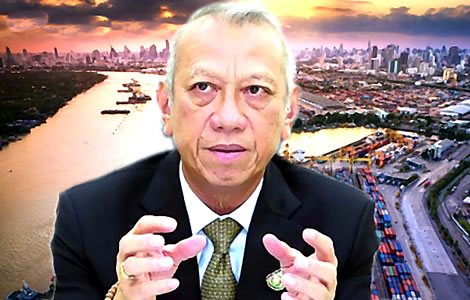
The battle over the future of Bangkok Port has begun after the Bhumjaithai-led government unveiled plans to transform one of Bangkok’s largest state-owned sites. At the centre of the proposal sits 2,353 rai of Port Authority of Thailand (PAT) land at Khlong Toei.
Deputy Prime Minister and Transport Minister Phiphat Ratchakitprakarn wants cargo operations gradually shifted to Laem Chabang Port before the land is redeveloped into a vast commercial district. The proposal would reshape a strategic section of the capital. More importantly, it would redefine the future role of Bangkok Port, one of Thailand’s oldest transport hubs.
The government’s concept reaches far beyond a conventional redevelopment project. Instead, ministers envision a casino-free entertainment complex surrounded by luxury housing, shopping centres, commercial projects and waterfront attractions.
Plans also include a cruise ship terminal and a yacht marina. Private investors would be invited through long-term concession agreements. In return, the government expects substantial new revenue from one of Bangkok’s most valuable undeveloped sites.
Bhumjaithai revives Khlong Toei redevelopment with a casino-free vision after Pheu Thai’s earlier plan failed
Officials believe the project could strengthen tourism while creating a new destination for business, exhibitions, culture and leisure.
Yet the proposal represents a sharp political shift rather than an entirely new idea. Previously, the former Pheu Thai government identified Bangkok Port as a potential location for an entertainment complex that included a casino. That proposal formed part of a broader strategy to attract tourism and investment.
However, resistance quickly centred on legalised gambling rather than wider redevelopment. Consequently, the plan stalled before eventually being abandoned.
By contrast, the Bhumjaithai government has deliberately separated its proposal from the casino debate. The party opposed Pheu Thai’s entertainment complex policy while serving in opposition. Accordingly, it abandoned the previous proposal after taking office.
Instead, ministers began developing their own concept centred on entertainment, tourism and commercial investment without gambling. Earlier this year, Mr Phiphat introduced that approach for projects within the Eastern Economic Corridor. The Bangkok Port proposal now represents the most ambitious expression of that policy.
On July 20, Mr Phiphat formally outlined his vision during a policy visit to the Port Authority of Thailand. Addressing PAT executives, he proposed relocating Bangkok Port’s cargo operations to Laem Chabang before redeveloping the entire Khlong Toei site.
According to the transport minister, the 2,353-rai property should generate significantly greater economic value than it does today. He argued that redevelopment would maximise opportunities across tourism, international conferences, exhibitions, arts, culture and entertainment while unlocking the commercial potential of a rare waterfront site in central Bangkok.
Phiphat says Bangkok Port’s future depends on shifting cargo to Laem Chabang before redevelopment
However, none of those ambitions can proceed unless the government’s transport strategy changes first. Redevelopment depends upon reducing Bangkok Port’s long-established role as a cargo gateway. Consequently, Mr Phiphat’s proposal rests on two parallel policies rather than one.
The first would gradually relocate cargo operations to Laem Chabang Port. The second would redevelop the land released through that transition. Both policies must advance together if the government’s broader vision is to succeed.
According to Mr Phiphat, Bangkok Port faces operational limitations that become more significant each year. Ships entering Khlong Toei must first navigate from the Gulf of Thailand into the Chao Phraya River.
They then travel considerable distances before reaching the port itself. In addition, the river channel lacks sufficient depth for many of today’s largest cargo vessels. Those restrictions inevitably reduce efficiency compared with modern deep-water ports. As global shipping continues evolving towards larger vessels, the minister believes those disadvantages will only become more pronounced.
By comparison, Laem Chabang already operates under very different conditions. The port accommodates substantially larger ships while offering greater room for future expansion.
Moreover, its Phase 3 development is already underway to increase cargo capacity further. Mr Phiphat believes those advantages make Laem Chabang Thailand’s natural long-term cargo gateway. Rather than dividing resources between two major ports, he argues the country should concentrate operations at one modern facility capable of handling future growth.
Government says one major cargo port would cut costs, improve logistics and ease Bangkok traffic
The transport minister also believes consolidation would produce wider economic benefits. Administrative costs would decline as operations become centralised. Personnel requirements could also be streamlined over time.
Meanwhile, logistics efficiency would improve through the use of deeper-water infrastructure designed for larger vessels. Equally important, the number of heavy trucks entering Bangkok could gradually fall as cargo increasingly bypasses the capital. Instead of functioning primarily as a freight terminal, Bangkok Port would steadily assume a different economic role.
Nevertheless, the government accepts that such a transition cannot happen overnight. Cargo operations at Bangkok Port remain extensive, while existing policies must first be examined carefully.
As part of this process, the Ministry of Transport has begun reviewing earlier Cabinet resolutions together with the original objectives behind Laem Chabang Port’s construction.
Officials want to establish whether previous governments intended Laem Chabang eventually to replace Bangkok Port as Thailand’s principal cargo hub. That historical policy review will shape the government’s next steps.
Cabinet review to determine if earlier policy already supported moving Bangkok Port to Laem Chabang
If those earlier decisions already support relocation, ministers intend to follow the original direction. Otherwise, the proposal will require fresh Cabinet discussions before any formal transfer can begin. Either way, the review represents the first major administrative hurdle facing the project. Until that work concludes, Bangkok Port will continue operating as normal while officials examine the legal and policy framework surrounding any future relocation.
Meanwhile, planning for the Khlong Toei site has continued to evolve. Should cargo operations eventually move east, the government intends to redevelop the entire 2,353-rai property rather than isolated sections. The entertainment complex would become only one element within a much broader mixed-use district.
Surrounding developments would include premium residential projects, shopping centres, commercial buildings and waterfront facilities designed to generate year-round economic activity.
Ministers argue that combining several complementary developments would maximise the long-term value of one of Bangkok’s largest remaining state-owned land holdings.
Notably, the proposal also attempts to address one of the area’s most sensitive issues. Rather than displacing the Khlong Toei community, the government says redevelopment will include new housing within the project itself.
Redevelopment plan keeps Khlong Toei residents with new homes, schools, parks and hospitals
Preliminary plans allocate between 500 and 600 rai for residential development capable of accommodating more than 40,000 people across approximately 12,600 households. High-rise buildings would replace lower-density housing. In parallel, schools, childcare centres, community hospitals and public parks would also form part of the redevelopment.
The remaining land would then become available for commercial investment under long-term concession agreements. Revenue generated through those concessions would return to the Port Authority of Thailand.
Separately, ministers say part of future profits would support education, healthcare, welfare and infrastructure within surrounding communities. The government argues that this approach would allow public ownership to remain intact while attracting private capital to finance large-scale redevelopment.
Even so, the proposal has already triggered intense debate despite the absence of casinos. The argument has now shifted towards logistics, employment, urban planning and land use rather than gambling policy. Supporters believe the project could unlock the economic value of a rare central Bangkok waterfront site.
Government promises new homes, community facilities and public investment in redevelopment plan
Critics, however, question whether weakening Bangkok Port would ultimately impose greater costs elsewhere in Thailand’s economy. As a result, the battle over Khlong Toei has expanded well beyond a simple property development and into a wider debate over the country’s future transport strategy.
Opposition has emerged from several directions since the proposal became public. Significantly, the strongest resistance has come from within the Port Authority itself rather than outside political circles.
While the government argues that Bangkok Port’s long-term role should diminish, many inside the organisation fundamentally reject that conclusion. Instead, they maintain the port remains an essential national asset whose value extends well beyond the land it occupies.
The Port Authority of Thailand State Enterprise Labour Union, together with PAT employees, has formally opposed any proposal to close or relocate Bangkok Port. In response, the union submitted an open letter to the chairman and board of the Port Authority demanding immediate clarification.
The letter specifically rejected plans to relocate cargo operations to Laem Chabang in order to redevelop the Khlong Toei site into an entertainment complex, even without a casino. Union leaders argued that removing gambling from the proposal does not resolve the wider concerns surrounding the project.
Port Authority union rejects relocation and demands answers over plans to dismantle Bangkok Port operations
According to the union, Bangkok Port has served as a vital component of Thailand’s logistics system for decades. It continues generating revenue while supporting domestic and international trade.
Moreover, it remains deeply connected to shipping companies, freight operators, logistics businesses and thousands of workers whose livelihoods depend upon daily port activity. Closing or relocating the facility, the union warned, would therefore affect far more than the Port Authority itself.
The union also questioned the government’s assessment of Bangkok Port’s future role. While ministers emphasise administrative savings and redevelopment opportunities, employees argue that the port continues performing an important economic function.
They also warned that uncertainty surrounding the proposal could undermine confidence among shipping lines, investors and commercial partners. Such uncertainty, they argued, could weaken the Port Authority’s standing before any relocation decision is even reached.
Accordingly, the labour union demanded that the PAT board publicly explain the government’s intentions. Members called for detailed information covering the relocation proposal, its implementation, its economic consequences and its likely impact on stakeholders.
Labour union demands transparency and warns of stronger opposition unless government clarifies plan
They also insisted that discussions should not remain confined to government agencies. Instead, employees, businesses and affected communities should receive full disclosure before any policy advances further.
The union also imposed a clear deadline. Members said they would monitor developments over the following seven days. If no satisfactory explanation emerged, they warned they would intensify opposition to the government’s policy.
That warning represented the first organised institutional challenge to Mr Phiphat’s redevelopment strategy. It also demonstrated that resistance extends beyond party politics into the transport sector itself.
Political criticism has since broadened the debate. On another front, Pol. Col. Pongsakorn Kwanmuang, spokesman for the Democrat Party, questioned the government’s choice of location rather than the redevelopment concept alone.
He asked why ministers had selected land occupied by an established community when the Port Authority controls other unused property. In his view, alternative sites should first be considered before disrupting one of Bangkok’s oldest neighbourhoods.
Democrats question Khlong Toei site and demand stronger protection for communities, jobs and public
He also argued that redevelopment priorities require reconsideration. Rather than concentrating primarily on commercial projects, he proposed greater emphasis on affordable housing, public space and employment opportunities for local residents.
Those objectives, he said, should remain central if such a valuable public asset is to be redeveloped. Otherwise, commercial interests could dominate decisions affecting long-established communities.
Beyond housing, the Democrat spokesman highlighted another issue receiving comparatively little attention. Thousands of workers depend directly or indirectly upon Bangkok Port. Those employees extend far beyond the Port Authority workforce itself.
Cargo handlers, shipping lines, transport operators, warehouse businesses and numerous supporting industries also rely upon activity generated by the port. Consequently, relocating cargo operations would produce economic effects reaching well beyond Khlong Toei.
For that reason, Pol. Col. Pongsakorn argued that government support measures must extend beyond residential redevelopment. Workers facing disruption would require continued employment opportunities, income protection and practical skills training.
Simply providing replacement housing, he suggested, would not resolve the wider consequences of relocating one of Thailand’s busiest cargo facilities. Labour policy, therefore, should accompany transport policy from the outset.
Democrat Party says worker protections must match housing plans if Bangkok Port relocation proceeds
Separately, transportation engineering expert Dr Samart Ratchapolsit has offered one of the most detailed technical assessments of the proposal. The former Democrat deputy leader and former deputy governor of Bangkok does not reject relocation outright.
Instead, he argues that the government’s economic calculations remain incomplete. In particular, he believes ministers have concentrated too heavily on administrative savings while giving insufficient attention to logistics costs across the wider economy.
Writing on Facebook on August 3, Dr Samart urged ministers not to focus exclusively on the commercial value of 2,353 rai in central Bangkok. Instead, he argued that every decision should begin with a straightforward question.
Will Thailand ultimately gain benefits exceeding the costs created by relocating Bangkok Port? Until that calculation is completed, he suggested the government cannot confidently conclude that the proposal serves the national interest.
Dr Samart acknowledged that Bangkok Port has genuine operational limitations. The Chao Phraya River remains relatively shallow, preventing many larger vessels from entering the port. Ships must also navigate a winding river channel before reaching Khlong Toei. Those constraints have existed for decades. Nevertheless, he noted they have never prevented shipping companies from continuing to use the facility.
Dr Samart backs reform but warns ministers to calculate the full national logistics cost of moving port
The explanation, he argued, lies in the destination of the cargo rather than the size of the ships. Most goods arriving at Bangkok Port are intended for Bangkok and neighbouring provinces.
Consequently, relocating every shipment to Laem Chabang would simply move the unloading point further away from the final customer. Every container would then require additional transport back into the capital by truck or rail.
Those extra transport movements inevitably carry additional costs. Businesses would first absorb those expenses through higher logistics bills. Eventually, however, consumers would also bear part of the burden through increased prices for goods.
Accordingly, Dr Samart argued that ministers should examine the cost of the entire logistics chain rather than concentrating solely on the Port Authority’s operating budget. Otherwise, savings achieved in one area could simply reappear elsewhere in the economy.
His analysis also extended beyond freight movements. As part of his assessment, Dr Samart warned against overlooking workers whose livelihoods depend upon Bangkok Port. Public discussion has largely focused on the Khlong Toei community and its future housing.
However, thousands of people working within the port economy also face uncertainty if cargo operations eventually move elsewhere. Their interests, he argued, deserve equal consideration.
Dr Samart says labour protections and gradual shifts offer a safer path than sudden relocation
Those workers include employees directly involved in port activities together with many businesses supporting daily operations. Therefore, any relocation strategy should include comprehensive labour transition measures alongside redevelopment plans.
Employment opportunities, income security and workforce adjustment programmes all require careful preparation before major operational changes begin. Without those safeguards, the economic disruption could spread far beyond the port itself.
Even so, Dr Samart does not oppose the government’s long-term objective. He accepts that Thailand may eventually require only one major cargo port if detailed studies demonstrate clear national benefits. However, he argues that any transition should occur gradually rather than through an immediate closure. Market forces, he believes, should determine the pace of change wherever possible.
Instead of ordering Bangkok Port to cease operations, Dr Samart proposes ending investment in new equipment while allowing existing facilities to continue operating until the end of their useful lives.
Gradual shift to Laem Chabang would reduce disruption while preserving market-driven cargo decisions
Meanwhile, future investment would concentrate increasingly on Laem Chabang. As efficiency improves there, shipping companies and logistics operators would gradually migrate according to commercial considerations rather than government directives.
In his view, such an approach would minimise disruption while still allowing Bangkok Port’s role to diminish over time.
Finally, Dr Samart addressed the commercial redevelopment proposed for the Khlong Toei site. If the government proceeds with long-term concessions, he argued the process must remain transparent and genuinely competitive.
He also stressed that the land belongs to the nation rather than any individual government. Consequently, any financial returns generated through redevelopment should benefit the state and the public appropriately, not merely a limited number of private investors.
While debate has largely focused on relocating Bangkok Port, the redevelopment of Khlong Toei did not begin with the current government. In fact, the Port Authority of Thailand has been planning the future of the area for years.
Since 2019, PAT has studied a comprehensive master plan covering the entire 2,353-rai site. Consequently, the land has never lacked a long-term development strategy. The current dispute instead concerns which vision should ultimately shape one of Bangkok’s most valuable public assets.
Master plan already envisioned major Khlong Toei redevelopment without closing Bangkok Port
The original PAT master plan proposed a broad mixed-use redevelopment while preserving the port’s operational role. Rather than replacing Bangkok Port, the authority intended to modernise it alongside new commercial projects.
The blueprint divided the site into five development zones covering offices, residential districts, medical facilities and smart communities. Mixed-use commercial developments also featured prominently throughout the proposal.
In addition, the master plan incorporated hotels, duty-free shopping, exhibition centres and e-commerce offices. Warehouse facilities and truck parking areas also formed part of the design. Public amenities received significant attention as well. Plans included sports complexes together with large public parks serving both residents and visitors. Accordingly, PAT’s vision already extended well beyond traditional port operations.
Importantly, the authority never intended to abandon cargo activities at Khlong Toei. Instead, Bangkok Port would evolve into what PAT described as a smart port. Modern container terminals would continue operating alongside coastal cargo facilities.
Separately, another zone would accommodate a dedicated cruise terminal. The proposal therefore combined logistics, tourism and commercial redevelopment within a single integrated plan. Redevelopment did not depend upon closing the port.
Phiphat wants to revolutionise PAT blueprint by replacing it with an entirely new redevelopment strategy
That distinction now lies at the centre of the government’s new approach. Rather than adapting PAT’s existing blueprint, Mr Phiphat has made clear he wants something fundamentally different. He believes the original master plan should be reviewed from top to bottom. Indeed, he has said it may need to be “revolutionised” before the project can proceed. That language signals a clear break with the authority’s earlier planning.
Before any revised master plan moves forward, several groups will participate in consultations. Mr Phiphat has said discussions must involve the Permanent Secretary of the Ministry of Transport together with the PAT board.
Community representatives will also be consulted. Likewise, the Port Authority State Enterprise Labour Union will take part in the process. Those consultations will determine whether a completely new development framework replaces the existing blueprint.
The government’s proposal therefore extends well beyond building an entertainment complex. Instead, ministers are attempting to redefine how central Bangkok’s largest remaining waterfront site should function over coming decades.
Everything depends upon reducing Bangkok Port’s traditional cargo role. Without that change, the broader redevelopment vision cannot proceed. The future of the land and the future of the port have therefore become inseparable.
Khlong Toei land is central to competing visions for Bangkok Port and Thailand’s logistics future
At the same time, the proposal illustrates how dramatically attitudes towards Khlong Toei have changed. For decades, Bangkok Port existed primarily as a working cargo facility serving the capital.
Today, however, the surrounding land is increasingly viewed as one of Thailand’s most valuable development opportunities. Large tracts of publicly owned land in central Bangkok have become exceptionally scarce. Consequently, successive governments have examined ways to unlock greater economic value from the site.
The Bhumjaithai administration has now placed that objective at the centre of its transport policy. Unlike the previous Pheu Thai government, it has removed casinos from the equation. Nevertheless, the broader ambition remains substantial.
Ministers want Khlong Toei to become a new commercial, tourism and residential district while preserving public ownership of the land through long-term concessions. In their view, redevelopment offers greater long-term value than maintaining the port in its present form.
Critics, however, argue that the calculation is far more complex. The debate now reaches well beyond gambling, real estate or urban planning.
Instead, it encompasses national logistics, transport efficiency, employment, community redevelopment and the future structure of Thailand’s maritime economy. Every proposal to redevelop the land also raises questions about freight costs, supply chains, labour protections and the long-term competitiveness of Bangkok as a logistics centre.
Government to decide if Bangkok Port’s future lies in redevelopment or modernised cargo operations
Equally, the proposal has exposed competing visions for the future of Bangkok Port itself. One approach favours concentrating cargo operations at Laem Chabang while transforming Khlong Toei into a high-value commercial district.
The other supports modernising the existing port while integrating new development around it. Both approaches seek economic growth. However, they differ fundamentally on whether Bangkok Port should continue playing a significant operational role.
For now, the government’s proposal remains at an early stage. Cabinet decisions, historical policy reviews and extensive consultations must all take place before relocation can begin.
New era for Thailand’s foreign tourism industry may be dawning as Casino bill is approved by cabinet
Legal casinos and gambling in Thailand being weighed up carefully after Deputy PM’s backing
Detailed studies will also determine whether transferring cargo operations produces greater national benefits than maintaining the existing system. Until then, Bangkok Port will continue operating while officials assess one of the most significant transport policy decisions in decades.
Even so, one conclusion already appears increasingly certain. The long-term future of Khlong Toei is now under active review. Whether the final outcome follows the government’s proposal or a modified version remains uncertain.
Likewise, a future administration could revisit PAT’s existing master plan. Yet the wider direction of travel has become unmistakable. The role of Bangkok Port is being reassessed, and 2,353 rai in the heart of Bangkok has become the focus of one of Thailand’s most consequential redevelopment battles.
Join the Thai News forum, follow Thai Examiner on Facebook here
Receive all our stories as they come out on Telegram here
Follow Thai Examiner here
Further reading:
New era for Thailand’s foreign tourism industry may be dawning as Casino bill is approved by cabinet
Minister outlines plans for Casinos, Disneyland and a tax support system for workers to Parliament
Legal casinos and gambling in Thailand being weighed up carefully after Deputy PM’s backing
Top Royal Thai Police officers under scrutiny over links to huge illegal online gambling cash flows
Unlikely rags to riches convict star arrested again in Thailand over online gambling promotion
PM plays clips to parliament to defend himself against media ‘distortion’ of gambling claims
Rayong gambling boss is arrested as fact-finding panel finds police and officials acted corruptly
Gamblers and hosts at illegal gambling dens are being jailed as massive crackdown proceeds apace
World cup brought home Thailand’s chronic gambling issue
Activist: more gambling dens in Rayong, 45-year-old security man tested on Sunday dies on Monday