Thailand faces a febrile week as anger over Israelis spreads from a NIDA poll to street protests. Sondhi targets foreign influence, Phuket cancels a Jewish event and the EC prepares a ruling on 138 senators that could ignite a wider political crisis.
Thailand is entering a volatile political week as public anger over Israeli nationals collides with economic strain, street protests and a deepening Senate crisis. A new NIDA poll shows 77.49% want strict enforcement of Thai law, while nearly half want shorter stays for Israelis. The findings follow embassy protests, the cancellation of a major Jewish event in Phuket and growing scrutiny of foreign landholding and nominee firms. Meanwhile, the Election Commission must rule on 229 people in the 2024 Senate collusion case, including 138 serving senators. The combined pressure now reaches tourism, business, national security, Thailand’s ties with Israel and the credibility of its political institutions.
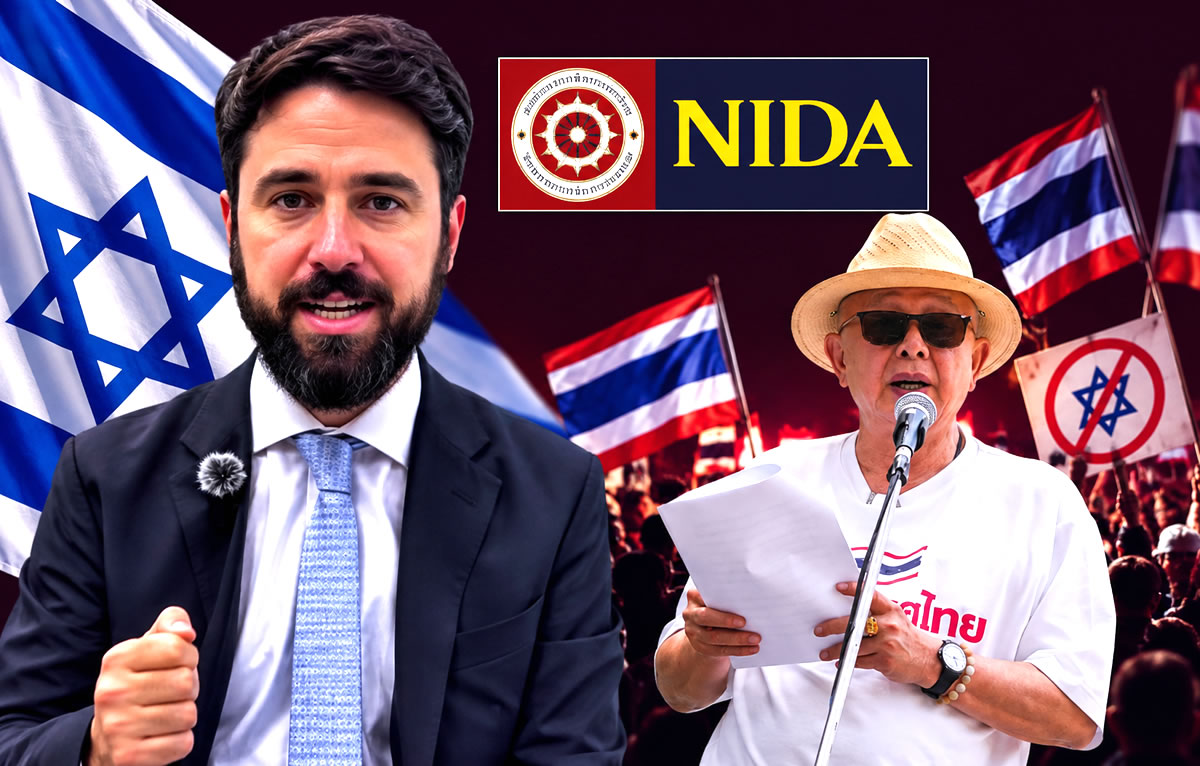
Thai public concern over Israeli nationals has hardened sharply amid protests, diplomatic intervention and mounting political pressure.
A major NIDA opinion poll released Sunday now puts hard numbers behind that change. Some 77.49% of respondents familiar with the controversy demanded strict enforcement of Thai law. Notably, 45.45% wanted shorter permitted stays for Israeli visitors.
The findings followed an extraordinary six days of protests, diplomatic exchanges and growing security concerns. Separately, Thailand faces another political flashpoint on Monday. The Election Commission must rule on the 2024 Senate collusion case involving 229 people.
That decision reaches deep into Thailand’s political establishment. It covers 138 serving senators and figures connected with Bhumjaithai. Prime Minister Anutin Charnvirakul’s party rejects claims that an organised operation controlled the Senate selection.
Economic strain deepens as foreign ownership and Israeli activity become sharper political concerns
Behind both controversies sits a difficult economic backdrop. Thailand’s economy continues growing, but that expansion remains uneven. Household income growth has slowed, while living costs have risen. At the same time, smaller businesses face tight credit and fierce competition.
The Bank of Thailand has described economic growth as low and uneven. SME lending continues contracting, while banks remain cautious about vulnerable borrowers. In contrast, large companies and technology-linked investors have performed more strongly.
Foreign investment remains central to Bangkok’s economic strategy. Yet foreign ownership, nominee structures and overseas influence have become increasingly prominent political issues. Within that wider argument, Israeli nationals have become unusually visible.
The National Institute of Development Administration surveyed 1,410 Thais aged 18 or over from September 8-10. Respondents came from six provinces, including Bangkok, Phuket and Surat Thani.
Those locations include major centres of foreign tourism and longer-term overseas communities. Phuket and Surat Thani have featured prominently in recent controversies involving Israelis.
NIDA found 76.38% had encountered reports about inappropriate conduct by some Israelis. Another 5.11% said they had personally experienced such behaviour. In addition, 4.33% had heard reports directly from eyewitnesses.
NIDA respondents cite lawbreaking, disrespect and nominee structures among concerns over Israelis
A further 3.48% had received information through third parties. By comparison, 17.45% had neither encountered reports nor experienced problems themselves.
NIDA then questioned 1,164 respondents with direct or indirect awareness of the controversy. Their strongest concern was respect for Thai law. Some 71.22% cited violations.
Beyond that, 46.39% complained about impolite language or insults towards Thai people. Another 45.96% cited disrespect for Thai culture. Likewise, 40.03% complained about disregard for local community lifestyles.
Some 36.43% raised concerns about disrespect for public and private spaces. However, the complaints stretched considerably further than tourist behaviour.
Some 31.44% raised concerns about Thai nominees being used to hold land. Another 29.04% cited businesses operated through Thai nominees. In parallel, Thailand is already intensifying scrutiny of foreign-linked corporate and property structures.
The poll also identified wider social concerns. Some 20.02% cited conduct potentially causing racial, ethnic or religious conflict.
Another 19.93% objected to Israeli cemeteries established without consultation with local communities. In Chachoengsao, officials have already acted against a Jewish cemetery following licensing and planning breaches.
Jewish cemetery breaches add to wider concerns over communities, visas and foreign-linked businesses
That cemetery occupied six rai in Bang Khla district. Its operating licence had expired in 2023 and had not been renewed. Officials also found distance violations involving a road and waterway.
Three burials were found to have been carried out unlawfully. A fourth was under examination. Subsequently, officials ordered structures removed and remains relocated.
The NIDA poll also found 18.47% concerned about expanding Israeli communities in particular areas. Visa and employment concerns followed.
Some 16.41% cited visa overstays. Another 10.48% complained about Israelis working in occupations reserved for Thais. Additionally, 10.22% raised concerns about premises used for religious ceremonies.
Some 9.54% cited work outside permit conditions. Another 9.36% referred to so-called zero-dollar tourism businesses.
A small minority rejected the growing criticism. Some 2.41% expressed no dissatisfaction. Meanwhile, 1.98% said they doubted negative reports concerning Israelis.
The survey’s proposed solutions were even more striking. Some 77.49% demanded strict application of existing Thai laws.
Next, 45.45% wanted the government to shorten permitted stays for Israeli visitors. Another 38.49% wanted stronger intervention by the Israeli Embassy.
Poll backs protests and tighter embassy action but enforcement remains the dominant public response
Some 26.46% supported Thai protests against misconduct or lawbreaking by Israelis. More significantly, 23.54% raised national-security concerns about expanding Israeli communities.
Another 17.53% supported protests against people assisting such misconduct. Even so, only 6.62% specifically demanded deportation of offenders.
The dominant response was therefore enforcement rather than general expulsion. Elsewhere in the poll, 1.20% urged people to verify reports before accepting them.
Another 1.12% favoured a restrained response because of possible damage to tourism. Crucially, 2.75% warned harsh measures could affect Thai workers in Israel.
That concern reflects the scale of bilateral links. Approximately 75,325 Thai nationals currently reside in Israel. Foreign Minister Sihasak Phuangketkeow said more than 60,000 Thai workers are there.
Agriculture remains central to that relationship. Tens of thousands of Thais have worked on Israeli farms. Their earnings support families and communities across Thailand.
As a result, serious bilateral friction could carry economic consequences far beyond Bangkok. It could also affect communities already exposed to economic pressure at home.
The relationship carries another powerful legacy. Thai agricultural workers were among those hit hardest on October 7, 2023.
Thai workers in Israel remain exposed as memories of October 7 shape the strained bilateral relationship
Hamas-led attackers struck communities across southern Israel that morning. Israeli Embassy commemorative figures recorded 41 Thai workers killed.
In addition, 31 Thais were taken hostage. Twenty-eight eventually returned alive. Others were subsequently confirmed dead.
Thailand and Israel worked closely during efforts to secure their release. Afterwards, Israel sought the return and expansion of its Thai agricultural workforce.
The current tensions therefore mark a dramatic change in the bilateral conversation. Three years ago, kidnapped and murdered Thai workers dominated Thai public attention towards Israel.
Today, the focus increasingly involves Israeli visitors, businesses, land interests and religious centres. Questions about longer-term Israeli communities have also entered mainstream political debate.
Tourism adds another layer. More than 277,000 Israelis visited Thailand during the first eight months of 2026.
That was about 7% higher than during the equivalent period last year. During 2025, Thailand received 410,125 Israeli visitors.
Israeli visitors generated an estimated US$1.2 billion of Thailand’s international tourism revenues. Accordingly, Thailand has a substantial commercial interest in preserving that market.
Israeli tourism brings billions as rising visitor numbers coincide with growing disputes across Thailand
Still, rising visitor numbers have coincided with repeated controversies. Cases have involved public conduct, immigration rules, business activity and community disputes.
The controversy moved decisively onto Bangkok’s streets last Thursday. Hundreds gathered outside the Israeli Embassy under veteran protest leader Sondhi Limthongkul.
His Take Thailand Back movement has widened beyond individual foreign offenders. It now targets nominee businesses, foreign landholding and foreign-controlled commercial activity.
As part of this, Sondhi has accused state agencies of failing to defend Thai interests. His campaign increasingly combines foreign economic influence with sovereignty and political power.
Speaking outside the embassy, Sondhi declared that the period of cautious diplomatic language had ended.
“The era of gentle diplomatic pleasantries and calculated silence … has come to an end,” he told supporters.
He also warned Israel about Thai hospitality. It should not be interpreted as permission to disregard Thai sovereignty, he said.
Sondhi pushes Israeli controversy into wider campaign over land, sovereignty and foreign business control
Since then, the campaign has moved beyond complaints about troublesome tourists. Property, businesses, religious centres and foreign communities have entered its sights.
Chabad centres have also become a focus. At the same time, some protest placards have targeted Israelis and Jews more broadly.
In response, the Israeli Embassy made an unusual public intervention on Thursday. Deputy Chief of Mission Rami Teplitskiy appeared in a video speaking Thai.
He acknowledged negative reports and public comments concerning Israeli tourists. However, he insisted the embassy was not remaining inactive.
Israeli diplomats were working closely with Thai government agencies. They were also coordinating with Tourist Police and Jewish community organisations.
Furthermore, the embassy was working with agencies inside Israel. Its stated objective was a sustainable response to recurring problems involving Israeli visitors.
Israel has prepared travel guidance specifically for its citizens. The material stresses compliance with Thai laws and cooperation with officials.
It also tells visitors to communicate courteously and respect Thai culture. The guidance covers public behaviour, traffic rules, visas and employment.
Israeli Embassy responds in Thai and issues detailed conduct rules as criticism of visitors intensifies
Israelis are advised against loud behaviour in streets, hotels and public places. They are also told to respect private and public spaces.
Visitors must not overstay visas or work without appropriate permits. They are also advised to dress appropriately in public areas.
Teplitskiy stressed the importance of the longstanding bilateral relationship.
“The Embassy of Israel will continue to work hard to maintain our friendship,” he said.
He added that visitors should enjoy Thailand with mutual respect. At the same time, he cautioned against accepting false reports without scrutiny.
Israel’s diplomatic position therefore draws a clear distinction between individual offenders and Israelis generally. Nonetheless, it accepts punishment for citizens breaking Thai law.
Several Israelis have already faced deportation following misconduct. The embassy itself referred to those cases when urging better behaviour.
Diplomatic action had started before Sondhi reached the embassy gates. Two days earlier, Sihasak met Israeli Ambassador Dr Alona Fisher-Kamm.
Sihasak presses Israeli ambassador on business conduct, tourism and respect for Thai laws and communities
Their discussions covered tourists, longer-term residents and Israelis operating businesses. Sihasak divided the concerns into two broad areas.
First came Israelis living or conducting businesses in Thailand. Foreigners breaking commercial laws would face enforcement without discrimination, he said.
Second came tourists and their behaviour towards local communities. Sihasak stressed that Thailand continued welcoming foreign visitors.
However, hospitality did not permit visitors to behave however they wished. Thai laws, customs and community life had to be respected.
He also argued tourism could not simply be reduced to revenue. Thai dignity and honour remained important considerations.
Fisher-Kamm acknowledged the concerns. She proposed a formal “do’s and don’ts” guide for Israelis travelling to Thailand.
Under the proposal, information could reach travellers before arrival. Airlines, tour operators and diplomatic missions could distribute it.
On the diplomatic front, both sides stressed their broader relationship. Thailand’s Foreign Ministry said they supported greater understanding of Thai laws and customs.
Phuket protest forces cancellation of Rosh Hashanah event as Israeli security concerns rise sharply
Then Phuket raised the stakes.
A Rosh Hashanah celebration at Chabad House in Patong was initially expected to attract around 1,000 participants. Local opposition subsequently triggered negotiations with provincial officials.
Attendance was reduced to 800. Activities were restricted to one location. The celebration also had to finish by 9 pm.
Despite those changes, more than 500 protesters marched through Patong on Friday. Some carried signs reading “SAVE PHUKET NO ISRAEL”.
Others chanted “Free Palestine”. Police deployed around the premises and managed the demonstration.
Shortly afterwards, the Rosh Hashanah dinner was cancelled. Israeli security officials advised organisers not to proceed.
Registered participants were told not to approach the area. Organisers said there were fears the protest could become violent.
For the first time that week, the controversy directly disrupted a major Jewish religious celebration. It therefore acquired an immediate security dimension.
Thailand stands apart regionally as Malaysia blocks Israelis and Indonesia keeps strict entry controls
Israel had already warned about heightened threats to Israelis and Jewish communities during the High Holy Days. Yet Jerusalem avoided escalating its public language towards Bangkok.
Instead, its embassy continued emphasising cooperation. The Phuket cancellation nevertheless gave Israeli security officials a direct stake in Thailand’s growing tensions.
Thailand’s approach also stands apart within Southeast Asia. Malaysia has no diplomatic relations with Israel.
Israeli travel documents are not recognised there for normal entry. Malaysian policy therefore largely excludes Israeli tourists.
Indonesia takes a different approach. It does not operate an identical Malaysian-style prohibition.
However, Israeli passport holders face a highly restrictive immigration process. Israel remains covered by Indonesia’s special Calling Visa arrangements.
Special clearance is therefore required before a visa can be issued. Thailand, by comparison, remains highly accessible to Israeli visitors.
It also maintains full diplomatic relations with Israel. At the same time, more than 60,000 Thai workers are employed there.
Senate scandal adds new political pressure as Sondhi and opposition campaigns advance on separate fronts
That combination makes Thailand commercially and diplomatically important to Israel. Conversely, Israel remains important to thousands of Thai families.
On another front, Thailand’s domestic political temperature is rising quickly. Sondhi’s campaign is expanding while another street movement targets the Senate selection.
The two movements remain separate. Their leadership, immediate demands and political origins are different.
Sondhi’s movement focuses heavily on foreigners, landholding, nominee businesses and sovereignty. The other campaign challenges the legitimacy of the 2024 Senate selection.
All seven Election Commissioners are due to consider the Senate case on Monday. It involves 229 people and seven sets of accusations.
Among those named are 138 serving senators. The case also covers ministers, MPs and Bhumjaithai figures.
Another 20 people are described in the case file as belonging to a Bhumjaithai network. Fifty others are reserve-list members or Senate candidates.
The Election Commission faces sharply conflicting recommendations from its own investigative process. One committee recommended moving against those implicated.
Election Commission faces decisive Senate vote as iLaw march demands Supreme Court scrutiny of all 229
Another recommended clearing everybody. Consequently, Monday’s seven-member commission vote carries considerable political weight.
If the EC proceeds, cases could reach the Supreme Court’s Election Cases Division. The EC office would then prepare formal petitions.
Pressure has already moved onto Bangkok’s streets. On Sunday, iLaw organised an 11-kilometre march demanding Supreme Court scrutiny.
People’s Party leader Nattapong Ruangpanyawut joined the mobilisation. People’s Party MP Parit Wacharasindhu also participated.
Former Election Commissioner Somchai Srisutthiyakorn was among those taking part. iLaw executive director Yingcheep Atchanont led the march.
In another escalation, iLaw threatened to publish evidence concerning anybody cleared by the Election Commission.
If nobody is referred, it has said it will release all case documents. The commission has scheduled a press briefing for 3 pm Monday.
The Senate dispute therefore adds another source of political pressure. It comes while economic difficulties remain pronounced at grassroots level.
Grassroots economic strain deepens as foreign investment surges and smaller businesses struggle
Thailand’s headline investment numbers tell only part of the economic picture. Major foreign investment commitments remain substantial.
Data centres and technology projects are bringing enormous proposed capital expenditure. Export-linked companies have also benefited from stronger external demand.
Yet many smaller businesses operate under very different conditions. SME credit remains tight, while household debt constrains spending.
Income growth has also weakened for many households. Higher living costs have added another burden.
In this environment, foreign economic activity has attracted growing political attention. Nominee companies have become a particular target.
Thai agencies are examining foreign-linked companies holding land across the country. Investigators are also tracing corporate ownership, directors and funding.
In early September, officials were examining 36,277 landholding companies with foreign participation. Those businesses were linked with 305,838 plots.
Together, the holdings covered more than one million rai. Separately, 7,082 foreign-linked companies were associated with 76,840 condominium units.
Foreign-linked land and condo holdings draw tougher scrutiny as nominee investigations widen nationwide
Commerce and Interior officials have consequently intensified cooperation. Their focus includes nominee structures used to circumvent Thai ownership restrictions.
Other enforcement drives have concentrated on Phuket, Pattaya, Koh Samui and other foreign tourism centres.
Israeli-linked business networks have featured in some investigations. However, foreign scrutiny extends across numerous nationalities and commercial sectors.
That distinction remains important. Thailand’s broader enforcement drive did not begin with the current Israeli controversy.
Still, Israeli nationals have become particularly prominent in public debate. Tourism numbers, community concentrations and recent incidents have increased their visibility.
Sondhi’s campaign has amplified that attention. The NIDA poll now shows substantial public concern beyond his street supporters.
Economic unease provides a broader backdrop. Small companies remain squeezed while Bangkok continues courting enormous foreign investment.
That produces a sharp contrast in Thailand’s economy. Foreign capital remains essential for growth, infrastructure and technology.
Thailand weighs foreign investment against tighter controls on land, nominees and overseas business power
At the same time, Thai agencies are tightening scrutiny of foreign-controlled land, businesses and employment. Nominee structures sit directly between those competing pressures.
Israeli interests now occupy a conspicuous place within that debate. However, Thailand cannot treat the relationship solely through domestic enforcement.
More than 60,000 Thai workers remain in Israel. Their welfare and employment are important bilateral issues.
Likewise, hundreds of thousands of Israelis visit Thailand annually. Their spending supports tourism businesses across major resort areas.
October 7 also remains part of the relationship. Thai workers suffered heavily, while both governments later cooperated over hostages and employment.
Against this complicated backdrop, the NIDA numbers carry unusual political weight. They show dissatisfaction stretching across several distinct issues.
Law enforcement remains the overwhelming priority. Yet shorter stays, embassy intervention and national security also attracted substantial support.
Thai workers and Israeli tourism complicate calls for tougher enforcement as NIDA pressure intensifies
At the same time, only 6.62% demanded deportation of offenders. Some respondents explicitly warned against measures damaging Thai workers or tourism.
The poll therefore captures pressures moving in opposite directions. Public demands for enforcement are rising while bilateral economic interests remain substantial.
Within six days, those pressures became visible across several fronts.
On Tuesday, Sihasak confronted Israeli concerns directly with Ambassador Fisher-Kamm. Two days later, Sondhi brought hundreds to the Israeli Embassy.
That same Thursday, Teplitskiy responded publicly in Thai. Israel promised cooperation, behavioural guidance and respect for Thai laws.
By Friday, more than 500 protesters were marching through Patong. Israeli security advice then led to the Rosh Hashanah dinner’s cancellation.
On Sunday, NIDA supplied hard polling numbers. Separately, thousands of steps across Bangkok carried another protest towards the Senate controversy.
Monday now brings the Election Commission decision. Its ruling could send cases involving serving senators and political figures towards the Supreme Court.
Israel dispute and Senate crisis unfold together amid economic strain and growing institutional pressure
These developments remain distinct. However, they are unfolding within the same unsettled economic and political environment.
For Israel, the immediate dispute concerns its citizens, businesses, visitors and Jewish institutions in Thailand.
For Bangkok, the picture is considerably broader. It encompasses immigration, tourism, property, nominee businesses, employment, security and diplomatic relations.
In parallel, Thailand faces mounting scrutiny of its own political institutions. The Senate case has already generated a separate street mobilisation.
Grassroots economic pressure adds another layer. Households face slower income growth, while smaller companies struggle with credit.
Yet Thailand continues seeking foreign investment and international tourism. Those competing economic realities are increasingly visible in political debate.
The Israeli controversy now sits directly inside that pressure. Sunday’s NIDA poll shows it has moved beyond isolated tourist incidents.
It now reaches questions about land, businesses, immigration and longer-term foreign communities. Religious and security concerns have also entered the dispute.
Sondhi widens his campaign as EC ruling threatens greater pressure on Thailand’s political institutions
Sondhi is seeking to widen that argument further. Meanwhile, the Israeli Embassy is trying to contain the damage through cooperation and direct guidance.
Monday’s Election Commission ruling opens another political front. It could intensify pressure on institutions already facing growing public scrutiny.
Thailand therefore begins the week with two separate tensions moving simultaneously. One centres on foreign influence and Israeli conduct.
Pressure movement against Israel in Thailand gains momentum as it combines with street protests
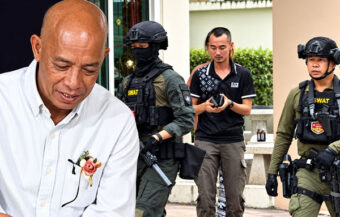
Veteran protest leader and media boss Sondhi begins his street protest campaign at Israel’s Embassy
The other reaches into the Senate and Bhumjaithai-linked political networks. Beneath both sits an economy delivering markedly different experiences across Thai society.
For now, the NIDA poll supplies the clearest measurement of one side of that pressure. Its central finding is unmistakable.
Thai respondents familiar with the Israeli controversy overwhelmingly want their country’s laws enforced more strictly.
Join the Thai News forum, follow Thai Examiner on Facebook here
Follow Thai Examiner on Google here
Receive all our stories as they come out on Telegram here
Follow Thai Examiner here
Further reading:
Pressure movement against Israel in Thailand gains momentum as it combines with street protests
Veteran protest leader and media boss Sondhi begins his street protest campaign at Israel’s Embassy
PM Anutin laughs off what political pundits see as rising threats to the stability of his government
Opposition alleging a potential whitewash by Election Commission on Friday over Senate election case
Ex PM and Democrat Party leader urges politicians implicated in Senate Collusion files to come clean
Opposition and People’s Party leader attacks ‘blue regime’ on the 12th anniversary of the 2014 coup
Thammasat University legal scholar and 1992 protest leader warns another coup cannot be ruled out