Troops reinforce Suvarnabhumi as the baggage breakdown enters a third day. Passengers wait six hours, others fly without luggage and Thai Airways struggles to clear the backlog after flooding prevents ground staff from reaching work as recovery continues.
Thailand’s military stepped deeper into the Suvarnabhumi baggage crisis on Monday as disruption entered a third day. Defence Minister Lieutenant General Adul Bunthamcharoen inspected operations as 131 military personnel reinforced exhausted airport teams. Yet the backlog remained unresolved by Monday night. Passengers had waited six hours, others flew without bags and one Thai Airways flight left almost eight hours late. Flooding never closed Suvarnabhumi. Instead, flooded roads kept ground staff from work, while baggage-cart failures deepened the breakdown. Flights continued as troops helped clear stranded luggage. Meanwhile, Don Mueang remained broadly operational despite serious flooding disrupting surrounding roads of the former main airport.
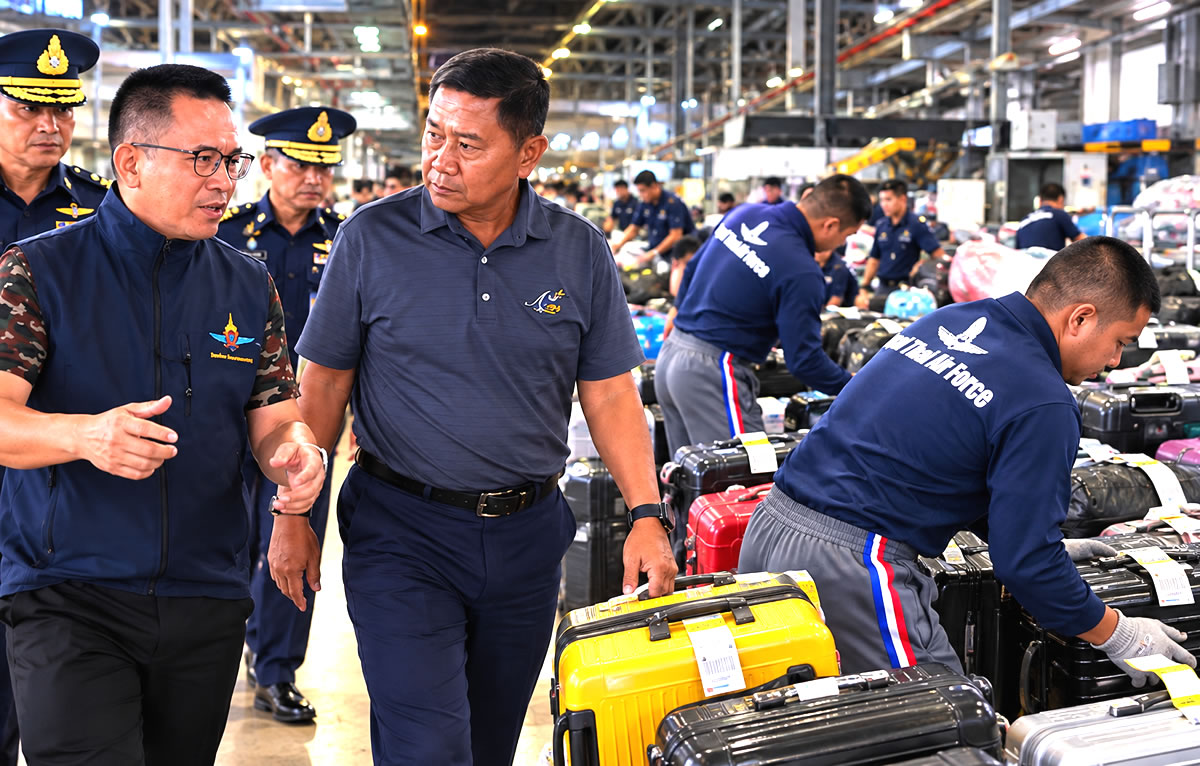
Thailand’s military reinforced Suvarnabhumi Airport on Monday as its baggage crisis entered a third day. The problems remained unresolved by Monday night, although a large recovery operation was underway.
Defence Minister Lieutenant General Adul Bunthamcharoen inspected the airport as military manpower rose to 131 personnel. Meanwhile, Thai Airways continued clearing delayed luggage and returning bags to passengers. Flights continued throughout the disruption, and Suvarnabhumi remained open.
Crucially, flooding had not shut the airport itself. Instead, flooded roads prevented ground staff reaching work and crippled parts of Thai Airways’ operation. Don Mueang, by contrast, continued operating broadly normally despite difficult road access.
Defence minister inspects Suvarnabhumi as military deployment expands to tackle major baggage crisis
Lt Gen Adul arrived at Suvarnabhumi on Monday afternoon to inspect the expanding recovery effort. By then, disruption had continued since Saturday, September 26. Air Chief Marshal Anurak Romnarak, Chief of Staff of the Royal Thai Air Force, joined the inspection.
At about 5 pm, senior officers reviewed operations with airport officials. In parallel, Lt Gen Adul met Airports of Thailand and Suvarnabhumi executives. Discussions focused on manpower, baggage operations and areas requiring additional military support.
Notably, the military response was still expanding during Monday afternoon. The Royal Thai Air Force initially deployed 69 personnel from its Security Forces Command. Flooding had prevented significant numbers of Thai Airways employees from reaching Suvarnabhumi. In response, military personnel were assigned to reinforce badly stretched ground operations. The Air Force later increased its deployment to 100 personnel.
As part of this expansion, another 23 personnel came from Wing 41 in Chiang Mai. Eight more were drawn from Wing 46 in Phitsanulok. The Air Force contingent was assigned to baggage and other ground-support operations. Separately, the Royal Thai Army deployed 31 personnel from the Territorial Defence Command. Those soldiers supported Thai Airways’ catering operation rather than baggage handling.
Military deployment reaches 131 as Suvarnabhumi struggles to clear baggage backlog after severe floods
Altogether, 131 military personnel were supporting operations connected with Suvarnabhumi by Monday afternoon. The Defence Ministry said those numbers could be adjusted according to operational requirements. Furthermore, military assistance would continue while Thai Airways and airport officials worked to restore normal services. That commitment remained significant late Monday because the baggage backlog had not been confirmed as cleared.
Instead, delayed luggage was progressively moving through the system. Thai Airways was also returning bags to passengers who had already left the airport. Accordingly, the recovery had advanced, but normal baggage operations had not been restored. The continuing military deployment provided the clearest indication of the remaining workload.
The crisis began during severe flooding across Bangkok and surrounding areas on Saturday. Importantly, floodwater did not close Suvarnabhumi. The airport’s runways and passenger terminals continued operating. Rather, flooding across surrounding areas prevented ground-handling employees from reaching work. This sharply reduced manpower available to Thai Airways.
At the same time, mechanical problems affected some baggage carts used by the airline. Consequently, Thai Airways faced simultaneous shortages of workers and equipment. The effects quickly spread through baggage handling and other ground services. Arriving passengers then faced lengthy waits for checked luggage.
Passengers wait six hours as baggage delays spread and military reinforces Thai Airways operations
At the worst point, some travellers reported waiting as long as six hours. Elsewhere, departing passengers continued their journeys without checked baggage. Their luggage could not be loaded onto aircraft in time. Flight delays also developed as pressure mounted across Thai Airways’ ground operations.
One Thai Airways service carrying Asian Games athletes departed almost eight hours late. Other passengers flew without bags, which remained at Suvarnabhumi. Thai Airways then faced another challenge after those passengers departed. It had to locate, process and deliver their delayed luggage.
Against that backdrop, the airline moved office and management employees into frontline operational roles. However, the staffing shortage remained serious enough to require military assistance. The Air Force consequently entered the airport operation. Its deployment subsequently grew from 69 personnel to 100.
On another front, the Army began supporting Thai Airways’ catering operation. That freed other resources while the airline battled disruption across several services. By Monday afternoon, military support had therefore become a substantial part of the wider recovery effort.
Military teams reinforce airport operations as Thai Airways works to clear delayed baggage backlog
Lt Gen Adul inspected where military personnel were working and where additional assistance could be required. Airport management was also continuing to assess manpower requirements. Under the arrangement, military personnel could be repositioned or reinforced according to operational needs. Officials were integrating those personnel with existing airline and airport teams.
The immediate priority was maintaining services while cutting the accumulated baggage backlog. Thai Airways was simultaneously processing luggage left behind since the weekend. From Monday afternoon, delayed bags were progressively dispatched to passengers. Those already away from Suvarnabhumi could register details for subsequent delivery.
In some cases, luggage was being sent to homes or hotels. Even so, operations had not returned fully to normal by Monday night. The Air Force said its personnel would continue helping until conditions normalised. There was therefore no confirmation that the baggage crisis had ended.
Instead, Suvarnabhumi remained in a large recovery operation late Monday. Additional manpower was still deployed. Delayed baggage was still being processed. Military personnel were still reinforcing civilian teams. Thai Airways was also continuing deliveries to passengers separated from their luggage.
Minister orders clearer passenger updates as Suvarnabhumi stays open despite baggage issues
Beyond manpower, Lt Gen Adul focused on passenger communications during his inspection. He instructed agencies to improve coordination and provide information more quickly. Officials were also told to issue clearer updates about airport services and recovery operations. The move followed passenger complaints during the weekend disruption.
Some travellers had waited for hours without clear information about their baggage. As a result, passenger communications became another element of Monday’s recovery work. Officials sought to provide better information while ground teams attacked the remaining backlog.
Despite the serious disruption, Suvarnabhumi’s core aviation infrastructure continued functioning. Aircraft continued landing and taking off. Runways remained operational, while passenger terminals stayed open. Airports of Thailand said commercial aviation areas remained protected from flooding.
In addition, water levels around Suvarnabhumi were being monitored around the clock. Contingency plans included additional pumping capacity if conditions deteriorated. The airport therefore faced no reported shutdown of its runways or commercial terminals.
Flooded roads hit airport staffing as baggage failures leave passengers waiting hours for luggage
The distinction was critical. Suvarnabhumi itself had remained open while the surrounding transport network suffered severe flooding. Essential workers then struggled to reach the airport. Thai Airways consequently lost manpower needed for baggage and ground operations.
Mechanical trouble involving baggage carts compounded those difficulties. Thus, the disruption developed despite aircraft continuing to use the airport. Large quantities of luggage accumulated while the passenger and flight operations continued around them.
For arriving travellers, the consequences were immediate. Some passengers waited hours beside baggage carousels. For departing travellers, the problem took another form. Some continued overseas or domestic journeys while their checked bags remained behind.
Thai Airways subsequently had to reunite those passengers with their luggage. By Monday, that operation was progressing. Yet no confirmed figure was available for the remaining backlog late Monday. There was also no confirmation that normal baggage handling had been completely restored.
Outside the terminals, access remained another complication. Flooding continued affecting roads around Suvarnabhumi. In particular, travellers were advised to avoid Lat Krabang Road because of significant standing water. Motorway 7 was recommended where practical.
Don Mueang stays operational despite surrounding floods as Suvarnabhumi struggles with staffing
Alternatively, travellers could use the Burapha Withi Expressway. Road disruption therefore remained capable of delaying passengers before they reached Suvarnabhumi. More significantly, the same road conditions had already disrupted the airport workforce.
Ground employees faced the same flooded transport network as passengers. Hence, Suvarnabhumi could remain dry while vital services inside suffered major disruption. The problem demonstrated itself directly through missing workers, delayed baggage and mounting operational pressure.
Conditions at Don Mueang Airport were markedly different on Monday. The airport remained open, with incoming and outgoing flights continuing. Internal operations also continued without a comparable baggage-handling breakdown.
Nevertheless, serious flooding around Don Mueang created confusion about conditions inside the airport. Images showed substantial floodwater in parts of the wider area. Some heavily flooded locations included the neighbouring Wing 6 military zone. They did not establish comparable flooding inside the commercial airport.
Don Mueang remains open as flooded roads disrupt airport access while flights continue operating normally
Airports of Thailand therefore stressed that Don Mueang remained protected and operational. Moreover, there was no evidence by Monday night of a baggage crisis matching Suvarnabhumi. Don Mueang’s main difficulties instead involved reaching and leaving the airport.
Flooded roads and severe traffic disruption complicated journeys around surrounding districts. Metered taxi services were temporarily suspended during the disruption. Ride-hailing services, however, remained available. Airport buses also provided another option.
For rail passengers, the Red Line continued offering access to Don Mueang. Motorists were advised to use the elevated Don Mueang Tollway where possible. That route offered more reliable direct access to the terminals during flooding.
Given those conditions, passengers were urged to allow considerably more travelling time. International travellers were advised to arrive about three hours before departure. Domestic passengers were advised to arrive approximately two hours beforehand. Those warnings reflected road uncertainty rather than an airport closure.
Bangkok airports stay open as Suvarnabhumi battles baggage crisis and Don Mueang faces road floods
Both major Bangkok airports therefore remained open on Monday despite widespread flooding. Their operational problems, however, were sharply different. Don Mueang’s greatest difficulty remained access through flooded surrounding areas. Suvarnabhumi faced a deeper problem inside its supporting ground operations.
At Suvarnabhumi, external flooding had reduced the availability of essential workers. Equipment failures then worsened the baggage disruption. The resulting backlog required military personnel to reinforce Thai Airways and airport operations.
By Monday afternoon, the Air Force had 100 personnel assigned to the effort. The Army had another 31 supporting catering services. The Defence Ministry also remained prepared to adjust military manpower if required.
Lt Gen Adul’s inspection brought the expanding operation under direct ministerial review. He examined manpower requirements and met senior airport officials. He also reviewed the continuing recovery work while military personnel supported civilian teams.
For its part, Thai Airways continued processing delayed luggage and arranging deliveries. Airport officials worked to maintain passenger movements while improving communications. Still, the recovery remained incomplete by Monday night.
Suvarnabhumi marks 20 years as military teams help clear baggage while flights continue operating
The disruption also came as Suvarnabhumi marked its 20th anniversary. Thailand’s principal international gateway opened in September 2006. It has since become the country’s dominant international aviation hub. During the first 11 months of fiscal 2026, it handled 59.63 million passengers.
Core aviation operations nevertheless continued through the latest crisis. Aircraft kept landing and departing. Terminals remained open. Runways remained available. The breakdown instead developed within supporting ground services.
First, severe flooding prevented employees from reaching work. Then baggage-cart failures increased pressure on the reduced workforce. Passenger baggage accumulated as flights continued. Some travellers waited hours, while others departed without their bags.
Thai Airways then began the difficult process of clearing accumulated luggage and returning it to passengers. By Monday, soldiers and airmen were reinforcing that effort. The backlog was being reduced, and delayed luggage was progressively leaving the airport.
Military remains deployed at Suvarnabhumi as baggage recovery continues through late Monday night
Even with that progress, the military deployment remained active late Monday. Thai Airways was still processing delayed baggage. The Air Force remained committed until operations normalised. Suvarnabhumi therefore entered Monday night still recovering from three days of serious baggage disruption.
Don Mueang, meanwhile, presented a considerably calmer picture. Flights and internal operations continued broadly normally despite flooding outside. Road access remained difficult, but there was no comparable baggage breakdown.
Tourism minister directs acute airport baggage crisis caused by workers who failed to turn up for shifts
Royal Thai Army deployed to Suvarnabhumi Airport after baggage chaos gets the better of exhausted staff
Ultimately, Bangkok’s two major airports entered Monday night under distinctly different operating conditions. Don Mueang was principally dealing with difficult external access. Suvarnabhumi was still clearing the effects of depleted staffing and baggage-equipment failures.
Recovery at Suvarnabhumi was firmly underway, but normal baggage operations had not yet been confirmed. Military personnel remained on site as Thai Airways worked through delayed luggage. The airport remained open, while flights continued and stranded baggage was progressively returned to passengers.
Join the Thai News forum, follow Thai Examiner on Facebook here
Follow Thai Examiner on Google here
Receive all our stories as they come out on Telegram here
Follow Thai Examiner here
Further reading:
Bangkok airports open and flights running but there are delays and baggage issues at Suvarnabhumi
Engineers work through night after Sunday’s fire on Bangkok’s Blue Line saw more damage than thought
Italian Thai boss and 16 others arrested on Thursday charged with Auditor General building deaths
Arrested man linked with Chatuchak building collapse now tells police he is a Chinese state employee