Defective baggage equipment and staff shortages hammer Thai Airways at Suvarnabhumi. CEO Chai Eamsiri apologises as bags from 52 flights remain affected, 34 services are delayed and eight cancelled while two rival handlers operate normally.
Thai Airways Chief Executive Officer Chai Eamsiri has apologised as a damaging baggage breakdown spiralled into a fourth day at Suvarnabhumi Airport. Defective baggage carts compounded staff shortages after flooding stopped workers reaching the airport. Yet Suvarnabhumi never closed and its two other ground handlers continued operating normally. By Tuesday, THAI was still returning luggage from 52 flights after 34 services were delayed Monday. Eight more flights were cancelled as military personnel joined the emergency recovery. Meanwhile, passengers faced punishing disruption. One Bangkok-Munich traveller was stranded for more than 36 hours without a hotel, her husband told this newspaper. Passengers received two ฿400 food vouchers as they waited, while the airline struggled to restore its schedule and clear the mountain of stranded baggage.
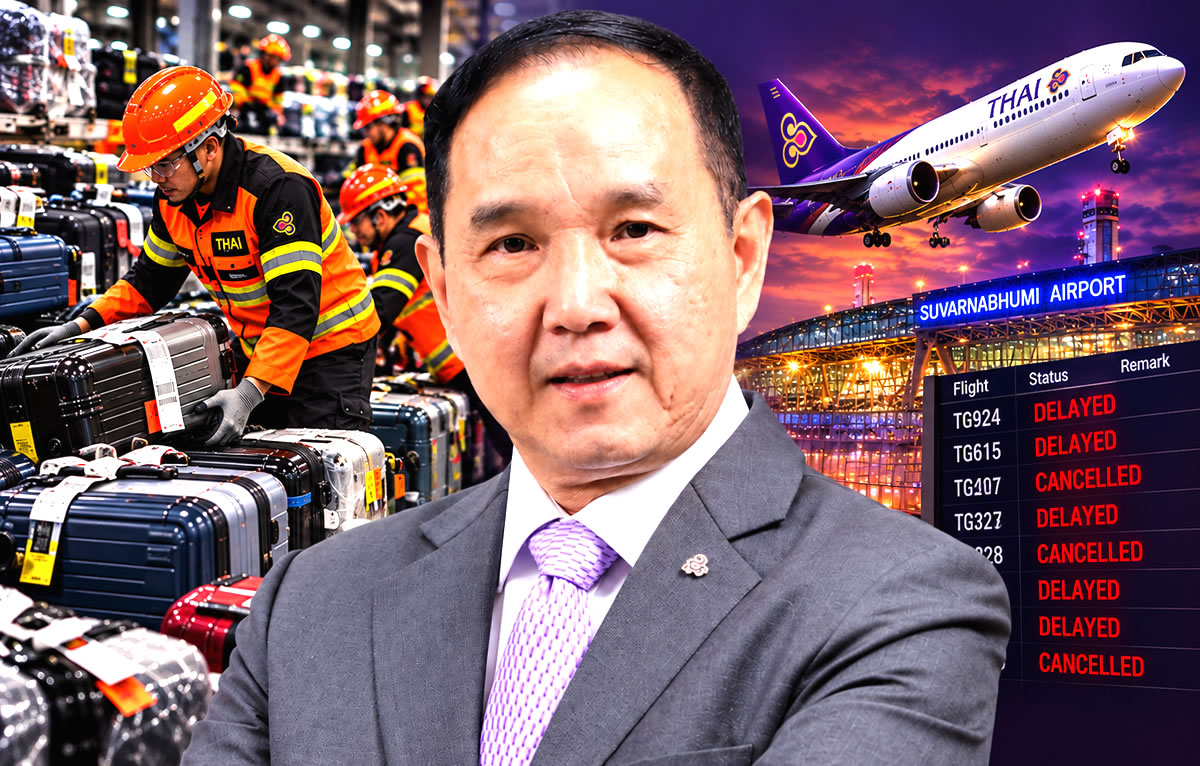
Thai Airways Chief Executive Officer Chai Eamsiri has apologised as defective baggage equipment emerged as a key factor in Suvarnabhumi’s crisis. Flooding initially prevented ground staff from reaching work.
However, baggage carts were also defective or unavailable when the manpower shortage struck. The combination quickly overwhelmed Thai Airways’ ground operation. Four days later, baggage from 52 flights was still being returned. Meanwhile, Suvarnabhumi’s two other ground-handling operators continued functioning normally.
Mr Chai issued his personal apology on Tuesday as the carrier struggled to restore operations. “I apologise to all passengers for the inconvenience caused,” he said in the company’s statement. Yet Thai Airways’ latest figures showed substantial disruption continuing. Baggage linked to 52 flights from September 26 and 27 remained in the recovery operation. In addition, 34 Thai Airways flights were delayed on Monday.
Thai Airways cancellations mount as baggage crisis spreads beyond the initial weekend airport breakdown
By Tuesday, the disruption had spread further into the airline’s schedule. Eight cancellations were confirmed across four return routes. As a result, the crisis had moved far beyond an initial weekend baggage backlog. Passengers remained separated from luggage several days later. Others faced severe flight delays and cancellations. At the same time, military personnel were helping airline workers clear accumulated bags.
Crucially, Suvarnabhumi Airport itself remained open throughout the crisis. Its runways did not close, while aircraft continued arriving and departing. More significantly, Airports of Thailand said the airport’s other two ground-handling operators continued functioning normally. That distinction has become central to understanding the breakdown.
Suvarnabhumi has three ground-handling operators. Thai Airways operates one and also provides services for other airlines. AOT President Paweena Chariyathitipong said the other two handlers did not suffer the same breakdown. Therefore, Suvarnabhumi’s entire baggage infrastructure had not collapsed. Instead, the severe disruption was concentrated inside the Thai Airways ground-handling operation.
The flooding nevertheless provided the initial trigger. Severe flooding across Bangkok prevented significant numbers of Thai Airways ground workers from reaching Suvarnabhumi. But the resulting staffing shortage collided with another operational problem. Some baggage transport carts used by Thai Airways were defective or unavailable. Consequently, fewer workers were moving growing quantities of baggage with reduced equipment.
Suvarnabhumi orders Thai Airways to fix defective baggage equipment as luggage backlog rapidly grows
In response, Suvarnabhumi Airport instructed Thai Airways to increase staffing. It also ordered the carrier to repair or replace defective baggage equipment. By then, the disruption was already spreading into subsequent flights. Incoming aircraft still required unloading, while bags from earlier services remained unresolved.
Departing aircraft also needed baggage sorted, transported and loaded. Accordingly, an initial staffing shortage developed into a much larger backlog. Ground workers and available equipment became tied up clearing earlier flights. This reduced resources for later arrivals and departures. The disruption then continued even as more personnel reached the airport.
Passengers bore the immediate consequences. Some waited up to six hours for their luggage. Others eventually left Suvarnabhumi without their checked bags. Separately, some departing passengers travelled onward without their luggage aboard the aircraft. Thai Airways then faced another major operation after those passengers had left.
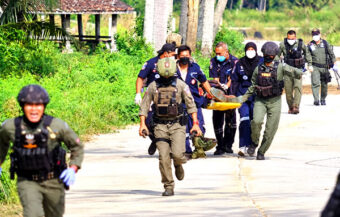
The carrier had to locate stranded bags and reconnect them with their owners. As the backlog grew, large quantities of luggage remained inside Suvarnabhumi. Eventually, military personnel were called in to help. Royal Thai Air Force personnel joined Thai Airways workers sorting and moving stranded baggage.
Military personnel join Thai Airways workers as baggage from 52 flights remains stranded at airport
Initially, 69 Air Force personnel were deployed. Additional military assistance was then planned as the recovery operation expanded. Defence Minister Lieutenant General Adul Bunthamcharoen also inspected operations. In parallel, Thai Airways drafted managers and office employees into groundwork.
The unusual deployment illustrated the scale of the recovery operation. Employees normally working elsewhere were helping move luggage. Even so, baggage from scores of flights remained outstanding on Tuesday. Thai Airways confirmed luggage associated with 52 flights was still being progressively delivered.
Those flights had operated on September 26 and 27. Thus, passengers remained separated from their belongings several days after travelling. Mr Chai said Thai Airways was mobilising personnel to accelerate deliveries. He also pledged to continue until every outstanding bag was returned.
Notably, Tuesday morning’s statement did not say the backlog had been cleared. Rather, it confirmed that the recovery remained underway. Passengers who registered missing luggage were being contacted as bags were located. Thai Airways said the bags could then be delivered to registered addresses.
Thai Airways offers baggage delivery and collection as flight delays and cancellations spread further
Alternatively, passengers can arrange personal collection. The Baggage Service Office operates on Level 2 outside the domestic passenger exit. It is open between 6.30 am and 11.30 pm. As part of this, passengers can register baggage details through a Thai Airways QR system. The carrier said passengers would receive telephone or email contact before delivery.
The operational damage extended well beyond luggage. Thai Airways recorded 34 delayed flights on Monday alone. Subsequently, the carrier began cancelling services while attempting to stabilise its network. Eight cancellations covering four return routes were confirmed for Tuesday.
The affected services included Bangkok-Khon Kaen and Bangkok-Phuket. Bangkok-Hanoi and Bangkok-Singapore flights were also cancelled. On another front, further disruption was reported on September 29 and 30. Services involving Udon Thani, New Delhi and Kuala Lumpur were among those affected.
European routes also entered the disruption. Services involving Frankfurt, Munich and Brussels were reported among affected flights. Hence, passengers could no longer regard the crisis as simply a weekend baggage problem. Its effects were moving directly through the Thai Airways flight schedule.
One case supplied directly to this newspaper shows the scale of that disruption. Buzz Langton contacted the newspaper concerning his wife, who was booked aboard Thai Airways flight TG924. The service was scheduled from Bangkok to Munich. Originally, TG924 was due to leave Suvarnabhumi at 12.50 am on Monday, September 28.
Bangkok to Munich passengers face a delay exceeding 36 hours with little information at the gate
Later, flight information showed a revised departure of 11.50 pm that night. That represented a 23-hour delay. Still, the flight did not leave as expected. By the time Mr Langton contacted the newspaper, he said the delay had exceeded 36 hours.
His wife and other passengers remained caught inside the airport departure system. According to Mr Langton, long periods passed without useful information. He also said Thai Airways personnel were absent from the gate for extended periods. Initially, flight information listed gate S108.
Later, the gate changed to S119. However, the change brought no certainty over departure. Mr Langton said hotel accommodation had not been provided. Instead, passengers received two ฿400 food vouchers during the exceptional wait.
Rebooking also remained uncertain. Passengers were reportedly told they might be placed aboard the next flight. Nevertheless, Mr Langton said no firm alternative departure had been provided at that stage. The aircraft rotation added another element to the delay.
Information available to passengers identified the incoming aircraft as TG615 from Beijing. That flight reportedly arrived two hours and 28 minutes late. Mr Langton accepted that this could explain an initial delay. However, he questioned how it could account for disruption exceeding 36 hours.
Stranded Munich flyer questions 36-hour delay as other Suvarnabhumi operations work normally
He also questioned the prolonged lack of passenger information. “I appreciate that the flooding and staff shortage are serious,” Mr Langton said. “But Suvarnabhumi has remained open and many other flights have continued operating.”
That contrast is significant. Suvarnabhumi was never closed by the flooding. Furthermore, AOT said its two other ground-handling operators continued functioning normally. Yet passengers aboard TG924 faced an exceptional wait while the wider airport remained operational.
Mr Langton said passengers remained airside for an extraordinary period. Throughout that time, information remained limited and departure arrangements uncertain. Eventually, affected passengers established a WhatsApp group. They used it to exchange flight information, photographs, documents and first-hand accounts.
Mr Langton said passengers might be prepared to speak publicly about their experiences. He also offered screenshots recording TG924’s changing status. According to his account, they showed the original 12.50 am departure. They also recorded the later 11.50 pm estimate. Photographs and video from the gate area were available as well.
Thai Airways handling breakdown spreads through flight schedules while two rival operators stay normal
The TG924 case demonstrates how the original baggage disruption spread into wider flight operations. Yet the central operational issue remains the concentration of the breakdown. Severe weather affected Bangkok generally, while flooded roads disrupted transport throughout the capital. Workers across many industries faced difficulties reaching their workplaces.
Nonetheless, all three ground handlers were operating at the same Suvarnabhumi Airport. According to AOT, two continued functioning normally. Thai Airways did not. Its ground operation suffered a major staffing shortage while baggage equipment was simultaneously defective or unavailable.
The combination quickly created operational pressure. Without sufficient workers, aircraft could not be serviced at their normal rate. Likewise, reduced baggage equipment limited what remaining employees could move. Bags from one flight consequently remained unresolved as later aircraft arrived.
That produced further delays. Those delays then consumed additional workers and equipment. In the meantime, more aircraft continued arriving. Departing aircraft also required ground services. An initial manpower and equipment problem therefore developed into a continuing backlog.
By Monday, its effects were visible throughout Thai Airways’ schedule. Thirty-four flights were delayed that day. The following day, cancellations were being implemented. At the same point, baggage from 52 earlier flights remained in the delivery process.
Other airlines escape worst disruption as Thai Airways ground handling remains centre of baggage crisis
Military personnel were also still involved. Thus, disruption continued well beyond the period when flooding initially prevented workers reaching Suvarnabhumi. The distinction between airport operations and Thai Airways’ handling operation became increasingly clear.
It also explains why other airlines did not necessarily suffer comparable problems. Airlines do not always handle their own luggage. Instead, carriers often contract specialist ground-handling operators to service aircraft. Thai Airways performs this work for its own services and customer airlines.
Accordingly, some foreign airlines can be affected by failures inside Thai Airways ground operations. Conversely, another carrier at the same terminal may use a different handler. That airline could therefore avoid the worst disruption.
The result was a markedly uneven picture across Suvarnabhumi. Some passengers encountered extreme baggage delays. Elsewhere, airline operations continued comparatively normally. AOT has explicitly identified the Thai Airways ground operation as the centre of the baggage disruption.
Moreover, the airport operator said the two alternative handlers did not suffer the same breakdown. This is particularly important because all three were operating during the same flooding. Each worked inside the same airport and faced the same broader weather emergency.
Old Thai Airways handling concession has no delay penalty as AOT seeks another operator at Suvarnabhumi
Another issue concerns Thai Airways’ ground-handling concession. AOT says the carrier operates under an old 35-year agreement. Significantly, the contract reportedly contains no penalty provision covering delayed ground-handling services.
AOT previously attempted to amend the arrangement following earlier baggage problems. Those efforts were unsuccessful. Meanwhile, the airport operator is pursuing an additional ground-handling company at Suvarnabhumi. AOT says another operator would increase capacity and competition.
The present breakdown has also highlighted the mechanics of airport ground operations. An airport can remain open while one ground-handling operation suffers severe disruption. Runways can continue accepting aircraft. Air traffic control can function normally. Immigration and security can also continue processing travellers.
Once an aircraft reaches its stand, however, extensive ground work begins. Luggage must be unloaded and transported. It then requires sorting and transfer. Similarly, departing baggage must be processed, moved and loaded aboard aircraft.
Ground crews also provide other services before aircraft can depart. For that reason, a large handling backlog can quickly affect an airline’s schedule. That sequence became increasingly apparent during the Thai Airways disruption.
Flooding and defective baggage carts trigger backlog as military and office staff join recovery effort
First, flooding sharply reduced available staffing. At almost the same time, baggage carts were defective or unavailable. Luggage consequently began accumulating. The growing backlog then consumed resources needed for later aircraft.
Afterwards, later flights suffered delays. Passengers became separated from their baggage. Some aircraft departed without all checked luggage. Thai Airways then had to arrange deliveries for bags left behind.
In turn, that recovery work placed additional demands on employees and equipment. The operation therefore continued after the original staffing emergency. By Tuesday, Thai Airways was still trying to catch up.
The Royal Thai Air Force was assisting a commercial carrier’s ground operation at Thailand’s largest international airport. Additionally, managers and office employees had been drafted into baggage work. Despite those measures, luggage from 52 flights still required processing or delivery.
Separate reporting has raised another issue concerning Thai Airways’ third-party airline customers. Reports suggested THAI faced competing demands between its own services and carriers purchasing ground handling.
Third-party airline contracts raise questions as confirmed staffing and equipment failures drive crisis
Some third-party contracts reportedly contain financial penalties when agreed service standards are missed. In contrast, the longstanding AOT concession reportedly contains no equivalent penalty for delayed handling.
Some reports consequently suggested contracted airlines received priority during parts of the disruption. However, Thai Airways did not establish that explanation in Tuesday morning’s statement. It therefore remains separate from the confirmed operational causes.
Those confirmed causes are substantial. Flooding prevented Thai Airways workers reaching Suvarnabhumi. This left the carrier with a serious ground-staff shortage. Simultaneously, baggage transport equipment was defective or unavailable.
A large luggage backlog followed. Thai Airways then required office workers, managers and military personnel to help clear it. By comparison, the airport’s two other ground-handling operators continued functioning normally.
The fallout remained substantial on Tuesday. Baggage from 52 flights was still being returned. Thirty-four Thai Airways flights had been delayed on Monday. Services were subsequently cancelled, while other passengers faced prolonged uncertainty.
Passengers seek answers over delays as Thai Airways apologises and baggage recovery continues
For Mr Langton, several questions remain unanswered concerning his wife’s experience. He wants an explanation for the TG924 delay exceeding 36 hours. He also wants clarification about accommodation and passenger assistance.
In addition, he has questioned what reimbursement and statutory compensation will be provided. Another issue concerns the prolonged absence of Thai Airways staff from the gate. According to Mr Langton, passengers endured long periods without meaningful information.
During that period, departure information repeatedly changed. Passengers nevertheless remained inside the airport awaiting a firm departure. The situation continued while many other flights at Suvarnabhumi operated.
Thai Airways has now publicly apologised. Mr Chai says the carrier is accelerating the return of stranded luggage. He has also promised the operation will continue until every outstanding bag is delivered.
Thai Airways recovery remains unfinished as military assists and two rival handlers continue normally
Even so, Tuesday morning’s figures confirmed that the recovery remained unfinished. The original weather emergency had begun several days earlier. Yet Thai Airways was still processing baggage linked to 52 flights.
Military personnel remained involved in the recovery. Meanwhile, 34 flights had been delayed on Monday before cancellations followed Tuesday. Suvarnabhumi Airport itself remained open throughout.
Military operations are expanded at Suvarnabhumi Airport as crisis is still not brought under control
Royal Thai Army deployed to Suvarnabhumi Airport after baggage chaos gets the better of exhausted staff
Most notably, its two other ground-handling operators continued functioning normally. Flooding triggered the Thai Airways manpower shortage. Defective or unavailable baggage equipment then compounded the breakdown.
The resulting backlog spread into later flights and aircraft rotations. It stranded baggage, delayed passengers and forced cancellations. Four days after the initial breakdown, Thai Airways was still clearing the consequences.
Join the Thai News forum, follow Thai Examiner on Facebook here
Follow Thai Examiner on Google here
Receive all our stories as they come out on Telegram here
Follow Thai Examiner here
Further reading:
Bangkok airports open and flights running but there are delays and baggage issues at Suvarnabhumi
Engineers work through night after Sunday’s fire on Bangkok’s Blue Line saw more damage than thought
Italian Thai boss and 16 others arrested on Thursday charged with Auditor General building deaths
Arrested man linked with Chatuchak building collapse now tells police he is a Chinese state employee