DBD sends details of over 100,000 foreign-linked firms to 43 embassies as Thailand widens its nominee crackdown. Land, shareholder funds and financial trails face scrutiny, with 2,100 firms showing structures indicating possible nominee links today.
Thailand has sharply widened its foreign nominee crackdown, sending details of over 100,000 foreign-linked companies to 43 embassies covering 48 nationalities. The move comes as officials trace investment funds, property holdings and corporate structures nationwide. Separate screening covers 125,622 companies, while 36,277 foreign-invested firms hold over 305,000 land plots. Around 2,100 firms show possible nominee links, with 10,000 more under scrutiny. Financial trails can also bring police, tax officials and the Anti-Money Laundering Office into cases. However, DBD stresses the 100,000 companies are not accused of wrongdoing. Crucially, what the embassies will do with the information remains unclear.
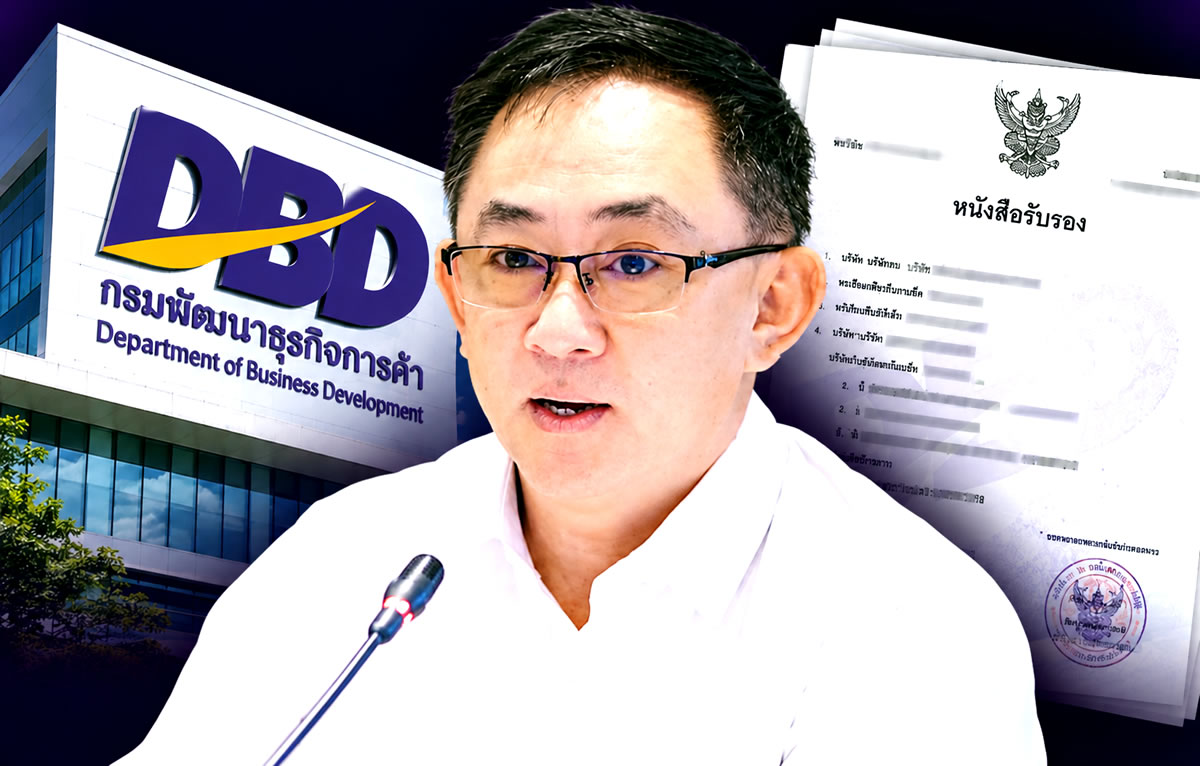
Thailand has widened its crackdown on illegal foreign nominee businesses, bringing 43 foreign embassies into a growing corporate scrutiny drive.
The Department of Business Development (DBD) has sent them information covering more than 100,000 Thai limited companies. Those businesses have foreign directors or shareholders spanning 48 nationalities. Crucially, DBD says they have not been identified as illegal nominee operations.
Nor does inclusion in the database establish wrongdoing by directors, shareholders or foreign investors. Instead, the enormous dataset covers companies across the full spectrum of foreign ownership in Thailand. DBD Director-General Poonpong Naiyanapakorn disclosed the initiative as the government intensifies checks on foreign-linked corporate structures. Notably, the information has already been distributed among the 43 diplomatic missions.
DBD sends data on over 100,000 foreign-linked Thai companies to 43 embassies as scrutiny now widens
DBD says the cooperation will help embassies monitor and facilitate investments involving their nationals. At the same time, the arrangement is intended to support businesses operating within Thai laws and regulations. The companies have been separated into three groups according to foreign shareholding levels. One covers businesses where foreigners own between 0.01% and 49.99%.
A second category includes foreign holdings ranging from 50% to 99.99%. Finally, the third category covers companies under 100% foreign ownership. Consequently, the 100,000-plus figure stretches far beyond businesses suspected of circumventing Thai foreign ownership restrictions. It includes legitimate foreign-owned and foreign-invested companies operating within existing Thai laws.
Indeed, Mr Poonpong stressed that inclusion does not mean a company has violated the law. It also does not establish that Thai shareholders have acted as nominees. Rather, DBD describes the information exchange as an initial measure under its verification powers. Nevertheless, the operation significantly broadens Thailand’s campaign against illegal nominee arrangements.
That campaign has increasingly focused on who controls companies and where their investment money originated. Previously, scrutiny centred heavily on corporate registrations and percentages shown on shareholder lists. Now, officials are also examining financial evidence behind those shareholdings. As part of this, the source of money invested by Thai shareholders has become an important enforcement issue.
Foreign Business Act crackdown targets nominee shareholders as financial and property checks intensify
The crackdown centres on arrangements designed to circumvent restrictions under the Foreign Business Act 1999. Under that law, foreigners face restrictions on conducting specified businesses in Thailand. Some prohibited structures use Thai shareholders to create the appearance of Thai ownership. However, Thai nationals cannot legally hold shares as nominees to help foreigners circumvent those restrictions.
DBD has warned Thais against accepting benefits to hold shares for foreign investors. Under Section 36, those convicted can face imprisonment for up to three years. Alternatively, fines can range from ฿100,000 to ฿1 million. Courts can also impose both imprisonment and fines.
Meanwhile, foreigners conducting restricted businesses unlawfully can face equivalent penalties under Section 37. DBD has also urged business operators and investment advisers to comply strictly with the Foreign Business Act. In parallel, the enforcement drive is extending beyond suspected violations of that legislation. Corporate registration checks are increasingly being combined with financial and property information.
Where additional evidence emerges, cases can be referred to other state agencies. Those bodies include police, tax agencies, the Department of Lands and the Anti-Money Laundering Office (AMLO). Significantly, AMLO has already received corporate financial profiles arising from previous nominee investigations. Such referrals allow financial investigators to trace transactions connected with businesses under examination.
Money laundering links enter nominee crackdown as DBD tightens checks on shareholder investment funds
Separately, DBD has proposed bringing nominee offences within the scope of predicate offences under anti-money laundering legislation. However, unexplained foreign investment does not itself establish a money laundering offence. Any prosecution requires evidence satisfying the relevant criminal and anti-money laundering laws. Even so, financial trails have become increasingly important within the wider nominee crackdown.
Earlier this year, DBD tightened scrutiny of financial documents supporting corporate ownership. Officials began demanding stronger evidence showing how Thai shareholders obtained funds used for their investments. Accordingly, investigators can examine whether shareholders possessed the financial capacity to make their declared investments. That examination can establish whether registered ownership corresponds with the underlying funding arrangements.
Moreover, the rules were strengthened again from August 1. Enhanced scrutiny now extends to changes involving shareholders and foreign authorised directors after incorporation. Therefore, checks are no longer concentrated solely on the original registration of a business. Later changes to ownership and management can also face examination.
Against that background, the embassy initiative adds another layer to the expanding enforcement structure. Until now, much of the operation involved information exchanges among Thai government agencies. This latest move extends cooperation to diplomatic missions representing investors from 48 nationalities. Yet the precise role expected of those embassies remains unclear from the information released.
Embassy role remains unclear as DBD expands foreign investment scrutiny across all 48 nationalities
DBD says diplomatic missions can jointly monitor and facilitate investors connected with their countries. Furthermore, the department says cooperation should help companies operate within Thai laws and regulations. However, no detailed public explanation has established exactly what individual embassies must do. For example, it remains unclear whether diplomatic missions are simply receiving existing corporate information.
Likewise, DBD has not said whether embassies will verify information concerning individual foreign investors. There is also no published confirmation that they will conduct checks in their home countries. Nor has DBD said they must examine the source of funds behind investments. Similarly, there is no confirmation that diplomatic missions will verify beneficial ownership structures.
No detailed mechanism has been disclosed for returning foreign information to Thai investigators. For now, DBD describes the initiative as cooperation involving monitoring, facilitation and legal compliance. At the same time, the department has stressed that legitimate overseas investors remain welcome. Mr Poonpong said the government remained ready to facilitate foreigners conducting legitimate businesses in Thailand.
That distinction matters because several large company figures have emerged from separate government screening operations. The 100,000 companies supplied to embassies are not 100,000 businesses accused of using nominees. On another front, DBD and the Department of Lands are conducting an extensive property-related screening exercise. Earlier this month, that operation covered records connected with 125,622 companies.
Property screening covers 125,622 firms as officials narrow nominee scrutiny to smaller target groups
Within that pool, 36,277 foreign-invested companies held 305,838 plots of land. Together, those holdings extended across 1,064,265.38 rai. Again, those companies formed part of a screening population rather than a list of proven offenders. The government has since narrowed parts of its enforcement work into substantially smaller groups.
Approximately 2,100 companies displayed structures indicating possible nominee connections. Meanwhile, more than 10,000 additional companies were undergoing further scrutiny. Thus, several different levels of investigation and screening are operating simultaneously. At the broadest level, government agencies are processing huge corporate and property datasets.
These checks cover foreign shareholders, company directors, ownership structures and property holdings. From there, officials can identify businesses displaying characteristics requiring closer examination. Investigators can then move into individual corporate structures and the people behind them. In addition, financial records and the origins of investment capital can become part of the investigation.
Cases can widen further when investigators find evidence suggesting offences under other laws. For instance, tax issues can be referred to the relevant agencies. Land ownership questions can bring the Department of Lands directly into an investigation. Likewise, suspicious financial activity can lead to scrutiny by AMLO.
Police and AMLO can enter cases as embassy initiative adds an international layer to corporate scrutiny
Police can also become involved when evidence indicates criminal offences. The embassy initiative now introduces an international component into that expanding framework. Information concerning more than 100,000 foreign-connected companies has moved from DBD to foreign diplomatic missions. Those missions represent 48 nationalities with investments or business interests in Thailand.
Still, DBD has emphasised that the information transfer is not a declaration of suspicion. The database covers companies across every level of foreign shareholding. At one end are businesses with foreign ownership as low as 0.01%. At the other are companies entirely owned by foreign shareholders.
As a result, substantial numbers of legitimate investors inevitably fall within the information supplied. DBD says embassy involvement can assist those investors while supporting compliance with Thai law. For foreign businesses, the initiative also gives diplomatic missions direct awareness of the expanding scrutiny. Embassies now have information concerning Thai companies connected with nationals from their countries.
Yet the scope of the information supplied has not been fully detailed publicly. Specifically, DBD has not disclosed every category of corporate information sent to individual embassies. The department has not detailed whether investors were identified beyond information contained in corporate registration records. Likewise, it has not announced whether embassies are expected to investigate individual shareholders or directors.
DBD scrutiny shifts towards investment funding as Commerce Ministry expands cooperation with embassies
Neither has DBD said whether diplomatic missions must verify investors’ financial backgrounds. Those unanswered points coincide with DBD’s growing domestic focus on the origins of investment funds. Increasingly, officials are looking beyond names and percentages recorded on shareholder registers. Instead, financial documents can establish whether declared shareholders actually supplied the capital attributed to them.
That scrutiny becomes particularly relevant where Thai shareholders cannot establish the source of their investment funds. Even then, enforcement action depends on evidence uncovered in each individual case. The embassy programme therefore operates alongside existing investigations rather than replacing them. During 2026, Thailand’s scrutiny of foreign-linked corporate structures has expanded substantially.
In particular, land and condominium holdings have faced nationwide examination. DBD has also strengthened requirements concerning shareholder funding and supporting financial documentation. Alongside this, suspected nominee structures have been narrowed into smaller groups for deeper investigation. Now, the Commerce Ministry has extended its cooperation to 43 foreign embassies.
Taken together, the various operations involve several distinct levels of scrutiny. More than 100,000 foreign-connected companies form the broad database supplied to diplomatic missions. Separately, 125,622 companies have appeared within the extensive property screening operation. Within that exercise, 36,277 foreign-invested companies held more than 305,000 land plots.
Investigators follow financial trails and property links as nominee enforcement expands across agencies
By contrast, approximately 2,100 companies showed structures indicating possible nominee links. A further group exceeding 10,000 companies has been subjected to additional scrutiny. Accordingly, the figures cannot be combined into a single list of businesses suspected of wrongdoing. Rather, they reflect different stages and purposes within a widening enforcement programme.
The most detailed investigations can move considerably beyond company registration records. Officials can follow financial trails and examine where investment capital originated. They can also scrutinise property ownership and links between associated companies. Where necessary, evidence can move between government agencies responsible for different areas of law.
DBD has already worked with several state bodies during previous nominee investigations. For its part, AMLO involvement has introduced financial tracing into relevant cases. Elsewhere, cooperation with the Department of Lands has added extensive property records to the screening process. The latest embassy initiative potentially creates another information channel.
However, the operation of that channel has not yet been publicly explained in detail. There is no confirmation that foreign embassies are conducting investigations themselves. Equally, there is no confirmation they have been asked to provide financial intelligence concerning their nationals. DBD has instead described their role in terms of monitoring, facilitation and compliance.
More than 100,000 firms remain unclassified as illegal while DBD widens checks on capital and property
The department also insists the 100,000-plus companies have not been classified as illegal operations. Nonetheless, the scale of the exercise is substantial. Corporate information covering more than 100,000 businesses has been distributed among 43 diplomatic missions. Those businesses involve directors or shareholders from 48 different nationalities.
Simultaneously, DBD is tightening checks on the capital supporting corporate ownership structures. Property records are also undergoing extensive screening. Afterwards, smaller groups of companies can be selected for deeper investigation. In turn, evidence of additional offences can bring other state agencies into individual cases.
The enforcement framework now stretches from company registrations to land holdings and financial transactions. It also extends from Thai shareholders and directors to foreign investors and their diplomatic missions.
Probe into 11,000 firms linked to foreigners holding 85 billion baht in property to be complete by Sept 30th
Nationwide probe targeting over 36K foreigner linked firms with land and a further 7k which own condos
For legitimate investors, DBD says the programme provides another channel for coordination and facilitation. For suspected nominee structures, increasingly detailed financial and corporate checks remain available to investigators.
Ultimately, the next key issue concerns the precise role assigned to those 43 embassies. So far, DBD has confirmed that corporate information has already been supplied. It has also confirmed that cooperation involves monitoring and facilitating investors. However, detailed procedures covering verification or the return of information have not been publicly disclosed.
For more than 100,000 foreign-connected companies, those details will define the practical reach of the latest initiative.
Join the Thai News forum, follow Thai Examiner on Facebook here
Follow Thai Examiner on Google here
Receive all our stories as they come out on Telegram here
Follow Thai Examiner here
Further reading:
Frenchman’s Koh Samui business empire enmeshed in knotty police probe of nominee firms and pot farm
Drive against foreign owned property and business on Koh Samui and Koh Phangan now targets leases
International reservations system used by hotels targeted in latest Koh Phangan swoop by ministers
Anutin visits Koh Phangan as nominee crackdown shows 68% of firms with foreign ownership links
Blitzkrieg on foreign firms and enterprises on Koh Phangan continues with French owned resort busted
Russian-Chinese Koh Phangan alliance to sell drugs to foreigners. Accused entered Thailand illegally
Crackdown aimed at upending foreign business trade moves from Koh Phangan to Phuket. Four arrested
Crackdown to wipe out foreign business abuses and ownership on Koh Phangan & Koh Samui intensifies