People’s Party MP Sahasawat Khumkhong has hit back at Chinese Ambassador Zhang Jianwei’s warning over the term ‘Chinese grey capital’, blaming weak Thai regulation—not Chinese investors—for illegal business networks and demanding sweeping reforms.
A People’s Party MP has challenged Chinese Ambassador Zhang Jianwei’s warning against using the term “Chinese grey capital”, arguing that Thailand’s real problem is not Chinese investors but years of weak regulation, poor oversight and lax enforcement. The unusually public exchange, after the envoy’s concerns were relayed to the Cabinet, has widened into a debate over nominee companies, visa policy, Board of Investment privileges and organised crime, exposing sharply different views on how Thailand should tackle illegal investment while protecting ties with its largest trading partner.
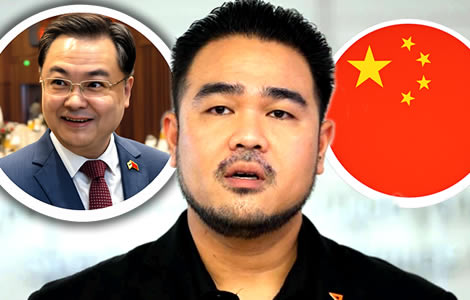
Chinese Ambassador to Thailand Zhang Jianwei’s call for Thais to stop using the term “Chinese grey capital” has sparked a sharp political response, with a People’s Party MP arguing that weak Thai regulation, not Chinese investors, created the conditions for illegal business networks to expand.
The exchange has brought into focus two competing explanations for the problem. Beijing says sweeping language unfairly brands millions of law-abiding Chinese citizens.
In response, Chonburi MP Sahasawat Khumkhong says Thailand should first address long-standing failures in regulating investment and enforcing the law.
Chinese envoy’s warning sparks political clash as MP blames weak Thai regulation for illegal investment
The ambassador’s concerns were conveyed to the Thai government last Tuesday before the weekly Cabinet meeting. Tourism and Sports Minister Surasak Phancharoenworakul relayed the message after discussions with the Chinese envoy. The intervention came as public debate over Chinese investment and organised crime continues to intensify.
Ambassador Zhang urged Thai politicians, officials and media organisations to avoid using language that associates organised crime with an entire nationality. Instead, he said terms such as “transnational criminal organisations” or “criminal networks” more accurately describe the problem.
According to the ambassador, the phrase “Chinese grey capital” unfairly damages the reputation of millions of Chinese citizens who obey the law. Equally, he said it harms genuine tourists and businesspeople who have invested legally in Thailand for many years. He warned that careless language risks undermining confidence between the two countries while discouraging legitimate investment.
At the same time, Ambassador Zhang reaffirmed China’s commitment to combating cross-border crime alongside Thailand. He pointed to intelligence sharing, joint investigations, extradition arrangements and coordinated police operations.
China stresses cooperation while warning language may harm lawful investors and bilateral confidence
He also highlighted continued cooperation against online fraud, money laundering, illegal gambling, human trafficking and organised criminal syndicates. Those efforts, he said, demonstrate that both governments share the goal of protecting public safety while preserving legitimate trade, tourism and investment.
The remarks come at a sensitive moment in bilateral relations. China remains Thailand’s largest trading partner. Moreover, it is one of the kingdom’s largest sources of foreign direct investment and international visitors. Chinese companies continue investing heavily in manufacturing, infrastructure, technology and electric vehicles, while tourism remains a key pillar of economic ties.
In response, Mr Sahasawat said he understood why Beijing objected to the expression. Nevertheless, he argued that the issue did not emerge because of Chinese nationals themselves. Instead, he blamed weaknesses inside Thailand’s own regulatory system.
“The grey area of China did not result from foreign interference but from the weakness of the Thai state,” he said.
Mr Sahasawat argued that years of weak enforcement allowed questionable investment structures to become established. According to the People’s Party MP, authorities focused too heavily on attracting investment while paying too little attention to monitoring projects after approval.
People’s Party MP says weak enforcement after investment approval allowed bad business practices
Separately, he challenged suggestions that immigration policy is the primary cause of the problem. He argued that tightening entry rules cannot resolve weaknesses in financial supervision, company regulation or investment oversight.
The MP also criticised the government’s decision to reduce Thailand’s general Visa Exemption period from 60 days to 30 days. He said many people mistakenly believe the move requires Chinese citizens to obtain visas before entering Thailand. However, he stressed that this interpretation is incorrect.
Thailand and China remain covered by their bilateral Visa Exemption Agreement, which took effect on March 1, 2024. Under that arrangement, Thai citizens continue travelling to China without visas. Likewise, Chinese citizens continue entering Thailand without visas under reciprocal conditions.
Instead, the recent change affects only Thailand’s wider Visa Exemption programme covering 93 countries and territories. That scheme previously allowed visitors to remain for up to 60 days. Now, the permitted stay has been reduced to 30 days. However, the bilateral agreement between Thailand and China remains unchanged.
Visa exemption changes do not affect Chinese agreement and may not be confused with crime control
Mr Sahasawat said ministers should communicate that distinction far more clearly. Otherwise, he warned, the public may wrongly conclude that shortening visa-free stays amounts to a crackdown on illegal Chinese investment.
According to the MP, the real problem lies elsewhere. He argued that illegal investment does not begin at immigration checkpoints. Rather, it develops inside Thailand’s investment approval and regulatory systems. He identified company registration, shareholder structures, bank accounts, land ownership and financial transactions as the areas requiring closer examination.
As part of that criticism, he pointed directly to Board of Investment projects and developments inside the Eastern Economic Corridor. He argued that investment promotion itself is not the problem. Instead, he questioned what happens after projects receive government approval and tax incentives.
Mr Sahasawat asked whether authorities actively monitor promoted businesses once they begin operating. He also questioned whether regulators inspect compliance often enough to identify irregularities before they become entrenched.
MP demands tougher oversight of BOI projects and questions agency coordination over nominees
On another front, he questioned whether government agencies exchange information effectively. He specifically referred to the Board of Investment, the Department of Business Development, the Department of Land, the Department of Industrial Works, the Immigration Bureau, the Revenue Department and the Anti-Money Laundering Office.
The MP also asked how many promoted projects had breached their investment conditions. Likewise, he questioned how many companies had subsequently lost their incentives. He further asked whether authorities had recovered investment benefits after discovering wrongdoing. Finally, he questioned whether systematic investigations routinely examine nominee ownership structures and illegal land use.
Mr Sahasawat then proposed eight measures which he said would address the issue more effectively than shortening visa-free stays.
First, he called for the publication of Board of Investment monitoring reports covering projects after promotion approval. Second, he urged disclosure of every project that has lost investment privileges. Third, he proposed systematic verification of land ownership involving promoted businesses.
Eight proposals seek tighter scrutiny of promoted projects, nominee companies and investments
Fourth, he called for stronger action against nominee companies, particularly inside the Eastern Economic Corridor. Fifth, he recommended measurable assessments of local content and technology transfer. Sixth, he said the Eastern Economic Corridor should be judged by investment quality rather than headline investment values.
Seventh, he argued immigration policy should be separated entirely from efforts to suppress economic crime. Finally, he proposed creating a shared database linking government agencies to monitor nominee ownership structures and financial transactions.
Notably, Mr Sahasawat also criticised the government’s public messaging. He said ministers should not imply that reviewing visa-free entry automatically suppresses so-called “Chinese grey capital”. According to him, such claims risk misleading the public.
Instead, he argued that criminal operators fear financial investigations rather than shorter visa stays. They fear scrutiny of nominee arrangements, detailed examinations of land ownership and the loss of investment privileges. They also fear equal enforcement of the law across every sector.
MP says stronger financial scrutiny and equal enforcement matter more than reducing visa-free stays
“If the government doesn’t address these root causes, even reducing the stay period from 60 days to 30 days will struggle to resolve the problem,” he said.
“The root cause isn’t the length of stay, but rather the loopholes in Thai government oversight.”
He concluded that the issue has never centred on how long visitors remain in Thailand.
“Because the problem has never been the number of days spent in Thailand, but rather the fact that the Thai state has allowed illegal activities to take root for so long.”
Tourism Minister passes on concerns of Chinese envoy to Thailand over coverage of ‘grey Chinese’ used in media coverage
Talks with Chinese ambassador indicate link between politics and Chinese visitors numbers to Thailand
Officials zero in on ownership of expanding Chinese food delivery services operating in the kingdom
The exchange has exposed a growing policy divide. Beijing is urging greater precision in describing criminal networks to avoid stigmatising legitimate Chinese citizens and investors. Meanwhile, the People’s Party argues Thailand must strengthen regulatory oversight, post-investment monitoring and enforcement if it wants to curb illegal investment networks operating inside the country.
Join the Thai News forum, follow Thai Examiner on Facebook here
Receive all our stories as they come out on Telegram here
Follow Thai Examiner here
Further reading:
Officials zero in on ownership of expanding Chinese food delivery services operating in the kingdom
Huai Khwang raid shows nominee shareholdings being used by Chinese infiltrating the economy
Sweep of nominee firms and business networks on Koh Phangan. 22 arrested, 200 million in land seized
Anutin visits Koh Phangan as nominee crackdown shows 68% of firms with foreign ownership links
Blitzkrieg on foreign firms and enterprises on Koh Phangan continues with French owned resort busted
Russian-Chinese Koh Phangan alliance to sell drugs to foreigners. Accused entered Thailand illegally
Crackdown aimed at upending foreign business trade moves from Koh Phangan to Phuket. Four arrested