Foreign property crackdown grips Thailand as 36,277 foreign-linked entities come under scrutiny. Officials are tracing nominee land deals, 30-year leases and condominium holdings, with offenders facing forced sales, ฿1m fines and jail.
Thailand’s crackdown on foreign control of property is expanding, with 36,277 foreign-linked legal entities now under scrutiny over land ownership nationwide. The probe is concentrated in 16 major provinces and has already moved from nominee company abuses into land, villas and 30-year leases using surreptitious arrangements. Condominium ownership is next, as the Department of Business Development (DBD) prepares to trace shareholders, bank funding and the real source of investment to facilitate condominium ownership, sometimes involving multiple units. Suspected nominee structure abuses face forced land sales, fines of up to ฿1 million and prison terms of up to three years.
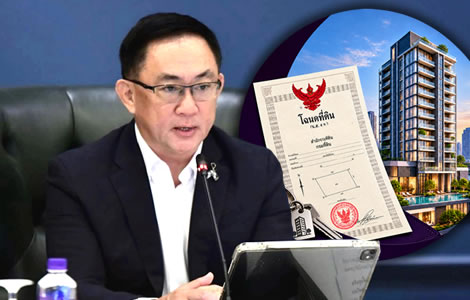
Thailand’s crackdown on foreign-controlled businesses is widening into a national examination of property ownership. Officials are scrutinising 36,277 foreign-linked legal entities holding land across the country. Notably, almost all are concentrated in 16 major tourist, commercial and surrounding provinces. Condominium ownership is now becoming the next target.
The Department of Business Development is preparing to examine foreign-linked companies holding condominium units. Officials will look for Thai nominees used to circumvent foreign ownership restrictions. In parallel, investigators are already examining company-held land and long-term property leases.
Department Director-General Poonpong Naiyanapakorn disclosed the scale after receiving extensive information from the Land Department. The original data covered real estate ownership involving 144,706 legal entities. Officials then checked those records against registrations maintained by the department.
Foreign-linked land holdings concentrated across 16 provinces as officials deepen nominee checks
Of that total, 125,662 legal entities were registered with the department. The property ownership information under examination covered 123,542 foreign-owned properties. The department subsequently divided the relevant companies according to their registered ownership structures.
Altogether, 87,265 legal entities were recorded as entirely Thai-owned. By contrast, another 36,277 had foreign investment. This second group is now targeted for deeper scrutiny over possible nominee arrangements. Investigators will establish whether Thai shareholders genuinely funded and controlled their registered stakes.
The geographic concentration is particularly significant. Of the 36,277 foreign-linked entities, 35,154 own land across only 16 priority provinces. Six cover Bangkok and its surrounding economic region. They are Bangkok, Nonthaburi, Samut Prakan, Pathum Thani, Samut Sakhon and Nakhon Pathom.
Separately, another ten are major tourism provinces. They comprise Chonburi, Surat Thani, Phuket, Rayong, Chiang Mai and Chiang Rai. Prachuap Khiri Khan, Krabi, Phang Nga and Mae Hong Son complete the group. Only 1,123 foreign-linked entities are scattered throughout Thailand’s remaining provinces.
Officials target 31,516 foreign-linked entities as high-risk group for possible nominee shareholding
Mr Poonpong said officials had divided the 36,277 entities into two main categories. The largest contains 31,516 entities where foreigners hold no more than 49% of shares. It comprises 30,633 limited companies, 737 public limited companies and 146 partnerships.
Crucially, officials consider this category a high-risk group for possible nominee shareholding. These companies remain majority Thai-owned according to their registered structures. Yet investigators will establish whether the Thai shareholders are genuine investors.
As part of this, officials will examine whether Thai shareholders actually supplied the capital attributed to them. They will also check whether Thais are holding shares for foreign investors. Many companies within this category operate in major tourist provinces. Furthermore, officials found that companies within the group had purchased additional condominium units.
The department has already mapped their land holdings in considerable detail. Among the 31,516 entities, 20,537 hold title deeds covering one plot. Another 8,068 hold between two and five plots. Some 1,511 hold between six and ten plots, while 1,400 hold at least 11.
Land area provides another measure of their holdings. Some 21,106 entities hold less than one rai. Another 2,250 hold more than one rai but no more than two. Meanwhile, 2,490 hold more than two rai but no more than five.
Thousands of foreign-linked firms hold more than ten rai as scrutiny expands into ownership funding
Further up the scale, 1,505 entities hold more than five rai but no more than ten. However, 3,865 entities hold more than ten rai. The figures do not establish wrongdoing by those companies. Instead, they identify entities requiring deeper scrutiny of ownership and funding.
A second category contains 4,761 entities where foreign ownership reaches or exceeds 49%. This group comprises 4,709 limited companies, 41 public limited companies and 11 partnerships. In many cases, however, these companies operate under different legal circumstances.
Many obtained land ownership rights through government investment incentives. These include privileges granted by the Board of Investment or Industrial Estate Authority of Thailand. Accordingly, numerous companies are concentrated inside industrial zones rather than tourist property markets.
The Eastern Economic Corridor is particularly prominent within this second category. Chonburi and Rayong contain significant numbers of foreign-invested businesses benefiting from investment privileges. Even so, officials have also analysed the land held by these companies.
Foreign-majority companies hold substantial land as investment privileges shape industrial ownership
Within the second group, 2,244 entities hold one land title deed. Another 1,906 hold between two and five plots. Additionally, 378 hold between six and ten plots. A further 233 entities hold at least 11 plots.
Their land areas are also substantial. Officials recorded 467 entities holding less than one rai. Another 154 were placed within the department’s next land-size category. Some 499 hold more than two rai but no more than five.
At the higher end, 783 entities hold more than five rai but no more than ten. More strikingly, 2,858 hold more than ten rai. These figures still do not show the total land held through foreign-linked companies nationwide.
Instead, the data gives investigators a detailed corporate base for further checks. It also marks a sharp expansion from earlier enforcement operations on Thailand’s southern tourist islands.
The crackdown initially gathered momentum on Koh Phangan. Subsequently, the operation expanded aggressively to neighbouring Koh Samui. Investigators first targeted companies suspected of using Thai nominee shareholders to disguise foreign control.
Under such structures, Thai nationals can appear as majority shareholders on company documents. Foreign investors may nevertheless provide the capital or exercise effective control. Investigators therefore began looking beyond registration documents into financial arrangements.
Koh Phangan and Koh Samui crackdown widens as officials trace nominee structures and foreign control
Property repeatedly emerged at the centre of those investigations. As a result, scrutiny moved towards companies holding land, villas, hotels and other valuable real estate. The Koh Samui operation showed the potential scale.
Officials examined 12,906 registered companies on the island. Significantly, 8,254 had foreign shareholders. Another 875 displayed characteristics raising concerns over possible nominee arrangements.
Investigators later identified 59 suspected companies connected with 37 plots of land and buildings. Together, those properties cover more than 31 rai. Their combined value is approximately ฿1.2 billion.
The investigation consequently produced 60 cases involving 88 suspects. They include 62 foreign nationals and 26 Thai nationals. Police have also obtained search and arrest warrants as the operation continues.
On another front, enforcement has moved beyond companies directly holding freehold property. Officials have started examining how foreigners obtain long-term control without owning the underlying land. That development brought 30-year lease agreements into the investigation.
Foreigners generally cannot directly own land in Thailand. Long leases have therefore become widely used in property transactions involving foreign residents and investors. They are particularly significant for villas and other residential property.
Koh Samui probe identifies ฿1.2 billion in property as officials turn attention to 30-year leases
Now officials are examining those agreements within the broader property campaign. The investigation therefore reaches beyond names recorded on title deeds. Leases, corporate structures and funding arrangements are increasingly part of the examination.
Earlier, the Department of Business Development strengthened financial checks across the 16 priority provinces. Thai shareholders and company directors can be required to provide financial documentation. In particular, investigators can demand bank statements establishing where investment funds originated.
Such checks allow officials to compare registered shareholdings with actual financial flows. They can establish whether Thai shareholders possessed the funds required for their declared investments. This becomes especially relevant to the 31,516 companies below the 49% foreign ownership threshold.
On paper, those companies retain Thai majority ownership. Nevertheless, the department has classified the group as higher risk for possible nominee arrangements. Officials can therefore examine whether registered Thai shareholders supplied their own investment funds.
Against that background, condominium ownership is opening another major front. The Department of Business Development is awaiting further information from the Land Department. Those records will cover condominium ownership involving foreign legal entities.
Financial checks target Thai shareholders as officials prepare scrutiny of foreign condominium holdings
Once received, officials plan rigorous checks of the underlying ownership structures. Foreigners can legally own condominium units in Thailand. However, foreign ownership is generally limited to 49% of a condominium’s total unit floor area.
The remaining 51% must remain under Thai ownership. Condominium ownership therefore operates differently from Thailand’s restrictions on direct foreign land ownership. Still, officials say loopholes have previously been detected.
Foreigners have used legal entities and Thai nationals as nominees to acquire interests within the remaining Thai portion. Those properties can then be leased. Alternatively, units can be resold for speculative purposes.
For that reason, officials are preparing detailed inspections of foreign-linked condominium holdings. Investigators will examine the legal entities used to acquire the units. They can also scrutinise the Thai shareholders behind those companies.
Financial documentation provides another investigative route. Bank records can establish who supplied the money used for corporate investments. Accordingly, officials can compare legal ownership with the actual source of investment capital.
The condominium probe represents another expansion of an increasingly broad property investigation. Initially, enforcement concentrated on foreign-controlled businesses and suspected nominee shareholders. Investigators then moved into company-owned land, villas and other buildings.
Condominium ownership faces detailed checks as officials investigate companies, nominees and funding
More recently, attention expanded to 30-year lease agreements. Now condominium holdings are being brought within the same campaign. The investigation therefore spans several distinct mechanisms through which foreigners can obtain interests in Thai property.
Mr Poonpong has also detailed the penalties available when investigators establish illegal arrangements. If illegal foreign land ownership is discovered, the Land Department can order the property sold. The land must then be disposed of within 180 days.
Afterwards, proceeds from the sale can be returned to the foreign party concerned. Different criminal penalties apply when nominee arrangements breach the Foreign Business Act. The Department of Business Development can prosecute those involved.
Conviction carries imprisonment for up to three years. Alternatively, offenders can face fines ranging from ฿100,000 to ฿1 million. Courts can also impose both imprisonment and a fine.
Property crackdown expands from 30-year leases to condominiums as tougher criminal penalties loom
The same penalties apply to foreigners illegally operating businesses without required permission. Thai nominees participating in prohibited arrangements can also face prosecution. Thus, enforcement can reach both foreign investors and Thai participants in corporate structures.
The department’s 36,277-entity database now provides the foundation for a much larger national investigation. Importantly, inclusion within the database does not itself establish any offence. Rather, the records identify companies requiring further examination.
Particular attention falls on the 31,516 entities where foreign shareholding does not exceed 49%. Their registered structures leave Thai shareholders holding majority stakes. Investigators must establish whether those stakes represent genuine Thai investment.
They can also trace whether foreigners ultimately control the companies and associated properties. In addition, bank records can establish whether declared Thai shareholders supplied their investment capital.
Nominees and foreign investors face prosecution as 36,277-entity database drives nationwide checks
The geographic reach adds another dimension. The investigation covers Bangkok and five surrounding provinces. It also extends through ten of Thailand’s principal tourist and investment centres.
At the same time, Chonburi and Rayong connect the exercise with the Eastern Economic Corridor. The crackdown has therefore moved well beyond its earlier concentration on Koh Phangan and Koh Samui.
Officials are now examining tens of thousands of foreign-linked legal entities nationwide. Corporate shareholdings are under scrutiny, alongside land title deeds and investment funding. Long-term leases have also entered the examination.
Drive against foreign owned property and business on Koh Samui and Koh Phangan now targets leases
Despite a slump in foreign condo sales, property industry leader touts stricter Chinese type ownership controls
Next comes condominium ownership. The Department of Business Development is waiting for Land Department records before starting those detailed checks. Officials will then identify foreign-linked condominium holdings requiring further examination.
From there, investigators can scrutinise companies, shareholders and the money behind individual purchases. The latest phase therefore extends the campaign from businesses and land into another major segment of Thailand’s property market.
Join the Thai News forum, follow Thai Examiner on Facebook here
Receive all our stories as they come out on Telegram here
Follow Thai Examiner here
Further reading:
Drive against foreign owned property and business on Koh Samui and Koh Phangan now targets leases
International reservations system used by hotels targeted in latest Koh Phangan swoop by ministers
Anutin visits Koh Phangan as nominee crackdown shows 68% of firms with foreign ownership links
Blitzkrieg on foreign firms and enterprises on Koh Phangan continues with French owned resort busted
Russian-Chinese Koh Phangan alliance to sell drugs to foreigners. Accused entered Thailand illegally
Crackdown aimed at upending foreign business trade moves from Koh Phangan to Phuket. Four arrested
Crackdown to wipe out foreign business abuses and ownership on Koh Phangan & Koh Samui intensifies