From Buriram heir to Cabinet minister, Chaichanok Chidchob’s rise has been rapid. At 36, he declares ฿161.92m in assets, including an ฿8m Bentley and ฿26.95m in watches, while his signature ฿1.6bn TH-AI programme comes under growing scrutiny in 2026.
At just 36, Digital Economy and Society Minister Chaichanok Chidchob has shot from first-time MP to Bhumjaithai secretary-general and Cabinet minister. Now, a National Anti-Corruption Commission (NACC) filing has exposed the extraordinary wealth behind his rise: ฿161.92 million in assets, an ฿8 million Bentley and nearly ฿27 million in luxury watches. Yet the fortune largely predates politics. The eldest son of influential Buriram powerbroker Newin Chidchob is meanwhile carving out his own profile through the ฿1.6 billion TH-AI programme. It has drawn more than 1.4 million registrations while facing opposition and state scrutiny over procurement. Behind the political ascent lies an equally unusual personal story spanning separation from his biological mother, 17 years in Britain, military service, e-sports and one of Thailand’s most powerful political families.
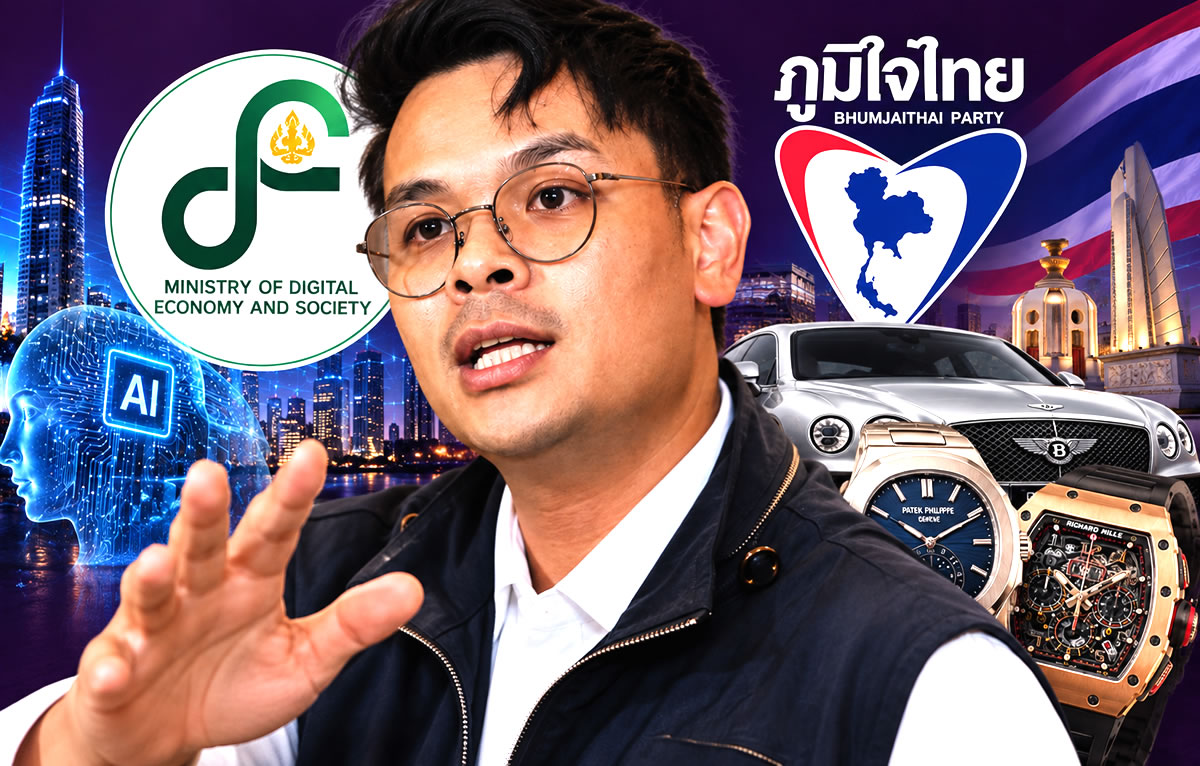
Digital Economy and Society Minister Chaichanok Chidchob is emerging as a major figure in Thailand’s Bhumjaithai-led government. At 36, he already occupies two powerful positions. He is a Cabinet minister and secretary-general of the ruling Bhumjaithai Party. Moreover, he is the eldest son of Newin Chidchob, the political heavyweight synonymous with Bhumjaithai’s Buriram heartland.
His rise has been exceptionally fast. Chaichanok entered Parliament for the first time after the May 2023 general election. Within a year, Bhumjaithai appointed him secretary-general. Then, in September 2025, he entered Cabinet under Prime Minister Anutin Charnvirakul. Subsequently, he retained the Digital Economy and Society portfolio following the February 2026 general election. Today, he is the youngest minister in Anutin’s Cabinet.
However, another side of the young politician came into sharp focus this week. On Tuesday, September 22, the National Anti-Corruption Commission (NACC) published his latest statutory assets declaration. The filing puts Chaichanok’s personal assets at precisely ฿161,920,281.20. It also confirms that the 36-year-old politician is single.
NACC filing details ฿161.92 million fortune with land, luxury cars and a prized ฿8 million Bentley
The declaration provides a detailed picture of his wealth. Chaichanok reported ฿1.5 million in cash and ฿60.49 million across 10 bank accounts. Meanwhile, his investments were valued at ฿13.07 million. He also declared 10 plots of land in Bangkok and Buriram worth ฿24.93 million. Additionally, interests in two homes in Bangkok’s Lat Krabang district were valued at ฿3.63 million.
Rights and concessions account for another ฿18.94 million. Yet some of the most striking entries concern his garage and watch collection. Chaichanok declared five cars and one motorcycle worth a combined ฿12.4 million. At the top of that list sits an ฿8 million Bentley Continental GT V8 4.0.
Alongside it, Chaichanok declared a Toyota Alphard worth ฿1.5 million. A Toyota Fortuner carries a declared value of ฿1.4 million. Furthermore, two Toyota Hilux Revo pickups were each valued at ฿600,000. Finally, his Ducati Multistrada 1200 Enduro motorcycle was valued at ฿300,000.
Even so, the Bentley is not his most valuable declared luxury possession. His five watches carry a combined valuation of ฿26.95 million. Indeed, one Richard Mille alone is worth more than the Bentley on the NACC declaration.
Five luxury watches worth ฿26.95 million dwarf annual salary as wealth remains broadly unchanged
The collection contains two Patek Philippe watches and three Richard Mille models. His Patek Philippe Nautilus 5712/A Moon Phase is valued at ฿1.4 million. Separately, a Patek Philippe Aquanaut Travel Time 5164A-001 carries a ฿1.55 million valuation.
The three Richard Mille watches are considerably more expensive. An RM35-03 Automatic Rafael Nadal is valued at ฿8 million. Another RM61-01 Limited Edition is listed at ฿5.5 million. Most notably, an RM65-01 Chronograph Rose Gold carries a declared value of ฿10.5 million.
Against that, his reported annual income is comparatively modest. Chaichanok declared ฿1,362,720 in yearly income, entirely from salary. His annual personal expenditure was put at ฿600,000.
Nevertheless, those figures require important context. The NACC declaration does not show Chaichanok becoming wealthy after entering politics. Instead, almost his entire present fortune was already disclosed when he first entered Parliament.
Following the 2023 election, Chaichanok declared assets totalling ฿161,625,029.76. At that point, he also reported an overdraft liability of ฿19,934.24. Consequently, his gross declared assets have increased by only about ฿295,000 over three years.
The composition has changed more noticeably. In 2023, Chaichanok reported ฿50.54 million in bank deposits. Today, that figure stands at ฿60.49 million. By comparison, investments previously stood at ฿12.99 million and land at ฿24.11 million. His vehicles were then valued at ฿14.5 million.
Earlier filing shows watches and Bentley predate Cabinet career as Chidchob legacy comes into view
Crucially, his luxury watches are not recent acquisitions. All five appeared in the 2023 declaration. Furthermore, their combined declared value was already ฿26.95 million. His Bentley also appeared in that filing. Therefore, the latest disclosure exposes longstanding wealth rather than a sudden increase after entering government.
At the same time, the filing adds considerable colour to an unusual political profile. Chaichanok was born in Buriram on July 14, 1990. He represents the third generation of one of Thailand’s most prominent provincial political families. Yet much of his childhood and early adult life unfolded thousands of kilometres from Buriram.
His late grandfather, Chai Chidchob, reached the highest levels of parliamentary politics. He served as House Speaker and President of Parliament. Meanwhile, Chaichanok’s uncle Saksayam Chidchob became Bhumjaithai secretary-general. Saksayam subsequently served as Transport Minister.
Above all, there is his father, Newin Chidchob. Newin formally withdrew from frontline politics years ago. Afterwards, he concentrated on business, football and motor racing interests centred on Buriram. Despite holding no formal Bhumjaithai position, his influence around the party remains widely recognised.
Chaichanok himself has acknowledged that influence. Earlier this year, he described Newin as “the power behind us”. However, he rejected suggestions that his father dictates every Bhumjaithai decision.
“I’m not going to deny that he has influence on us,” Chaichanok said. At the same time, he stressed that father and son sometimes disagree.
Newin’s influence looms over Bhumjaithai as Chaichanok acknowledges his father’s political weight
The family is closely associated with Thailand’s “Baan Yai”, or “Big House”, political tradition. The term describes powerful provincial families supported by deep electoral networks. However, Chaichanok’s personal upbringing was far removed from a conventional political apprenticeship.
His biological parents separated when he was extremely young. In June, Chaichanok publicly discussed the subject after his mother entered political debate. He said Newin and his biological mother divorced when he was approximately two or three years old.
As a result, Chaichanok was not raised by his biological mother. Instead, Karuna Chidchob brought him up from childhood. Chaichanok said he was too young to remember his parents separating. He also acknowledged having virtually no relationship with his biological mother.
At one point, Chaichanok asked his father about her. However, he sensed that Newin was uncomfortable discussing the subject. Accordingly, the son decided not to press him further.
Later, Chaichanok learned that his biological mother had established another family. He said he had neither met nor spoken with her. Still, as he grew older, he followed information about her wellbeing. He said she appeared comfortable and remained in a long-standing relationship.
When the matter surfaced publicly, Chaichanok made one specific request. He asked that his biological mother not be dragged into political attacks against him. Thus, the episode exposed an intensely private element of the Chidchob family story.
Chaichanok reveals he was raised by Karuna after losing contact with his biological mother in childhood
Soon afterwards in his childhood, another separation from home followed. At about eight years old, Chaichanok was sent to Britain. He would spend approximately 17 years there.
During that period, he attended Millfield School in England. Later, he studied economics and finance at a London university. However, he did not complete that degree. Chaichanok has also openly acknowledged repeating academic years and changing schools.
Eventually, he returned to Thailand aged around 25. Thereafter, his life changed direction again. Chaichanok volunteered for military service, an experience he later described as life-changing and eye-opening.
Following military service, he completed a bachelor’s degree in political science at Chalermkarnchana University in Buriram. Politics, however, was not his immediate destination. Instead, he became involved in the Chidchob family’s extensive sporting operations.
Those interests included Buriram United Football Club and Chang International Circuit. In parallel, Chaichanok developed a strong interest in technology, gaming and competitive e-sports. At 29, he founded Buriram United E-sports and became its chief executive.
That experience is particularly relevant to his present Cabinet portfolio. Unlike many career politicians, Chaichanok arrived with direct experience of gaming and digital entertainment. Nevertheless, his formal political career did not begin until 2022.
That year, he joined Bhumjaithai. Then, in May 2023, he contested Buriram constituency 2. He won and entered the House of Representatives for the first time.
Seventeen years in Britain led to military service, Buriram sports, e-sports and a political career
Barely ten months later, another promotion followed. In March 2024, Bhumjaithai appointed the 33-year-old MP as secretary-general. He replaced his uncle Saksayam in one of the party’s most important organisational posts.
Notably, Chaichanok did not deny that his family background helped him. “Being a political heir is a big plus,” he told reporters. However, he said he was prepared to prove himself. Ultimately, he said party members and supporters could judge his performance.
His ascent accelerated again in September 2025. Bhumjaithai leader Anutin Charnvirakul became Prime Minister with crucial parliamentary support from the People’s Party. That support formed part of an agreement that included constitutional reform.
Against this backdrop, Chaichanok entered Cabinet as Digital Economy and Society Minister. The appointment immediately gave the young Bhumjaithai secretary-general a national platform. More importantly, it placed him in charge of one of Thailand’s fastest-changing policy areas.
Then came the February 2026 general election. Chaichanok returned to Parliament as Bhumjaithai’s No.2 party-list candidate. Afterwards, Anutin retained him at the Digital Economy and Society Ministry.
His rapid rise has inevitably fuelled discussion about his future within Bhumjaithai. Thai PBS World has described Chaichanok as the party’s “heir apparent”. Other reporting has similarly characterised him as a political heir within the Chidchob dynasty.
Rapid promotion takes Chaichanok from first-time MP to party secretary-general and Cabinet minister
However, there is no formal party designation making Chaichanok Anutin’s successor. Bhumjaithai has announced no succession arrangement. Even so, his existing positions place him close to the party’s organisational centre.
The political picture is straightforward. Chaichanok is Newin’s eldest son and Bhumjaithai’s secretary-general. At the same time, he controls an important Cabinet ministry. His father, meanwhile, remains closely associated with the party’s Buriram power base.
Unsurprisingly, Chaichanok’s relationship with Anutin attracts persistent attention. There have been periodic reports of disagreements involving the Prime Minister, Chaichanok and Newin. In response, Chaichanok has publicly played down suggestions of a serious rupture.
In July, he described Anutin and his father as personally close. Furthermore, he said disagreements between them were normal. He stressed that their long-standing relationship remained based on trust.
Personal links between the families remain visible as well. In June, Anutin presided over the Bangkok wedding of Chaichanok’s younger brother, Chanchanok Chidchob. Meanwhile, Chaichanok has increasingly established a national political profile independent of both men.
Artificial intelligence has become his principal vehicle for doing so.
Anutin ties draw attention as Chaichanok builds his own national profile through artificial intelligence
Since taking office, Chaichanok has made AI adoption a defining feature of his ministerial tenure. In particular, his flagship TH-AI Passport programme carries a budget of approximately ฿1.6 billion. The programme aims to give up to five million Thais access to advanced generative AI technology.
Beyond access, the scheme includes training. Its target groups include students, workers, entrepreneurs and government personnel. Members of the wider public can also participate.
By its August launch, the platform involved more than 14 technology providers. Additionally, users could access more than 30 AI models. The project also incorporates a “Learn, Earn, Plern” approach designed to encourage practical skills.
According to the ministry, the programme extends beyond subsidising AI subscriptions. Instead, officials want users to acquire practical experience with rapidly developing technology. Chaichanok has repeatedly argued that widespread AI access is essential for Thailand’s competitiveness.
Registration opened on August 19. By August 28, more than 1.3 million people had registered. Subsequently, the platform began full operation on August 31.
By September 2, cumulative registrations had reached 1,455,289. Around the same period, approximately four million AI prompts had been recorded. Consequently, Chaichanok gained substantial headline numbers when defending his signature project.
TH-AI Passport targets five million users as registrations surge past 1.4 million after its August launch
However, those registration numbers tell only part of the story. Approximately 450,000 active users were initially reported on August 31. Thereafter, updated active-user figures stopped being publicly supplied.
Thai PBS reported that the responsible agency had not received later figures from the contractor. Therefore, registrations cannot automatically be described as regular active users. In addition, registrations remain considerably below the programme’s five-million ceiling.
Chaichanok has acknowledged slower registrations and Thailand’s continuing digital divide. Even so, TH-AI has already become the defining programme of his Cabinet career.
At the same time, it has become his biggest political controversy.
Opposition politicians have repeatedly questioned the ฿1.6 billion procurement. Their questions cover the timetable, tender specifications and selection of the successful consortium. Specifically, People’s Party MP Pawoot Pongvitayapanu questioned whether some requirements were unusually restrictive.
Opposition MPs also challenged the speed of the procurement. On another front, they examined requirements involving digital advertising screens in convenience stores. They also raised claims of business connections involving companies previously awarded work by Bhumjaithai-controlled ministries.
These remain opposition claims and questions. They are not findings that Chaichanok manipulated the procurement.
Active-user figures stop as opposition MPs intensify scrutiny of the ฿1.6 billion TH-AI procurement
The successful TH Consortium involved Turnkey Communication Services and Human Intelligent. Significantly, Chaichanok subsequently acknowledged personally knowing the successful bidder. However, he denied participating in the procurement process.
Faced with criticism, the minister also rejected claims that the tender was rushed. Chaichanok said preparations had actually started months earlier. According to him, the overall process took approximately five months.
As part of this defence, he said the procurement included legally required public consultation. He also insisted that the project remained open to examination.
Separately, Chaichanok has defended the programme’s economics. He calculated its cost at approximately ฿27 per participant each month. Furthermore, he argued that centralised procurement could strengthen Thai data sovereignty.
Yet opposition scrutiny continued as implementation gathered pace.
On September 1, People’s Party MP Rakchanok Srinok submitted material concerning TH-AI to the NACC. She requested an investigation involving five people connected with the project.
Her submission questioned whether tender specifications favoured a particular private bidder. Again, those claims remain matters submitted for investigation. They are not established findings against Chaichanok.
Chaichanok admits knowing successful bidder but denies any role in procurement as NACC scrutiny follows
Three weeks later, another challenge followed. On September 21, Democrat Party deputy leader Karndee Leopairote approached the State Audit Office. She also requested scrutiny of the ฿1.6 billion programme.
Consequently, TH-AI now presents two sharply contrasting sets of facts. It has attracted more than 1.4 million registrations. However, its procurement remains under sustained political and institutional scrutiny.
For Chaichanok, the controversy has also highlighted his political style. He has not avoided public confrontation over the programme. Instead, he has defended its procurement, cost and objectives directly.
More recently, Chaichanok reflected publicly on his first year in Cabinet. He said the experience had taught him greater patience. He also referred to learning how to handle criticism and misunderstanding.
Away from government, his private life remains comparatively guarded. The NACC declaration formally records him as single. Nevertheless, Thai media interest in his relationship status has become substantial enough to feature in long-form interviews.
There is also another unusual strand to his personal history. Chaichanok has spoken about previously considering remaining permanently in the monkhood. He said he once believed he had relinquished many personal attachments.
State Audit Office scrutiny adds pressure as Chaichanok defends TH-AI after his first Cabinet year
By contrast, his NACC declaration documents an extensive collection of valuable possessions. There is the ฿8 million Bentley Continental GT. There is also the Ducati motorcycle and almost ฿27 million in luxury watches.
Beyond those items, Chaichanok owns 10 plots of land and interests in two houses. He has ฿60.49 million spread across 10 bank accounts. His investments, meanwhile, are valued at ฿13.07 million.
Altogether, his declared assets stand at ฿161.92 million. Yet those possessions largely predate his ministerial career. Indeed, his overall declared wealth has barely moved since he entered Parliament.
Politically, however, almost everything has changed.
In 2023, Chaichanok was a first-time Buriram MP. One year later, he was Bhumjaithai secretary-general. Then came a Cabinet seat in 2025.
By 2026, he was running a ฿1.6 billion national AI programme. At the same time, opposition MPs were taking questions about that programme to independent state bodies.
Meanwhile, the Chidchob family remains deeply embedded in Bhumjaithai’s political story. Chaichanok’s grandfather reached the presidency of Parliament. His uncle ran the party organisation and later controlled the Transport Ministry.
Political ascent outpaces changes in wealth as the Chidchob family remains deeply linked to Bhumjaithai
His father became one of the defining political figures in Buriram. Now Chaichanok himself occupies the Bhumjaithai secretary-general’s office.
Nevertheless, his route there remains highly unusual.
He was not raised by his biological mother after his parents separated. Instead, Karuna Chidchob raised him from childhood. Then, at eight, he left Thailand and spent roughly 17 years in Britain.
His academic career included setbacks, repeated years and changes of school. After returning home, he volunteered for military service. Later came university in Buriram, football, motor racing and e-sports.
Only then did electoral politics begin.
Chaichanok joined Bhumjaithai in 2022. He entered Parliament in 2023 and became party secretary-general in 2024. The following year, he entered Cabinet.
Now his political position sits at the intersection of several important forces inside Bhumjaithai. Anutin remains party leader and Prime Minister. Newin remains an influential figure around the Buriram political network.
From an unusual childhood to Britain and e-sports, Chaichanok reaches the centre of Bhumjaithai politics
Chaichanok, meanwhile, holds the party’s secretary-generalship and an increasingly prominent Cabinet portfolio. Accordingly, his advancement has strengthened perceptions that he represents Bhumjaithai’s next political generation.
Still, that future remains unwritten. There is no formal declaration that he will eventually lead Bhumjaithai. Nor has Anutin announced any succession plan.
What is established is already substantial.
At 36, Chaichanok has spent only three years in Parliament. Yet he already holds one of Bhumjaithai’s most important party posts. He also controls Thailand’s Digital Economy and Society Ministry.
TH AI plan runs into problems and bottlenecks. New AIS deal offering cheap 29 baht per month internet
Paying AI users in Thailand had a nightmare week online just as the government waded into the market
Furthermore, his signature programme is attempting to put advanced AI technology into millions of Thai hands. That same ฿1.6 billion programme is also facing scrutiny over its procurement.
Now the latest NACC filing adds another dimension. It documents the Bentley, Ducati, land, houses and investment portfolio. It also details two Patek Philippes and three Richard Milles. Yet the numbers deliver a clear historical comparison.
Chaichanok entered Parliament in 2023 declaring approximately ฿161.63 million in assets. Three years later, he declared approximately ฿161.92 million.
Therefore, his reported fortune has changed little during his extraordinary political ascent. His position inside Thai politics has changed dramatically.
Join the Thai News forum, follow Thai Examiner on Facebook here
Follow Thai Examiner on Google here
Receive all our stories as they come out on Telegram here
Follow Thai Examiner here
Further reading:
Paying AI users in Thailand had a nightmare week online just as the government waded into the market
Ministry fails to halt ฿25.4 billion payment order to Hong Kong based firm linked to 1990 contract