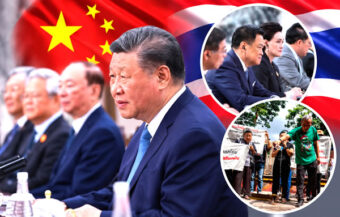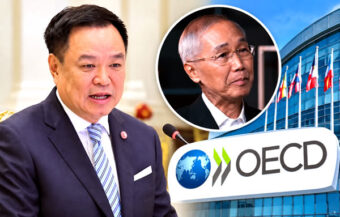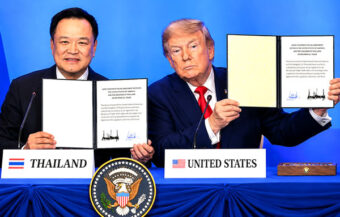
Washington turns up the heat on Thailand nine days after Anutin’s Manila breakthrough with Trump. Proposed tariffs could rise to 18% or even 25%. Business leaders welcome Thailand’s competitive position but warn that rice, shrimp and tuna remain exposed.
Thailand faces a fresh US tariff battle with nearly ฿3 trillion in annual exports and 1.25 million jobs at stake. On Wednesday, November 25, United States Trade Representative Jamieson Greer unveiled sweeping tariff proposals in Washington. Thailand faces an 18% ceiling, but Washington could impose a punishing 25% rate. Crucially, American investigators targeted Thailand’s industrial subsidies, soaring trade surplus and deepening economic ties with China. On Thursday, Deputy Prime Minister and Minister of Commerce Suphajee Suthumpun defended Bangkok’s negotiating strategy. Meanwhile, Thai Chamber of Commerce Chairman Dr Poj Aramwattananont welcomed Thailand’s competitive position but demanded agricultural exemptions. Technology exports could escape additional duties. However, rice, shrimp and tuna remain exposed. Just nine days after Prime Minister Anutin Charnvirakul’s Manila breakthrough with President Donald Trump, Bangkok faces a race to seal its trade deal.
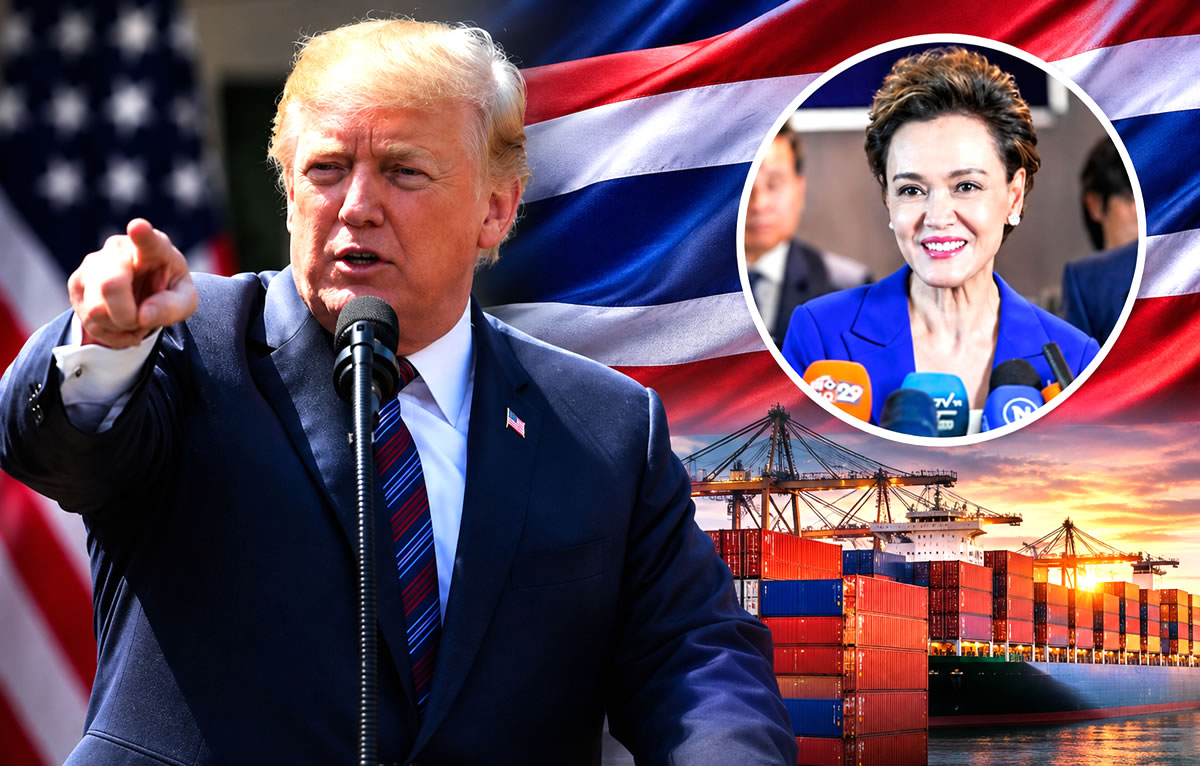
Thailand faces a fresh US tariff threat following sweeping trade measures announced by President Donald Trump’s administration in Washington on Wednesday. American authorities proposed tariffs of up to 18% on Thai exports on November 25.
However, Washington has reserved the option of imposing a substantially higher rate of 25%. The announcement followed an eight-month investigation into industrial overcapacity across 16 major trading partners.
Crucially, the measures came nine days after Prime Minister Anutin Charnvirakul reached a major trade understanding with President Trump in Manila. Thailand’s government welcomed Washington’s proposed treatment on Thursday morning.
Minister and business leaders welcome proposed US tariff ceiling but seek further trade concessions
Business leaders also expressed relief over Thailand’s position relative to regional competitors. Nevertheless, the announcement puts nearly ฿3 trillion in projected annual Thai exports under renewed scrutiny.
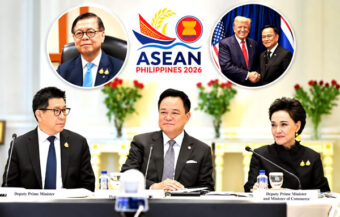
Deputy Prime Minister and Minister of Commerce Suphajee Suthumpun defended Bangkok’s negotiating strategy on Thursday, November 26. She stressed that Washington’s proposed 18% tariff represents a ceiling rather than a definitive rate.
Furthermore, she credited Thailand’s advanced bilateral negotiations with securing favourable treatment. Her ministry will pursue further concessions before Washington completes its formal review.
In parallel, Thai Chamber of Commerce Chairman Dr Poj Aramwattananont urged the government to accelerate negotiations. The business leader believes Thailand could escape the worst consequences of Washington’s latest measures.
He highlighted extensive proposed product exemptions and Thailand’s competitive position against regional manufacturing rivals. Agricultural and food exporters, by contrast, face considerably greater uncertainty.
Washington targets Thailand’s industrial subsidies, investment incentives and economic ties with China
Beyond the immediate tariff threat, Washington’s investigation delivers a direct challenge to Thailand’s industrial development policies. American investigators have targeted government subsidies, preferential financing, investment incentives and import restrictions.
They have also examined Thailand’s expanding economic relationship with China. Specifically, Washington contends that Thailand provides an alternative manufacturing base for excess Chinese industrial production.
The findings encompass several sectors central to Thailand’s manufacturing economy. These include electronics, automobiles, machinery and electrical equipment. Notably, Washington has scrutinised Thailand’s electric vehicle subsidy programmes and incentives administered through the Board of Investment.
Government production targets and broader industrial development strategies also feature in the American findings.
United States Trade Representative Jamieson Greer formally announced the measures on Wednesday. The proposals target 14 economies following investigations conducted under Section 301 of the US Trade Act of 1974.
That legislation authorises Washington to respond to foreign trading practices deemed unfair. Import tariffs are among the principal measures available under its provisions.
US reserves option of imposing 25% tariffs on Thai exports as Bangkok races to complete its trade deal
Of particular significance is the official Federal Register notice detailing Washington’s proposed treatment of Thailand. American authorities have identified two alternative tariff ceilings. The preferred 18% rate depends on satisfactory negotiations and commitments from Bangkok.
The alternative 25% rate remains available should Washington consider Thailand’s commitments insufficient.
Neither proposed rate has entered into force. Instead, American authorities have established a formal consultation process extending into the first quarter of 2027. Thai officials, exporters and American importers can submit written representations. Interested parties can also challenge the proposed treatment of specific products and request additional exemptions.
For Bangkok, the immediate priority is completing the Agreement on Reciprocal Trade with Washington. The November 17 breakthrough in Manila established substantial agreement between both governments.
However, it did not produce a signed, legally enforceable final treaty. Several important domestic approval procedures remain outstanding.
At present, non-exempt Thai goods entering America face an additional Section 301 tariff of 12.5%. Washington introduced that charge on July 24, 2026. It followed a separate investigation into inadequate protections against forced labour. Similar duties were imposed across dozens of America’s international trading partners.
Proposed 18% US tariff would raise existing additional duties by 44% while a 25% rate doubles the charge
Importantly, the latest proposed tariffs incorporate that existing charge. Washington will not impose another 18% on top of the current 12.5% levy. Rather, the revised rate would replace the existing additional duty. This distinction significantly affects the financial calculations facing Thai exporters and American importers.
An increase to 18% amounts to 5.5 percentage points. In financial terms, the existing additional tariff burden would increase by 44%. Implementation of Washington’s alternative 25% proposal would double the current charge. Businesses shipping substantial volumes of goods would consequently face considerably higher customs expenses.
For example, a non-exempt Thai shipment valued at $100,000 currently attracts an additional duty of $12,500. Under Washington’s preferred proposal, that charge would increase to $18,000. At the alternative rate, the additional duty would reach $25,000. Ordinary American customs duties must be calculated separately.
Accordingly, the proposed Section 301 ceilings do not necessarily represent the maximum customs liability on individual Thai products.
Other applicable trade measures could increase the final charge. Product classifications and specific exemptions will also determine the amount payable. Businesses must distinguish these additional tariffs from ordinary American import duties.
Suphajee credits Manila trade breakthrough with securing Thailand’s competitive position against rivals
Speaking on Thursday morning, Suphajee defended the government’s decision to advance negotiations before Washington released its findings. Her response was reported at 9.45 am Bangkok time.
The commerce minister highlighted the November 17 joint statement issued in Manila. It followed direct discussions between Prime Minister Anutin Charnvirakul and President Donald Trump.
Despite the outstanding agreement, Washington has placed Thailand alongside three Southeast Asian economies with completed trade agreements. Suphajee identified that treatment as an important achievement for Bangkok. She argued that Thailand’s negotiating strategy had protected its competitive position. America remains Thailand’s largest individual export market.
Across Southeast Asia, Washington’s proposals establish significant differences between competing manufacturing economies. Malaysia, Indonesia and Cambodia face the same proposed 18% ceiling as Thailand. Bangladesh has also been included at that level. Singapore faces a proposed rate of 20%.
Vietnam, by comparison, faces a proposed tariff ceiling of 35%. Successful negotiations with Washington could reduce that figure to 20%.
The difference is particularly important for Thai manufacturers competing directly against Vietnamese exporters. Both economies have attracted substantial international manufacturing investment targeting overseas markets.
Bangkok pursues lower US tariffs as Thai business leaders stress the importance of matching regional rivals
Previously, Bangkok had sought a reduction in its existing additional American tariff to 10%. Suphajee confirmed that the government would continue pursuing the lowest possible final rate. The American administration has made no binding commitment to such a reduction. Its definitive decision will follow negotiations and the formal review process.
On the business front, the Thai Chamber of Commerce delivered its first substantive assessment at 10.19 am on Thursday. Dr Poj Aramwattananont also chairs the Board of Trade of Thailand. He expressed confidence that Thailand could maintain its competitive position. Relative tariff treatment remains a central consideration for the country’s business community.
Thai exporters have consistently prioritised tariff parity with their principal international competitors. Equivalent American duties on competing products could help Thailand retain market share.
Consequently, higher customs charges do not automatically translate into weaker export performance. Production costs, exchange rates and international logistics remain important factors.
Proposed exemptions cover over half of Thai exports to America but rice, shrimp and tuna remain concerns
Dr Poj identified three principal reasons for the Chamber’s assessment. First, Thailand remains competitive against major Southeast Asian manufacturing rivals. Second, Washington will incorporate existing Section 301 duties rather than impose overlapping charges. Finally, extensive product exemptions could considerably reduce the overall financial impact.
An initial assessment by Kiatnakin Phatra, cited by the Thai Chamber of Commerce, offered further encouragement. Products proposed for exemption reportedly account for more than half the value of Thailand’s exports to America.
These include technology products serving the rapidly expanding artificial intelligence industry. Computers, hard disk drives and data storage equipment feature prominently.
Separately, Washington has identified exemptions covering oil, natural gas, critical minerals and fertilisers. Certain pharmaceutical products and semiconductor chips are also included. The proposed exemptions extend to certain foods that cannot be grown in America. Their scope will determine the effective tariff burden across individual industries.
Agricultural exporters face a different set of circumstances. Dr Poj wants Bangkok to secure additional concessions covering rice, shrimp and tuna. These industries support substantial employment throughout Thailand’s provinces. Smaller domestic businesses also have less financial flexibility than multinational manufacturing corporations.
Thai business chiefs fear agricultural losses and weaker investment incentives as tariff gap with China narrows
Unlike international manufacturers, many agricultural exporters cannot readily relocate their production operations. Their businesses depend heavily on domestic agricultural supplies and established processing facilities.
Additional customs expenses could therefore prove particularly difficult to absorb. The Chamber has made further agricultural exemptions a priority for the government’s negotiations.
On another front, Dr Poj highlighted a potential threat to Thailand’s attractiveness as an international manufacturing base. The Chamber is concerned about the narrowing tariff differential between Thailand and China.
A smaller difference could weaken incentives for international companies to relocate manufacturing operations. Chinese investment already features prominently in Washington’s investigation.
As part of its preparations, the Ministry of Commerce is coordinating with the Federation of Thai Industries. The ministry confirmed those discussions on Wednesday. Potential government assistance includes financial support and export market diversification.
Additional measures could strengthen domestic manufacturing and support businesses facing increased international competition.
Nearly ฿3 trillion in exports and 1.25 million Thai jobs at stake as US challenges industrial policies
The economic figures explain the urgency of Bangkok’s response. According to Suphajee, Thai exports to the United States reached ฿2.37 trillion in 2025. The government projects that figure could reach ฿3 trillion in 2026. America accounted for approximately one-quarter of Thailand’s total exports in 2025.
More than 1.25 million Thai jobs are linked to exports to the American market. Agricultural shipments alone account for approximately ฿170 billion. That figure excludes rubber and rubber products worth at least another ฿160 billion. Together, these industries represent substantial domestic employment and export revenue.
Yet Washington’s latest investigation extends considerably beyond the immediate cost of Thai goods entering America.
Its 171-page report identifies five broad areas of concern. These encompass industrial development, import restrictions, government subsidies, labour protections and Chinese investment. Each features in Washington’s case for imposing additional tariffs.
American investigators contend that government production and export targets distort international market forces. They argue that such policies encourage manufacturing capacity beyond market requirements.
Preferential financing arrangements and tax concessions also feature in the findings. Washington maintains that these measures contribute to excessive industrial production.
Suphajee defends Thai investment incentives as Washington highlights soaring $71.2 billion trade surplus
With regard to domestic market access, American investigators have scrutinised Thailand’s import licensing requirements. Washington contends that these restrictions protect domestic producers from international competition. Labour protections have also come under scrutiny. Investigators argue that inadequate safeguards contribute to artificially low manufacturing costs.
Thailand’s electric vehicle industry occupies a prominent position in the American findings. Washington has examined government subsidy programmes designed to encourage investment and production.
Incentives administered through the Board of Investment also feature in the investigation. These measures form part of Thailand’s broader industrial development strategy.
In response, Suphajee rejected Washington’s contention that Thailand deliberately promotes excessive industrial production. The commerce minister defended the country’s investment promotion policies. She maintains that Thailand’s incentives comply with World Trade Organisation obligations. Bangkok can formally defend those measures during the forthcoming American consultation process.
Among the most striking figures are Thailand’s rapidly expanding bilateral trade surpluses with America. The November 25 findings recorded a Thai goods trade surplus of $34.5 billion in 2021. By 2025, that figure had reached $71.2 billion. The increase amounted to 106.4% over four years.
US investigators highlight surging Chinese investment and imports as Thai industrial capacity lies idle
Conversely, Thailand recorded overall global trade deficits of approximately $11 billion to $12 billion annually between 2023 and 2025. Washington examined those figures alongside Thailand’s growing reliance on Chinese industrial supplies.
Imports of Chinese intermediate goods increased by 155% between 2017 and 2025. These goods include industrial inputs used in further manufacturing processes.
Over the same period, China’s share of Thailand’s intermediate goods imports increased from 17% to 27%. Cumulative Chinese direct investment in Thailand reached an estimated $22.4 billion to $24 billion. American investigators examined these figures alongside Thailand’s expanding bilateral trade surplus. Their findings directly address the relationship between Chinese investment and Thai export production.
Equally significant are Washington’s findings concerning unused manufacturing capacity within Thailand. According to American investigators, industrial capacity utilisation has remained below 60% since 2023. The automotive industry recorded considerably lower levels. Manufacturing capacity utilisation in that sector fell below 40%.
Thai technology exports could escape new tariffs as Washington targets China’s global industrial expansion
In the technology sector, American authorities highlighted Thailand’s prominent position within international supply chains. The country accounts for approximately 17% of global hard disk drive production.
These products serve international data storage operations and expanding artificial intelligence infrastructure. Proposed technology exemptions could substantially limit the immediate tariff impact on this sector.
Washington’s wider investigation identifies China as the principal source of global industrial overcapacity. American authorities accuse Beijing of promoting production far beyond international market demand.
They contend that Chinese manufacturers subsequently export excessive volumes of industrial goods. The Trump administration argues that these practices undermine American manufacturers.
The industries identified include steel, aluminium, electric vehicles, electrical appliances and solar energy products. American investigators have examined the international movement of Chinese investment alongside exports from these sectors.
Their findings also cover manufacturing operations established across Southeast Asia. Washington is concerned about potential circumvention of tariffs imposed directly on Chinese goods.
Beijing rejects US overcapacity claims as Washington scrutinises Chinese factories across Southeast Asia
In Beijing, Chinese Foreign Ministry spokesperson Guo Jiakun rejected Washington’s position on Wednesday. He dismissed the American contention that China generates excessive industrial capacity.
The Chinese government maintains that its export performance reflects genuine competitive advantages. These include manufacturing efficiency, advanced technology and industrial development.
“The so-called ‘overcapacity’ is a false issue, and China opposes using it as an excuse for political manipulation,” Guo said. He called for stable relations between the world’s two largest economies. Chinese officials stopped short of threatening immediate retaliation. The existing bilateral trade truce remains in place.
Elsewhere in Southeast Asia, American investigators have examined Chinese investment in Vietnam, Indonesia and Cambodia. Washington is assessing whether manufacturing operations provide alternative routes into the American market.
Its investigation encompasses investment flows, industrial inputs and the destination of finished goods. Thailand faces similar scrutiny under the latest American findings.
The origins of Wednesday’s announcement stretch back to a major legal defeat for President Trump’s administration. In February, the US Supreme Court overturned earlier global import tariffs. Subsequently, Washington turned to alternative legal mechanisms for imposing duties on international trading partners. Section 301 investigations became an important part of that process.
Eight-month American trade investigation culminates in proposed tariffs targeting 14 major trading partners
On March 11, the United States Trade Representative launched its investigation into structural industrial overcapacity. The original investigation covered 16 economies and major trading partners. These included China, the European Union, India, Japan, South Korea, Mexico, Vietnam, Taiwan and Thailand. Malaysia, Indonesia, Switzerland, Norway, Singapore, Bangladesh and Cambodia were also investigated.
Ultimately, Wednesday’s proposed tariff measures covered 14 economies. Mexico and Norway were not included in the latest announcement. Washington described its investigation as addressing “structural excess industrial capacity”. The findings provided the legal basis for the proposed additional import duties.
Alongside that investigation, American officials launched a separate examination of forced labour protections. It covered 59 countries and the European Union. Washington subsequently imposed additional tariffs of either 10% or 12.5% across those 60 economies. Those measures entered into force in July.
Between May 5 and May 8, American authorities conducted public hearings concerning industrial overcapacity. American and Thai officials subsequently held bilateral consultations on May 14. Those discussions failed to resolve Washington’s concerns. The November 25 announcement followed more than eight months of investigation and consultation.
Washington sets January deadlines for tariff submissions and hearings as China trade truce nears expiry
Under the latest American timetable, interested parties have until January 5, 2027, to submit written representations. The same deadline applies to applications to participate in forthcoming public hearings. Thai authorities and businesses can formally challenge Washington’s findings. American importers can also submit representations concerning the impact of proposed duties.
Public hearings are scheduled to begin at 10 am in Washington on January 25. Interested parties can seek modifications to the proposed measures and additional product exemptions. The expected statutory deadline for concluding the Section 301 process is March 11, 2027. American authorities have not announced a definitive commencement date.
In practical terms, the existing additional tariff remains applicable to affected Thai goods. American officials have indicated that implementation could begin as early as January, following the required consultation procedures. Until then, Wednesday’s announcement does not immediately change customs charges. The proposed rates remain subject to Washington’s formal decision.
Another major international trade deadline falls on January 10, 2027. The existing trade truce between Washington and Beijing is scheduled to expire on that date. Under the arrangement, additional tariffs imposed during Trump’s second term are limited to 20%. Earlier American duties on Chinese goods remain separate.
US seeks stable relations with China while pledging to honour tariff ceilings in existing trade agreements
Those first-term tariffs amount to approximately 25%. Washington’s latest proposals therefore do not eliminate the substantial existing tariff burden on Chinese imports. American authorities have also identified approximately $30 billion worth of Chinese goods under consideration for tariff reductions. Those products would be excluded from the proposed new measures.
Nevertheless, American officials have emphasised their desire to maintain stable relations with Beijing. They highlighted the recent meeting between President Donald Trump and Chinese President Xi Jinping. A senior American official addressed the administration’s position on Wednesday. The official acknowledged Chinese opposition to the latest trade measures.
“We know that they don’t like these actions, but we are seeking stability with the Chinese. China is seeking stability with us,” the official said. The American official also described the recent presidential meeting as “really great”.
Regarding other trading partners, Washington has indicated that proposed duties will respect tariff limits established under existing agreements. The European Union, Japan, South Korea and Taiwan have agreed tariff caps of 15%. Malaysia previously secured a ceiling of 19%. Thailand’s final bilateral agreement has yet to reach that stage.
Global stock markets fall as Trump presses ahead with tariffs despite mounting domestic political opposition
On international financial markets, the prospect of fresh American trade restrictions weighed on share prices on Wednesday. The MSCI global stock market index declined by 0.5%.
The announcement came as a technology-led market rally continued losing momentum. International investors were confronted with another expansion of Washington’s tariff programme.
“It is another reminder that while the legal justification for tariffs keeps changing, US protectionism is becoming increasingly difficult to unwind,” ING analysts wrote.
Domestically, President Trump faces substantial American opposition to his administration’s tariff policies. Higher consumer prices have contributed to criticism of the import duties. A recent American opinion poll found that 62% of respondents supported efforts to repeal the tariffs. The poll followed Republican Party setbacks in November’s midterm elections.
Despite those setbacks, the Trump administration is pressing ahead with revised trade measures. Wednesday’s announcement represents another step towards restoring tariffs overturned by the Supreme Court.
The latest proposals rely on findings from specific investigations into international trading practices. Washington has also incorporated concessions negotiated under existing bilateral trade agreements.
Bangkok faces legal and parliamentary hurdles to finalise US trade deal as agricultural concerns persist
Back in Bangkok, completing the Agreement on Reciprocal Trade remains a major government priority. The November 17 White House statement confirmed substantial completion of negotiations between Washington and Bangkok.
Formal signature, legal review and Cabinet consideration remain outstanding. Public consultation and parliamentary approval must also be addressed.
Before ratification, legislative amendments may be required to implement commitments contained in the final agreement. American demands for greater access to Thailand’s domestic agricultural market remain politically sensitive.
These negotiations concern industries supporting substantial domestic employment and agricultural production. Bangkok must address those demands while pursuing protection for its agricultural exports.
For its part, the American Embassy in Bangkok has clarified that the proposed percentages represent upper limits. Definitive rates will emerge following Washington’s formal review.
Section 301 also permits subsequent revisions as economic circumstances and trading practices change. The proposed arrangements therefore allow American authorities to reconsider tariff treatment after implementation.
Thailand faces negotiations over tariffs, agricultural exemptions and Chinese industrial investment
At the same time, American officials have reiterated concerns about Thailand’s position within Chinese industrial supply chains. Those concerns extend to manufacturing investment, industrial inputs and the destination of finished goods.
Washington’s findings place Thailand’s investment promotion policies directly within the bilateral trade dispute. Suphajee maintains that those policies comply with international trade obligations.
Thailand’s government and business community enter the next stage with distinct negotiating priorities. Suphajee is pursuing the lowest possible tariff while advancing the reciprocal trade agreement.
Government stoutly defends US-Thai trade pact or understanding signed last week as critical economically
The art is the deal agreed in writing in Manila which makes major concessions to the US on trade access
Dr Poj wants additional exemptions protecting agricultural exporters and domestic businesses. The Federation of Thai Industries is coordinating preparations with the Ministry of Commerce.
The immediate diplomatic deadline is January 5, when Washington closes its initial written submission process. Public hearings follow on January 25.
Bangkok must present its case before the expected March 11 conclusion of the American investigation process. The negotiations will determine the additional duties facing non-exempt Thai goods in America’s largest import market.
Join the Thai News forum, follow Thai Examiner on Facebook here
Follow Thai Examiner on Google here
Receive all our stories as they come out on Telegram here
Follow Thai Examiner here
Further reading:
Good news in Manila as Anutin and ministers report 2.9% growth and a trade deal terms with Trump
Three Chinese nationals rescued by police in Tak province near Burma. Police top brass want answers
Tourism chiefs furious as another Chinese abduction and a spat with the Embassy threaten bookings