Northern Thailand’s worsening river poisoning crisis has moved from scientific reports to street protests, with campaigners accusing Chinese-backed mining across the Myanmar border of contaminating key waterways and demanding urgent international action.
Two protesters were injured outside China’s Chiang Mai consulate on Monday as anger over alleged toxic pollution from Chinese-backed gold and rare earth mining in Myanmar spilt onto Thai streets, highlighting a widening cross-border crisis that now threatens northern Thailand’s rivers, drinking water and public health. With growing evidence linking contamination in the Kok, Sai, Ruak and Mekong rivers to mining inside Wa-controlled territory, Beijing rejecting responsibility and Bangkok struggling to influence events beyond its borders, the dispute has rapidly evolved into one of Thailand’s most serious environmental and diplomatic challenges.
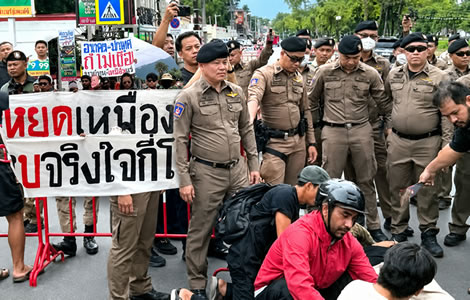
Two protesters were injured after clashing with police outside the Chinese Consulate General in Chiang Mai on Monday as demonstrators demanded action over alleged toxic contamination flowing into northern Thailand from mining operations across the border in Myanmar.
The confrontation unfolded during a protest organised by the People’s Network to Protect the Kok, Sai, Ruak and Mekong Rivers. About 50 campaigners gathered outside the diplomatic mission to deliver a petition urging China to investigate mining activities they believe are contaminating rivers flowing into Thailand.
Police maintained a security cordon outside the consulate throughout the demonstration. However, tensions rose as protesters pressed towards the entrance carrying banners and placards.
Police restore order after two protesters are injured outside China’s Chiang Mai consulate general
A brief struggle then broke out between demonstrators and officers. Two protesters were injured during the confrontation. Nevertheless, police quickly restored order and prevented further disorder. The demonstration continued after the incident and ended without additional violence.
Because the Consulate General of the People’s Republic of China in Chiang Mai was closed, protest leaders could not present their petition directly. Instead, they handed the document to officials of the Chiang Mai provincial administration, along with a representative of the Chinese consulate.
In response, demonstrators observed a minute of silence to honour people they say have suffered from toxic contamination. They also recognised those injured during the confrontation before dispersing peacefully.
Throughout the protest, campaigners displayed banners reading “Stop toxic mine” and “When will China be truthful?” Speakers accused upstream mining operations involving Chinese investors of contaminating the Kok, Sai, Ruak and Mekong rivers.
The network renewed its call for an investigation by the Chinese government and other relevant authorities. Members said pollution has damaged ecosystems, threatened livelihoods and created mounting public health concerns across northern Thailand.
Growing evidence links Myanmar mining to toxic contamination flowing into northern Thailand’s rivers
The demonstration reflects growing alarm over intensive gold and rare earth mining in Myanmar’s eastern Shan State.
Increasing evidence from Thai researchers, environmental organisations and international media points to heavy metal contamination moving downstream into Thailand. As a result, what began as an environmental dispute has become a public health concern and an increasingly sensitive diplomatic issue. It has also become another consequence of Myanmar’s prolonged civil conflict.
Much of the concern focuses on territory controlled by the United Wa State Army, one of Myanmar’s largest and best-equipped ethnic armed organisations. The Wa have maintained an autonomous administration for decades.
They exercise effective control over extensive territory bordering China. Notably, security analysts have long described the organisation as maintaining close political, military and commercial links with Beijing. China, however, has consistently denied directing or controlling the United Wa State Army.
Wa-controlled borderlands emerge at the centre of scrutiny over mining, Beijing links and river pollution
Rare earth mining has expanded rapidly because global demand continues to accelerate. Heavy rare earth elements such as dysprosium and terbium are critical for electric vehicles, wind turbines and advanced electronics.
At the same time, China dominates global rare earth processing and Myanmar has become one of its principal suppliers. Satellite imagery has revealed extensive leaching ponds and large hillside excavations close to Thailand’s border. Extracted ores are then transported north into China for processing.
The mining boom has also reshaped the economy of Myanmar’s borderlands. Historically, the Wa region was associated with narcotics production and cross-border smuggling. Now, analysts say gold and rare earth mining provide another increasingly valuable source of revenue.
In parallel, conflict elsewhere in Myanmar has disrupted traditional trade routes and commercial activity. Mineral extraction has therefore become even more financially significant for armed groups operating beyond the control of Myanmar’s central government.
Gold and rare earth mining becomes a key revenue source as contamination spreads into Thai waterways
For Thailand, the consequences are now being measured downstream. Scientific testing has detected elevated arsenic concentrations together with heavy rare-earth elements in rivers entering Chiang Rai and Chiang Mai provinces.
Those waterways include the Kok, Sai and Ruak before eventually flowing into the Mekong. Consequently, communities have raised concerns over drinking water, irrigation systems, fisheries and agricultural production. Researchers have also warned that prolonged exposure to heavy metals may present long-term health risks, particularly for children and pregnant women.
Thailand has responded cautiously despite growing public concern. Bangkok has concentrated on monitoring water quality, issuing health advisories and maintaining dialogue with Myanmar.
Meanwhile, Myanmar’s fragmented political landscape has complicated efforts to resolve the issue. Large sections of the mining region remain beyond the effective control of Myanmar’s military authorities.
As a consequence, pollution sources remain difficult to regulate or inspect. Critics argue that engagement with Myanmar alone is unlikely to resolve contamination originating inside territories controlled by powerful ethnic armed groups.
Thailand monitors poisoned rivers as diplomacy struggles to reach mining areas beyond junta control
China continues to reject suggestions that it bears responsibility for cross-border pollution. Beijing says it supports stability in Myanmar and denies directing the commercial activities of armed organisations operating there.
Separately, Chinese officials reject allegations that the government controls overseas mining ventures through proxy organisations. Instead, they maintain that Chinese companies operating abroad must comply with local laws and regulations.
Chiang Mai MP raises alarm about government stasis in the face of a chronic arsenic river poisoning crisis
River Kok in Chiang Rai poisoned with arsenic from Wa state-controlled gold mining across the border
Even so, concern continues to intensify across northern Thailand. Residents living along the Kok, Sai, Ruak and Mekong rivers increasingly fear contamination affecting water supplies, farmland and fisheries. Monday’s protest involved only about 50 demonstrators.
Even so, it underscored mounting frustration over a cross-border environmental crisis that remains largely beyond Thailand’s direct control. With mining continuing upstream in territory dominated by powerful armed groups, pressure is growing for stronger international engagement to address pollution flowing into Thailand’s northern river systems.
Join the Thai News forum, follow Thai Examiner on Facebook here
Receive all our stories as they come out on Telegram here
Follow Thai Examiner here
Further reading:
River Kok in Chiang Rai poisoned with arsenic from Wa state-controlled gold mining across the border
Rangsiman Rome MP calls for stiffer response to Myanmar’s junta over the jailing of Thai sailors
Myanmar Junta meltdown threatens to end Bangkok’s condominium sales boom as Kyat currency fails
Tyrant of Nay Pyi Taw’s days are numbered as Karen soldiers burn the hated Myanmar flag in Myawaddy
Outgoing Foreign Minister defends his two days of regional dialogue with Myanmar held in Pattaya
Hated Burmese junta regime seeks peace talks as its grip on power across the country unravels