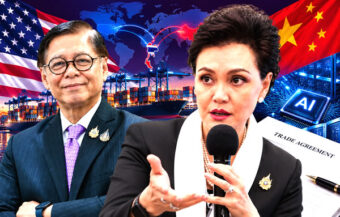
US-China AI battle puts Thailand on the spot as Deputy PM Yotsanan insists Bangkok must stay neutral. He calls for stronger data, hardware, cybersecurity and science to resist outside pressure, while Foreign Ministry talks will shape its AI position.
Thailand is preparing for a high-stakes battle over AI as Washington and Beijing intensify their global technology rivalry. Deputy Prime Minister Yotsanan Wongsawat insists Thailand must remain neutral if the US pressures allies to choose sides. However, he warns that neutrality requires stronger domestic technology, data, hardware and cybersecurity. Bangkok is already building ties with France, Japan and South Korea while seeking investment and technology transfers. Meanwhile, Mr Yotsanan will hold talks with Foreign Minister Sihasak Phuangketkaew to determine Thailand’s position as geopolitical pressure mounts.
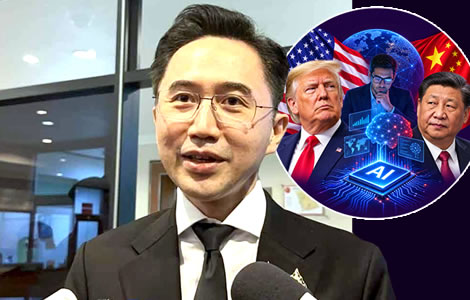
Thailand must remain neutral as the United States and China intensify their competition over artificial intelligence, Yotsanan Wongsawat said Monday. The Deputy Prime Minister said Thailand must first build stronger technological foundations. Otherwise, pressure from either side could leave the country with fewer choices.
Mr Yotsanan said Thailand must prepare if Washington presses allies to choose sides over AI technology. In response, he will discuss the country’s position with Deputy Prime Minister and Foreign Minister Sihasak Phuangketkaew. Those talks will examine Thailand’s approach as competition between Washington and Beijing deepens.
Mr Yotsanan spoke at Government House at 9.30 am on August 17. He is also Minister of Higher Education, Science, Research and Innovation. His comments followed reports about US preparations to confront allies with choices over competing AI technologies.
Semiconductors and global AI forums force Thailand to weigh neutrality as US-China rivalry deepens
Notably, Mr Yotsanan said the contest extends far beyond individual AI systems. Semiconductors are among the critical industries involved. Numerous groups are already discussing developments across the technology sector. Thailand must therefore consider those wider relationships before settling its position.
Separately, Mr Yotsanan referred to China’s World Internet Conference as an event Thailand may need to attend. Participation in such international forums requires careful consideration, he said. For Thailand, however, he argued that neutrality would deliver the greatest advantage.
As part of this, Mr Yotsanan wants Foreign Minister Sihasak involved before Thailand determines its wider approach. The government needs to examine different perspectives, he said. That assessment would cover Thailand’s participation in international technology initiatives and its broader diplomatic position.
Asked whether Thailand would eventually have to choose sides, Mr Yotsanan shifted attention towards domestic capabilities. He said Thailand was already working to strengthen essential scientific and technological foundations. Without them, the country could remain under continuing outside pressure.
Thailand builds technology ties with France, Japan and South Korea to strengthen its foundations
In parallel, Thailand has discussed technological development with France, Japan and South Korea. Mr Yotsanan said those discussions focused on strengthening fundamental capabilities. Building those resources would give Thailand more options when international pressure emerged.
The work has accelerated during the past two or three months. Mr Yotsanan acknowledged that some initiatives had been rejected. Even so, he said Thailand was managing and had made considerable progress.
Meanwhile, officials are closely monitoring developments surrounding technology and AI. Domestic and international teams have also been prepared to work collaboratively. Mr Yotsanan said strengthening Thailand’s foundations should remain the priority.
From there, Thailand could decide what it could compromise on and what remained non-negotiable. He rejected framing those choices around particular foreign powers. Instead, officials should establish Thailand’s own capabilities and identify areas of technological strength.
Once identified, those strengths could support new plans and existing strategies. Mr Yotsanan said the government must quickly reinforce this work. Stronger domestic capabilities would then shape decisions about cooperation with individual countries.
Science, data and cybersecurity investment seen as crucial to maintaining Thailand’s AI neutrality
On another front, Mr Yotsanan was asked how Thailand could remain neutral under pressure from major powers. He again identified scientific and technological knowledge as critical. Serious investment in those areas was essential, he said.
Crucially, infrastructure development cannot focus solely on artificial intelligence. Mr Yotsanan described AI as the upper layer of a much larger technological structure. Underneath sit data, hardware, security and other infrastructure needed to operate AI systems.
Accordingly, Thailand’s AI position is closely tied to its control over those underlying resources. Data collection is one critical component. Cybersecurity is another. Hardware also determines how much technological independence the country can maintain.
At the same time, Mr Yotsanan said the government could not build those capabilities alone. Private companies must participate. Government agencies would concentrate on risks, while businesses could pursue areas offering commercial benefits.
Consequently, data collection, cybersecurity and AI development form parts of the same technological structure. Mr Yotsanan said work had continued across these areas for three months. The programme is designed to establish stronger foundations before wider strategic choices arise.
Domestic databases, hardware and security would give Thailand greater freedom in choosing AI partners
Turning to international cooperation, Mr Yotsanan said the issue was not simply whether Thailand needed foreign partners. The more important questions concerned hardware, security and data. Those fundamentals would determine which AI systems required outside cooperation.
In particular, Mr Yotsanan stressed the importance of Thailand developing its own databases. Domestic data resources could provide greater independence. They could also help determine which AI technologies needed international collaboration.
With that foundation, Thailand could decide which systems should work with particular foreign partners. Different technologies could require different relationships. Mr Yotsanan said stronger foundations would make those decisions easier.
By contrast, weak foundations would leave Thailand facing difficult choices under external pressure. Mr Yotsanan said that could create uncertainty and fear. For that reason, he again called for serious investment in science and technology.
Beyond government investment, he said public and private sectors needed to combine their resources and connections. Existing economic mechanisms could help coordinate that work. Mr Yotsanan specifically cited the Joint Public-Private Sector Committee for Economic Problem Solving.
Government and business cooperation anchors four-pillar plan to attract investment and technology
Through that mechanism, government and businesses could work jointly on technological development. AI should also be viewed within the broader technology sector, Mr Yotsanan said. He described artificial intelligence as a subset of that wider field.
More broadly, the government wants technology considered as an opportunity for Thailand. Mr Yotsanan said all sides must recognise what needs to be pursued. He also called for serious attention to building the country’s technological capabilities.
Investor confidence formed another part of his argument. Asked how investors could be reassured, Mr Yotsanan outlined four pillars within the government’s economic programme. Together, they link investment, trade, technology and business facilitation.
First, Deputy Prime Minister and Finance Minister Ekniti Nitithanprapas oversees investment. His portfolio covers the first pillar identified by Mr Yotsanan. Investment is closely connected with Thailand’s effort to attract advanced technology.
Second, Deputy Prime Minister and Commerce Minister Suphajee Suthumpun oversees sales and trade. That portfolio forms another part of the government’s economic structure. Trade policy therefore sits alongside investment as Thailand seeks stronger technology links.
Yotsanan links people and technology to investment as Thailand targets transfers and investor confidence
Third, Mr Yotsanan oversees people and technology. He said that the portfolio connects directly with both investment and trade. The government is preparing measures to strengthen investor confidence and encourage further investment.
Importantly, Mr Yotsanan said Thailand could attract technology while also securing technology transfers. He said the country could achieve this without suffering disadvantages against competitors. Regulation would also play an important role.
Within that framework, he identified the Industrial Estate Authority of Thailand as a potential driving force. The agency could support the government’s regulatory approach to industrial development. Technology attraction would therefore be linked with investment rules and industrial policy.
Industrial estate authority seen driving regulation as Thailand seeks technology transfers and investment
Finally, Deputy Prime Minister for Legal Affairs Pakorn Nilpraphan oversees business development and facilitation. His responsibilities form the fourth pillar outlined by Mr Yotsanan. The structure brings investment, trade, technology and business development under coordinated government portfolios.
Taken together, Mr Yotsanan’s comments place technological foundations at the centre of Thailand’s response to the US-China AI contest. However, the country’s formal position has not yet been settled. Discussions with the Foreign Ministry will help determine that stance.
For now, work on domestic technological capacity is already underway. It covers scientific knowledge, data, hardware, cybersecurity and supporting infrastructure. Private businesses are also expected to participate alongside government agencies.
Internationally, Thailand has already discussed strengthening its foundations with France, Japan and South Korea. Furthermore, domestic and overseas teams have been assembled during the recent push. Mr Yotsanan said considerable progress had followed despite some setbacks.
Against that background, the government faces the possibility of greater pressure from Washington over competing AI systems. Mr Yotsanan said Thailand should seek neutrality. Yet he tied that position directly to the country’s ability to strengthen its own resources.
Thailand builds domestic technology foundations as pressure grows to choose between US and China
In practical terms, those resources would determine Thailand’s options when selecting technology partners. Strong databases could increase independence. Better cybersecurity would strengthen infrastructure, while domestic scientific knowledge would support broader technological development.
Similarly, stronger hardware capabilities would influence which AI systems Thailand could adopt or develop. The country could then assess partnerships individually. Mr Yotsanan said decisions should follow Thailand’s technological strengths rather than pressure from particular countries.
Thailand ramps up space ambitions with a bold new partnership with China to be signed during PM’s visit
Dr. Cheng goes to Brussels to get Thailand’s access to Horizon Europe, an advanced technology programme
The immediate diplomatic work now falls partly to discussions with Foreign Minister Sihasak. Those talks will examine Thailand’s response if the geopolitical technology contest becomes more demanding. Mr Yotsanan has already set out the position he favours.
Thailand should remain neutral between the United States and China over artificial intelligence, he said. At the same time, the country must rapidly strengthen its technological base. Only stronger foundations would expand Thailand’s choices over future cooperation.
Join the Thai News forum, follow Thai Examiner on Facebook here
Receive all our stories as they come out on Telegram here
Follow Thai Examiner here
Further reading:
Ex Energy Minister supports oil and arms supplies blockade against Cambodia in the Gulf of Thailand
War to continue says PM Anutin. Dismisses President Trump’s ceasefire talk as a ‘misunderstanding’
Confusion after Trump’s 20 minute phone call with PM Anutin. US side claimed a ceasefire was agreed