Thailand brushed off China’s arms support for Cambodia as Defence Minister Lt Gen Adul insisted Bangkok would strengthen its own defences before PM Anutin’s crucial Beijing visit. Border tensions, Chinese tanks and regional security will dominate July talks.
Thailand has shrugged off China’s expanding military support for Cambodia, insisting it will bolster its own defences while confronting the kingdom’s most sensitive regional security challenge in years through diplomacy. Defence Minister Lieutenant General Adul Bunthamcharoen’s remarks came as Prime Minister Anutin Charnvirakul prepares to lead Thailand’s military chiefs to Beijing next month for crucial talks against a backdrop of Chinese arms deliveries to Cambodia, an unresolved border stand-off and intensifying scrutiny of one of Southeast Asia’s most important strategic relationships.
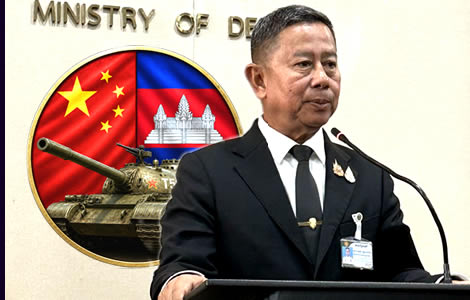
Thailand will not be distracted by China’s military support for Cambodia, Defence Minister Lieutenant General Adul Bunthamcharoen declared on Friday.
Instead, Bangkok will strengthen its own security while pursuing an active diplomatic strategy ahead of Prime Minister Anutin Charnvirakul’s visit to Beijing next month. The trip comes as China’s expanding military relationship with Cambodia draws increasing attention across the region.
Lieutenant General Adul was responding to questions about Prime Minister Hun Sen and General Tea Banh’s visit to China between June 25 and June 27. The delegation was widely expected to discuss military equipment and defence cooperation with Beijing.
Defence minister dismisses talk of Cambodia-China military ties as Thailand focuses on its own security
However, the defence minister brushed aside the speculation. “That’s his business,” he said. He added that every sovereign nation has the right to determine its own security policy. Instead, he argued, Thailand should focus on protecting its own interests. The credibility of each country, he said, remains the more important issue.
In parallel, Thailand is strengthening its own security posture. Lieutenant General Adul said neighbouring countries are also reinforcing security in their respective areas. Thailand is therefore preparing its forces and reviewing strategic measures.
Military readiness, however, is only one part of the government’s response. Diplomatic engagement must continue alongside defence preparations. Accordingly, he expressed confidence in the Ministry of Foreign Affairs and the government’s proactive diplomatic policy. He also backed Prime Minister Anutin, the security leadership and Thailand’s foreign affairs team to safeguard national interests in every dimension.
Anutin to lead military chiefs to Beijing for security talks and broader strategic cooperation in July
As part of this strategy, Prime Minister Anutin will make an official visit to the People’s Republic of China from July 16 to July 20. Lieutenant General Adul and the commanders of Thailand’s armed forces will accompany him.
The programme includes meetings at both government and military levels. Those discussions will centre on defence cooperation and wider bilateral relations. The visit is expected to reinforce one of Thailand’s most important strategic partnerships.
Notably, the diplomatic mission comes during one of the most sensitive periods in Thailand-China relations in recent years. Bangkok is seeking to preserve close ties with Beijing while responding to growing concern over China’s military support for Cambodia.
Recent Chinese arms deliveries have intensified scrutiny inside Thailand. Officials have confirmed they were aware of the transfers before they became public. The shipments included armoured vehicles, artillery ammunition and other military equipment.
Thailand says Chinese arms deliveries were agreed before ties with Cambodia sharply deteriorated recently
In response, Thai ministers have repeatedly sought to calm domestic concern. They have stressed that the agreements were concluded before relations between Thailand and Cambodia deteriorated. Officials also insist the deliveries do not represent a sudden change in China’s regional policy. Nevertheless, the optics remain politically awkward as tensions persist along the Thai-Cambodian frontier.
Over the past decade, China has become Cambodia’s largest military partner. Beijing has financed defence infrastructure and supplied increasingly advanced military equipment. It has also played a major role in modernising the Cambodian armed forces.
Consequently, the latest deliveries have attracted close attention in Bangkok. They come after last year’s border conflict and during an ongoing military stand-off along sections of the frontier.
Separately, Beijing continues presenting itself as a neutral regional power. That position has become increasingly important as regional tensions persist. During Foreign Minister Wang Yi’s visit to Bangkok in April, China expressed hope that relations between Thailand and Cambodia would improve. Beijing also reaffirmed its commitment to expanding defence cooperation with Thailand. Joint efforts against cybercrime were also highlighted during the discussions.
China balances close military ties with Cambodia while reassuring Thailand on broader regional cooperation
On another front, Thailand’s relationship with China extends far beyond security matters. China remains Thailand’s largest trading partner and one of its biggest sources of foreign investment. It is also one of the kingdom’s largest tourism markets.
Moreover, Beijing remains a leading supplier of military hardware to Thailand. Joint military exercises have steadily expanded in recent years. Cooperation has also deepened in railway development, electric vehicles, technology and cross-border crime.
Even so, recent events have exposed the complexity of Beijing’s regional interests. Thai policymakers increasingly recognise China’s strategic position inside Cambodia. Beijing enjoys substantial political influence there and continues investing in major infrastructure projects. Those investments include the strategically important Ream Naval Base. As a result, China’s relationship with Cambodia has become an increasingly important security consideration for Bangkok.
Against that backdrop, Prime Minister Anutin’s July visit carries considerable diplomatic weight. Thai officials are expected to seek reassurance that China’s military support for Cambodia will not undermine the regional balance.
Thailand seeks reassurances from Beijing as border tensions with Cambodia continue to dominate the agenda
Border stability is also expected to feature prominently during the talks. Discussions are likely to include defence cooperation and mechanisms to prevent future misunderstandings.
Meanwhile, Thailand appears determined to maintain its long-standing policy of strategic balance. Bangkok continues defence cooperation with China while maintaining close military ties with the United States.
Thai PM assures the public that the Kingdom is ready to defend itself as Cambodia acquires Chinese tanks
Advanced anti tank rockets being used against Thai military forces in the raging border with Cambodia
It also remains committed to ASEAN unity and regional stability. Officials are equally determined to prevent tensions with Cambodia from widening into a broader geopolitical confrontation.
Ultimately, the July meetings will be closely watched across Southeast Asia. Beijing is seeking to preserve Thailand’s confidence while maintaining its close partnership with Cambodia. Bangkok, meanwhile, wants stronger cooperation without compromising its own security interests. The outcome will help shape one of the region’s most important strategic relationships during an increasingly uncertain period.
Join the Thai News forum, follow Thai Examiner on Facebook here
Receive all our stories as they come out on Telegram here
Follow Thai Examiner here
Further reading:
Ex Energy Minister supports oil and arms supplies blockade against Cambodia in the Gulf of Thailand
War to continue says PM Anutin. Dismisses President Trump’s ceasefire talk as a ‘misunderstanding’
Confusion after Trump’s 20 minute phone call with PM Anutin. US side claimed a ceasefire was agreed