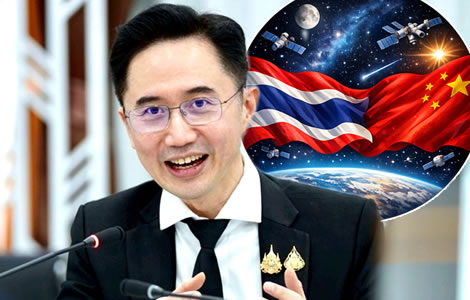
Deputy PM Yotsanan will sign five landmark China technology deals during Prime Minister Anutin’s Beijing visit, launching cooperation on AI, deep space, nuclear fusion and satellites in Thailand’s biggest scientific partnership with China to date.
Deputy Prime Minister Yotsanan Wongsawat is set to sign five landmark technology agreements with China during Prime Minister Anutin Charnvirakul’s official visit to Beijing, launching Thailand into closer cooperation on deep space exploration, nuclear fusion, Artificial Intelligence, satellite navigation and advanced scientific research in one of the Kingdom’s most ambitious technology partnerships to date.
Thailand is preparing to launch its closest high-technology partnership yet with China as Prime Minister Anutin Charnvirakul begins an official visit on Thursday.
The five-day trip is expected to produce five agreements covering higher education, science, research and innovation. Together, they target strategic technologies expected to shape future industrial and economic development.
On Tuesday, the Cabinet approved the agreements before Deputy Prime Minister and Minister of Higher Education, Science, Research and Innovation Yotsanan Wongsawat outlined their scope. He will formally sign the documents at the Great Hall of the People in Beijing.
Five agreements to deepen cooperation in space, nuclear fusion and strategic technology development
The ceremony will take place during Mr Anutin’s visit from July 16 to July 20. The agreements have been negotiated between Thailand’s Ministry of Higher Education, Science, Research and Innovation and agencies of the People’s Republic of China.
The package concentrates on deep technology and scientific fields regarded as global megatrends. Three flagship projects form its core. First, Thailand and China will establish a joint laboratory for deep space exploration.
The facility is intended to strengthen advanced space research. Next, both countries will prepare for the development and transfer of nuclear fusion technology. The project targets one of the world’s most closely watched energy fields.
Finally, the agreements expand cooperation on China’s BeiDou satellite navigation system. Researchers will work together on developing technologies linked to the satellite network.
Partnership expands into AI, biotechnology, smart agriculture and university research collaboration
Beyond those projects, the partnership extends across several future industries. Artificial Intelligence ranks among the leading priorities.
Smart agriculture also forms part of the programme. In parallel, cooperation will include future food, biotechnology, advanced materials science, energy research and climate change adaptation. Researchers from both countries will exchange expertise. They will also share access to advanced scientific infrastructure and cutting-edge research facilities.
The agreements reach well beyond laboratories. Student exchanges between Thai and Chinese universities will increase. Likewise, academic exchanges will expand under the new framework. Scholarship programmes are also included.
As part of this, both governments will promote Thai and Chinese language teaching. Universities will also strengthen institutional links through broader research networks.
Mr Yotsanan said the collaboration aims to produce high-quality human resources ready for modern industries. He said stronger scientific capability would support future research and innovation. In turn, that research should generate broader economic and social benefits. He added that the partnership would strengthen Thailand’s long-term competitiveness while reinforcing relations between Bangkok and Beijing.
China visit highlights expanding strategic ties through science, innovation, AI and diplomatic cooperation
The agreements will be among the principal outcomes of Mr Anutin’s first official visit to China since becoming Prime Minister. The trip follows an invitation from Chinese Premier Li Qiang. Earlier this week, the Chinese Embassy confirmed the programme through a Facebook statement.
Separately, China’s Ministry of Foreign Affairs announced the visit through its official spokesperson. Beijing said the programme reflects the importance both governments attach to bilateral relations.
Mr Anutin will also attend the 2026 World Artificial Intelligence Conference. In addition, he will participate in the High-Level Meeting on Global AI Governance.
The conference will bring together political leaders, scientists, technology specialists and policymakers. Discussions are expected to focus on Artificial Intelligence and international governance.
Chinese leaders to meet Anutin as Thailand broadens technology, trade and diplomatic cooperation
Notably, the Prime Minister will also meet China’s senior leadership. President Xi Jinping is scheduled to hold talks with Mr Anutin during the visit. Chinese Premier Li Qiang will also meet the Thai leader.
On another front, Zhao Leji, Chairman of the Standing Committee of the National People’s Congress, will hold separate discussions. Those meetings highlight the strategic importance both governments attach to expanding cooperation.
Defence Minister not concerned with military support for Cambodia from China. Says Thailand is confident
Thailand and China agreed to deepen cultural and heritage ties to assist stronger trade and diplomacy
The agreements establish a broad framework for long-term collaboration. They cover advanced research, technology development and scientific exchanges. They also support researcher mobility and shared scientific infrastructure.
In response to rapid technological change, the package focuses on sectors expected to drive future growth. These include Artificial Intelligence, deep space exploration, nuclear fusion, satellite navigation, biotechnology and advanced materials science.
The formal signing in Beijing is expected to become one of the defining outcomes of the Prime Minister’s official visit and a significant milestone in Thailand-China scientific cooperation.
Join the Thai News forum, follow Thai Examiner on Facebook here
Receive all our stories as they come out on Telegram here
Follow Thai Examiner here
Further reading:
Ex Energy Minister supports oil and arms supplies blockade against Cambodia in the Gulf of Thailand
War to continue says PM Anutin. Dismisses President Trump’s ceasefire talk as a ‘misunderstanding’
Confusion after Trump’s 20 minute phone call with PM Anutin. US side claimed a ceasefire was agreed