An unlikely green-red-orange coalition grips Bangkok gossip as scandals threaten Anutin’s government. Pheu Thai holds the balance of power behind Government House smiles and public hugs while two major investigations now close in on Bhumjaithai rule.
Bangkok is buzzing with extraordinary rumours that an unlikely “traffic lights” coalition could emerge from the crisis engulfing Prime Minister Anutin Charnvirakul’s government. Although the green, red and orange parties deny talks, speculation is intensifying as Bhumjaithai faces widening scandals and investigations. Pheu Thai now holds the balance of power under severe pressure, behind the facade of smiles and public hugs of support at Government House.
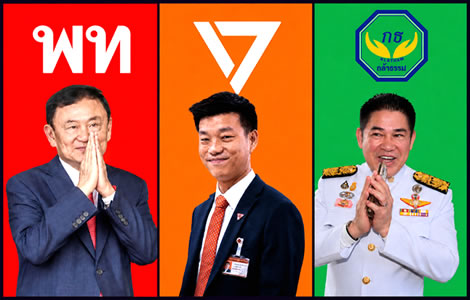
Bangkok is buzzing with rumours of a possible “green-red-orange” coalition as pressure closes in on Prime Minister Anutin Charnvirakul’s government. The colours identify the Kla Tham Party, Pheu Thai Party and opposition People’s Party. Together, they could potentially replace the Bhumjaithai-led coalition without another general election. However, all three parties deny that formal negotiations are underway.
For now, the proposal remains an unconfirmed political scenario. Political analysts also consider the alliance difficult because of deep ideological and personal divisions. Even so, the persistent speculation reveals mounting uncertainty surrounding Mr Anutin’s government. Less than six months after its election victory, the coalition faces several damaging investigations.
Bhumjaithai won 193 House seats in February’s general election. It subsequently formed a government with Pheu Thai and several smaller parties. As a result, the coalition holds a substantial parliamentary majority. Opposition parties cannot remove it through parliamentary arithmetic alone.
Pheu Thai holds the balance as corruption scandals fuel talk of a replacement three-colour coalition
Crucially, that protection depends upon coalition unity. A Pheu Thai withdrawal would sharply change the balance. Defections by important coalition factions could also threaten Mr Anutin’s position. Consequently, Bangkok’s attention has shifted from opposition numbers towards possible government fractures.
The proposed formula would unite three sharply different political forces. Green represents Kla Tham and its leader, Captain Thamanat Prompow. Red represents Pheu Thai and its established political movement. Meanwhile, orange denotes the People’s Party, led by Nattapong Ruangpanyawut.
Reports suggested former Prime Minister Thaksin Shinawatra met Captain Thamanat overseas. Both sides denied any secret meeting, negotiation or agreement. Nevertheless, those reports gave fresh momentum to alternative coalition speculation. Political attention immediately focused on possible cooperation between Kla Tham and Pheu Thai.
In response, the People’s Party repeatedly rejected claims that it was negotiating to join another government. Its leaders insist their immediate role remains in opposition. More specifically, they say the party is exposing corruption through Parliament. That position places it at the centre of attacks against Bhumjaithai.
People’s Party rejects coalition talks as Anutin projects unity amid mounting political pressure
Yet the proposed alliance would demand a major reversal from the People’s Party. It would need to work with provincial networks it has strongly criticised. Accordingly, many observers consider the formula unlikely without a severe government crisis. Personal rivalries and conflicting interests create further barriers.
Prime Minister Anutin has publicly laughed off the speculation. He insists Bhumjaithai remains secure and the coalition continues working normally. Likewise, Pheu Thai ministers have displayed public unity with the Prime Minister. Their embraces and reassuring statements have presented a stable coalition front.
Still, those displays have failed to kill Bangkok’s political gossip. Each investigation has increased scrutiny of Pheu Thai’s continued participation. Furthermore, a looming no-confidence debate will place ministers under sustained parliamentary pressure. That confrontation could test coalition discipline across several contentious issues.
At the centre of the crisis sits the Senate election collusion investigation. The case covers 229 people across the political and senatorial system. They include 138 serving senators and 91 political or associated figures. Its potential consequences therefore extend well beyond provincial campaign organisers.
Senate collusion investigation targets 229 people as August 31 Election Commission deadline nears
The Election Commission faces an August 31 deadline to decide the cases. Its 26th investigative committee previously recommended action against all 229 people. Subsequently, the Commission’s 36th committee overturned that recommendation. The reversal created serious questions about the Commission’s internal process.
Opposition politicians claim the evidence reveals a coordinated nationwide operation linked to Bhumjaithai networks. Reported material includes secret meetings and organised voting instructions. In addition, it includes offline vote calculations and suspected financial payments. Undated resignation letters and identity card copies have also attracted scrutiny.
Notably, an audio recording has increased the political pressure. It reportedly contains a reference to “higher-ups” connected with the operation. Opposition politicians now want investigators to identify the organisers and financiers. They oppose limiting prosecutions to operatives working in individual provinces.
The complaints cover a strikingly large group. Serving senators account for 138 of the 229 people involved. Alongside them, another 91 political or associated figures face complaints. Thus, the case reaches far beyond disputed actions by several isolated candidates.
Audio reference to ‘higher-ups’ fuels demands to identify organisers behind the Senate vote network
The reported evidence also extends beyond contested Senate votes. It covers meetings, calculations, instructions, payments and personal documents. On that basis, opposition politicians claim the operation required nationwide coordination. They are demanding an investigation into its suspected command and financing structure.
Separately, the Commission’s conflicting committee decisions have become part of the controversy. The 26th committee recommended action against everyone named. By contrast, the 36th committee overturned that finding. The Commission must now reach its decision before the August 31 deadline.
In parallel, the Department of Special Investigation is examining possible criminal offences. Its inquiry covers suspected money laundering and secret-society activity. Hence, the Election Commission cannot necessarily bring the wider affair to an end. A criminal investigation could continue regardless of its decision.
That separate process leaves the government exposed on another legal front. Even a favourable Commission ruling would not automatically close the case. Conversely, action against the 229 people could intensify criminal scrutiny. The August deadline therefore represents one stage in a wider investigation.
Department of Special Investigation keeps criminal scrutiny alive beyond the Commission’s decision
Beyond that, the Senate case carries direct political risks for Bhumjaithai. Opposition politicians claim the suspected operation was linked to its networks. They also say investigators must pursue those operating above provincial level. The recorded reference to “higher-ups” has sharpened that demand.
At the same time, a local government recruitment scandal is spreading. The affair falls directly under the Interior Ministry, which remains controlled by Bhumjaithai. Mr Anutin also serves as Minister of Home Affairs. Consequently, the investigation reaches a ministry under his direct political command.
The National Anti-Corruption Commission has opened a special investigation involving 6,014 people. That group includes 22 state officials and thousands of successful candidates. More than 400,000 people applied for the local government positions. Accordingly, the inquiry reaches deeply into a huge national recruitment exercise.
Investigators believe some candidates paid between ฿350,000 and ฿800,000 for appointments. The suspected operation reportedly involved brokers and examination personnel. Moreover, manipulated answer sheets formed part of the reported scheme. Influential political networks have also entered the investigation.
Recruitment scandal reaches Anutin’s Interior Ministry as 6,014 people face an anti-graft inquiry
Investigators are now following financial trails connected with the suspected payments. They are also preparing action against organisers and beneficiaries. In practical terms, the case reaches beyond examination staff and brokers. Successful candidates who purchased appointments could also face action.
The numbers make the affair particularly dangerous. More than 6,000 people fall within the special anti-corruption inquiry. Besides that, suspected payments reached ฿800,000 for individual appointments. Financial records could now identify organisers, brokers, recipients and beneficiaries across the network.
Prime Minister Anutin has promised that nobody will receive protection. Nonetheless, the investigation presents a direct test for his government. His dual role places him close to the ministry responsible for local government. Bhumjaithai’s control of that ministry raises the political stakes further.
Unlike the Senate affair, this scandal reaches directly into government recruitment. It concerns appointments sought by more than 400,000 applicants. As part of this, investigators are examining answer sheets, brokers and suspected financial transfers. They are also pursuing possible links with influential political networks.
Money trails and suspect answer sheets expose the growing scale of the local recruitment scandal
The suspected payment range points towards a lucrative operation. Some candidates reportedly paid ฿350,000, while others paid as much as ฿800,000. For that reason, financial trails could become decisive evidence. Investigators are preparing action against those who organised and benefited from the scheme.
On another front, the opposition is preparing attacks over the TH-AI Passport procurement. The issue will provide another target during parliamentary proceedings. Additionally, opposition parties are challenging the government’s ฿400 billion emergency borrowing decree. These disputes widen the coming confrontation beyond the two corruption investigations.
The no-confidence debate will bring those controversies into one parliamentary arena. Opposition members can question ministers about investigations, procurement and borrowing. In turn, ministers must defend several contested matters simultaneously. The debate will also test discipline among every coalition faction.
Numerically, Mr Anutin’s government remains strong. Its substantial House majority protects it against an immediate defeat. Politically, however, the coalition faces pressure from investigations and possible defections. Its central danger does not currently come from opposition seat totals.
Borrowing and passport procurement attacks widen the opposition’s coming no-confidence offensive
Pheu Thai therefore occupies a decisive position. Its continued participation secures Bhumjaithai’s majority and Mr Anutin’s premiership. Alternatively, its withdrawal could transform the parliamentary balance. Such a move would make other coalition formulas immediately relevant.
So far, Pheu Thai remains inside the government. Its ministers continue standing beside the Prime Minister and displaying public unity. Despite this, speculation persists because that unity faces growing political pressure. The major investigations have not yet reached their decisive stages.
Kla Tham would also become important in any replacement coalition. Inevitably, reports involving Captain Thamanat attract immediate political attention. Thaksin remains central to speculation about Pheu Thai’s direction. The claimed overseas meeting therefore carried instant political weight.
Both sides denied the meeting and any secret deal. Their denials removed no political pressure from Mr Anutin’s coalition. Instead, the three-colour scenario continued circulating as the scandals widened. The formula has become a measure of uncertainty around Bhumjaithai.
The People’s Party remains the greatest obstacle. Joining such a coalition would require it to leave its opposition role. It would also need to accept partners from networks it has fiercely criticised. Its leaders have given no indication that they will take either step.
Pheu Thai holds the decisive votes as rumours persist over a new replacement three-colour coalition
Rather, the People’s Party continues concentrating on parliamentary scrutiny. Its leaders say their immediate role is exposing corruption. Under those circumstances, joining a replacement government would require a major shift. No such change has been announced or acknowledged.
For this reason, the alliance remains improbable under present conditions. It has no publicly accepted negotiations, agreement or shared programme. Each party denies that coalition talks are underway. Yet the scenario survives because Bhumjaithai faces several threats simultaneously.
First, the Senate investigation targets 229 people, including 138 serving senators. Second, the recruitment scandal involves 6,014 people and 22 officials. Beyond these cases, the opposition is targeting the TH-AI Passport procurement. The ฿400 billion emergency borrowing decree adds another line of attack.
Each controversy strikes a different part of the government’s position. The Senate case threatens political networks associated with Bhumjaithai. In contrast, the recruitment scandal reaches directly into the Interior Ministry. Procurement and borrowing questions provide additional ammunition for the no-confidence debate.
Mr Anutin does not currently face an immediate parliamentary collapse. His coalition controls enough seats to defeat ordinary opposition challenges. Even then, parliamentary numbers cannot halt independent investigations. Nor can they guarantee the continued loyalty of government partners.
People’s Party resists coalition switch while scandals tighten pressure on Bhumjaithai’s majority
An adverse Senate decision could rapidly increase political pressure. Further recruitment findings could produce another damaging confrontation. At that point, the no-confidence debate would give the opposition a national platform. Coalition parties would then face demands to defend every contested issue.
The August 31 deadline is therefore critical. The Election Commission must decide cases recommended by its 26th committee. Yet the Department of Special Investigation will retain its separate criminal inquiry. The Senate affair could consequently continue after the Commission rules.
Simultaneously, anti-corruption investigators are tracing money in the recruitment scandal. They are preparing action against organisers and beneficiaries. Further disclosures could emerge before or during the parliamentary confrontation. The timing increases the pressure on Bhumjaithai and its coalition partners.
Pheu Thai’s response will receive intense scrutiny throughout this period. It can maintain its support and preserve the government’s majority. Otherwise, withdrawal could force a completely new coalition calculation. Its ministers have presently chosen public loyalty to Mr Anutin.
Senate deadline and recruitment inquiry push coalition loyalty towards a decisive political test
For his part, the Prime Minister continues dismissing the rumours. He maintains that his government remains secure and functions normally. In public, the coalition still appears intact and numerically powerful. Behind that majority, several investigations are moving towards critical decisions.
The green-red-orange coalition remains unlikely today. Deep divisions, political rivalries and repeated denials continue blocking the formula. Nevertheless, a severe government crisis could change those calculations quickly. An improbable alliance could then become a practical route to power.
Political pressure building up in advance of expected August 31 decision on the controversial Senate collusion case
Former PM Paetongtarn Shinawatra calls on Pheu Thai MPs and ministers to aid Northern flooding victims
Until then, Bangkok’s coalition rumours will move with each investigation. The Senate case, recruitment affair and no-confidence debate are now converging. Meanwhile, passport procurement and emergency borrowing give the opposition further targets. Every development increases scrutiny of Bhumjaithai’s internal coalition support.
Ultimately, Mr Anutin’s immediate protection remains his large House majority. That majority survives only while coalition partners remain beside him. Continued scandals could make that support harder to sustain. If Pheu Thai changes course, the three-colour option could become a serious political alternative.
Join the Thai News forum, follow Thai Examiner on Facebook here
Receive all our stories as they come out on Telegram here
Follow Thai Examiner here
Further reading:
Ex PM and Democrat Party leader urges politicians implicated in Senate Collusion files to come clean
Opposition and People’s Party leader attacks ‘blue regime’ on the 12th anniversary of the 2014 coup
Thammasat University legal scholar and 1992 protest leader warns another coup cannot be ruled out