Anutin is overseas as legal heavyweights prepare to scrutinise the Election Commission’s Senate ruling. Two dissenting commissioners say evidence justified action over political involvement, while other major legal battles close in at home this week.
A powerful group of legal heavyweights is preparing to question the Election Commission’s handling of Thailand’s Senate scandal. Their September 30 examination comes after two commissioners rejected key majority findings that cleared political figures from proceedings. Dissenter Sitthichot Intrawises maintains evidence supported action involving political players, while Prime Minister Anutin Charnvirakul was among those not referred. The dispute persists despite 77 people, including 26 serving senators, heading towards Supreme Court proceedings. Meanwhile, a NIDA Poll places both the Election Commission and Mr Anutin prominently in the continuing political and legal fallout. With Anutin overseas, further pressure is building from the local examination scandal and an approaching Constitutional Court ruling on election ballot barcodes.
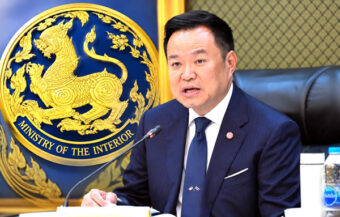
Prime Minister Anutin Charnvirakul is overseas while several serious political and legal battles continue to develop at home. He travelled first to Japan before heading to the United Nations in New York. The United Kingdom is also on his itinerary. At home, however, the political picture is considerably more complicated.
The Bhumjaithai Party-led government retains a comfortable parliamentary majority. Meanwhile, the main opposition People’s Party is dealing with problems of its own. Some Thai media have consequently portrayed Mr Anutin’s government as increasingly secure. Yet several major legal cases remain unresolved and are approaching important deadlines.
Most significantly, the controversy surrounding the 2024 Senate selection has entered another phase. The Election Commission delivered its long-awaited decision on September 14. It resolved to pursue proceedings against 77 people before the Supreme Court’s Election Case Division. However, that decision failed to end arguments surrounding the investigation.
EC split leaves Senate case alive as dissenters point to strong evidence involving political figures
The group includes 26 serving senators. Another 36 were eligible participants in the Senate selection, while 15 other people were also referred. Crucially, no MPs, party executives or political officeholders were among those sent forward. As a result, the decision removed an immediate legal threat hanging over several prominent political figures.
Prime Minister Anutin was not referred. Neither were other political figures whose names had surfaced during the investigation. Government supporters could therefore point to September 14 as an important decision for the Prime Minister. Within hours, though, disagreement inside the Election Commission itself became public.
Two commissioners, Sitthichot Intrawises and Chai Nakornchai, disagreed with crucial elements of the majority decision. The seven-member commission divided five to two over important allegations. Notably, Mr Sitthichot subsequently made clear that his assessment differed sharply from the majority.
He maintained that evidence showed connections between political party personnel and the suspected Senate collusion operation. That distinction remains central to the controversy. The majority decided against referring political officeholders, MPs and party executives over those allegations. By contrast, the minority believed the evidence justified proceedings concerning political involvement.
Mr Sitthichot subsequently detailed some of the material supporting his position. It included witness testimony, telephone information and financial evidence. In addition, investigators examined provincial meetings, suspected voting lists and apparently coordinated voting patterns. Evidence was also gathered concerning political personnel and meetings before the Senate selection.
Provincial voting lists and Bangkok hotel meeting form key strands of the Senate collusion evidence
Mr Sitthichot referred specifically to activity in several provinces. These included Nakhon Si Thammarat, Phuket, Nong Bua Lamphu, Uthai Thani, Nakhon Sawan and Sukhothai. According to his account, suspected lists corresponded with candidates eventually finishing between first and seventh. Investigators also examined claims that MPs and party personnel had been assigned roles.
Separately, another important strand concerned a Bangkok hotel meeting. Investigators examined a gathering at the Pullman Bangkok on July 21, 2024. Telephone location information reportedly placed at least 40 senators around the location. At the same time, investigators examined 12 suspected voting lists linked to the wider inquiry.
Mr Sitthichot also referred to accounts concerning telephones being collected during the gathering. Furthermore, evidence included reports that a political party figure was seen leaving the location. Rather than treating each item separately, the minority considered the material collectively.
Mr Sitthichot used a striking comparison when explaining his assessment. “When all the suspicious points are considered together, it’s like looking at the whole elephant,” he said. “We know the real elephant is here; the other minor details are wrong, but the whole elephant is here.”
Minority finds political assistance claims substantiated as EC majority clears the wider group of 229
Mr Sitthichot and Mr Chai concluded that the first two allegations under examination were substantiated. The first concerned political assistance provided to Senate candidates. The second concerned candidates accepting such assistance. Nevertheless, the five-member majority reached a different conclusion.
Accordingly, the September 14 decision did not close the dispute. Instead, attention shifted towards how commissioners assessed evidence collected during the investigation. The disagreement matters because investigators initially examined a much larger group than the final 77 respondents.
One investigative process covered 229 people. They included 138 senators and 91 political figures or other individuals. A committee and the Department of Special Investigation recommended proceedings against all 229. Subsequently, another Election Commission committee voted five to two to clear the entire group.
Eventually, the Election Commission settled on proceedings involving 77 people. Allegations three to seven covered candidate introductions, benefits, hospitality and suspected coordinated voting. Allegation three alone resulted in 36 referrals, including 26 serving senators.
As part of this process, the commission repeatedly considered the facts, evidence and applicable law. It also stressed that commissioners reached their conclusions independently. On September 11, the EC confirmed that additional material had been requested before final deliberations. The decisive meeting followed three days later.
Supreme Court proceedings could suspend 26 senators as reserve senators seek a wider examination
Even so, referral does not constitute a finding of guilt. The Supreme Court must consider the petitions and supporting evidence. Before that happens, the Election Commission must complete the required documentation and formally submit the cases.
Once accepted, however, proceedings could have immediate consequences for serving senators. An affected senator must stop performing Senate duties once the Supreme Court accepts the petition. If the court ultimately rules against that senator, membership ends from the suspension date. Thus, the next stage could directly affect the composition of the Senate.
Twenty-six serving senators are involved. However, the controversy now extends beyond those members and the other 51 respondents. On September 16, reserve senators approached the Supreme Court’s Election Case Division. They asked judges to examine wider evidence concerning the original group of 427 respondents.
Their intervention renewed questions about the scope of the Election Commission’s final decision. On another front, a potentially significant legal gathering is approaching. On September 30, senior figures from Thailand’s legal establishment will publicly examine the Senate controversy.
Legal heavyweights prepare to examine Senate evidence, legal standards and the EC’s divided decision
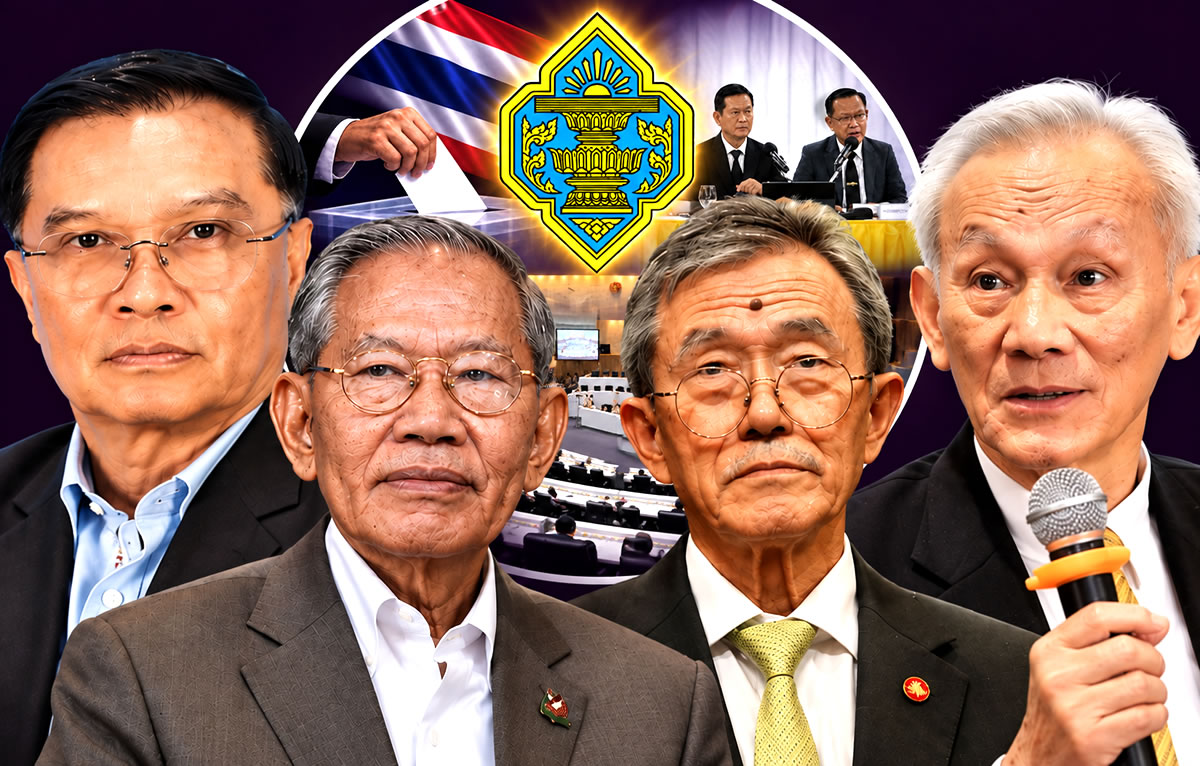
The Royal Society of Thailand is preparing the seminar. Participants include Charan Pakdithanakul, Was Tingsamitr, Vicha Mahakun and Election Commissioner Sitthichot Intrawises. Their backgrounds give the gathering particular significance within Thailand’s legal establishment.
All have occupied senior positions across Thailand’s courts, independent organisations or justice system. Moreover, they come from a legal establishment generally regarded as highly conservative. Mr Sitthichot’s presence adds another dimension because he participated directly in the Election Commission deliberations.
In effect, the commission’s internal disagreement will now enter a broader legal discussion. The seminar is expected to examine evidence, applicable legal standards and the September 14 decision. In particular, questions have surfaced concerning the evidential threshold applied during consideration of the case.
Attention has focused on standards used for criminal proceedings and questions involving electoral rights. Consequently, the September 30 gathering goes beyond another political seminar. Senior legal figures will examine a case which the Election Commission itself considered for months.
Significantly, scrutiny surrounding the case is no longer confined to opposition politicians or activists. Figures from within the legal establishment are now preparing to examine the decision publicly. One Election Commission member who dissented will be sitting among them.
NIDA Poll puts Election Commission and Anutin at centre of perceived political and legal battles
In parallel, public opinion has added another dimension. The National Institute of Development Administration released its latest NIDA Poll on Sunday, September 20. The nationwide survey questioned 1,310 adults on September 15 and 16.
Importantly, those interviews took place immediately after the Election Commission delivered its decision. Respondents were asked who could face a major political or legal battle following the ruling. The Election Commission itself topped the responses.
Some 35.57% identified the current Election Commission. Prime Minister Anutin followed closely with 31.53%. Elsewhere, 25.42% identified the government coalition parties. Another 15.88% selected the 77 people referred for proceedings.
Bhumjaithai itself was named by 13.97%. In comparison, only 8.24% identified the 26 serving senators facing proceedings. The Election Commission and Prime Minister therefore ranked above those senators in responses to that particular question.
The poll also revealed mixed expectations surrounding the September 14 outcome. Some 21% said the decision was very much what they expected. Another 15.50% said it was somewhat consistent with expectations. Conversely, 17.86% said the outcome was not at all expected.
A further 10.84% said it was not really what they expected. Meanwhile, 34.27% said they had made no prediction beforehand. Another 0.53% gave no answer. Taken together, those figures showed no uniform public expectation before the decision.
Public concern remains divided as Constitutional Court prepares to rule on election ballot barcodes
The poll also measured concern about possible political turbulence. Some 15.04% said they were very worried, while another 30.46% were somewhat worried. Against that, 19.16% said they were not very worried. Another 35.34% said they were not worried at all.
Public concern about wider political consequences was therefore divided. Still, another result was particularly notable. The Election Commission was most frequently identified as facing a major political or legal battle. Prime Minister Anutin followed in second place.
At the same time, the Senate controversy is not the only major legal matter approaching a deadline. Thailand’s Constitutional Court will rule on September 28 over barcodes and QR codes printed on election ballots.
The ballots were used during the February 8, 2026 general election. The case followed 22 complaints submitted to the Ombudsman. Subsequently, the matter was referred to the Constitutional Court for a ruling.
At issue is whether the codes could identify voters and connect individuals with their voting choices. The case therefore concerns constitutional protections surrounding secret voting. In response, the Election Commission has defended the system throughout the controversy.
It maintains that the codes were designed for internal ballot management. The commission says they could not identify individual voting choices. On August 26, the Constitutional Court heard five witnesses during its examination.
Barcode ruling nears as local examination scandal brings fresh political pressure around PM Anutin
The following day, two judges inspected stored ballots. Accordingly, the court has examined testimony alongside physical election material. Its ruling is scheduled for September 28.
Beyond that case, political pressure continues over the local government examination scandal. Police are investigating suspected manipulation involving roughly 2,000 candidates. Investigators are also tracing what they believe was a wider network behind the operation.
Already, ฿320.86 million in assets has been seized or frozen. More recently, the inquiry has moved closer to the political arena. People’s Party MP Rangsiman Rome is demanding answers concerning Anutin adviser Thongchuea Chatkitcharoen.
Police have supplied information concerning the matter to the Prime Minister. However, its contents have not been publicly disclosed. Mr Anutin has promised that everyone implicated by evidence will face action.
Likewise, he has pledged there will be no protection for anyone implicated. Mr Rome is pressing the Prime Minister over whether that commitment extends into his political circle. A House committee hearing is scheduled for September 24.
Another important deadline connected with the matter follows on September 30. Taken together, several separate political and legal controversies are converging within a remarkably short period.
For now, the government retains its comfortable parliamentary majority. Equally, the opposition has difficulties of its own. The September 14 Election Commission decision also removed political figures from immediate proceedings in the Senate case.
Senate referrals, barcode ruling and examination scandal keep legal pressure active outside parliament
Outside parliament, however, the underlying Senate investigation remains active. Seventy-seven people are moving towards proceedings before the Supreme Court. Twenty-six are serving senators.
More importantly, two election commissioners publicly disagreed with crucial elements of the majority decision. One dissenter detailed evidence which he believed supported proceedings involving political figures. Reserve senators have separately asked the Supreme Court to examine the wider evidential picture.
Next comes the September 30 gathering of senior legal figures. Before then, another major judgment is due. The Constitutional Court will deliver its ballot barcode ruling on September 28.
Simultaneously, the local government examination investigation continues. Police are examining roughly 2,000 suspected altered results. Assets worth ฿320.86 million have already been seized or frozen.
Additionally, political questions surrounding that case have reached an adviser to the Prime Minister. The House committee will return to the matter on September 24.
The NIDA Poll adds another significant piece of information. Respondents most frequently identified the Election Commission when asked who faced a major political or legal battle. Prime Minister Anutin was next.
Senate dispute remains alive as legal scrutiny and two other major cases approach crucial deadlines
For the moment, the September 14 decision has settled only one procedural stage of the Senate controversy. The Supreme Court process still lies ahead. Meanwhile, disagreement inside the Election Commission is firmly established on the public record.
Against this background, senior figures from Thailand’s conservative legal establishment are preparing to examine the controversy publicly. Two other politically sensitive matters are also moving towards important dates.
All this is unfolding while Prime Minister Anutin completes his overseas engagements. Parliamentary numbers remain comfortable for his government. Beyond those numbers, several major legal processes remain active.
Election Commission member derails PM Anutin Charnvirakul’s efforts to put Senate scandal in the past
Election Commission exposed based on Monday’s sweeping decisions and judgments warns opposition
First comes the September 24 House committee hearing linked to the local government examination controversy. Four days later, the Constitutional Court delivers its ballot barcode ruling.
Finally, September 30 brings the legal seminar examining the Senate case. The same date also marks another important point in the local government examination affair.
The Election Commission delivered its Senate decision on September 14. Since then, the Supreme Court process has remained ahead and internal dissent has become public.
The government’s parliamentary arithmetic remains favourable. Yet outside parliament, the political calendar is crowded with unresolved legal cases and approaching decisions.
Join the Thai News forum, follow Thai Examiner on Facebook here
Follow Thai Examiner on Google here
Receive all our stories as they come out on Telegram here
Follow Thai Examiner here
Further reading:
Election Commission exposed based on Monday’s sweeping decisions and judgments warns opposition
Election Commission creates more questions than answers as it refers 77 people to the Supreme Court
Ex Pheu Thai minister warns Commission members that soon they could be judged as crunch vote looms
Opposition and People’s Party leader attacks ‘blue regime’ on the 12th anniversary of the 2014 coup