
Thailand’s high season takes a hammer blow as Norse Atlantic grounds its fleet. Some 36,600 monthly airline seats are at risk as foreign arrivals plunge 12% in October. Tourism receipts are down ฿36.4 billion, putting Thai household livelihoods at risk.
Thailand’s battered tourism industry suffered a hammer blow on Thursday, November 26, as Norse Atlantic Airways suspended all flights. By Friday, its Norwegian operating subsidiary had filed for bankruptcy after emergency financing failed. The collapse threatens 36,600 monthly airline seats from Britain and Scandinavia into Bangkok and Phuket. Meanwhile, Thailand’s Fiscal Policy Office revealed a staggering 12% plunge in October foreign arrivals. Tourism receipts have already fallen by ฿36.4 billion this year. Furthermore, Chinese group tourism has slumped by at least 40%, while soaring fuel costs threaten European airfares. Despite booming exports, millions of ordinary Thais depend on tourism earnings. Thailand enters its crucial winter high season with fewer flights, weakening demand and household incomes under mounting pressure.
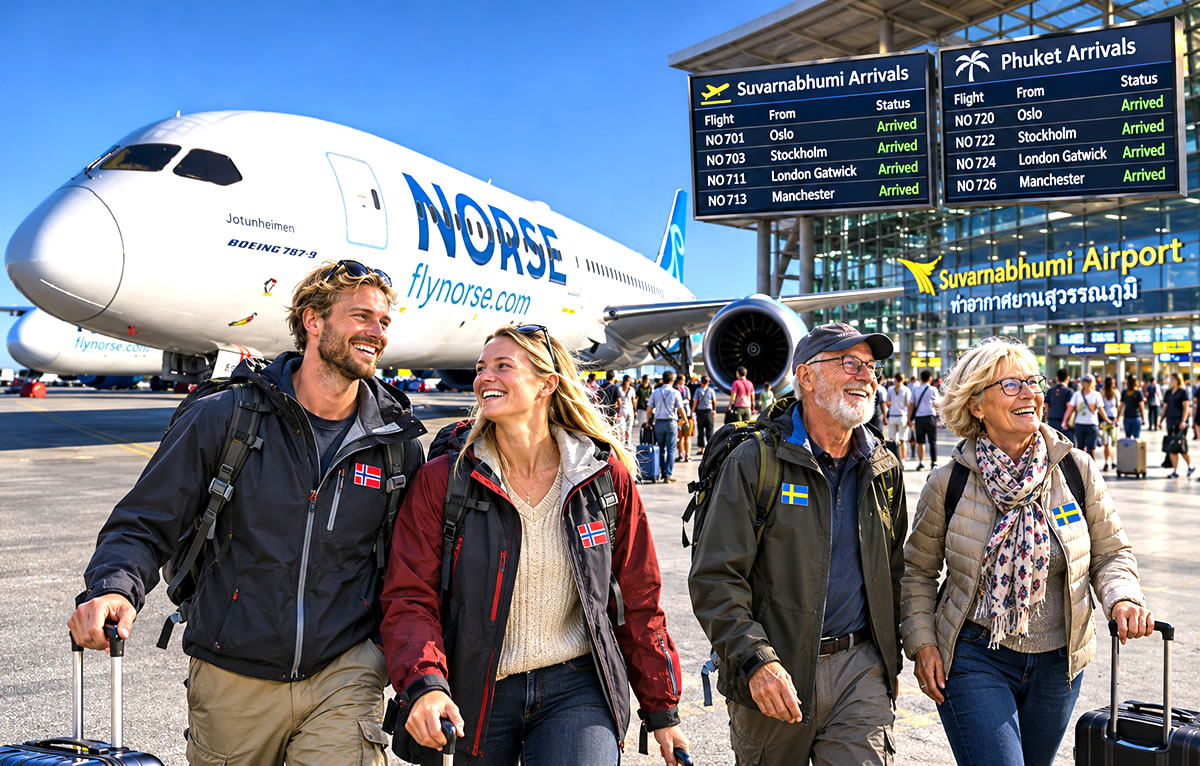
Thailand’s struggling foreign tourism industry suffered a major blow on Thursday, November 26, when Norse Atlantic Airways suspended all flights. On Friday, the Norwegian budget carrier’s operating subsidiary filed for bankruptcy after emergency financing efforts failed.
The collapse threatens 8,450 weekly airline seats linking Britain, Norway and Sweden with Bangkok and Phuket. Meanwhile, Thailand’s Ministry of Finance released disturbing figures showing a sharp deterioration in international tourism during October.
Foreign arrivals plunged 12% annually, leaving Thailand with approximately 310,000 fewer international visitors. The contraction comes as the kingdom enters its crucial winter high season. Crucially, foreign tourism generates income for millions of ordinary Thais, including lower-income households and workers outside the formal economy.
Norse Atlantic grounds aircraft and leaves passengers stranded worldwide as shares plunge 85% in Oslo
The Norwegian airline’s collapse left passengers stranded at airports in Thailand, Britain, South Africa and Florida. No timetable was provided for restoring flight operations. Significantly, the suspension came just days before Norse Atlantic was scheduled to introduce additional direct flights from Britain.
The carrier had been expanding its Thailand network throughout the preceding year. Its winter programme represented a substantial commitment to Thailand’s European tourism market.
The financial crisis became public on Wednesday, November 25, following an emergency announcement to investors. Norse Atlantic Airways disclosed that its financial position had become critical. In response, the company’s shares plunged 85% on the Oslo Stock Exchange.
Its market value had already been almost entirely wiped out during 2026. The airline’s board immediately sought emergency short-term financing to prevent the collapse of operations.
On Thursday, President and Chief Executive Officer Eivind Roald confirmed that aircraft had returned to their European bases. These included facilities in Norway, Sweden and Britain. In parallel, negotiations continued with potential investors interested in acquiring the financially distressed airline.
Emergency rescue talks fail as Norwegian subsidiary files for bankruptcy and British flights are cancelled
Those discussions included proposals for additional financing alongside a possible corporate takeover. However, Norse Atlantic warned that “there can be no assurance that a viable solution will be found.”
By Friday, November 27, those negotiations had failed to produce sufficient funding. Consequently, the Norwegian operating subsidiary filed for bankruptcy. Its parent company continued exploring options to preserve its British subsidiary.
Nevertheless, all British flights were cancelled and ticket sales discontinued. United Kingdom Civil Aviation Authority spokesman Andrew McConnell confirmed the cancellations on Friday. He urged affected passengers not to travel to airports expecting their scheduled flights to operate.
Separately, international sources estimated that approximately 2,500 British passengers were booked on Norse Atlantic flights home. The airline has not disclosed how many passengers remain stranded in Thailand.
Neither has it announced comprehensive refund arrangements for affected customers. Passengers who purchased tickets directly using payment cards may seek reimbursement through their card providers. Under package holiday arrangements, organisers must provide alternative transportation or refunds.
Aircraft leases terminated and salaries unpaid as soaring fuel costs batter Norwegian long-haul carrier
Further evidence of the company’s financial collapse emerged on Friday. International sources reported that aircraft leasing companies had terminated agreements covering all 12 of the carrier’s Boeing 787-9 Dreamliners.
Norse Atlantic subsequently disputed the validity of those termination notices. Adding to the crisis, the International Transport Workers’ Federation disclosed that the company could no longer meet its payroll obligations. Employees had been informed that their salaries could not be paid.
Norwegian aviation entrepreneur Bjørn Tore Larsen established Norse Atlantic Airways in 2021. The company specialised in affordable long-haul flights between major international destinations.
Its commercial operations also included aircraft leasing, charter services and cargo transportation. During 2026, escalating aviation fuel costs placed enormous financial pressure on the business. Particularly damaging was the company’s failure to hedge its fuel requirements against rising prices.
European aviation fuel prices double as Middle East conflict threatens higher airfares for Thai holidays
European aviation fuel prices more than doubled in March following supply disruptions linked to the US and Israeli war with Iran.
Prices remained volatile throughout the remainder of the year. Without fuel hedging arrangements, Norse Atlantic remained directly exposed to those increases. Budget long-haul carriers face particular difficulties because their customers are generally more sensitive to rising ticket prices.
Beyond Norse Atlantic, the aviation industry’s fuel crisis threatens substantially higher international travel costs. Ryanair’s chief executive has warned that European airfares could increase by up to 20% during 2027.
That warning was conditional upon the continuation of the Middle East conflict. For Thailand, higher long-haul airfares represent another threat to attracting European holidaymakers operating within limited budgets.
Against this backdrop, Norse Atlantic had been strengthening its Thailand operations while reducing several American services. The carrier launched direct Stockholm and London Gatwick flights to Bangkok in October 2025.
Over the following year, its Thailand network expanded considerably. Growing demand for European winter holidays supported plans for additional services during the 2026–2027 season.
Seven direct European routes to Bangkok and Phuket hit as ambitious December flight expansion collapses
On October 12, 2026, the Norwegian-Thai Chamber of Commerce publicised the airline’s extensive winter expansion programme. The schedule included seven direct routes connecting four European airports with Bangkok and Phuket.
Norse Atlantic was already operating four weekly flights between London Gatwick and Bangkok. As part of its expansion, three weekly Gatwick to Phuket services were scheduled to commence on December 4. The following day, four weekly direct flights between Manchester and Bangkok were due to begin.
Across Scandinavia, the carrier’s winter programme included five weekly flights between Oslo and Bangkok. Another two weekly services connected the Norwegian capital with Phuket. Stockholm was scheduled to have an identical allocation of services to both Thai destinations.
On Friday, Norwegian airport operator Avinor listed the scheduled Oslo to Phuket flight as cancelled. The suspension therefore affects established Scandinavian services alongside the planned expansion from Britain.
Thailand faces losing 36,600 monthly airline seats as Christmas demand threatens higher replacement fares
Each Boeing 787-9 Dreamliner accommodated 338 passengers, including 56 premium seats. Taken together, the expanded winter programme comprised 25 weekly inbound flights. Bangkok accounted for 18 services, providing 6,084 passenger seats.
Phuket accounted for seven flights, offering another 2,366 seats. Across both destinations, the expanded schedule represented approximately 36,600 inbound seats monthly. Over four calendar months, maximum scheduled capacity would have approached 146,000 passengers.
Notably, the Tourism Authority of Thailand (TAT) had partnered with Norse Atlantic to promote British winter holidays. The campaign formed part of Thailand’s strategy to diversify its international tourism markets.
Direct services offered alternatives to connecting flights through major European and Middle Eastern aviation hubs. They also provided additional competition on long-haul routes into Thailand. The airline’s disappearance removes that competition immediately before Christmas and New Year.
Replacing the lost capacity presents substantial commercial and logistical difficulties for competing airlines. Additional services require available aircraft, airport slots and flight personnel.
Compounding the problem, December and January traditionally generate exceptionally strong demand for international flights. Passengers seeking replacement services face the prospect of considerably higher ticket prices. For holidaymakers operating within fixed budgets, additional transportation costs leave less money available for spending inside Thailand.
October tourism slump follows ฿36.4 billion revenue loss during the first ten months of a difficult year
The airline’s collapse coincided with the Ministry of Finance’s October economic assessment, released on Friday, November 27. Fiscal Policy Office (FPO) Deputy Spokesperson Pann Ananapibut confirmed continued weakness across Thailand’s international tourism industry.
The kingdom welcomed just 2.27 million foreign tourists during October. That represented a double-digit annual contraction during the period immediately preceding Thailand’s peak winter season. On a more positive note, international arrivals increased by 4.5% from September after seasonal adjustments.
Domestic tourism, by comparison, provided little additional momentum for Thailand’s hospitality businesses. Thai travellers made 23.3 million domestic trips during October, representing annual growth of just 0.4%.
On a seasonally adjusted monthly basis, domestic travel increased by 0.6%. The figures showed limited growth in domestic tourism alongside substantially weaker international demand. They followed an already disappointing performance across Thailand’s foreign tourism industry throughout much of 2026.
On November 5, Minister of Tourism and Sports Surasak Phancharoenworakul disclosed figures covering the year’s first ten months. Thailand welcomed 25,464,306 foreign visitors between January 1 and October 31.
That represented a decline of 4.59% compared with the corresponding period in 2025. More significantly, international tourism receipts contracted by 2.85% to ฿1.24 trillion. Based on those rounded figures, Thailand lost approximately ฿36.4 billion in foreign tourism revenue. The kingdom also received approximately 1.225 million fewer international visitors.
Chinese tourism recovery falters as Malaysian and South Korean arrivals fall and group tourism slumps
Among Thailand’s ten leading international tourism markets, only China, Taiwan and the United States recorded growth during those ten months. Chinese arrivals increased by 12.44% to 4.24 million. Conversely, Malaysian arrivals contracted by 16.34% to 3.23 million.
South Korean arrivals suffered an even steeper decline of 26.86%. The figures exposed widespread weakness across several of Thailand’s most important Asian tourism markets.
Despite earlier gains, the recovery in Chinese tourism suffered a significant reversal during October. Tourism Authority of Thailand figures showed Chinese arrivals falling by 13.6% year on year to 308,942. The decline coincided with flooding in Bangkok.
During the same month, the Chinese Embassy issued a safety advisory to its citizens. China remained Thailand’s largest international tourism market despite the renewed contraction.
Earlier in November, Association of Thai Travel Agents (ATTA) President Thanapol Cheewarattanaporn warned of deeper problems within organised Chinese tourism. His association estimated that Chinese group tourism had already contracted by at least 40%.
Looking ahead, Thanapol warned that overall Chinese arrivals could fall by 20% during November and December without effective intervention. That warning covered two important months for Thailand’s hospitality industry.
Chinese Lunar New Year tourism faces a sharp decline as long-haul arrivals offer Thailand some relief
The association also expressed serious concern about the forthcoming Lunar New Year holiday in early 2027. Thanapol warned that Chinese group arrivals could plunge by more than 50% during that holiday period.
His assessment pointed to continued difficulties extending beyond Thailand’s traditional European winter tourism season. Organised Chinese tourism therefore remains a particular concern for travel agents and businesses serving that market.
In contrast, Thailand recorded encouraging developments across its long-haul tourism markets towards the end of October. Ministry of Tourism and Sports figures showed long-haul arrivals increasing for five consecutive weeks.
Between October 25 and 31, Thailand welcomed 227,153 long-haul visitors. That represented an increase of 13.6% over the previous week. Growing arrivals from Russia and the United States contributed to the improvement.
Overall, Thailand received 538,661 international visitors during the final seven days of October. Tourism officials were already monitoring potential reductions in European airline services.
The Norse Atlantic suspension subsequently removed a substantial component of Thailand’s planned winter aviation capacity. The setback directly affects markets that Thai tourism authorities had been targeting through expanded long-haul connections.
Longer foreign holidays sustain tourism receipts and generate earnings across Thailand’s service economy
The financial importance of longer-staying international visitors was highlighted in the Bank of Thailand’s October 30 economic assessment. Foreign tourism receipts remained broadly stable during the third quarter despite declining arrivals.
The central bank attributed that performance to visitors spending longer periods inside Thailand. Extended holidays generate expenditure across accommodation, restaurants, transportation, entertainment and personal services. As a result, longer stays can support tourism receipts even when overall visitor numbers decline.
Foreign tourism occupies a distinctive position within Thailand’s economy because of its extensive distribution of income. International visitors generate earnings for street food vendors, market traders, independent restaurants and small accommodation providers.
Their spending also supports taxi drivers, tuk-tuk operators and motorcycle taxi drivers. Within the hospitality industry, hotel cleaners, kitchen staff, receptionists, tour guides and massage therapists depend on tourism expenditure.
Further down the supply chain, tourism generates business for laundry operators, fishermen, farmers, boat operators and food suppliers. Many workers across these occupations depend on daily earnings, commissions and tips.
Tourism earnings support rural households as booming Thai exports contrast with weaker consumer confidence
They frequently have limited financial reserves and irregular incomes. Moreover, tourism workers in Bangkok and Phuket send portions of their earnings home to relatives in rural provinces. Foreign tourism income consequently reaches communities hundreds of kilometres from Thailand’s principal holiday destinations.
The industry also provides employment opportunities for people without advanced academic qualifications or specialist industrial skills. Its commercial activities extend across registered businesses, independent operators and Thailand’s substantial informal economy.
Unlike capital-intensive manufacturing, tourism distributes revenue through numerous comparatively small commercial transactions. These transactions generate direct earnings for workers and independent business operators across the country.
On another front, Friday’s Fiscal Policy Office report revealed exceptionally strong merchandise export growth. Thai exports surged by 27.5% in October to $36.86 billion. It marked the 28th consecutive month of annual export growth.
Domestic economic indicators, however, presented a less encouraging picture. Private consumption expanded more slowly than during the corresponding period last year. Consumer confidence also deteriorated, falling from 52.1 in September to 50.9 in October.
Inflation hits household purchasing power as officials report stable investment and high foreign reserves
Fiscal Policy Office officials attributed the deterioration in consumer confidence partly to flooding and the elevated cost of living. Headline inflation reached 3.90% in October, placing additional pressure on household purchasing power.
Core inflation stood at 1.58%. Even so, farmers’ real incomes increased by 12.8%. New car registrations rose by 19.5% year on year, while new motorcycle registrations increased by 3.3%.
Turning to investment, imports of capital goods surged by 104.6% annually during October. The Fiscal Policy Office uses those imports to monitor private investment in machinery.
Yet capital goods imports contracted by 2.9% compared with September. Cement sales also declined by 5.8%. Taking these indicators into account, the Fiscal Policy Office characterised overall private investment as stable.
Officials maintained that Thailand’s broader economic position remained stable despite mounting external pressures. Public debt stood at 68.6% of gross domestic product at the end of September. That remained within established fiscal discipline limits. In addition, the country’s foreign currency reserves reached $272.8 billion at the end of October.
Electronics growth contrasts with tourism weakness as Middle East conflict and US trade risks intensify
Previously, the Bank of Thailand identified electronics exports and data centre investment as important drivers of economic growth. It also reported weakening tourism activity and more cautious consumer spending on hotel and restaurant services.
The contrasting performances are particularly significant for employment and household earnings. Electronics manufacturing and data centre developments are comparatively capital-intensive industries. Strong growth within those sectors does not directly replace lost earnings among hospitality workers and independent tourism operators.
Regarding external risks, the Fiscal Policy Office identified the Middle East conflict as a continuing threat to Thailand’s economic performance. Officials reported that tourism was contracting slightly because of the conflict.
Threats to shipping through the Strait of Hormuz were maintaining uncertainty surrounding energy and transportation costs. The economic consequences extend beyond aviation to other industries dependent on imported energy and international transportation.
The office also identified American trade measures and retaliatory action by trading partners as risks to global commerce. Those pressures threaten Thai supply chains, production costs and economic growth.
Global tourism growth slows as Thailand faces uncertainty over spending lost through airline cut backs
Thailand therefore faces external economic risks despite its exceptionally strong merchandise export performance. The country’s tourism industry remains directly exposed to international transportation costs and disruptions affecting aviation.
At the international level, UN Tourism reported worldwide tourism growth of just 0.4% during the first half of 2026. The organisation identified rising travel costs and the Middle East conflict as constraints on international tourism. Thailand’s difficulties are consequently unfolding against a background of substantially weaker global tourism growth.
During the first ten months of 2026, Thailand’s average foreign visitor expenditure stood at approximately ฿48,700 per arrival. That nationwide average covers international visitors across different markets and lengths of stay.
Norse Atlantic’s scheduled winter services represented a substantial volume of potential tourism expenditure. However, maximum aircraft capacity cannot be treated as confirmed bookings or an equivalent number of lost foreign visitors.
Some affected passengers will secure alternative flights, while others face the prospect of abandoning their Thai holidays entirely. The airline also carried passengers other than foreign holidaymakers, including people returning to Thailand.
Thai tourism businesses face a crucial winter season as the airline collapse threatens household earnings
No official assessment of the financial damage arising from the suspension has been released. The final impact on tourism receipts will depend partly on replacement aviation capacity and the number of cancelled holidays.
For Thailand’s hospitality industry, the immediate concern is the availability of affordable European flights during December and January. These months represent a crucial annual trading period for independent restaurants, accommodation providers, transport operators and other tourism businesses.
Hardline foreign tourism confirmed by new minister. More charges, shorter visas and mandatory insurance
Tourism Ministry should hold its nerve and pursue long-haul markets with higher visitor spends strategy
European tourism market for high season vulnerable to Middle East instability as Chinese arrivals slump
Earnings generated during the winter help sustain businesses and households throughout the subsequent low season. A disappointing high season leaves smaller operators with fewer financial reserves for the months ahead.
Thailand enters December facing renewed weakness in Chinese demand, falling annual tourism receipts and substantial reductions in planned European aviation capacity. Rising operating costs and inflation are placing additional pressure on businesses already facing weaker international demand.
The Norse Atlantic bankruptcy has added another serious commercial setback to an industry struggling to recover lost income. Its consequences extend beyond airline passengers and major hotel operators to ordinary Thai households dependent on daily tourism earnings.
Join the Thai News forum, follow Thai Examiner on Facebook here
Receive all our stories as they come out on Telegram here
Follow Thai Examiner here
Further reading:
60-day visa regime to be ended confirms Minister responding to rising industry security concerns
Tourism boss warns Thailand it is facing a Chinese blacklist if another security controversy erupts
Visa waiver scheme questioned with another China Crisis for foreign tourism driven by security fears
Tourism cryptocurrency sandbox payment plan is bound to face stiff opposition from the central bank
Thaksin calls for crypto-based bonds. Notes success and beauty of Isan women who marry foreigners
Future Bank of Thailand Chairman Pick warns that the Thai economy faces ‘disaster’ without rate cuts