Thailand steps up its fight against toxic rivers in Chiang Rai and Chiang Mai. Border teams investigate suspected mines in Burma, while scientists deploy arsenic tests and filters. Anutin presses China and Burma as a 150km control zone takes shape.
Prime Minister Anutin Charnvirakul has ordered a major crackdown on suspected Chinese-backed mines in Burma as arsenic poisoning threatens northern Thailand’s rivers. On Sunday, November 22, National Security Council Secretary-General General Chaiyapruk Duangprapat inspected mining sites across the Chiang Rai border. Meanwhile, Deputy Prime Minister Yodchanan Wongsawat or ‘Dr. Cheng’ took charge of emergency measures in Chiang Mai and Chiang Rai. The government is preparing bans on mining chemicals, a 150-kilometre pollution control zone and advanced arsenic testing. Emergency water supplies, filtration systems and agricultural protection measures are being expanded. Crucially, Thailand is pressing Burma and China for action against upstream pollution, with urgent negotiations scheduled for November 24–26.
Thailand has launched a major offensive against arsenic poisoning in its northern rivers, targeting suspected Chinese-backed mining operations across the Burmese border.
Prime Minister Anutin Charnvirakul has ordered tougher border controls, emergency water supplies and advanced scientific investigations. On Sunday, November 22, National Security Council Secretary-General General Chaiyapruk Duangprapat inspected mining sites opposite Chiang Rai.
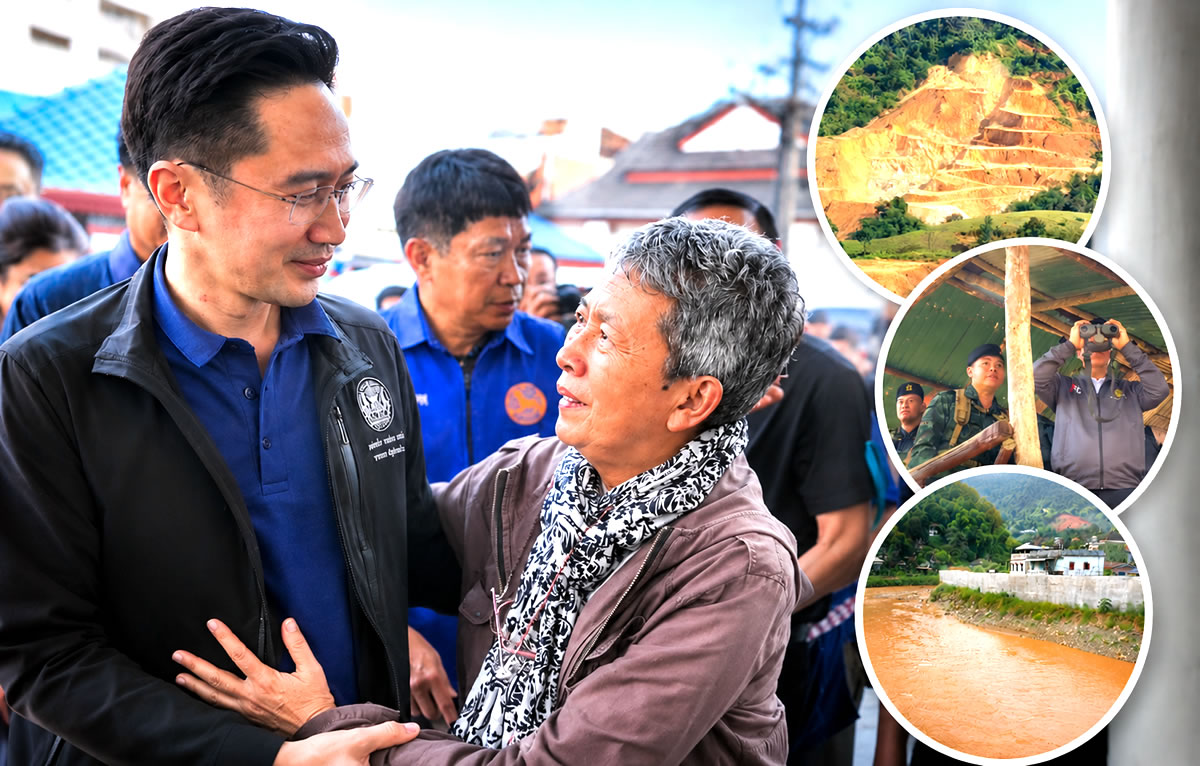
At the same time, Deputy Prime Minister Yodchanan Wongsawat arrived to direct the government’s domestic response. The operation includes a proposed 150-kilometre pollution control zone, specialised arsenic filtration and urgent negotiations with Burma and China.
Northern rivers face arsenic contamination as Thai authorities target mining operations across Burma
The government is confronting contamination affecting the Kok, Sai, Ruak and Mekong rivers in northern Thailand. Authorities suspect mining operations in Burma’s Shan State are releasing toxic substances into waterways crossing the frontier.
Several operations hold concessions involving Chinese companies, while others operate in territories controlled by armed groups. Consequently, the crisis has moved beyond environmental regulation into national security, foreign policy and emergency management. Chiang Mai and Chiang Rai are at the centre of the expanding government operation.
The contamination threatens drinking water, agricultural irrigation, fisheries and communities dependent on northern rivers. Furthermore, arsenic can accumulate in riverbed sediment, complicating water treatment and agricultural protection.
The government has therefore divided its response into two operations. Security and diplomatic agencies are targeting suspected pollution sources across the border. In parallel, scientists and provincial authorities are strengthening water supplies, contamination testing and public health protection inside Thailand.
Security chief inspects Burmese border mines as Thailand prepares bans on mining chemicals and exports
General Chaiyapruk travelled to the Ban Mong Kao Lang military operational base in Chiang Rai on Sunday. The position overlooks mining areas across the border in Burma. Officers from the Taksin Task Force, Pha Muang Force and other security agencies briefed him.
Notably, the inspection followed direct instructions from Prime Minister Anutin to strengthen measures against suspected upstream pollution. The security chief examined mining locations visible from Thai territory and reviewed intelligence concerning their operators.
The National Security Council is preparing restrictions on chemicals used in mineral extraction. These could include export bans and tighter controls on shipments passing through Thailand into Burma. In particular, officials are examining substances associated with mining and rare-earth processing.
The agency is compiling an inventory of chemicals requiring additional controls. This will be submitted to the Ministry of Defence for consideration. Defence Minister Lieutenant General Adul Boonthamcharoen is expected to examine the proposals on Monday, November 23.
On another front, the Ministry of Commerce will assess chemicals imported from third countries before entering Burma through Thailand. Some shipments transit Thai territory without being intended for domestic use.
Thailand tightens border inspections and maps suspected mines as security agencies prepare controls
Officials are examining the legal arrangements governing these goods. General Chaiyapruk confirmed that border crossings, ferry terminals and informal transport routes would face closer inspection. Security agencies are particularly concerned about chemicals reaching unregistered or illegal mines. Accordingly, the government is preparing restrictions on selected shipments and stronger border enforcement.
The National Security Council is also assembling detailed intelligence on mining operations along the frontier. Investigators will record the number of sites, mineral types, distances from Thailand and legal arrangements.
Additionally, they will identify armed groups or other authorities controlling individual locations. The findings will determine which measures are appropriate for each operation. Some mines are registered, while others operate outside formal government controls. As a result, Thai authorities are preparing separate responses rather than treating every site identically.
Nevertheless, sections of the frontier remain sensitive because border demarcation is incomplete. Security agencies must coordinate investigations carefully with Burmese counterparts.
Elsewhere, local environmental groups have identified mining locations near Ban Mae Jok in Wa-controlled territory. Community representatives have raised concerns about mining expansion towards Thailand and contamination entering northern waterways.
General Chaiyapruk confirmed that the government is moving beyond repeated warnings. The Prime Minister has instructed security agencies to prepare measures that can be implemented immediately.
Deputy Prime Minister Yodchanan takes charge of Chiang Rai emergency response and scientific coordination
Separately, Deputy Prime Minister and Minister of Higher Education, Science, Research and Innovation Yodchanan Wongsawat began a two-day Chiang Rai mission. He arrived on Sunday, November 22, to direct the scientific and domestic emergency response.
His appointment followed an emergency meeting at Government House on Saturday, November 21. The National Disaster Prevention and Mitigation Command assembled senior officials responsible for managing the contamination crisis. Minister of Natural Resources and Environment Suchart Chomklin was among those involved.
Yodchanan has been assigned responsibility for environmental monitoring, scientific investigations and public health protection. His duties also include agricultural assessments, emergency water supplies and preparations for international negotiations.
Crucially, the government wants scientific information consolidated into a single reporting system. Different agencies have previously produced separate measurements and assessments.
The new arrangement will connect laboratory findings, monitoring stations and government decisions. Provincial authorities are also preparing more frequent public updates to provide current contamination information.
Yodchanan inspects Chiang Rai laboratory as scientists prepare advanced arsenic tests for border talks
During Sunday’s mission, Yodchanan inspected the heavy metal analysis laboratory at Mae Fah Luang University in Chiang Rai. Researchers demonstrated advanced equipment used to detect arsenic and other toxic substances.
The inspection formed part of preparations for negotiations with Burma and China beginning on November 24. The university’s central research laboratory was established in 2018, with analytical instruments installed in 2020. The facility occupies approximately 900 square metres and includes specialised rooms for heavy metal testing.
One room covers 30 square metres and is used for microwave sample digestion. Another occupies 27 square metres and houses equipment for identifying and measuring chemical elements. Laboratory personnel demonstrated the complete sample preparation process.
Glassware is first cleaned with acid to eliminate residual contaminants. Subsequently, a separate distillation system purifies analytical-grade acid before samples are processed. Researchers then place samples and concentrated acid inside sealed, heat-resistant vessels.
These vessels are transferred to a microwave digestion machine. The equipment uses controlled heating to break down organic and inorganic substances before analysis. Each processing cycle can handle up to 15 sample sets and takes approximately one hour, including cooling.
Furthermore, a scrubber-type ventilation system removes dangerous acid fumes and chemical vapours. The procedure is designed to minimise contamination during testing and protect laboratory personnel.
Advanced mass spectrometry and river maps strengthen Thailand’s investigation into arsenic pollution
The prepared samples are then examined using inductively coupled plasma tandem mass spectrometry, known as ICP-MS/MS. This advanced equipment measures extremely small concentrations of heavy metals.
Significantly, researchers demonstrated how the system improves arsenic measurements. Other substances can interfere with the analytical signal, complicating measurements at low concentrations.
The equipment initially identifies arsenic at mass number 75. It then uses an oxygen reaction to shift the measurement to mass number 91. Consequently, interfering substances can be separated more effectively, improving the accuracy of arsenic readings.
Yodchanan also examined digital maps displaying river sampling locations and laboratory findings. The system combines geographical information with measurements collected across affected waterways.
These findings will support investigations into contamination sources. Moreover, the data will strengthen Thailand’s scientific evidence during negotiations with Burma and China. The government is examining isotope analysis to distinguish contamination from different sources.
Researchers intend to investigate chemical signatures associated with mining and other activities. Mae Fah Luang University is also preparing to cooperate with Chinese scientific partners using compatible laboratory standards.
Chiang Rai residents confront Yodchanan over river pollution as government prepares Kok River control zone
Following the laboratory inspection, Yodchanan met affected residents in Mae Sai district. Former Senator and environmental activist Teunjai Deethes joined representatives raising concerns about water quality.
Residents also questioned proposals involving dams and structures intended to intercept contaminated sediment. In response, Yodchanan confirmed that their concerns would be incorporated into government assessments.
Construction proposals will be examined against actual conditions in affected areas. The Deputy Prime Minister also stressed his personal connection with northern Thailand, describing Chiang Rai and the North as his home.
The government is preparing one of its largest domestic interventions through a proposed pollution control zone. The Ministry of Natural Resources and Environment intends to designate more than 150 kilometres of the Kok River.
The zone will cover affected sections within Thailand and establish coordinated environmental management arrangements. Minister Suchart Chomklin confirmed that the proposal will reach the Pollution Control Committee on November 27. Thereafter, it must receive approval from the National Environment Board.
Thailand targets December 2 for Kok River pollution zone as regional laboratories speed up arsenic testing
The designation will then be published in the Royal Gazette under Section 59. The government is targeting December 2 for completion, subject to the required approvals. The governors of Chiang Mai and Chiang Rai will supervise integrated environmental management plans.
These will coordinate provincial agencies responsible for monitoring, water supplies and pollution responses. As part of the programme, approximately 20 monitoring points are planned along the Kok River and its tributaries.
New analytical laboratories are also being prepared in Chiang Mai and Chiang Rai. Previously, water samples sent to Bangkok could take between 20 days and one month to produce results. Regional laboratories are intended to reduce these delays substantially.
Consequently, officials expect faster identification of changing arsenic concentrations. More recent measurements will guide decisions on water treatment, agricultural protection and public advisories. The Department of Disaster Prevention and Mitigation will coordinate provincial reporting, with updates potentially issued twice daily.
Another major element involves specialised arsenic filtration technology. The National Nanotechnology Centre, Synchrotron Light Research Institute and Department of Science Service are developing and installing treatment systems.
New arsenic filters and sediment traps target communities as emergency water reserves are deployed
These will target communities dependent on threatened water sources. Priority areas include Fang and Mae Ai districts in Chiang Mai, alongside vulnerable communities in Chiang Rai.
Importantly, the equipment is intended to remove arsenic from contaminated water before domestic use. Ordinary water treatment does not necessarily eliminate dissolved arsenic. Specialised systems must therefore be tested against the contamination present.
In a separate initiative, Naresuan University is involved in developing a sediment interception system known as Sai Sai. A pilot project has been identified at Mueang Daeng in Mae Sai district. The proposed system would intercept contaminated sediment before it enters agricultural irrigation networks.
Solid material would settle before being removed mechanically. Meanwhile, separated water would undergo testing before release. Captured sediment would require controlled disposal under Pollution Control Department standards. The pilot will establish whether the technology performs effectively under local river conditions.
Emergency water supplies are being expanded across affected areas. The Royal Irrigation Department has reserved 22.5 million cubic metres of water across three reservoirs. By November 20, authorities had distributed more than 100,000 litres of clean tap water.
Government expands water facilities and testing as Sai River arsenic remains above drinking-water limits
Additionally, another 14 community water supply facilities are being developed or upgraded. Approximately 20,000 residents are expected to benefit from these projects. The Department of Water Resources is identifying additional raw water sources, with planning extending into the 2027 and 2028 fiscal years.
The Ministry of Public Health is strengthening arsenic screening. The National Science and Technology Development Agency has developed field testing kits for more frequent measurements.
At the same time, the Pollution Control Department is deploying additional rapid testing equipment. Laboratory analysis will continue where precise measurements are required. The expanded programme will help authorities identify contamination changes and determine which communities require additional protection.
Recent government findings show improvement at one monitoring location, although arsenic concentrations remain above the drinking-water safety limit. At Ban Hua Fai on the Sai River, an earlier concentration reached 0.284 milligrams per litre.
A subsequent field reading recorded 0.017 milligrams per litre. That represents a reduction of approximately 94%. Nevertheless, the latest figure remains above the commonly applied drinking-water arsenic limit of 0.01 milligrams per litre.
Scientists widen river monitoring as ministry prepares colour-coded contamination maps for farms
The Pollution Control Department has monitored 22 locations across the Kok, Sai, Ruak and Mekong rivers since March 2025. Officials are increasing sediment analysis because arsenic can accumulate in riverbed material.
The findings will establish whether contamination levels are changing consistently or fluctuating with river conditions. Notably, measurements from one location cannot establish water quality throughout the river system. The government is therefore expanding both geographical coverage and laboratory analysis.
Agricultural protection forms another major part of the operation. The Ministry of Agriculture and Cooperatives is collecting samples of soil, irrigation water and agricultural produce. A further assessment is scheduled between November 23 and 25.
Results will be incorporated into the government’s Agri-Map information system. By December 15, authorities intend to produce a colour-coded agricultural contamination map. The system will classify affected areas according to assessed risks.
Green zones will identify lower-risk areas where farmers may pursue Good Agricultural Practices certification. Yellow zones will require additional investigation, monitoring or precautionary management. Conversely, red zones will identify higher contamination risks requiring stronger intervention.
Farmers await contamination rules as Thailand prepares talks with China and Burma over river poison
The government has not yet announced the final operational restrictions for each classification. The programme is particularly important for Chiang Rai’s agricultural economy. Farmers are concerned that reports of river contamination could damage confidence in rice and other produce.
Yodchanan said preliminary proactive checks of rice had not identified the contamination problems feared by residents. Nevertheless, further examinations of crops, soil, aquatic life and irrigation water are continuing.
Where contamination causes confirmed damage, the government may consider assistance and compensation. The agriculture and interior ministries will participate in those assessments. The planned public information system will also allow agricultural findings to be assessed alongside water-quality measurements.
On the diplomatic front, Thailand is preparing fresh negotiations with Burma and China. Deputy Prime Minister and Minister of Foreign Affairs Sihasak Phuangketkeow is involved in coordinating the discussions. The initiative follows Prime Minister Anutin Charnvirakul’s meeting with Chinese President Xi Jinping on Friday, November 20.
During those talks, Thailand raised concerns about toxic contamination entering its northern rivers. China pledged technical cooperation over the crisis. However, the meeting produced no announced agreement to close suspected polluting mines.
Thailand seeks eight border monitoring stations and tougher controls on chemicals feeding Burmese mines
Ministerial-level discussions are scheduled for November 24. These will be followed by working-level meetings involving Thailand, Burma and China on November 25–26. The Thai-Burmese Joint Working Group on Water Quality will also meet in Bangkok.
Its agenda includes contamination sources, monitoring arrangements and controls affecting cross-border waterways. Thailand is proposing eight monitoring stations, divided equally between the two countries. The objective is to establish comparable measurements on both sides of the frontier.
Scientific cooperation with China could also help establish common analytical standards. This would strengthen the evidence available during discussions about upstream mining activities. The negotiations must address operations under different legal and territorial arrangements.
Some mines hold concessions involving Chinese companies. Others operate illegally or within territories controlled by armed organisations. Meanwhile, the National Security Council is examining whether restrictions on chemical shipments can reduce harmful mining activity.
General Chaiyapruk has confirmed that Thailand will pursue immediate protective measures alongside longer-term cooperation. His agency is preparing recommendations based on border inspections and intelligence gathered from security units.
Officials are also considering international environmental mechanisms. Thai authorities are coordinating with Burmese counterparts at the local level, particularly where border demarcation remains unresolved.
Government sets November and December deadlines for border talks, pollution controls and agricultural maps
The government has established several important deadlines. International negotiations begin on November 24, followed by consideration of the pollution control zone on November 27. Formal designation is targeted for December 2.
Meanwhile, the agricultural contamination map is expected by December 15. These decisions will determine the next stages of environmental monitoring, agricultural protection and government intervention.
The operation brings together the National Security Council, Ministry of Defence, Ministry of Commerce and Ministry of Foreign Affairs. Scientific agencies, provincial authorities and public health officials are also involved.
Deputy Prime Minister Yodchanan is coordinating domestic measures across Chiang Mai and Chiang Rai. In parallel, General Chaiyapruk is examining restrictions intended to disrupt chemicals reaching suspected polluting mines.
The response combines border enforcement, emergency water supplies, specialised filtration and advanced laboratory investigations. Digital mapping will connect scientific findings with decisions affecting farmers and local communities.
Prime Minister Anutin has ordered security agencies to prepare stronger measures following months of warnings. The government is also pressing Burma and China for cooperation against upstream contamination.
Northern communities receive clean water and arsenic testing as Thailand targets upstream pollution
For affected communities, immediate measures include clean water distribution, additional testing and preparations for arsenic filtration. Provincial authorities are strengthening environmental monitoring and public reporting.
Researchers are examining contaminated sediment and tracing possible pollution sources using sophisticated laboratory equipment. At the same time, government agencies are expanding agricultural assessments and identifying alternative water supplies.
The next phase will bring decisions on chemical restrictions, pollution-zone designation and international monitoring arrangements. Scientific teams will continue tracking contamination across the northern river system. Meanwhile, security agencies will prepare further controls on chemicals entering Burma through Thailand.
China’s President Xi Jinping promises help in effort to respond to chronic river poisoning in the North
Public anger growing with poison levels in Thailand’s northern rivers as zombie fish horrors are exposed
Thailand’s intensified response is advancing on two fronts. Security and diplomatic agencies are targeting suspected pollution sources across the border.
At home, scientists and provincial authorities are expanding protection for communities, farmland and water supplies. The November 24–26 negotiations will determine the next stage of cooperation against contamination entering Thailand’s northern rivers.
Join the Thai News forum, follow Thai Examiner on Facebook here
Follow Thai Examiner on Google here
Receive all our stories as they come out on Telegram here
Follow Thai Examiner here
Further reading:
River Kok in Chiang Rai poisoned with arsenic from Wa state-controlled gold mining across the border
Rangsiman Rome MP calls for stiffer response to Myanmar’s junta over the jailing of Thai sailors
Myanmar Junta meltdown threatens to end Bangkok’s condominium sales boom as Kyat currency fails