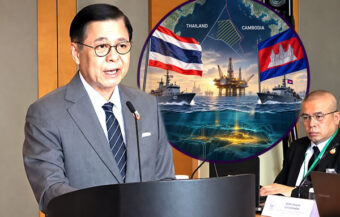
China has unveiled a sweeping security pact with Cambodia covering defence, policing and cybercrime as Beijing deepens its military footprint ahead of Thai PM Anutin’s visit to Beijing. The move could reshape Southeast Asia’s strategic balance.
President Xi Jinping has unveiled China’s strongest security commitment yet to Cambodia, proposing a far-reaching partnership spanning defence, political security, law enforcement and the fight against transnational cybercrime. The move comes as Beijing expands military support for Phnom Penh and prepares to host Prime Minister Anutin Charnvirakul and senior Thai military leaders next month, raising the stakes for Thailand as China’s influence and security footprint accelerate across mainland Southeast Asia.
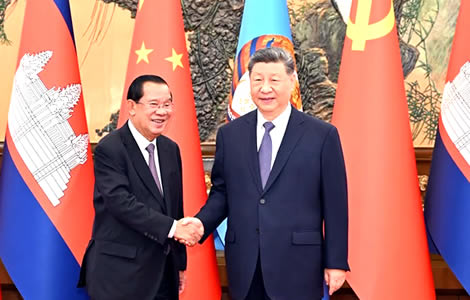
China has taken a major step towards strengthening its strategic alliance with Cambodia after President Xi Jinping announced that Beijing is ready to establish a formal security partnership with Phnom Penh.
Xi made the declaration on Friday during talks in Beijing with Cambodian Senate President and Cambodian People’s Party (CPP) President Samdech Techo Hun Sen. The proposal reaches well beyond conventional military ties.
Instead, it extends into political security, law enforcement and the fight against transnational crime. As a result, the announcement could reshape the regional security landscape. It also comes only weeks before Prime Minister Anutin Charnvirakul is expected to visit Beijing with senior Thai military commanders.
Xi links new security partnership to telecom fraud crackdown and wider regional stability goals in Asia
Hun Sen is visiting China from June 25 to 27 on what Beijing has described as an official goodwill visit. During the meeting, Xi said China was prepared to establish a security partnership with Cambodia, according to the Xinhua News Agency.
He also praised Cambodia’s campaign against telecommunications and online fraud. In addition, Xi pledged closer cooperation to eliminate what he called the chronic problem of telecom fraud.
Reuters separately reported that Xi described the criminal activity as a “tumour” requiring sustained action by both governments. The language reflected Beijing’s determination to place organised cybercrime at the centre of bilateral security cooperation.
Xi also framed the proposal within a wider geopolitical context. He said the international and regional situation was undergoing “complex and profound changes.” Therefore, China and Cambodia should work together to inject greater stability into regional peace and development.
Beijing expands strategic framework through defence, policing and political cooperation with Phnom Penh
Xi also reaffirmed that China regards Cambodia as a priority in its neighbourhood diplomacy. Moreover, he said Beijing firmly supports Cambodia in safeguarding its sovereignty and national security. He then called on both countries to raise strategic mutual trust “to a new height,” signalling an intention to deepen cooperation across multiple security sectors.
Although Beijing disclosed few operational details, Xi’s language suggested a broader institutional framework than a conventional defence agreement. Chinese state media reinforced that interpretation.
Reports highlighted political security, defence cooperation, law enforcement coordination and anti-fraud operations as central pillars of the proposed partnership. In parallel, the initiative builds on diplomatic progress already made this year. China and Cambodia held the first meeting under their new “2+2” Strategic Dialogue Mechanism in April.
That framework brought together the foreign and defence ministers of both countries. Those talks focused on political cooperation, defence relations and regional security. Friday’s announcement appears to elevate those discussions into a permanent strategic structure.
Thailand faces a pivotal Beijing visit as China’s military partnership with Cambodia gathers momentum
For Thailand, the timing is particularly significant. Prime Minister Anutin Charnvirakul is expected to travel to Beijing at the end of July. He is also expected to be accompanied by senior military leaders.
Security, border stability and defence cooperation are likely to dominate those discussions. Xi’s announcement, therefore, provides an important strategic backdrop before the visit. Bangkok has watched China’s growing military footprint in Cambodia with increasing attention. That scrutiny has intensified as Beijing expanded both military assistance and political engagement with Phnom Penh.
China has already supplied Cambodia with Chinese-made Type 59 tanks and other military equipment. Joint military exercises have also expanded steadily.
Separately, defence cooperation has become increasingly institutionalised through regular high-level contacts. Chinese investment has also spread across infrastructure, transport, telecommunications, energy and logistics. Consequently, Cambodia has emerged as Beijing’s closest strategic partner in mainland Southeast Asia. The latest announcement further underlines China’s intention to deepen that relationship through formal security mechanisms.
Scam compounds become central to China’s regional security agenda and expanding cooperation
Notably, Xi devoted considerable attention to telecommunications fraud. Chinese state media also gave the issue unusual prominence. That emphasis reflects Beijing’s growing concern over industrial-scale scam operations across mainland Southeast Asia.
Cambodia has become internationally associated with large online scam compounds targeting victims throughout Asia, Europe and North America. Numerous international investigations have alleged that many of those operations are controlled by Chinese organised crime syndicates.
Victims have frequently included trafficked foreign workers. Many were allegedly forced to conduct investment fraud, romance scams and cryptocurrency schemes from heavily guarded compounds.
In response, Chinese authorities have steadily intensified regional cooperation against organised cybercrime. Officials have repeatedly warned that telecommunications fraud harms domestic social stability while damaging China’s international reputation. Beijing has therefore expanded security cooperation with Cambodia, Myanmar, Laos and Thailand.
Those operations have targeted scam compounds and led to the repatriation of Chinese suspects. Xi’s latest proposal suggests anti-fraud cooperation will become a permanent element of China’s security relationship with Cambodia rather than a series of isolated operations.
China’s regional influence grows as Cambodia emerges as Beijing’s closest strategic partner in Southeast Asia
On another front, the rapid expansion of organised scam networks has highlighted the complex relationship between criminal groups, commercial interests and regional security. Analysts continue to distinguish between China’s campaign against organised crime and broader questions involving overseas Chinese business networks.
There is no evidence that the Chinese government directs organised crime syndicates operating scam compounds. However, security specialists have long observed that Beijing has maintained pragmatic relationships with influential overseas Chinese figures when doing so supported broader diplomatic or intelligence objectives. Importantly, those observations should not be interpreted as evidence of official Chinese involvement in organised crime.
As part of this broader strategic shift, Cambodia’s importance to Beijing continues to grow. Chinese support has contributed to the modernisation of Cambodia’s armed forces. It has also supported facilities, including the upgraded Ream Naval Base.
Those developments have attracted sustained attention from Western governments. Meanwhile, China’s influence now extends across Cambodia’s defence, infrastructure, transport, energy and telecommunications sectors. Together, those investments have reinforced one of Beijing’s closest strategic relationships anywhere in Southeast Asia.
Thailand balances US alliance with deeper China ties as regional security tensions continue to intensify
Against that backdrop, Thailand continues to balance its most important international relationships. Bangkok remains one of Washington’s oldest treaty allies in Asia. At the same time, China has become one of Thailand’s largest trading partners and an increasingly significant defence partner.
Anutin’s forthcoming Beijing visit, therefore, comes at a particularly sensitive moment. Border tensions involving Cambodia remain unresolved. Meanwhile, China’s military cooperation with Phnom Penh continues to deepen.
Defence Minister not concerned with military support for Cambodia from China. Says Thailand is confident
Thai PM assures the public that the Kingdom is ready to defend itself as Cambodia acquires Chinese tanks
Cross-border organised crime is also expected to feature prominently during discussions. Xi’s latest announcement signals Beijing’s determination to strengthen its long-term security presence in Cambodia while expanding cooperation into law enforcement and internal security.
Whether the initiative ultimately develops into a formal treaty remains unclear. Even so, China has publicly committed itself to deepening one of its most important strategic partnerships in Southeast Asia, giving next month’s high-level talks in Beijing added significance.
Join the Thai News forum, follow Thai Examiner on Facebook here
Receive all our stories as they come out on Telegram here
Follow Thai Examiner here
Further reading:
Ex Energy Minister supports oil and arms supplies blockade against Cambodia in the Gulf of Thailand
War to continue says PM Anutin. Dismisses President Trump’s ceasefire talk as a ‘misunderstanding’
Confusion after Trump’s 20 minute phone call with PM Anutin. US side claimed a ceasefire was agreed